
New NYC Subway Murals Redefine Geography
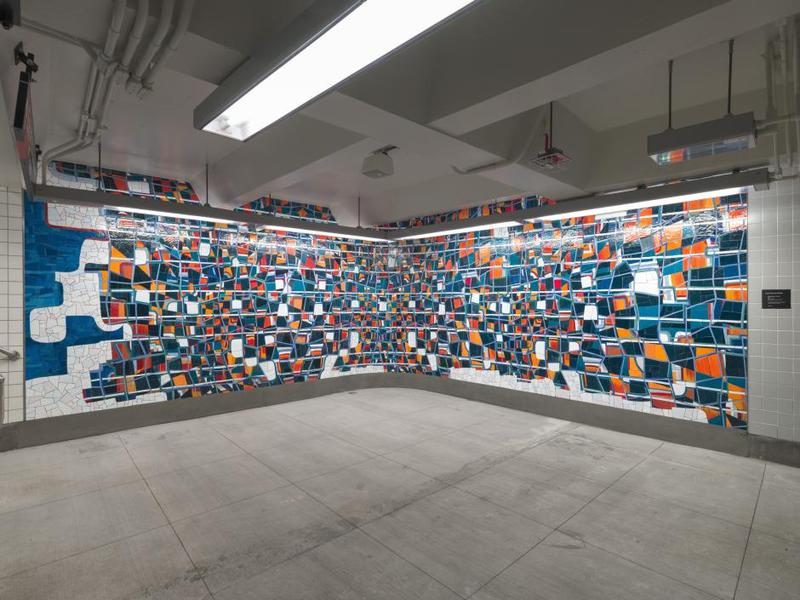
( © Lisa Corinne Davis, NYCT 68 St-Hunter College. Commissioned by MTA Arts & Design. Photo: JSP Art Photography )
Alison Stewart: This is All Of It on WNYC. I'm Alison Stewart. Lisa Corinne Davis is an artist. You can see her work in several places in New York City. First at the Miles McEnery Gallery. She has a current show there called, hope I say this right, Syllogism.
Lisa Corinne Davis: Syllogism.
Alison Stewart: Syllogism. You can see her when you get off the 6 train at 68th street and Lexington Avenue. Davis is a recent addition to the MTA Arts & Design program, installing new pieces as part of the MTA's permanent collection. That station is a fitting because she has been teaching at Hunter College for more than two decades. Lisa Corinne Davis is a member of the National Academy of Design. She was a Guggenheim Fellow. She joins us now in studio. It is really nice to meet you.
Lisa Corinne Davis: Thank you, Alison. It's a pleasure to be here.
Alison Stewart: When you looked around at the station at 68th street and Lex, before this all started, what did you see in this space? Then how did you decide, what am I going to do in this space?
Lisa Corinne Davis: First, I want to just add one thing, I also was an MFA student at Hunter College, so I have the trifecta here of student, professor, and now the station. That station's a really interesting, complex mix of upper eastside people, students coming and going, all different ages, generations, types of people. It's always active. It's potpourri of what New York City's all about.
Alison Stewart: What did you think you wanted to do with the space, with your art?
Lisa Corinne Davis: My work is about, in general, locations and spaces. I wanted to make sure that the mosaic showed a navigational system, that people were on the move with abstract elements that suggest movement. Also a lot of frenetic energy, which I think is present in the work. Also spots where you stop, locations, resting places, whether you're going to a restaurant or you're going to a classroom, those are places of stop in the navigation of the Upper East Side.
Alison Stewart: How did it come to you? How did the program come to you?
Lisa Corinne Davis: I have no idea. I have been up for several subway stations. The MTA contacted me. I had the pleasure of working with Yaling Chen there. That was a pleasure. It's quite a rigorous process. You have to make a proposal, and then you're presented that proposal to arts professionals that are random, so you don't know who they are ahead of time. Then you wait and you see if you get it.
Alison Stewart: Once you did get it, do you have a free reign or does the MTA give you guidelines?
Lisa Corinne Davis: They give you guidelines. You're always trying to be in conversation with the neighborhood that you are making these works for. In the proposal, they suggest that you do that, and then you try to make an artwork that reflects the location, which in this case was one I knew quite well. Hopefully, in the end, it does have something to say about the location of the station.
Alison Stewart: It's interesting because you described it as quite a diverse location. You have a lot of different people going in and out of that station. How did that influence your work?
Lisa Corinne Davis: In the sense that I hope that the work suggests a multitude of personalities in it, through colors and fragments of glass that make up the mosaic. I just hope that in an abstract work that someone looking at it is always bringing a bit of themselves to what they're looking at. Therefore there's a navigation between self and what's proposed in the abstract work.
Alison Stewart: One of the pieces is titled Liminal Locations. What does that mean to you?
Lisa Corinne Davis: Liminal, transitional, between here and there. That's exactly what I'm trying to suggest.
Alison Stewart: What first went into designing that piece of Liminal Locations.
Lisa Corinne Davis: All the works there are reference to my regular paintings that I make.
Alison Stewart: We're talking about those too.
Lisa Corinne Davis: This was a little different because I had to start with a digital image. I used the vocabulary that I use in my normal paintings and mixed them up and came up with three different designs. Two that are more of flank the subway tracks, that are more similar, and then a slightly different one that's on a curved wall as you enter the station.
Alison Stewart: I'm interested in the one on the curved wall. Describe your path for getting that around that curve.
Lisa Corinne Davis: That was really the MTA department and also the Mayor of Munich who created the piece. I create this digital file, and then it goes to a mosaicist. In this case, Mayer of Munich is a fifth generation glass mosaicist that exists in Munich, Germany. They did an incredible translation of the painting.
Alison Stewart: It's interesting because it's a large abstract piece. Sometimes it looks like there's a little bit of a window someplace, and someplace it looks like there's a little bit of a river in different locations. How do you hope commuters who are trying to go from point A to point B, what do you hope they will encounter when they come upon your piece?
Lisa Corinne Davis: I hope they encounter the things you suggest, and that they are looking at something that implies a map, implies locating oneself, going to locations, being in locations, looking at locations. The work is supposed to be maximal and minimal at the same time. It could be aerial or not. The sense of just movement. I don't want the person to be somewhere, but be really aware that they're moving to and from spaces.
Alison Stewart: We're talking to abstract artist Lisa Corinne Davis. Her work is on display at the Miles McEnery Gallery. She's also a recent addition to the MTA arts program. You can see her work at 68th and Lexington Avenue Station. The other piece, the one that meets up, is Tempestuous Terrain. It's interesting, there's more like a grid-like setting in this one. It goes from one side of it to the other side of it. How did you want to use the grid-like setting, especially because you're in a subway station?
Lisa Corinne Davis: Sure. I use the grid in every work. It's somewhere in every piece I do. I think of the grid as a very factual, stable, abstract language, very measured, unquestioning. Then in every piece, I try to mess with that grid so it becomes more personal, subjective, human. The grid is not only the grid of New York City, the grid of fact and measured space, but it's also the starting point for how to bring that into a more subjective realm.
Alison Stewart: What does it mean to you to have this piece of art where so many people can see it?
Lisa Corinne Davis: The world. It's just been the best experience. I've had strangers contact me that live on the Upper East Side and say how much they're enjoying the station now that they're traveling through it. Of course, my students at Hunter College get to see the work too, which is incredible. It's just really great to get the work out into a public space, not that I don't love the art gallery, but it's a different kind of space where one can casually observe it, spend as much time as they want, zoom by it if they want. It means the world to have that work there.
Alison Stewart: Before we leave this, is there any subway art that you've seen recently that you thought, "Oh, that is a beautiful piece of art?"
Lisa Corinne Davis: Oh, I can't answer that question because there's so many. I think that the MTA Arts & Design program is making so many stations beautiful. The Second Avenue line is particularly one of my favorites.
Alison Stewart: It's gorgeous.
Lisa Corinne Davis: Right. Many of the artists that are doing these projects are people I know, so I'm not going to pick favorites.
Alison Stewart: That's fair. Let's talk about your exhibit at the Miles McEnery Gallery. For people who want to see pictures, I took pictures on Saturday. They're up on our Instagram-
Lisa Corinne Davis: Thank you for going.
Alison Stewart: -at allofitwnyc. I did my best. They're not professional pictures, but they do give you a sense of the show. First of all, I want to talk, what does the title mean?
Lisa Corinne Davis: Oh. I have to thank my friend Jerry Lieblich, who I met at Yaddo this past spring, who's a great theater playwright for that term. He came to look at the paintings in the studio and threw out that word which I had never heard before, syllogism. It's a form of reasoning which a conclusion is drawn from or not to assume premises. That's the essence of how I want my work to live. That it's somehow some assumption or determination comes from premises that every individual brings themselves to the pieces.
Alison Stewart: The gallery is just full of these huge paintings, like 80 by 60, I think one of them was. Why that size?
Lisa Corinne Davis: I work best at that size. It's something about the body. It's something about being able to create greater scale differences within the work. I think when things get smaller for me, I can't make the range of perceived scale that I like to have in larger pieces.
Alison Stewart: I described you as an abstract artist. What does that mean to you to be an abstract artist?
Lisa Corinne Davis: It's very important to me. Abstraction to me is the felt. I'm not telling a specific story, I'm not narrating something. I'm working from the inside, not the outside. In my work I'm talking about a very specific feeling I had in my life as a light skinned African American woman who grew up in a Orthodox Jewish neighborhood and went to a Quaker school.
Alison Stewart: That's a lot.
Lisa Corinne Davis: That's a lot.
Alison Stewart: That's a lot to handle.
Lisa Corinne Davis: Yes. It's a specific experience. It's not a generic one.
Alison Stewart: Some of your work uses sharp angles. Sometimes it's more of an amoeba-like form. What determines the shape of your work?
Lisa Corinne Davis: The works are very conversant. I start anywhere. Because I'm always trying to disrupt a perception, if it starts hard edged, geometric, again, feeling more factual and determined, I try to, in the next move, loosen it up so things get more lyrical and biomorphic and expressionistic. The works are combinations of those languages that go back and forth in a conversant way until they land in a spot where I feel things are very indeterminate.
Alison Stewart: I'm speaking with artist Lisa Corinne Davis. We'll have more after a quick break. This is All Of It. [music]
You are listening to All Of It on WNYC. I'm Alison Stewart. We are joined by abstract artist Lisa Corinne Davis. Her work is on display at the Miles McEnery Gallery. It's in West Chelsea on West 22nd Street. She's also a recent addition to the MTA Arts Program. You can see her work at 68th and Lexington Avenue stop. I want to go back to the gallery show. One piece is called Fleeting Form. It's a painting really bright pinks and then there are blues involved. First of all, how do you decide on the names of the paintings? Let's start there.
Lisa Corinne Davis: Oh, I have a lot of fun with the titles. Each painting title is something that, again, it seems very pragmatic like form, and then something that seems a little more subjective like fleeting. I love alliteration, so that often plays into the titles.
Alison Stewart: I was looking at one painting and I got really close, and it was really interesting because it was geometric, but underneath there was a C shaped form that was underneath that you had painted over. I was curious about that.
Lisa Corinne Davis: I never give up on a painting. Once I start, it just keeps going until it is completed. That shape was a shape I thought I wanted in a painting. It was something different and a big gesture. As the painting developed, it made no sense, so it got buried under the layers on top. There's evidence of it there, but it's not a prominent element in the painting anymore.
Alison Stewart: If you'd like to see any of these paintings, you can go to our Instagram Stories at allofitwnyc. You have mostly oil on canvas. I think there's one acrylic painting in there.
Lisa Corinne Davis: No, it's probably one that started with acrylic and then went to oil.
Alison Stewart: I got you. In the smaller gallery over to the left, they're much smaller works, like 18 by 14 works. Are they in conversation with the bigger pieces or are they their own things?
Lisa Corinne Davis: They're their own things. When I go to residencies, I often can't take big canvases with me. I always have this sense that I'm going to draw, but then I realize I don't draw, I'm a painter. I have all these pencils and interesting drawing things with me, and I can't draw, so they become acrylic paintings on paper. Last year I was at several residency and made a bunch of those. I think they inform the paintings, but they are a separate thing.
Alison Stewart: What questions would you like people to have after going to the gallery and spending some time with your paintings?
Lisa Corinne Davis: I would like them to ask what they're looking at. Normally people sense the map metaphor that underlies everything. People often associate themselves with, this reminds me of this, or this is this location, or is that Paris, or that kind of thing. I want them to be aware that those things aren't really in the paintings, that they're bringing their subjective self, the way they interpret it, their histories, their biases into what they want that painting to be. Again, it parallels an experience of my own people wanting me to be what they wanted me to be based on who they were in the world. I want them to be aware that they're making these determinations and that they have questions.
Alison Stewart: Was there any painting in that series which was harder than the rest?
Lisa Corinne Davis: Unfortunately, I can't think of the title. There's one when you come into the right, that was a killer. It has become people's favorites from the exhibition. I feel like I was abused in some way by that painting, so I can't even look at it. I'm glad it's being seen in a positive light, but I have a hard time looking at it. It took so long.
Alison Stewart: You just had to keep going at it--
Lisa Corinne Davis: Had to keep going. It was trying to beat me, but it didn't in the end.
Alison Stewart: I heard you in one interview say that you're a slow painter.
Lisa Corinne Davis: Yes.
Alison Stewart: What does that mean, to be a slow painter?
Lisa Corinne Davis: It takes a long time to make decisions for the next layers, their oil, so it's materially very slow. They're layered, so they are slow paintings.
Alison Stewart: Let me ask you a really naïve question. You said that oil makes it slow. Why is that? It takes a long time to dry?
Lisa Corinne Davis: It takes a long time to dry. When you're putting a layer on top of a layer, sometimes you want it to be wet on wet, which means you see this juicy brushwork, and sometimes you want it to be more still, the paint on top, and therefore the layer below has to be dry. I use a lot of oil in the paint, and oil makes it even slower to dry. Patience is important here.
Alison Stewart: Do you remember what your first exposure to art was?
Lisa Corinne Davis: Oh, I absolutely do. When in 2nd Grade in Friends School in Baltimore, Maryland, a teacher took us out with paper and a sponge and paint, and made us look at the landscape and said, "Paint that." We took the sponge, we dabbed it in the paint and somehow foliage appeared. I just thought that was magic, that somehow what I was looking at could be translated with these tools to an image that represented what I was looking at. It's pure magic. That was it. I was off to the races after that.
Alison Stewart: When did you think, "I'm going to be an artist?" When did that come to you?
Lisa Corinne Davis: I don't think I could do anything else. I don't think I was capable. That way of seeing the world, that happened in 2nd Grade onwards. I don't think you ever forget. You want to keep making things, you want to keep translating the world into something. Everything else is fine, but not as interesting as that.
Alison Stewart: When did you get serious about painting?
Lisa Corinne Davis: In college. I always knew I was going to pursue fine arts. My mother seriously wanted me to be a doctor or a lawyer.
Alison Stewart: Of course she did, as she should.
Lisa Corinne Davis: I went off to Cornell University, majoring in fine art and then transferred to Pratt Institute in New York.
Alison Stewart: When you were in an academic situation, did it change the way you felt about art, or did it enhance the way you felt about art?
Lisa Corinne Davis: I think it enhanced it. I think in the undergrad level you're learning the mechanics, the how to, so that's fascinating. In the grad level, you're learning to have your own voice, and you find this population of people that you never leave behind. They're still your friends, you still talk to them, they're your posse. Both were enhancing in different ways.
Alison Stewart: We talked about what abstract art meant to you. Was that initially what you gravitated towards, or did you gravitate towards still life? When did you start painting and when did it switch over to abstract?
Lisa Corinne Davis: Very interesting. I started as a representational painter, I think, as most people do. When I was pregnant with my first child, I came up with this question about what identity, race, culture meant and how imposed it is on people in sometimes false ways.
I simply did self portraits for years, imposing clear objects of cultural heritage, like a grease vase over my face, setting up the question, is there a relationship between that woman lurking there and that Greek vase? If there is, why are you assuming that? Et cetera. That played itself out and again, I was more interested in the feeling I had navigating different spaces, cultures in my childhood. That really holds a firm place in what abstraction can do about the felt and the visceral.
Alison Stewart: My guest is artist Lisa Corinne Davis. You mentioned children. How did children change the way that you were an artist? How did it change your practice initially, anyway?
Lisa Corinne Davis: It made it much more organized.
Alison Stewart: Oh, really?
Lisa Corinne Davis: Yes. When my son was born, I knew I had a choice at that point. I could give it all up, I had every excuse to stop, but I knew I couldn't stop. I set out a project of just doing small works on paper tThese portraits that I was talking about that I could do very quickly. When he slept, I worked. Then later, when he got older, he spent time in my studio doing his things while I did mine.
Alison Stewart: Why did you decide to go that route?
Lisa Corinne Davis: Which route?
Alison Stewart: To paint. You could have given it up and gone back.
Lisa Corinne Davis: It's true. Again, it wasn't a choice. I can't describe it more clearly than that. It just wasn't a choice. I knew I would not be happy or complete without painting.
Alison Stewart: When you look back, what was your big break as an artist?
Lisa Corinne Davis: My big break was showing at the June Kelly Gallery. A friend of mine, painter Philemona Williamson, she showed there. She said, "I'd like to show June your work." I said, "I don't really have anything to show her."
Alison Stewart: That's a big gallery. Right?
Lisa Corinne Davis: Yes. My husband at the time said, "When are you going to show anyone anything?" June came over. Being June, very honest person said, "I can't sell this work, but I like the work." Then came back later, and it changed her mind. That was the big break.
Alison Stewart: That's interesting when someone says, "I like your work, but I can't sell your work."
Lisa Corinne Davis: I loved it. I love the clarity of that, because often these discussions aren't that clear. I love that she knew who her buyers were. She knew what my work was, and until she felt that had shifted, she was clear she couldn't sell it.
Alison Stewart: You were able to make the shift?
Lisa Corinne Davis: She was able to make the shift. She came back maybe a year later and decided differently.
Alison Stewart: You teach now at Hunter, which is great because it exposes you to the culture, because the culture is always changing. What are your students interested in?
Lisa Corinne Davis: Oh, my God. First off, I just have to say, I love my job. My students are fantastic, undergrad and grad. My students are primarily interested in no technology. They're really tired of it and trying to find ways to get around it.
Alison Stewart: Artist Lisa Corinne Jones. You can see her work at the Miles McEnery Gallery. You can also see her at 68th and Lexington Avenue Station. Thank you so much for coming in, Lisa. We really appreciate it.
Lisa Corinne Davis: Thank you, Alison. It was a joy.