
Music in the Halls of Congress
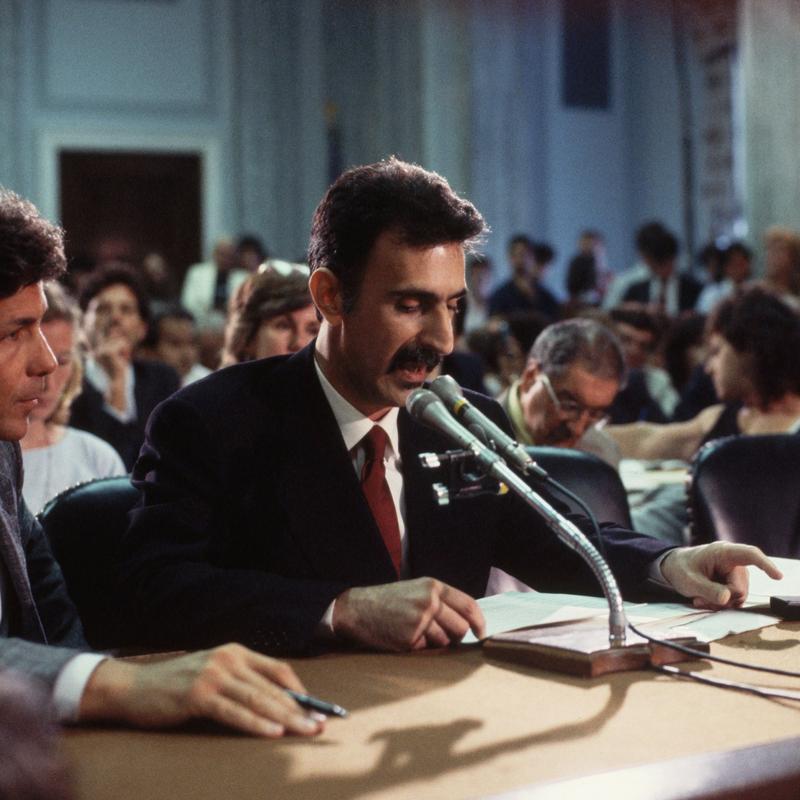
Alison Stewart: This is All Of It on WNYC. I'm Alison Stewart. There have been many songs, political songs, throughout history, but only some of them have made their way into the halls of our country's political institutions. In some rare cases, those songs have actually influenced legislation and shaped American political history. Those influential pieces of music are the subject of a new book by Johns Hopkins University professor Anna Harwell Celenza. The book is called On the Record: Music that Changed America.
Celenza will be in conversation at P&T Knitwear tonight, but she's in studio with me right now. It is nice to see you.
Anna Harwell Celenza: Thank you, Alison. It's great to be here.
Alison Stewart: Listeners, do you have a favorite political song, whether it was one that influenced American politics or inspired legal action, or just one that really speaks to political and social issues that matter to you? You can call in or text us now at 212-433-9692, 212-433-WNYC. Let's start where the book begins, with The Star-Spangled Banner, which was not the official anthem of the United States till 1931.
Anna Harwell Celenza: Yes, it took over a century.
Alison Stewart: Why did The Star-Spangled Banner win out over other songs?
Anna Harwell Celenza: Actually, it just took tons of debate. There were a number of songs that were being considered, for example, like Hail, Columbia!, and the argument against that piece was, well, with The Star-Spangled Banner, the flag is the unifying symbol, and with Hail, Columbia!, it's the president. There were folks who thought, maybe that wouldn't be good if a single figure, a person-- he could become tyrannical if that happened, so they had some foresight there.
Yes, so there have been lots of songs. Even Yankee Doodle Dandy was considered. In the end, I think a lot of it had to do with our congressmen in Maryland who really worked to get that song front and center.
Alison Stewart: I was surprised to learn that it wasn't earlier, that it didn't happen earlier. Why wasn't The Star-Spangled Banner our national anthem earlier than 1931?
Anna Harwell Celenza: Well, I think the big question is what was the instigating thing that made it come together, and it really was the Great Depression and the stock market fall in 1929. That created a time in the United States when there was a lot of polarity, not just economically, but politically. There were race riots that were happening, all of these sorts of things. Politicians were trying to do lots of legislation to kind of bring people together, and they said, we need to create this secular ritual and find a song that we can all unify behind, and so The Star-Spangled Banner won out.
Alison Stewart: Many people know that Francis Scott Key was a slave owner.
Anna Harwell Celenza: Yes.
Alison Stewart: A lot of people didn't know he was a prosecutor as well, and you write about one Supreme Court case he was involved in, United States v. Reuben Crandall. What is significant about this case?
Anna Harwell Celenza: Well, what's significant about it is that you've got the abolition-- He's an abolitionist, and basically, Francis Scott Key is saying, you don't have the right to voice those opinions when you're here in Washington, D.C. which was very strange. Yet at other times, if there were free Black business owners, he would support them owning their businesses. He was kind of hypocritical. [chuckles]
Alison Stewart: Yes. Did his personal politics affect public opinion of The Star-Spangled Banner?
Anna Harwell Celenza: Well, that's kind of a strange story, because it's really the Civil War when The Star-Spangled Banner comes into its own. What's strange about that is Francis Scott Key, all of his relatives, these many generations later, were basically for the south, and yet the south had to reject this song because it was about the flag, and they were seceding from the Union. Then, at the same time, you've got what became the national anthem for the south, at least unofficially, which was Dixie, and yet that was written by a northerner who had written it to make fun of the racist policies in the south. Go figure. [laughs]
Alison Stewart: A large portion of that chapter deals with Lift Every Voice and Sing, often called the Black national anthem. What makes it a meaningful alternative when talking about the political history of the national anthem?
Anna Harwell Celenza: Well, I think the reason I put those two pieces in conversation is because I think we often kind of talk about the national anthem, and then we see Lift Every Voice and Sing as this separate thing. If we really look at the history of those two pieces, they were both incredibly popular. Lift Every Voice and Sing is written around 1900, but what keeps Lift Every Voice and Sing from being able to spread across the country in the 1930s and the '40s was the fact that the publisher of the song held the copyright.
When that song started to rise in popularity and was even being talked about by the composer James Johnson, that this could be a piece that could also perhaps serve as a national anthem, what you see is the publisher starts to charge really high fees to reprint or perform that music. You have a third character in this book is the music industry, and the music industry, ever since the turn of the 20th century, had a huge impact on the pieces that can have an impact and those that can't.
Alison Stewart: I'm speaking to professor and musicologist Anna Harwell Celenza. Her new book is called On the Record: Music that Changed America. We're taking your calls. What's your favorite political song? Whether it influenced American history or just reflects on it, we want to know. 212-433-WNYC, 212-433-9692. Someone has texted in, "Patti Smith's People Have the Power." Let's talk to John, who's calling from Harrington Park, New Jersey. Hi, John. Thank you for calling All Of It. You're on the air.
John: How are you? Thanks for having me. You will know this one, Ohio. It was written by Neil Young in response to the Kent State massacre. I think it's an extremely powerful and legendary American political song. I think you know the story probably. I believe it was Neil Young went off into the woods after the incident, came back out with a song, and I believe it was within about three days later it was on the air.
Alison Stewart: Thank you for calling in, John. We got a text that says, "The song Move on Up a Little Bit Higher, sung by Mahalia Jackson, was an important anthem of the civil rights movement and an emblem of the Great Migration." I want to go on to George Gershwin's Rhapsody in Blue. It comes up in a few chapters. Why is Rhapsody in Blue important to US Congressional history?
Anna Harwell Celenza: Because it got a lot of politicians to start thinking about intellectual property. A lot of politicians in the 1920s when that composition took off, they said, "Wow, we've found the American sound to counteract European culture." Then, we start to get these debates on, well, how do you protect that American sound? For me, what I think is most important, this is another chapter that talks about Rhapsody in Blue, but it talks about it in conversation with Duke Ellington and his Symphony in Black.
He and Gershwin have a musical conversation over a number of decades and a number of pieces, and I think the power of Duke Ellington's music was to say there is not one American sound.
Alison Stewart: In 1963, Ellington recorded his own arrangement of Rhapsody in Blue. Before we listen to it, what does this recording demonstrate?
Anna Harwell Celenza: Well, it demonstrates Ellington's respect for Gershwin, but at the same time, his desire to claim jazz and that jazz sound as not only an important piece, but as what inspired Gershwin to write his piece. More importantly, he's pushing back against Leonard Bernstein, who in 1958 did his own sort of interpretation of Rhapsody in Blue where he made it very Mullerian and classical and slowed it down and switched out the saxophones for French horns and this sort of thing.
I see this as Ellington stepping back and saying, no, African American culture is really the core of a lot of things that we call American.
Alison Stewart: Let's listen to Rhapsody in Blue.
[MUSIC - George Gershwin: Rhapsody in Blue]
Alison Stewart: I'm speaking to professor and musicologist Anna Harwell Celenza. Her new book is called On the Record: Music that Changed America. While we're talking about jazz, in the chapter titled America's Secret Sonic Weapon, it deals with the State Department's use of music abroad. How has the United States used music as a diplomatic tool in history?
Anna Harwell Celenza: Yes, it was this great, powerful weapon. Well, what you see happening is we're in the middle of the civil rights era, and the United States, there's a lot of negative press going around, especially coming from the USSR, that oh, well, we tout to have these ideas of freedom and democracy and equality, but look what is happening in the United States to African Americans. Look at the violence that's happening. Look at the civil rights uprisings that are happening.
The United States' first thought, well, if we could just show that we are cultured and we have art, then we can make a difference. They first tried with classical music. It didn't really move the needle much. Then, there was this understanding, well, wait, what about jazz? Jazz is so popular in Europe, and it's taking off in other places, so what if we send jazz musicians, Dizzy Gillespie was the first, to countries where communism has either taken over or is becoming a powerful force, and we can present jazz as a symbol of democracy?
It's equality, everyone gets to play a solo, but there's rules that we agree to follow in creating this piece. It was an incredibly powerful tool.
Alison Stewart: Let's talk about Strange Fruit. Most people know the song Strange Fruit as sung by Billie Holiday. Can you talk a little bit about the story behind the song and its writer, Abel Meeropol?
Anna Harwell Celenza: Yes. Abel Meeropol lived right here in New York. He grew up in the Hell's Kitchen area. His parents were immigrants. He was Jewish. He was also a card-carrying member of the Communist Party. I should say, in the 1930s, for many people, communism was not a negative thing. Communism was a government structure that focused on equality, so economic equality, racial equality, gender equality.
In the 1930s, right when The Star-Spangled Banner becomes the national anthem and we have all this economic disparity because of what's happened with the Great Depression, another thing that happens is we get a real uptick in racial violence. Lynchings across the United States become-- There's an uptick in them. We start to hear about them. In fact, every state in the United States but three in the Northeast had a lynching in the 1930s. It was this horrific thing that was happening.
Abel Meeropol by this point was teaching high school up in the Bronx, and he was seeing the impact this violence had on his students. He was a poet. He was also very involved in theater. He wrote this poem, originally titled Bitter Fruit, and published it in a teacher's magazine. Then, that was in 1935. In '37, he set some music to it. He was also a sort of amateur musician. He and his wife would sing this song at communist rallies. Then, he met another communist friend, Barney Josephson, who had just opened this club in 1939 called Cafe Society here in New York.
It was the first racially-integrated club in New York City. Billie Holiday was the house singer. The idea was hatched, what if we got her to sing the song?
Alison Stewart: Let's hear a little bit of Strange Fruit.
[MUSIC - Billie Holiday: Strange Fruit]
Billie Holiday: Southern trees bear a strange fruit
Blood on the leaves and blood at the root
Black bodies swinging in the Southern breeze
Strange fruit hanging from the poplar trees
Alison Stewart: At one point, the lyrics of this song were given to every US senate member.
Anna Harwell Celenza: Yes.
Alison Stewart: What was the goal? A theater arts committee did this.
Anna Harwell Celenza: Yes.
Alison Stewart: What was the goal?
Anna Harwell Celenza: The goal was to make them think about the horrific act of lynching. I should note, at this point in history, lynching was not a federal crime. What was happening is that a lynching would happen, and then in the local district where it happened, people would never be prosecuted for it. It took until 2022 for us to get an anti-lynching federal law, the Emmett Till Antilynching Act that Kamala Harris had first introduced. What struck me, I remember when that happened because I had actually first written this chapter, and it was about, isn't it horrific that we've never passed legislation?
I remember watching on television and then scrolling on social media as Biden signed the Emmett Till Antilynching Act, and on social media, everybody started posting recordings of Strange Fruit. Just the power that this song from 1939 until 2022. It took a while, but the seeds took root when that legislation was passed.
Alison Stewart: Let's talk to John, who's calling in from New York. John, you're on the air.
John: Okay. Very quickly, I don't know if this is completely appropriate, but political songs, one that I heard recently, I hadn't heard in a long, long time, which I thought was a rallying cry, is this Simple Song Of Freedom by Bobby Darin of all people. I don't know if people are familiar with it, but give it a listen. It was basically about we don't want a war kind of song, and it would be very appropriate I think now.
Alison Stewart: Yes. John, thank you so much for calling in. We've gotten a ton of calls and a ton of texts about it, so I'm going to just read this one. It says, "What's Going On by Marvin Gaye, very powerful song."
Anna Harwell Celenza: I talk about that.
Alison Stewart: Yes, tell me more.
Anna Harwell Celenza: I will note. There's a chapter about protest songs, and anytime I've talked to people about this project, that these are musical works that influence Congress, people go, oh, well, then it must be you're writing all about protest songs. What's interesting about protest songs is they are incredibly powerful. They give us a sense of unity, especially if we're at an event or we're singing them together, or the lyrics, that if we really focus on them, they make us very aware of a situation.
Interestingly, Congress does not pay a lot of attention to protest songs. Unless they're sort of forced to, like with Strange Fruit. Marvin Gaye's song is amazing in a couple of ways. One is when you listen to the music, it just makes you feel so good. It's very laid back, and it has this groove. Even more importantly, it opens with the sound of people on the street talking and hanging out, so you get that feeling of community, even if you're listening to the song alone in your room.
Then, the next powerful thing is the title of What's Going On is not a question. There's not a question mark. He is just stating this is what's going on, people are dying, people are crying, there's a lot of violence happening. Because the music has such a beautiful feel-good groove, it is a song that says, despite all these things that are happening, there is hope that it will get better. That music, the music, just the pure music element helps us tap into what's human. I think that's what's super powerful about that piece.
Alison Stewart: Let's hear What's Going On and Marvin Gaye.
[MUSIC - Marvin Gaye: What's Going On]
Marvin Gaye: Mother, mother
There's too many of you crying
Brother, brother, brother
There's far too many of you dying
You know we've got to find a way
To bring some lovin' here today, yeah
Father, father
Alison Stewart: We're talking about the new book On the Record: Music that Changed America. My guest is Professor Anna Harwell Celenza. Before we run out of time, I want to get to musical theater. Two pieces of musical theater get their own chapters in the book, West Side Story and Hamilton. Of all the music theater out there, what make these two works stand out?
Anna Harwell Celenza: Politicians talk about them. [laughs] When JFK was running for office, he never really talked about juvenile delinquency or crime and youth, and this sort of thing. Then, a couple of months into becoming president, suddenly he puts together this task force and he's really talking about juvenile delinquency, and how do we make sure that kids are protected and they get what they need, social things? People were going, where did that come from?
They asked one of his assistants, one of his lawyers, like, what made Kennedy suddenly get so interested in this? He said, West Side Story. The way that musical looks at juvenile delinquency as far as the Jets go, the white gang, it made a lot of people think about how we're treating our youth. That being said, it is also a musical that can have some real negative things, I would say stereotypes of Puerto Ricans or considering Puerto Rico not part of America, that those negative stereotypes were only reinforced all the more in that musical. Mainly just I think because it was a quick choice to, "Oh, let's do--"
I mean, originally, West Side Story was called East Side Story, and it was about Jewish folks and Catholic folks having a conflict. There was that quick switch out to suddenly make it Puerto Rico. They didn't really do their research. They didn't really get to know communities so that they could really engage them in a three-dimensional way.
Alison Stewart: The book is called On the Record: Music that Changed America. My guest has been professor and musicologist Anna Harwell Celenza. She'll be at P&T Knitwear tonight. Thank you for being with us.
Anna Harwell Celenza: Thank you so much. Dessa will be with me.
Alison Stewart: Dessa will be with you tonight. Let's go out on a little bit of Hamilton. This is History Has Its Eyes on You.
[MUSIC - Christopher Jackson, Lin-Manuel Miranda, and Original Broadway Cast of Hamilton: History Has Its Eyes on You]
Washington: Let me tell you what I wish I'd known.
Copyright © 2026 New York Public Radio. All rights reserved. Visit our website terms of use at www.wnyc.org for further information.
New York Public Radio transcripts are created on a rush deadline, often by contractors. This text may not be in its final form and may be updated or revised in the future. Accuracy and availability may vary. The authoritative record of programming is the audio record.