
MoMA's Wifredo Lam Exhibit Closing Soon
Alison Stewart: This is All of It on WNYC. I'm Alison Stewart. Thank you for sharing part of your day with us. Spring has sprung, and if you're looking for ways to break your winter hibernation, we wanted to let you know that it's your last chance to catch one of our favorite art exhibits at MoMA. It's called Wifredo Lam: When I Don’t Sleep, I Dream. The exhibit tracks Lam's career from his early training in Madrid and his involvement in the Spanish Civil War to his time in Paris with artists like Picasso, to his creative, fruitful return to Cuba.
With a semi surrealist, semi cubist, semi abstract style, Lam used his work to depict traditional Afro Caribbean life and spirituality. His work is often colorful and dense and full of interesting faces, creatures and plants. His artistic practice used his European training to remain grounded in the African diaspora. You can see this work by heading to MoMA between now and April 11th. Wifredo Lam: When I Don’t Sleep, I Dream first opened back in November. We had co-curators Christophe Cherix and Beverly Adams on to talk about it. I started by asking Christophe about the pre-existing relationship between the artist and the museum.
Christophe Cherix: It started very early. It started in 1939, so only 10 years after the very founding of the Museum of Modern Art when its first director, Alfred Barr visited the first exhibition Wilfred Lam had in Paris at a gallery named Galerie Pierre, a very well-known place, was also Miro's gallery. Lam had his show under the advice of Pablo Picasso who he had met not long ago. What's exceptional is that Alfred Barr acquired a work on the spot, Mother and Child, a beautiful work from the late '30s made the same year, which now hangs in the exhibition.
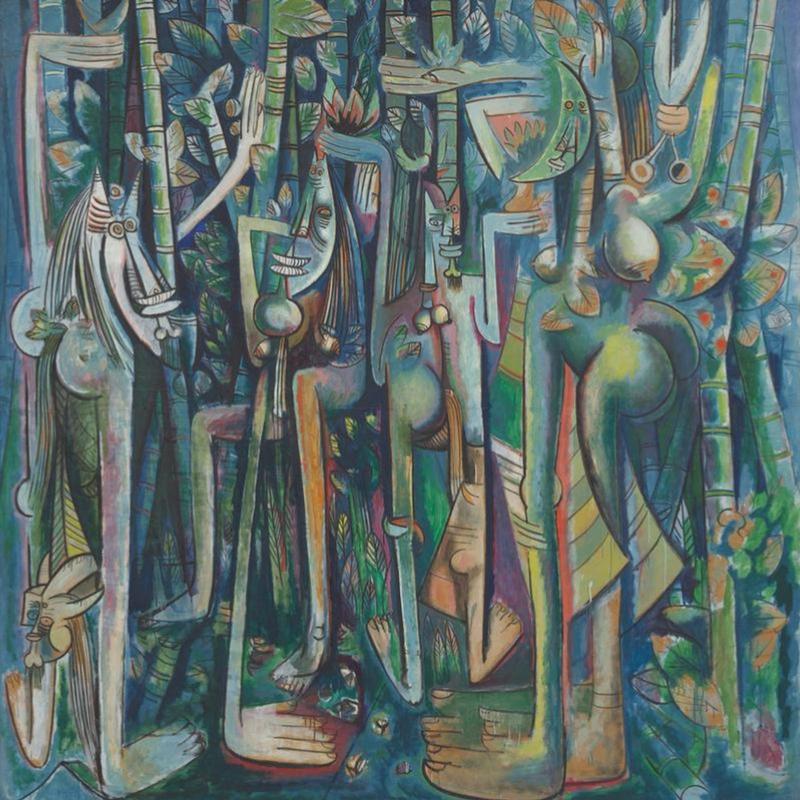
He didn't stop there. There was a commitment for emerging artists, but there was also an international vision. Three years later, Alfred Barr goes to Cuba, visits Lam in his studio in Havana and acquire a second work, The Beautiful Satan, another large gouache. Three years later, in 1945, James Sweeney acquired for the Museum of Modern Art The Jungle of Pierre Matisse's gallery. In six years, the museum acquired three key works by Lam.
Alison Stewart: Beverly, for many years, the jungle hung in the lobby of MoMA, not within the galleries. Would you explain why?
Beverly Adams: When it was first exhibited, actually it did hang in the galleries. It was considered contemporary art and it hung alongside other contemporary artists in this big reinstallation of the museum's galleries. Very soon after that, it fell out of the major narrative that MoMA was trying to put forth on modern art. It would show up in exhibitions or galleries of Latin American art or paintings that were at large scale or other kinds of thematic things. Most of the time, it greeted people at the entryway of the museum.
I think it was because as the narrative of modernism at the institution became narrower and more of a straight line, an arrow through history, they didn't know what to do with this artist. He was a transnational artist. He was from Cuba, he was Black, he was Chinese. He made this amazing picture which they recognize as important, important enough to hang and not keep in storage, but he didn't fit tidily into any of the categories that the museum was trying to create and maintain at that time.
Alison Stewart: I have to say, this exhibition is beautiful. It's huge, for sure.
Christophe Cherix: Thank you.
Alison Stewart: I tell people, set aside time to go see it. I understand, Christophe, that some of these works were challenging for the Museum of Modern Art to get to bring to New York. What was the most challenging piece for you to acquire?
Christophe Cherix: I think one of the complexity of the project, that Lam's work is very much scattered all around the world. It's an exhibition that brings together 59 lenders, 39 private collectors, 20 institutions. We really, Beverly and I, wanted to go back to drawing board, just try to really look at everything we could put our sight on and really pick what we felt was the most decisive picture. One of them, maybe the most challenging of all, was his largest ever made work, almost 15 foot long, almost mural size, and on paper, mounted on canvas, making it very fragile. That work was so large, so fragile, that it had not been exhibited since the mid-50s. It became, for us, absolutely a priority to bring it back and to show it for the first time in New York.
Alison Stewart: Do you have a favorite image, Beverly? You said the most difficult one perhaps, to bring.
Beverly Adams: It's really hard. It's like choosing your favorite child, because we worked so long and so hard on this exhibition. One of the goals of the exhibition was to bring people past the jungle into the later work. For me, that's been really important. The way the installation is, is that you get to the jungle almost right away. You enter the museum, you look one way, you see the Civil War, you look another way, you see the jungle.
We really wanted people to understand how full and complex and gorgeous his career was and what an amazing art maker he was. I'd have to say I can't narrow it down to one, but I was thrilled to learn about these works from the late 1950s, that verge on abstraction called the Bruce paintings. I had not seen those in person before, and it's their first time in New York. I hope people will be as surprised and excited about them as I was when I first saw them.
Alison Stewart: We have to talk about the jungle. This was wild. This is not painted on canvas. That blew my mind. Why did he paint this on paper?
Beverly Adams: His use of paper, and it's just plain brown wrapping paper known as craft paper.
Alison Stewart: Wrapping paper. Amazing.
Beverly Adams: It starts in Spain. He's trying to paint and make art during the war, and materials are scarce. What can he get his hands on? He can get his hands on paper. He's making his own gouaches. He's like catch as catch can, trying to make art, but he doesn't have the money or the availability of materials. When he paints Spanish Civil War, this great picture in 1937, he gets to scale by piecing two large pieces of this brown paper together. Then when he goes back to Cuba, when he wants to paint a statement painting, a big picture, he still doesn't have any canvas, and so he goes back to this wrapping paper paper, not some very fancy artist paper, but this brown craft paper.
For him, it becomes this touchstone. He actually falls in love with this material, and he goes back to it every time we see this great statement or experimentation. Grande Composition, his largest picture that Christophe was talking about earlier is also on this paper, as are the Bruce pictures. It really becomes something freedom for him to work with this material.
Alison Stewart: Those are the practical aspects. I can afford this material. I can afford to use it. Let's talk about his spirituality a little bit, Christophe. How does spiritual influences, how do we see it in his art?
Christophe Cherix: I think we see it-- I think first there's, again, a sense of purpose, a sense of civic engagement. The idea that art is not just about art itself. Art is also for a cause. How he's going to bring together very, very powerful motif that talked about that, about the mission of art, to transcend art itself and to be about our contemporary lives. You'll see in his work, particularly in Cuba, a number of motifs that really come directly out of the Cuban religions, the Afro-Caribbean religion, you can even identify. He's going to play with those motifs, integrate them within his own vocabulary. Creating a world that's both immersive, magical, but also deeply, deeply connected to a sense of faith.
You see also that earlier in Spain, he's attracted by the way we can use very powerful motifs that allow to bring people into a new world. The jungle is very much about that. It's sugar cane, and between the sugar canes you'll see those extraordinary creature. You don't know if they're friendly or they could be a bit hostile. You have to catch them to find them, the creatures of the night sometimes. They bring the viewer into a place that is completely unexpected.
Alison Stewart: You mentioned the latter work, which seems a little spookier than his previous work. What was going on in his life when he was creating the work in his later years?
Beverly Adams: I think the big break actually comes in 1946. He's spent the war in Cuba. He's been showing the whole time in New York City. When he's finally able to travel again, he goes first to New York, then shows in London some works that he had done while he was in Haiti, where he had exhibited, and then goes back to Paris. Post war Europe, really for lack of a better word, freaks him out. He sees the devastation. He's just like, "Oh my God, I can't believe this." He thought maybe he would go back and continue his career that he had left in Paris in 1940, and he's not happy.
Another thing he sees there, which impacts him, I think greatly, is he sees his friend Aime Cesaire, who he had met in Martinique on his way back to Cuba, but he also sees African art being sold like baubles in the street. He sees the separation between the cultural production of these people from Africa divorced from its context, its spiritual context, its day to day context, its life and meaning. That really impacts him a lot.
When he returns to Cuba after this trip, he has a lot to digest. One of the things that he states in some very powerful letters that he writes is that he doesn't want to be objectified like that. He wants to find a way to recontextualize African art of the diaspora in a new way. He abandons colorful tropical light and plants and makes these darker, more brooding compositions, but they are very theatrical and very stately. I don't know, there's a epicness to them because they're so theatrical that I think is motivated by this trip back to Europe in 1946.
Alison Stewart: That was my conversation with co-curators Christophe Cherix and Beverly Adams. The show is called Wifredo Lam: When I don't sleep, I dream. You can catch it at MoMA through April 11th.
[music]
Alison Stewart: Coming up, comedian Jeff Ross talks about his Broadway debut, a one man show called Take a Banana for the Ride, which was recently added to Netflix. That's coming up. This is All of It.
[music]
Copyright © 2026 New York Public Radio. All rights reserved. Visit our website terms of use at www.wnyc.org for further information.
New York Public Radio transcripts are created on a rush deadline, often by contractors. This text may not be in its final form and may be updated or revised in the future. Accuracy and availability may vary. The authoritative record of programming is the audio record.