
Mexodus' Most Nominated At Lucille Lortel Awards
Alison Stewart: This is All Of It on WNYC. I'm Alison Stewart. Happy Friday, everybody. If you were here with us last hour, we hope you enjoyed our conversations with the cast and creative team behind the Broadway revival of Ragtime and their performances live from The Greene Space. If you missed any part of that and want to watch the whole thing, it'll be up on our website soon. You can also watch the whole event on YouTube.
Later on, we'll hear this week's installment of our Poetry Month partnership with outdoorsman and actor Nick Offerman to send you into the weekend. Before that, we're going to hear about a pair of shows that have been nominated for the Lucille Lortel Awards, which recognize outstanding Off-Broadway productions and performances. We'll hear about Bigfoot, which is up for Outstanding Musical. First, we'll hear some music and conversation from this year's most nominated production.
[music]
Alison Stewart: Critics called the musical Mexodus "a thrilling multicultural hip-hop history lesson and something truly dynamic." It resurrects the little-known history of the underground railroad that ran south into Mexico. Researchers estimate between 5 and 10,000 people fled enslavement in the US by migrating into Mexico, where slavery was fully outlawed in 1837. In the show, the history is reflected in the characters Henry and Carlos. Henry, an injured slave who flees his Texas plantation to cross the Rio Grande, where a Mexican sharecropper, Carlos, finds him unconscious and tends to his wounds.
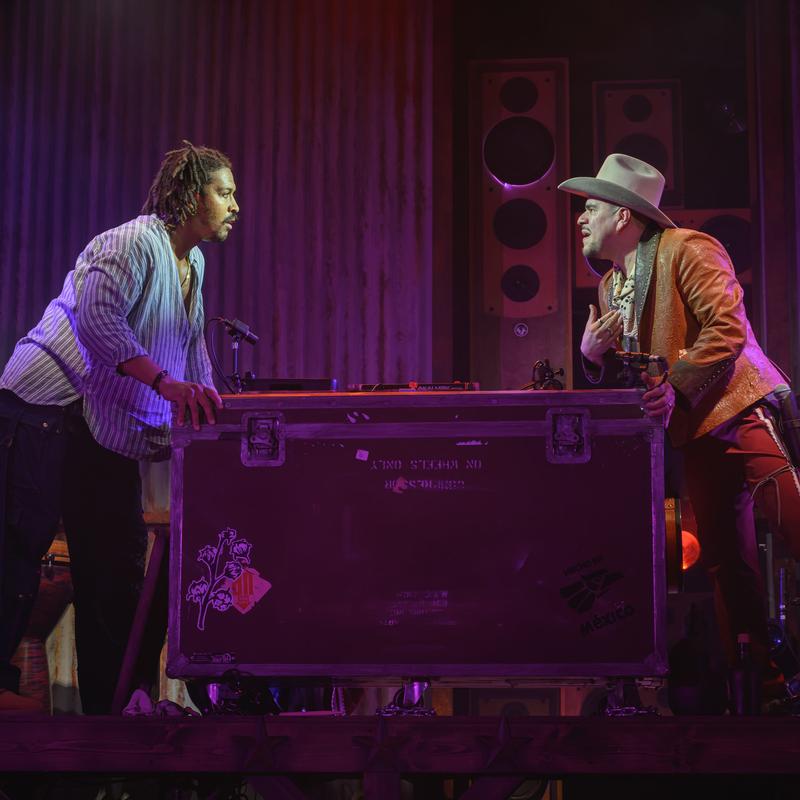
The show is as much about the past as it is about the present, reminding us to lend a hand to those in need today. The musical is titled Mexodus, and it's running at the Daryl Roth Theater on Union Square. It's been extended through Sunday, June 14th. As of yesterday, you can get an audio version of the show through Audible. It's also the most nominated show at this year's Lucille Lortel Awards, including Outstanding Musical, Outstanding Director, Choreographer, Scenic Design and Lighting Design, Sound Design, and Projection Design. Both of its actors are up for Outstanding Lead Performers in a Musical. They are Brian Quijada, who plays Carlos, and Nygel D. Robinson, who plays Henry. They are also the co-creators of Mexodus.
When Brian and Nygel joined us at WNYC to perform live from our Studio 5, I started by asking Nygel to set up their first performance.
Nygel D. Robinson: Oh, you got to come out hot.
Alison Stewart: All right.
[laughter]
Nygel D. Robinson: The whole thing about the show is that we come out as ourselves, introduce ourselves, and are like, "We learned some history that you probably haven't heard about, and we're going to share what we researched and what we learned in a groovy, fun way."
Brian Quijada: Yes.
Alison Stewart: All right.
Nygel D. Robinson: Here's the first track. It's called Two Bodies.
[music]
Alison Stewart: Oh, we had a harmonica. We had a bass.
Brian Quijada: [chuckles] Just at the very end, a little surprise.
Alison Stewart: My guests are Brian Quijada and Nygel Robinson. They are Mexodus, which is performing at the Daryl Roth Theater in Union Square. It's extended through Sunday, June 14th. Brian, you could have told the stories many, many ways. Why did a musical make sense?
Brian Quijada: Oh, wow, that's a great question.
Nygel D. Robinson: Musicals always make sense.
Alison Stewart: [laughs]
Brian Quijada: I love me a good musical. There's a reason why we're so proud of it. It is as American as apple pie musical theater. I really, truly believe that music is the-- they say it's the first language of humans, right? It's the first way we communicated was through rhythm and beat and melody. I just think it's so powerful to be able to sing these songs. We say we only sing in it because that's the way we live with it. Truly, I do believe that. By the end of the show, we get people singing with us, and it's just so powerful.
Alison Stewart: Why do you think musical makes sense for the story?
Nygel D. Robinson: Oh, I think the reason why we sing in a musical, to begin with, is because our emotions are so high and it's so heightened that we must sing. We cannot speak it. I'm one of those guys who's like, "If I'm in a theater watching something, don't talk to me, sing at me." It's already ridiculous. Let's make it more ridiculous. No, we're only singing it because that's the way we're living it.
Also, music is in the fabric of both of our cultures, and it's a means of protest, it's a means of revolution, and especially hip-hop music in particular, that we're using a lot in the show style that we both grew up with. Lin-Manuel, I want to quote him. He said, "Hip-hop is the language of revolution." This show is a small part of a very general revolution and awakening that is happening right now, so we have to use music in order to tell this story.
Alison Stewart: Brian, tell us what Carlos is about. What is he feeling in the show?
Brian Quijada: Well, both of these characters are a composite of a bunch of research, but Carlos is a veteran of the Mexican-American War. He was a medic in the war and fled the war, and his brothers on the field was displaced, moved farther south into what has remained the southern border of the United States, and is a sharecropper now, is a farmer. His whole world is really kind of flipped upside down when he finds Henry floating in the river and takes him out, and goes back to his instincts of being a medic.
Alison Stewart: You promised us a song.
Nygel D. Robinson: I did promise a song.
Alison Stewart: Wade in the Water. That's a Negro spiritual.
Nygel D. Robinson: Yes.
Brian Quijada: Tis.
Nygel D. Robinson: Henry finds himself on the banks of the Rio Grande, and a storm is coming up. For this moment, I was like, "I'll use some juxtaposition." Like, use this very-- I mean, it's not calm, but it's like wade in the water, as if the water is calm, but using that in the mind to get through this storm. This is Wade in the Water.
[music]
Alison Stewart: We're listening to my conversation with Brian Quijada and Nygel D. Robinson, co-stars and co-creators of Mexodus, the most nominated show at this year's Lucille Lortel Awards. More with them in just a minute. This is All Of It.
[music]
Alison Stewart: Welcome back to All Of It. I'm Alison Stewart. We'll continue our conversation now with the co-stars and co-creators of the off-Broadway musical Mexodus, which is nominated in nine categories at this year's Lucille Lortel Awards, including Outstanding Musical, Outstanding Lead Performance for both of its stars, Brian Quijada and Nygel D. Robinson. Mexodus is running at the Daryl Roth Theater on Union Square through Sunday, June 14th. As of yesterday, you can get an audio version of the show through Audible.
Before we get to hear their live and studio performance of a song called Libre, let's return to our discussion. When they came into the studio at the end of March, the production had recently moved to the Daryl Roth Theater. I asked them how it felt different from their previous venue.
Nygel D. Robinson: Well, it's not bigger.
Alison Stewart: It's not bigger?
Brian Quijada: [crosstalk] It's actually less seats.
Alison Stewart: It is?
Brian Quijada: Yes, it's actually quite more intimate, which is quite nice. You really see us sweating up there and spitting. [laughs]
Alison Stewart: Oh, that's interesting.
Brian Quijada: It's great. It's only like eight rows deep, and so it's a truly-- You go in there, we are talking straight-
Alison Stewart: Oh, my gosh.
Brian Quijada: -to the audience. Yes, it's amazing.
Nygel D. Robinson: It's a different kind of storytelling where you're not trying to play up to the mezzanine and play way, way back. We're like 10 feet away from the nearest audience member.
Alison Stewart: What kind of reactions have you gotten from people being that close?
Brian Quijada: Oh, people are more vocal.
Alison Stewart: Really?
Brian Quijada: I mean, we invite it. We say, "Hey, listen, you come here, you yell, you dance." People really chat with us.
Nygel D. Robinson: Yes.
Alison Stewart: It's interesting because there have been shows that have been at the Daryl Roth, which have gone to Broadway. Is that something that you see for yourself, for the show?
Nygel D. Robinson: If you say it out loud.
Brian Quijada: From your mouth to God's ears.
Alison Stewart: [laughs]
Nygel D. Robinson: Start a rumor that it's going to Broadway. Rumors are just manifestation techniques.
Alison Stewart: How does the show keep developing and growing over time?
Brian Quijada: Go ahead.
Nygel D. Robinson: As the times get more turbulent, that we respond to that, and different lines mean different things today than it did a year ago.
Brian Quijada: There's a line in the show that goes, "We are given reasons to fight and start wars." That hits different.
Nygel D. Robinson: A little different now.
Brian Quijada: A little different than it did two weeks ago. Little things like that, that I think we wake up, and we're talking about black and brown solidarity. You wake up to the news cycle, and we get to go to work every day.
Alison Stewart: I understood there was a line in this show about Cesar Chavez.
Nygel D. Robinson: Yes.
Brian Quijada: Yes.
Alison Stewart: Tell us a little bit about that and what you decided to do.
Brian Quijada: Just recently, obviously, a lot of news outlets came out with the allegations against Cesar Chavez, which is incredibly sad, and we feel terrible for the victims. Kudos and respect to California changing it from Cesar Chavez Day to Farmworkers Day. There is a line in the show that was-- when we're talking about moments of black and brown solidarity in history, and one of the places that we cited was Cesar Chavez joining to have a civil wrongs righted, we say. We swapped it out with Dolores Huerta, and it is amazing.
Artists should be a reflection of the times, of society, of our communities. That's one where we're like, "The art has to reflect what's going on, and we have to listen and be in solidarity with the survivors."
Nygel D. Robinson: Broadway is like when you have to lock something for sure, for sure. Like, there's no changing it. It's immortalized, whatever. Being in a space where off-Broadway is technically still development. We can change things whenever we want. I like to think of plays and musicals as living documents until they have to be set in stone. This show is a living document, and if something happens and we catch it, we'll change it on the fly.
Alison Stewart: As artists, how do you see your role as artists in fostering these critical dialogues about the society we live in?
Nygel D. Robinson: I think we get to express feelings in a different way. Rather than try to talk you into feeling something, we get to [strums bass guitar]. What does that mean to the heart rather than words? We get to put words on top of it, but we get to sing out feelings. I think people don't like being preached at; they like being shown. If I can invite you in and try to get you in a moment, and not preach at you, but just show you something. I think my favorite thing about this show is that we're not preaching about solidarity; we're showing you what it can look like. Like, Brian hits a button for me, I'll record something. I hit a button for Brian. We're helping each other the whole time.
Brian Quijada: What it means for just two people to create an orchestra's worth of sound. What's amazing about being an artist is that we are able to create balms. People come into our theater thinking that they're going to-- The first third of the play is a slave narrative. Nygel kind of goes into his ancestral history with it, but by the end, you are dancing with us and singing with us. I think it is an act of rebellion. It is a triumph to be singing in times of, I think, troubled times. It's quite moving for us, healing for us to be able to do the show, but also for our audiences, who, I think, need a place to sing and dance.
Alison Stewart: Let's hear one final song. What are we going to hear?
Nygel D. Robinson: It's called Libre.
Brian Quijada: Libre means free.
[music]
Alison Stewart: That was my conversation with Mexodus co-stars and co-creators Brian Quijada, who plays Carlos, and Nygel D. Robinson, who plays Henry. The show is running through the middle of June, and it is nominated in nine categories at this year's Lucille Lortel Awards. Yesterday, they dropped a recorded version of the show on Audible, so check it out there.
Copyright © 2026 New York Public Radio. All rights reserved. Visit our website terms of use at www.wnyc.org for further information.
New York Public Radio transcripts are created on a rush deadline, often by contractors. This text may not be in its final form and may be updated or revised in the future. Accuracy and availability may vary. The authoritative record of programming is the audio record.