
Merchants of Joy' Follows NYC Christmas Tree Sellers
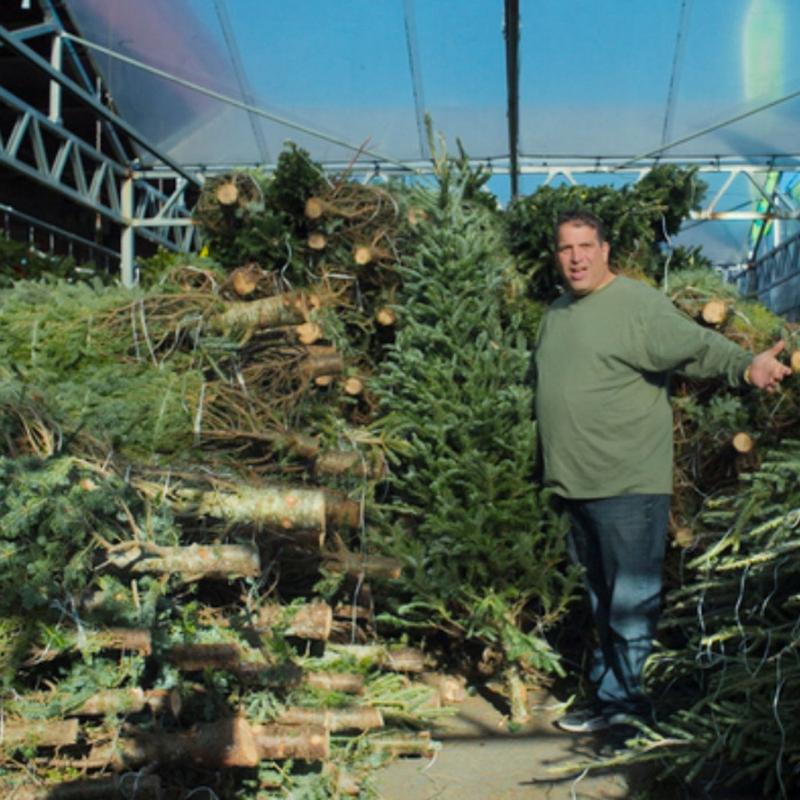
Alison Stewart: This is All Of It on WNYC. I'm Alison Stewart. Christmas decorations are starting to pop up all over New York City. If you bought or plan to buy a tree for your apartment, chances are it came from one of the five families of Christmas who are the subjects of a new documentary called Merchants of Joy. Here's a clip to introduce them.
Gregory Walsh: Nobody can compete with Fifth Avenue store windows. There's music everywhere.
Ciree Nash: I love the vibrancy of the city. I like the noise. I like the chaos.
Gregory Walsh: I love when it's Christmas in New York and a movie.
Jane Waterman: Christmas doesn't start really in the city until the Christmas tree people get here.
Heather Neville: New York is probably the hardest place to sell Christmas trees, and people don't realize a lot of the stands going up are owned by this small group.
Gregory Walsh: My name is Gregory Walsh.
Heather Neville: Heather Neville.
George Smith: George Smith.
Ciree Nash: I'm Ciree Nash.
Jane Waterman: I'm Jane Waterman.
George Nash: I'm George Nash.
George Smith: We're the five families of Christmas.
[music]
Alison Stewart: These five companies dominate Christmas tree sales in New York City. Celia Aniskovich directed the film Merchants of Joy, which is streaming now on Prime Video, and Ciree Nash is one of the subjects. She runs a tree-selling business uptown, selling Christmas trees. Welcome to the studio.
Ciree Nash: Thank you.
Celia Aniskovich: Thank you.
Alison Stewart: I'm sorry, your name is Ciree, and people's phones are going to be going off. That's just the way it is.
Ciree Nash: Yes.
Alison Stewart: Listeners, we want to hear from you about your Christmas tree stories. Tell us about your most memorable Christmas tree purpose or a wild story bringing it home. Our phone lines are open. 212-433-9692, 212-433-WNYC. You can call in and join us on air, or you can text to us at that number as well. Celia, these families are the nexus of your film. Can you introduce them to us with one line, each family?
Celia Aniskovich: Oh, gosh, that's a hard one. I'll start with Ciree and Uptown Christmas Trees, who's sitting next to me?
Ciree Nash: Ciree, since I'm sitting right here.
Celia Aniskovich: I would say Ciree and her parents, and Uptown Christmas Trees, are really tradition and family tradition and really heart and soul in Vermont. George Smith is definitely our comedic relief. He is the class clown of our film. Big Greg and Little Greg, oh, another tradition and a family story, but really just, I think if I had to pick one word, probably Santa Claus, because Big Greg is Santa Claus, and Heather Neville. Heather is a force of nature, is how I would describe her. Between them, they control most of the stands in New York City.
Alison Stewart: Ciree, how long have you been selling trees?
Ciree Nash: 47 years. Since I was born, I've been in this business. I think I actually went to the city for the first time when I was 10, but we were tree orphans before that because my parents were always gone. That's actually doing trees. My kids had been tree orphans, but now they're in the city. I think I came to the city when I was 10 for the first time. That's when I sold my first tree. I started doing a location when I was 15. I think the first time when I was 18, I did it, and for years after that. My whole life.
Alison Stewart: What do you like about selling Christmas trees?
Ciree Nash: I don't know if that is such a simple answer. I was steeped in it, so it fits my personality. There's so much crazy chaos, and problems come up, and you have to solve them. We always say that an hour of tree time is two days in normal business because so much can happen, and that fits my personality so well because I have ADD, so I'm usually all over the place. I also used to do crisis work, so I tend to work really well in a-- That calms me, and that is the thing that I love about it the most. Really, my dad has-- The Merchants of Joy is very true.
The fact that we sell little pieces of moments in time and joy, and happiness. Christmas is not just for Christians. It's a feeling. That season is so long, and t's a favorite time of year because it's not just one day. The Christmas tree is the main center of it. I'm very sentimental in that way, so I cry at Hallmark commercial movies.
Alison Stewart: Celia, documentary filmmaker question. Where did you get the idea for the film, and then how did you track down the families?
Celia Aniskovich: This story first became known to me and these five families through an article in Epic magazine called Secrets of the Tree Trade that was published a couple of years ago now. I, like many New Yorkers, I think we go to bed one day, and we wake up the next morning, and a forest has grown in our city. Despite having been a New Yorker now for 15 years, I never thought to ask, "Huh, where did they all come from?" I love a story that's hidden in plain sight. It's one of my favorite stories to tell.
The first person who sent me that article was my mother, who likes to claim that she is the reason this film got made, as mothers do, and then dozens of other people sent me that article because I am an enormous Christmas fan. I love Christmas, as Ciree knows well.
Ciree Nash: That's true. You look very Christmasy every time I've seen you.
Celia Aniskovich: I look very Christmassy. I have Christmas nails on and Christmas earrings. Then I met Big Greg to start. I went to visit him at his house in Queens. If anyone knows Big Greg, knows immediately, "You want a camera crew to follow me around, sign me up," was his answer. He then also called each of the other families for me and said, "There's this woman here. I think you should talk to her." I always say, I think you guys were maybe a little skeptical at first, but I like to think that you saw my genuine love of Christmas.
Ciree Nash: We did, for sure, but we do get a lot of people that want this-- which is strange because I don't think it's very interesting. It's just my life.
Alison Stewart: It's your life, right?
Ciree Nash: This is all very surreal and very strange to find that people are so interested in this business. We were a little skeptical, but it didn't take long. It didn't take long to see the vision.
Alison Stewart: What did you notice, Celia, about the families, the themes that seem to run through the families? Each family is very different-
Celia Aniskovich: Very different.
Alison Stewart: -but there is a sense of central theme that runs through it.
Celia Aniskovich: Absolutely. Greg said something to me early on in making this film. Greg is one of our tree salesmen. He said, "Look, we're hustlers. We're all street peddlers at heart, but the reality is all of us could have chosen to sell anything, but we chose to sell trees, and there's a reason for that." It's something Ciree touched on earlier. Yes, this is their livelihood. They're trying to make a living, but if someone came up to them and said, "I need a tree," they'd find a way to give them the tree.
This is about something more, and I think for all of them, there's this sense of, "We are selling a piece of magic, a piece of joy, a piece of hope." There's a real unity amongst tree salesmen, a real sense of what they're doing as a real purpose and a calling. I think now more than ever, especially in the documentary format, we hear true crime stories, we hear celebrity stories. You don't really get stories of working-class Americans spreading joy. That's not something you see on screen a lot. It was really an incredible thing for me. I just feel so eternally grateful to get to share a story like this on a platform as big as Amazon.
Alison Stewart: Ciree, there's a certain amount of sacrifice that goes into selling trees. Will you share with the audience what you have to sacrifice for these 45 days?
Ciree Nash: It used to be, now that I'm very happy that my children are here with me, but you're sacrificing time. You're in your own world here. Everything else goes away as it has to be. My son broke up with his girlfriend, but he can't focus on that right now because everything is go, go, go, hectic. Also, it is interesting because I don't do anything else the rest of the year, but you have to be able to be at the drop of the hat, having to travel here. It doesn't leave time for another career. I was a therapist before.
Alison Stewart: Oh, that's interesting.
Ciree Nash: There's not room for both because I wouldn't be able-- I had to choose. I touched on it in the movie when I was getting sober. It was like, "Do I want to keep devoting my time to doing therapy, or is this going to fit my life better?" There's not room for much of another career.
Alison Stewart: Do you ever find yourself therapizing people who are--
Ciree Nash: All the time.
Alison Stewart: Yes, right?
Ciree Nash: All the time.
Alison Stewart: When they're talking about their tree, they're often talking about something else.
Ciree Nash: I do it in business, too. Heather and I are probably the only two women that are in this field, and we deal with-- I use my therapy skills every day when I'm dealing with customers or wholesale customers or tree growers. You have to figure out how to be a woman and work in this industry.
Alison Stewart: Let's take a call. Happy is calling in from Manhattan. Hi, Happy. Thanks for calling All Of It. You're on the air.
Happy: Hi there. I grew up in Plattsburgh, New York, where winter used to be winter and snow would be on the ground by Thanksgiving. We'd go with my next-door neighbors, my three brothers and I, and the four of them all packed into one station wagon with their father and drive up to a place called Lion Mountain, which probably got its name because there used to be mountain lions up there. We would drive in, and we were all given hand axes or bow saws to cut down trees to bring back down. You can imagine eight boys, one parent--
Alison Stewart: A bunch of saws all at once. Thank you so much for calling in. Can you tell us a little bit of the practical nature of getting the trees from the north back down to New York?
Ciree Nash: Oh, that is always a fun process. Usually, at the beginning of the season, I know about how many trees I'm going to have from each grower. Then I have to determine how many can I fit on a tractor-trailer load based on their size, based on their grade. Also, then, when do I want this type of tree coming into the city? Because each weekend is different, and what mix of trees do I want? Once I determine all that, I start to arrange for truckers because I'll know I'm going to have five loads. I'm going to want them on these days.
Best laid plans, that is the best possibility, is that you're going to get those trucks in. It has to be at seven o'clock at night because we unload them onto ours, and then we deliver them through-- but you can't do that during the day. That's the best-case scenario, but that doesn't happen. Most of the time, what I plan is not what happens. Either the truck is not on time, or they didn't put the trees on, the same trees that I wanted, or who knows? It never goes the way that you want it to.
Celia Aniskovich: The year we filmed, we didn't end up including it in the movie, but one of their trucks broke down on the way from Vermont to New York, and they had to abandon it on the side of the road and come back for it.
Ciree Nash: Yes, we had to offload onto another truck. We almost had that happen this year, too, because the lights all came on on one of the trucks. Luckily, we were early enough on. They were like, "Okay, there's a U-Haul place here and a heavy diesel mechanic here. Let's see what happens." Again, an hour in tree time is a couple of days. We worked it out, and we went on our way.
Alison Stewart: It's so much problem-solving.
Ciree Nash: It is, and you never know-- We got here and the season was so chaotic. I got there and showed up, and Kevin Hammer had stolen one of my locations.
Alison Stewart: Oh, we're going to get to Kevin Hammer. We're going to get to Kevin Hammer. Before we get to Kevin Hammer, Celia, they get their locations through the New York City parks. Can you explain that?
Celia Aniskovich: Yes. Once every five years, the tree salesmen have to put in closed bids to bid for the next five years of how much they're going to pay for their spot across the city. I think a lot of people don't realize a lot of land is parkland, even though it might not be actually in a park, if it's adjacent, if it's a sidewalk around it. Ciree, correct me if I'm wrong, but part of the thing about selling trees is that you want a really wide sidewalk. That's what you're looking for.
Ciree Nash: Yes.
Celia Aniskovich: A lot of park spots have great sidewalks, and so they're looking for those. One of the five years happened to be captured the year we were filming, and so we did film, and what you learn from the filming of it is that there's an unwritten rule. You bid on the stands that you've had for many years. People, as you've heard, have been doing this for 30, 40, 50 years, but sometimes people don't abide by the rules, and they like to come in and say, "Too bad," and swoop a stand out from someone.
Ciree Nash: Cause all kind of chaos.
Celia Aniskovich: Yes.
Alison Stewart: Where did you end up this year?
Ciree Nash: I have my main hub, which is 124th in Madison, and that's where all of our trees come in. Different than the other players in this movie is that I have a lot of locations that aren't at parks, which is a whole different-- You have to get them from either the permission from the storefront. If it's a co-op building, sometimes it really depends on whose store you're in front of, or what building you're in front of. It's very complicated. I have 20 locations, or actually I had 20, and then now I have 19, because again, Kevin Hammer.
Celia Aniskovich: Kevin Hammer.
Alison Stewart: Kevin Hammer. We'll talk about him in a minute.
Ciree Nash: I got, though, everything that I bid on.
Alison Stewart: I'm speaking to Celia Aniskovich and her documentary, Merchants of Joy. Also joining us is one of its subjects, Ciree Nash, who runs Uptown Christmas Trees. The documentary is available to stream now on Prime Video. I suggest you do it. Let's talk to Bernadette, who's calling from the Catskills, actually. Hi, Bernadette, thanks for calling All Of It. You're on the air.
Bernadette: Hey, it's great to be on the air. Thank you so much. I love this topic. I love Christmas. I'm going to tell you the story of going to get a Christmas tree with my father in Riverdale in the Bronx. It was in a schoolyard at St Margaret's, and basically, I picked out the tree. I was thrilled. The vendor said $10. My father said, "I'll give you five." I was like, "What are you doing? What? We're going to lose this tree," and then the vendor said nine. My father said six. Vendor went down to eight. My father said, 7.50.
I needed therapy by the time this was over because I still wanted that tree. Anyway, we got the tree for 7.50, and I learned the art of negotiation. It was a memorable time. I've never forgotten it, and I always love watching those trucks roll into the city.
Alison Stewart: Got a practical advice out of it as well as a magical moment. Thank you for calling. Let's talk to Holly. Holly, thank you for calling All Of It. You're on the air.
Holly: Thank you so much. I love your show. Alison. I sold Christmas trees part-time for a couple of years, and I just want to say in terms of a retail position, it is the best because everyone is happy. Any other retail position, people are not as exciting. I highly recommend selling Christmas trees.
Alison Stewart: Thank you for calling. Is there a way to sell a Christmas tree?
Ciree Nash: I think you have to just find out what the customer is looking for, because the biggest question we get is, "How much are the trees?" There's not a simple answer for that. It's like, "Well, what kind of tree do you want?" We always say we have a tree for every budget, and there's always a home for every tree, because you just find out what that person is really looking for. You can get an idea. They may not even know what they're looking for. You just start asking questions.
The last caller was correct, or Celia was correct, too. It's like you can feel good about this because people are happy. Once they find that tree that they want, oh, that's such a-- Every time. That never gets old. Never gets old showing a kid how to count the rings to see how old their tree is, and telling them all this-- That's one of the things that's the best about it.
Celia Aniskovich: People often ask me, "How was it to spend all these days on the streets of New York filming this?" Not only were we with the tree salesman, but we filmed every New York City Christmas experience. You'll see a Puerto Rican paramba in East Harlem. You'll see 30 Rock. You'll see all sorts of different things and other holiday celebrations, too, and I think the cynical New Yorkers in us want to say, "Oh, we're fighting the crowds," but I have to say it was magic at every turn. It really is. That caller was right. You're right. There's just something about it. There's magic everywhere.
Alison Stewart: You don't shy away from difficult topics, though. Sobriety is a big issue in the film. You mentioned it earlier, Ciree. When did it become clear this would be a part of the documentary, Celia?
Celia Aniskovich: What I have to say is every single one of the tree salesmen came to this project with such authenticity and vulnerability. I say to anyone, if you go visit any of the tree stands, they will appear exactly in real life as they are in the film. They are completely themselves, and I was so honored that they trusted me in that way.
Alison Stewart: Heather, who runs New York City Trimlady, is nine years sober as an example as well.
Celia Aniskovich: Big Greg was as well. A number of our participants, the tree salesman, are sober, and so that just naturally came out. I don't know your opinion on it, but I feel like it gives you a different lease on life as well, which tied into many of the things we were talking about and asking, and that sense of-- Big Greg says it, that AA teaches you, you take it one day at a time, and he said it was the day, spoiler alert, he got his cancer diagnosis. He said, "I'm selling flowers today. Today's a pretty good day. Tomorrow might not be, but today's a pretty good day."
I love that perspective, and I see it so much with all of you that you go through, "Okay, we didn't sell a lot of trees today, but you know what? Tomorrow could be a good day."
Ciree Nash: Yes, it rained all day yesterday, but that was yesterday.
Alison Stewart: That did surprise me. I thought about you yesterday as it was raining. I was like, "I didn't normally think about the weather, but that's a--" Again, two days in your life.
Ciree Nash: It makes a huge difference.
Celia Aniskovich: Help a tree salesman. Go by a tree when it's raining. Helps them a lot.
Ciree Nash: It's actually not that fun to sell a tree when it's raining for anybody involved.
Alison Stewart: It's so funny. I walk by Heather every day on the way to work, and I see her doing her magic.
Celia Aniskovich: Oh, I love that.
Alison Stewart: It's wild. Let's talk about Kevin.
Ciree Nash: Ugh.
Alison Stewart: Wow. How would you describe Kevin, who did not agree to be necessarily in the documentary? You have his voice in the documentary fairly briefly, but we get a sense of who Kevin is.
Celia Aniskovich: Kevin is one of our five tree salesmen. The other four are in the film. Kevin, as you described, only his voice is in the film through recorded phone calls that I did with him in New York. I would describe Kevin the way that other people have described him to me. I've never met him in person. Ciree has and can speak to that more. People have described him as the Keyser Söze of Christmas. They've described him as the Donald Trump of the tree trade. He has more stands than anyone. He is serious about people encroaching on his territory, and he will do whatever it takes.
Ciree Nash: Yes, he doesn't really care too much of who he pisses off.
Alison Stewart: This says, "We used to get real trees until we got two cats. Are there any trees that are safe for cats?"
Ciree Nash: I don't know what safe means. Keeping them off of it. Good luck.
Celia Aniskovich: This might be an answer that I know, actually. I don't know about keeping them off, but I've heard that for pets, they're worried about people drinking the water in the tree, and you actually can get-- I was at a tree show with Greg.
Ciree Nash: Oh, yes, that's true.
Celia Aniskovich: You can get this gel material now that even if they try to eat, it's safe for them, but they don't because it's more solid, and it still hydrates the tree.
Ciree Nash: I wish that I had the answer for that, but unfortunately, I think that that is just a cat problem you're never going to get rid of.
Alison Stewart: This text says, "I walk past St. Mark's Church in the Bowery, 2nd Avenue between 10th and 11th, at a much slower pace this time of year, savoring that precious smell of pine.
Ciree Nash: Is that on 42nd Street?
Alison Stewart: That's on the Lower East Side.
Ciree Nash: Yes, but between 9th and 10th, we have a spot right there.
Alison Stewart: It might be your spot.
Ciree Nash: The 42nd. That spot is so beautiful. He has so much room. He's got lights up. It's like a little forest. I recommend anybody just walking through there if you want. It smells so good because there's a bakery right there, too. You got the Christmas-- Oh, it's so beautiful. I was just down there yesterday.
Alison Stewart: What questions do people have for you when they come to get their trees?
Ciree Nash: When they come to get their tree?
Alison Stewart: Yes. They show up, "Here I am, I'm going to get a tree." What do they want to know?
Ciree Nash: It's been a bit since I've been on the street, but lots of people want to know the different types. What's the difference? Which one the needles are going to fall off on? Also, can you plant it after? Which, no, you cannot. It has no roots. Do we deliver? Yes, we do. How much do they cost? Again, that's not the simplest answer.
Celia Aniskovich: I will say too, the one that I get, and we were talking about this right before we came on, is we've seen so many people say, "Ugh, but I buy a fake tree because you're cutting down the real trees." That's such a misperception of what's actually the reality, which is that trees are a crop and for every tree that gets cut down, five more gets planted, and so if you're comfortable eating corn, you should be comfortable buying a real tree, and it's not bad for the environment.
Ciree Nash: It's actually better than mass-produced agriculture because these are actually trees that grow natively in forests, which this is what the land would be, is forest land. It's not like you're cutting down a rainforest and planting palm oil trees because those are homogenous and not part of the environment. The Frasers only grow in certain parts. Balsams only grow in certain parts of Canada. That's what they're growing. Like Celia said, you cut down a tree, you're planting five to 10 more. It's sustainable and renewable, unlike fake Christmas trees.
Alison Stewart: What is the role of big box stores in the Christmas tree business?
Celia Aniskovich: Big box stores are loss leaders. If you say, "Oh, I go to Trader Joe's, and I get my $29.99 tree," they're not actually making money off their trees. They're loss leaders that bring you into their stores to buy other stuff. This is probably my biggest rallying cry. Buy from a mom and pop. Buy from one of these tree sellers. You don't need to give more money to a big box store. You should help a family.
Ciree Nash: I can't tell you--- Sorry.
Alison Stewart: No, go for it. She wants in.
Ciree Nash: I can't tell you how many people bring their trees to us to cut the bottoms off because they don't give you that experience, and how many people come back to us like, I brought my tree, and now it's dead. It's because nobody's there, being like, "Okay, you need to cut the bottom off." They just care about, "Here, you take this tree and leave." There's no variety. There's no feeling. There's no feeling.
Alison Stewart: This text says, "Which tree smells the best?"
Ciree Nash: Balsam.
Alison Stewart: Why?
Ciree Nash: Just the--
Alison Stewart: It just does.
Ciree Nash: Just does. It's the traditional Christmas tree. It's the old school. It's been a Christmas tree forever. In the recent years, Frasers have only gotten more popular, probably in the last 15 years, but Balsam is that traditional. You can tell when you walk into your house when you first put it up.
Alison Stewart: The name of the documentary is Merchants of Joy. You can watch it on Amazon Prime. I've been speaking to its director, Celia Aniskovich, and Ciree Nash, who runs Uptown Christmas Trees. Thanks for coming in. We really appreciate it.
Ciree Nash: Thank you.
Celia Aniskovich: Thank you.