
Menopausal & Rocking in 'Riot Women'
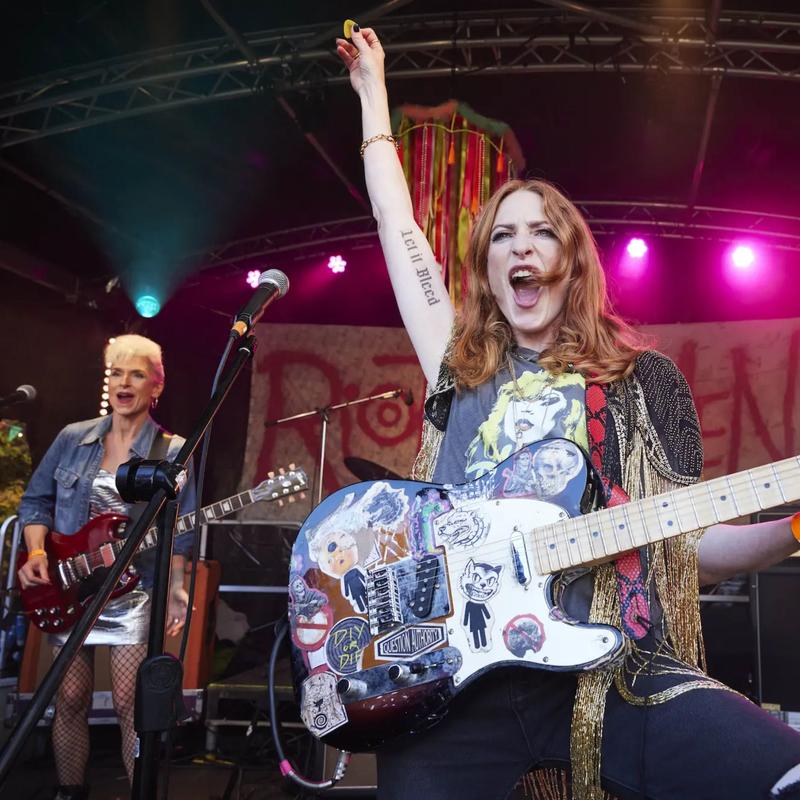
Tiffany Hanson: This is All of It on WNYC. I'm Tiffany Hanson, in for Alison Stewart. You may have heard of the punk, political and musical feminist movement from the '90s dubbed Riot Grrrl. You can think of bands like Bikini Kill and Bratmobile. Well, today we're introducing you to Riot Women, specifically a group of menopausal British women who are fed up women like this.
Beth Thornton: Women like us who are where they are in the world, and then suddenly all this nonsense happens that they never even saw coming. Difficult parents.
Kitty Eckersley: Oh my God, and to marry.
Beth Thornton: Midlife crisis husbands and your child still doing your heading.
Kitty Eckersley: Still.
Beth Thornton: Then the menopause.
Kitty Eckersley: Oh, f-ing menopause.
Beth Thornton: Tearful, every tiny stupid thing. The anxiety, the brain fog. In the middle of all that, you become invisible, even to yourself.
Kitty Eckersley: You're right.
Beth Thornton: Even when you're screaming and shouting, you're invisible.
Kitty Eckersley: I know.
Beth Thornton: How does that happen?
Kitty Eckersley: I don't know.
Beth Thornton: Just when you thought you got traction in the world. Just when you finally think, "I've got it sorted."
Kitty Eckersley: I know.
Beth Thornton: I think whatever we do, we should do it with attitude.
Tiffany Hanson: That is actor Joanna Scanlan, who plays Beth in the new series called Riot Women, from writer, producer, director, creator Sally Wainwright. The show centers on a group of five middle aged women who come together and form a punk band. Initially, they conceived of it as their entry into a local talent contest. Over time, the women realized they had a lot to say about grown up children, husbands, aging parents and their own middle age. Some of what they had to say was about the rage they feel, rage that can, in moments, feel very uncomfortable for everyone.
Wainwright is responsible for writing and creating Happy Valley and Last Tango in Halifax, and is also known for bringing strong female characters to the screen and for her rich storytelling. Now, if you believe The Guardian newspaper, she and her shows must also be prescribed as hormone replacement therapy. Sally Wainwright created Riot Women. She writes and directs the show which will stream on BritBox in January. She joins us in studio now to talk about it. Sally, welcome.
Sally Wainwright: Thank you. It's nice to be here.
Tiffany Hanson: I summarized the series a little bit there. Did I do a good job of really what the essence of it is, five women coming together?
Sally Wainwright: Yes. I tend to write about the age I'm at, and I started to work to develop the idea for the show about 10 years ago. It was finding that I was in a place where I was just juggling a lot of life things, big life things, like having a pretty big career going on and teenage sons. My mother had started to develop dementia. My relationship with my husband was under the strain of me being away from home a lot and him bringing up the children by himself without me around so much. At the same time, the menopause kicks in. I didn't even realize it was the menopause to start with because kind of symptoms that you don't always recognize or that you don't know a part of the menopause, like brain fog and low mood and that kind of thing.
Tiffany Hanson: Tired.
Sally Wainwright: You're kind of juggling a lot of things. You're really busy, and in the middle of all that, you start to kind of disappear or you start to feel like you're not quite the person you thought you were and that kind of thing. I thought it was worth writing about. I thought it was something that I should dramatize the way I was feeling.
As I say, it became apparent that this was the menopause. I realized more about it, but I wanted to find a way of writing about it that kind of wasn't moany, that was kind of uplifting and saying that women at this age are interesting. They're not just people who are disappearing. They're women who are-- we still got a huge amount to offer. The women who are very capable and are capable of juggling a lot of things and managing a lot of things, but in the middle of that, you feel like you're being pulled in lots of different directions and no one's looking out you anymore.
Tiffany Hanson: Why a band?
Sally Wainwright: Why a band? I've always wanted to write about female rock bands. There's a show on TV when I was a kid. I was about 13, and there was a show on telly called Rock Follies, and it was about a female rock band. It changed my life. I wasn't an obsessive TV watcher as a kid. When I watched this show, it really hit me. It was like something had happened to me. It wasn't just a TV show. It made me think, "Oh, that's what I'm going to do. I'm going to work in television. I'm going to write TV shows." I remember really consciously thinking, "I'm going to write shows like that." That kind of never left me.
I'd always had this desire to write about a female rock band. It's kind of putting the two ideas together. It was finding a way to write about-- it's not a show about the menopause. It's about women at that age when that's one of the things that comes to get you. It was to find a way of writing about it that would allow it to be uplifting. It's about the fact that women at that age are still very creative and we're still capable of lots of things. I'd never seen it dramatized on TV. If ever it is dramatized at all, it's usually in a sort of comedic context.
Tiffany Hanson: Sure, right. Music, though, can be a very good outlet for women who are interested in telling their story. I think for the music as a medium for the storytelling for these women to each talk about what it is that you've outlined that's happening for them, but punk? I mean, I get the rage, don't get me wrong.
Sally Wainwright: Sure. No, it did seem very appropriate. I remember talking to someone early on about the idea and they said, "Oh, they can't be punk. Punk's about youth. It's about youth and rebellion and anger." I thought, like, there's nothing more angry than menopause women.
Tiffany Hanson: Amen.
Sally Wainwright: It seemed very appropriate on that level, but also the age. eth, who's the kind of the catalyst of it all, is the same age as me. When I was 14, 15, punk was what we were listening to. It felt very much that was the soundtrack to my teenage years and, and the attitude as well.
Tiffany Hanson: There is a lot of anger in middle-aged women. I can say this as speaking as one. She mentioned it, the character Beth mentioned it in her little soliloquy there. You've mentioned it. How do you address it in the show, that rage?
Sally Wainwright: I think what's hopefully interesting about Beth is as we're introduced to her, she goes into work where she feels nobody kind of notices her. She's a very nurturing person, and the kids at school kind of take her for granted, don't notice her. She's a bit of a jerk. Then she has an encounter with her boss, the deputy head, where she's being taken to task for speaking in a way that's been perceived as a put down to one of her junior members of staff. She tells her boss that she tried to commit suicide last night, and he literally doesn't hear what she's saying. He thinks she's exaggerating.
I think it's kind of about that. The anger comes from feeling that you are now invisible. You've got to that age where people literally don't notice you anymore. They take for granted everything you do, all the big stuff you do, and it's kind of taken for granted. I think that's certainly where I feel that anger comes from me, when I feel that people just don't notice. They want what you've got, they want what you can do, and they want what you can offer, but they don't notice what you're going through. They don't always notice if you're having a bad time or if you're struggling with stuff.
Tiffany Hanson: How do you think society accepts or doesn't women who are angry?
Sally Wainwright: It's interesting. Joanna, when she was doing an interview in London, was saying that it's not a feminine attribute, anger. We're sort of persuaded that we shouldn't appear to be angry or difficult or that kind of thing, because in women, it's perceived as weakness, a nastiness. Whereas in men, it's probably perceived as something very different. It's perceived as being decisive or not taking any bullshit off anyone.
That's part of the rebellion, and part of what I wanted to write about was women who are suddenly empowered to be just as angry and as difficult as they choose to be to express them. That's what comes through in the songs, that they can write these songs where they do express those emotions that are generally considered to be unfeminine.
Tiffany Hanson: We're talking with the writer, director, creator, producer of the new show Riot Women. It's a show that will be streaming on BritBox coming in January. It's about a group of menopausal women who form a punk band, which I just think that alone sounds like a brilliant idea. Do you think society-- Sally Wainwright. I didn't say your name.
Sally Wainwright: That's right.
Tiffany Hanson: There it is. Sally, do you think that society is sexist about aging in general? We have silver foxes, men who are with the gray, Pierce Brosnan with his graying locks, and women who are cougars, which has a very negative connotation to it as a sort of predator. There's something inherently dismissive in that about aging women is, are we just all sexist about the way women age?
Sally Wainwright: I think the way women are portrayed in the media and certainly in drama is a problem. I think it seems to be acceptable on TV for men to be older, not necessarily attractive, interesting to look at all shapes and sizes. Whereas, predominantly, women tend to be thin, glamorous, under the age of 30, and not really very interesting. I think that's probably because, historically, women have been dramatized by men. Women on screen have predominantly been male constructs of what women are or what they want women to be.
I think it's only in the kind of last 20 years or so when more women have been writing screen parts. Well, even now, I think it's a problem that women writers still tend to write what they think people want on TV, which is kind of inauthentic women, which I think goes back to the idea of women being male constructs on television. I think it's unusual to see women as they really are. It's still considered quite niche.
I think there's definitely that-- you talk about Pierce Brosnan be the silver fox thing. That's still sexy and interesting. Whereas women, cool girls. I mean, I think that's a male construct. It's this idea that if you put a group of women together, they'll just be bitchy, or the old idea that if you put women together together, they'll talk about men, which they don't. They talk about what they're interested in, and it's not all men. I think things are changing, but as ever, it's slow. It's a slow process, and it doesn't always move forward. It often feels like one step forward and two steps back.
Tiffany Hanson: Women who are portrayed who look authentic, whatever that means, are the butt of the joke, or they're meant to be funny, or they're not the tall, skinny version.
Sally Wainwright: I suppose what I mean by authentic is women that you recognize. I mean, one of the nice things since the show's gone out in the UK is that we've had a huge response from women saying, "Thank you for representing me as I am, not a sort of glamorized version of women that I fall short of or makes me feel inadequate." It's women seeing themselves recognizable on screen.
Tiffany Hanson: One of the things that I found so lovely about the program is that these five women are not all cookie cutters of the same woman.
Sally Wainwright: No.
Tiffany Hanson: They each have their own very distinct past, their own very distinct view about how to approach the world and approach their life now that they are at this certain age. Just talk a little bit about those characters and how they differ and maybe how fun and challenging that might have been to create all of these differing viewpoints.
Sally Wainwright: Well, it's kind of embarrassment of riches, really. I got a chance to create five women. They're sort of loosely connected with one another. Holly and Yvonne are sisters. Jess runs a pub and she knows Holly because, as a police officer, Holly's had to go in and occasionally sort things out at closing time, when it gets a bit rowdy. Jess was at school with Beth, so they're old friends, and Kitty doesn't know any of them. She's a complete wild card when she comes into it. They're all women who live in the same area and they're all of a certain age and they're all similar class. They are all really distinct personalities. They're all a nice complement and contrast to one another.
Tiffany Hanson: They all have a differing response to their circumstance. Not everybody is angry. Not everybody is a doormat. Not everybody is--
Sally Wainwright: Oh, not at all. I mean, like Holly, for instance, who's the police officer. She joins the band because she's can-do. Jess has a list of people she could ask to be in her band and they've all been crossed out because everybody said no. There's one tick and it's next to Holly's name because Holly's the kind of person who will always say yes. Life's for living. They're a nice mixed bag of different personalities.
Tiffany Hanson: Each of them has specific challenges that they're dealing with. Job, grown children.
Sally Wainwright: Yes. Well, again, it's the kind of issues I was talking about earlier, where they're all women who are balancing a lot of things. They've all got a lot on their plate, a lot of things to deal with. For me, one of the catalysts for wanting to write it was when my mum started to develop dementia. It's one of those things you don't really see coming, even though a lot of people experience that with their parents and have to deal with it, but you kind of don't plan for it because you don't expect it to happen.
It's one of those things you don't think is going to happen to you, and then when it does, how do you deal with it? There's not a lot of help out there. There's not a lot of guidance about what next steps are and that kind of thing. Of course, it brings with it a lot of issues in the sort of personal politics of families. I found it's often the way that when that happens, one sibling is left to look after the parent while the others sort of happily turn a blind eye. There's all that, which is what happened, one of the stories in the show, of course.
Tiffany Hanson: We've been talking a lot about being angry and women feeling invisible, but there's a lot in this show that is hopeful.
Sally Wainwright: Oh, yes. In a way, it's a celebration of women at this age, too. It's a celebration of the idea that you've reached a certain maturity and you kind of know who you are. Your personality is layered and developed. That's why I do like writing about people who are more mature. It's one of the things I've learned as a dramatist as I've got older, that characters who've got some history have a lot more about them.
I wrote a drama called Last Tango in Halifax a few years ago, which, again, was based on my mom. It was about two people who fell in love and got married at 75. They'd known each other since they were little. It was a story that kind of started 60 years ago, and the penny dropped for me then that a story that starts 60 years ago is inevitably going to have so many layers and depth and anecdotes from the past and just two people who know each other incredibly well, even though they haven't seen each other for 60 years because they knew each other as children. I always think that a story that has some history to it and we meet it at a certain point when a lot is already underway and there's a lot of backstory to it, inevitably it's going to be a richer tale that you're telling.
Tiffany Hanson: These women are very resilient.
Sally Wainwright: Well, we kind of are, aren't we? When we get to this age, we've had a lot of things to deal with. We've seen a lot of stuff.
Tiffany Hanson: We have, haven't we?
Sally Wainwright: Yes.
Tiffany Hanson: I think this show for me also illustrates something that I really have come to understand as I've gotten older, which is the power of friendship and how much my women friends, and how important it is to cultivate those friendships.
Sally Wainwright: Yes. Again, I think there's this kind of myth in the way women are often portrayed in drama and on TV. Again, it's a male construct. If you put women together, they're going to be scratching each other's eyes out within minutes and it'll probably be over a man. That's a complete myth.
I think one of the really interesting things I've discovered in recent years, particularly when my mom developed dementia, the people who helped me were my friends. There was a real sense of support from amongst my friends in terms of not just listening to you, but just giving you practical advice and help. My best friend came with me to help empty my mom's house, for instance, which my sister didn't want to do because my mom and my sister had a difficult relationship.
It was a real eye-opener, that hat's true, that your female friends do become much more important the older you get, I think. It's an important part of the way we now talk about the menopause, and we are all talking about the menopause more, but it's really helpful and supportive and brilliant that women talk to each other about it in a way that people just didn't used to do.
Tiffany Hanson: The show is called Riot Women. Sally, the show premieres on BritBox in January.
Sally Wainwright: That's correct.
Tiffany Hanson: We have a text here from someone who says, "I'm an OG Riot Grrrl drummer in my 40s. Excited to see Riot Women. Really love Gentleman Jack." We'll let it go on this question, "Does Sally have any more shows in the works?" There's a season two of Riot Women, right?
Sally Wainwright: Yes. We've already been recommissioned for a second series of Riot Women. I'm writing a film at the moment, which I'm working on with James Norton, who was in Happy Valley, and I've got two other series.
Tiffany Hanson: Busy lady, busy lady.
Sally Wainwright: I'd love to tell you what they are, but they've not been announced yet, so I'm not allowed to talk about them.
Tiffany Hanson: Well, we're happy to have talked to you about Riot Women that premiering on BritBox coming up in January. We've been talking with Sally Wainwright, who is the creator, producer, director, writer. Sally, thanks so much for your time today. We appreciate it.
Sally Wainwright: Oh, thank you. Thank you very much.
Tiffany Hanson: This is All of It. I'm Tiffany Hanson, in for Alison Stewart today. She'll be back tomorrow. Join us then.