
Mass Layoffs at the Washington Post and What it Means for Journalism
Alison Stewart: This is All Of It. I'm Alison Stewart, live from the WNYC Studios in SoHo. Thank you, yes, you for spending part of your day with us. I'm grateful that you are here. On today's show a Queens native spent over 20 years building a full model of New York City in between his shifts as a truck driver. The model will be on display at the Museum of the City of New York, and its builder will be with us. We'll also talk about the 30th anniversary of Infinite Jest by David Foster Wallace and a new book on the 1992 siege on a cabin in Idaho and how it changed American history. That's all coming up, but let's get things started with the state of journalism today.
[music]
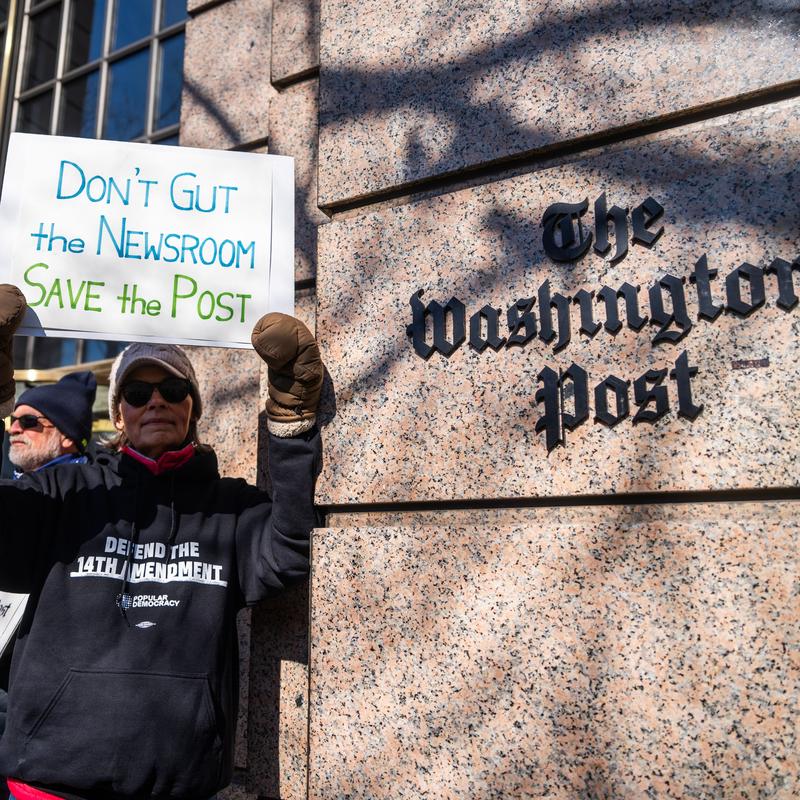
Alison Stewart: Last week, a former employee of The Washington Post called the events a bloodbath as the paper laid off roughly 30% of its workforce, ending jobs for 300 people. Entire departments like sports and book reviews were eliminated, and deep cuts were made to international desks. Then over the weekend, the publication's controversial CEO, Will Lewis, resigned. Hired by owner Jeff Bezos, who bought the paper in 2013, Lewis's two-year tenure was marred by turbulence. We'll get into that in just a moment. Where do this leave the Post, Jeff Bezos, and its readers? NPR's media correspondent David Folkenflik has been covering this story in depth and joins us now. Hey, David.
David Folkenflik: Hey, Alison.
Alison Stewart: Listeners, how do you feel about the changes at The Washington Post? How have you kept your subscription? Have you canceled your subscription? How do you feel about the changes in the media in the Trump era? What would you like to see more of and less of in The Washington Post? Or if you're a former Washington Post staffer, give us a call, tell us how you're feeling right now. Our number's 212-433-9692 212-433-WNYC. As we said, 300 people were laid off last week from the Post. What was the reason given?
David Folkenflik: The Post said it needed to make changes to prove financially viable. That is, despite being owned by one of the richest people walking the planet, it had encountered years of severe shortfalls, losses stretching at one point, according to its former publisher, Will Lewis, up to $100 million a few years ago. 77 million another went down a bit, was said to have spiked up a bit last year. This was, at a certain point, not what Bezos was willing to entertain anymore after years and years of investing in the newsroom, expanding the newsroom. Let's give him credit for that, expanding the business side and other related ventures at the Post company. Bezos said no more.
I think you're seeing the leadership of the Post in the person of its executive editor, its top newsroom executive, Matt Murray, say they have to focus on what readers are rewarding them for. You're hearing now the newly appointed acting CEO and Bezos themselves this past weekend say they're going to be driven by customer data. They're protecting from what we can tell, national security coverage, national politics coverage and policy coverage.
There hasn't been a true strategy laid out for what this means for the Post, where it is going forward, who it intends to serve, who it intends to compete with. You mentioned in passing some of the places that have been pretty eviscerated, local is down to, as I understand it, 10 reporters and two editors from more than 40 people. That means the metro area, greater Washington, there's no other institution that has covered greater Washington better than The Washington Post in recent decades, and it's been eviscerated.
They've also essentially dispensed with sports coverage, except for a few sports reporters dispatched over the feature section. They've killed sports. That's also something that binds people. There are a number of cultural critics who have been laid off. Those tend to cover cultural events and institutions around the area. These are the kinds of things that bind you as a subscriber, certainly to the waning print edition, but also digitally, who's the Post for and what is its point moving forward? I think that's a question even as the hundreds of journalists left no doubt want to continue to do important work.
Alison Stewart: This isn't the first round of layoffs at the Post in recent years. Why is this round making news?
David Folkenflik: The scale of it is completely redefining for the Post. I've said this and we can get into this and I'm sure we will, that number of events over the past, call it two-plus years will be written about as historical elements of the face of American journalism in the Post, in particular, the Post, a singular, institution in American and international journalism, from the Pentagon Papers to the Watergate to all the things in the years since.
However, this is redefining. It is, in the terms you use, a bloodbath. It is not just a revamp and, "Hey, we're going to do a light emphasis," or, "We're just simply going to be a federal newspaper from now on." You mentioned that 30% of the company staff is gone. I think the percent will be far higher in the newsroom itself. We don't know. The Post is privately held. It's not required to share data, and they sure aren't being very transparent about all this, even with their own people at the moment.
We don't know the full effects. I've spoken to any number of tearful and absolutely bereft journalists at the Post who said that each day they're learning more about colleagues who have been laid off, because it's not as though there's been a master list that the news organization has posted or that it's publicly really articulated. They're figuring this out. We'll bring this news to our listeners and readers as we have them at NPR and through WNYC.
When you have an institution that has been so important, that holds powerful institutions to account, including at times those owned by its owner. Amazon Blue Origin have been aggressively covered by the Post reporters, and so have his business interests. He has, to Bezos' great credit, never seemingly interfered with that, but that's different now. They've laid off much of the tech coverage team, the Silicon Valley team. They've laid off the Amazon beat reporter. We don't know what kind of coverage that will be done.
In the last year, Bezos, famously, in just a few days before the 2024 elections, killed a planned editorial endorsement of Kamala Harris, the Democratic nominee. Bezos, I'm told, had sensed and believed that it was quite likely that President Trump would return to office, and polls certainly were showing it very close at that time. He didn't want to be on the wrong side of him, given how severely Trump reacted to those corporate interests that had seemingly crossed him or vexed him, as Bezos's Washington Post did for his interests over at Amazon. He did that.
Then in early 2025, he reinvented and redefined his opinion pages again, editorial, opinion pages, both totally within the rights of the owner to do. On the other hand, he did so in ways that put him on increasingly the right side of President Trump, in concert with other actions he took to warm up to the president, for example, authorizing significant payments and many tens of millions of dollars to Melania Trump to get her to participate in a documentary that Amazon put out about her.
That's caused severe rift with readers, hundreds of thousands of subscribers canceled. It has also caused real questions within the Post about his commitment to the Post and that they see these cuts as him signaling that he's stepping away from considering this a defining element of who he is, which in the years after his acquisition of the Post in 2013, he said, this will be one of the things I'm proudest of when I look back at the age of 90 at what my life has become.
Alison Stewart: I'm speaking with David Folkenflik, NPR's media correspondent. We're discussing the recent mass layoffs at The Washington Post and the decisions that led to them, as well as the state of journalism. We are taking your calls. How do you feel about the changes at The Washington Post? Have you kept your subscription? Have you canceled your subscription? What would you like to see more of or less of? If you're a former Washington Post staffer, give us a call, tell us how you're feeling. Our number is 212-433-9692 212-433-WNYC. Let's talk to Bill in Garrison, New York. Bill, thanks for taking the time to call All Of It.
Bill: Hi there. I'm a longtime reader and subscriber to the Post, and there's nothing like it. It is not like the Times at all. As far as I'm concerned, it's far more superior. That said, in all the discussions about what's going on at the Post and other media outlets, too, nowhere do you ever hear management being blamed for bad decisions. Yet the Wall Street Journal, the New York Times are very profitable and the readership is going up. Why couldn't this happen at a paper like the Post?
Alison Stewart: That's a good question. What do you think, David? Why isn't management ever being blamed for the problems that have happened at the Post?
David Folkenflik: I'd encourage your listener to read some of our stories in depth because, in fact, I think that top executives have failed here. To be fair, Bezos poured a lot of money into the business side and rethinking strategy as well, but he's been blamed by a number of folks at the Post, including senior executives, for in some ways not being more involved to help give some digital guidance. The two CEOs that he picked, Fred Ryan, whom he brought over after Ryan had left POLITICO, and then Will Lewis, who had been the head of The Wall Street Journal during its successful embrace of the paywall, and was involved in a new startup of his own.
Subsequently, Lewis had a lot of talk about the new ideas he'd bring, the use of AI, the news of what he called a third newsroom, where they could experiment with new areas of coverage and new ways to provide that to readers and new ways to get people on board. On the business side, they were experimenting, and I think this one had some very modest success with trying to figure out things shy of full-on subscriptions that nonetheless would get people on board as paying readers and users and perhaps get them to evolve to pay more on longer terms.
These things didn't amount to much. Lewis was diffident. I had reported just before he came on board -- He was supposed to start in January 2024 and did in December of 2023. I wrote about these allegations that had surfaced in lawsuits in Britain, showing that there was some evidence suggesting something he denies, but suggesting that he had been involved to cover up criminal activity at Rupert Murdoch's newspapers back when he was an executive in 2021 in the UK for Rupert Murdoch.
This haunted Lewis. He pressured me and then tried to buy me off to prevent me from writing this story. We did it anyway, and it changed the nature of what his time would become. It turned out he had pressured his own executive editor not to let her reporters report on it. The Post has a long history of really reporting, I think, quite honorably, about its own institution and interests. When he sought to demote that editor, she left, and he held a town hall, at which point he really laid into the reporters who were asking him some very tough questions. This was in June of 2024, and said, "Nobody's reading your stories, essentially saying it's your fault."
After that point, he never met again with the newsroom. He didn't participate in the announcement last week about the evisceration of their staff, the devastation of their staff. Even to say, "Look, we got to make this for financial reasons. It's hard, folks, but we're going to come out of this stronger and here's why. You never heard from him. Not at all. That is not leadership. I think Will Lewis really in some ways, was like a captain who abandoned the Post on a ship that was going into some very perilous waters.
There is failure of leadership. I will say that the Times and the Journal have evolved. The Journal never had to worry about this. The Times really started to do so more in the '80s, and really more severely did so over the last five years or so, where it really pulled back from its metropolitan coverage. It's got some, but it's no longer thinking of itself. It's the New York Times, but it's not solely of New York. It sees itself as citizens of the world, looking for digital subscribers all over to the variety of products that it offers, including, at its core, this brilliant news report that it does.
The Post was always caught in between being, are we a preeminent regionally based newspaper that covers the nation because we are in the Capitol and is worldly as a result, or are we a federal paper in the nation's capital. We acknowledge what happens around that influences that federal government, but really, we are beyond borders and Washington is not that important to us. It used to be, prior to Bezos that it was of and for Washington, the Post, that it would both think of itself as federal but be rooted in local.
If you get rid of local coverage to overwhelming degree, if you don't cover traffic and weather in the same way, if you're not going to cover sports and arts in the same way, you are unraveling the connection that people who are based in that metro area have with that publication as something distinctive. You're saying to them, "Look, you can go to POLITICO, you can go to The New York Times, or the Wall Street Journal, and you won't lose that much." That's the challenge that the people at the Post have. It was a slightly different one than the Times, which had much more nationalized and even internationalized itself.
Alison Stewart: That's interesting because we have a text here that says, "Shameful, what has come to this Graham [unintelligible 00:14:00] legacy institution?" Which leads me to the question that I'm thinking, like, is this a legacy media problem or is this a Washington Post problem, or is it both?
David Folkenflik: I think it's indicative of both. I think that the Washington Post is of signal importance to the nation, an exemplar of being able to show you can do important, rigorous local news reporting, but also have the sophistication of anyone. Some of their coverage of national matters over the last decade was as good or better than anyone's in the country, imperfect, to be sure, as all of us are. It's a mortal endeavor, journalism, and you're trying to straighten the record and get it even better the next day every time.
They've done marvelous work. They've tremendous reporters covering the Israel-Hamas conflict, covering Ukraine-Russia war at great personal risk, and have done the equivalent for decades. To see the entire Middle East desk laid off, to see the bureau chief and the full-time reporter for Ukraine let go, to see this real tradition unraveled. You saw Don Graham, this incredible figure in American journalism, who relinquished the Post because he thought it was in the Post's best interest to do so really that he thought that Bezos, because of his vast wealth, which is about a tenth of what it is now, but Bezos vast wealth and also his digital know-how, made him the right person to lead the paper into the future at a time where the Grahams were out of answers.
You saw Don Graham take to Twitter last week in response to all of these individual personal announcements from reporters who were laid off. He'd say, "You're so terrific. Let me know if I can help you." He'd respond to another reporter and say, "God, you've done such great work for the Post. If I can connect you to something, let me know." He was almost serving as a jobs resource board, this great figure who had been in the past, until 2013, the owner of the Washington Post. That is the emotional investment you could see playing out in public and the sense of responsibility to do what he could.
Alison Stewart: We're talking about the mass layoffs at the Washington Post with NPR's media correspondent David Folkenflik. We'd like to get you in on the conversation. How do you feel about the changes at the Washington Post? Our phone number is 212-433-9692. We'll be right back.
[music]
Alison Stewart: You are listening to All Of It on WNYC. I'm Alison Stewart. I'm speaking with David Folkenflik, NPR's media correspondent. We are talking about the recent mass layoffs at the Washington Post and the decisions that led to them as well as the state of journalism. We're taking your calls. How do you feel about changes at the Washington Post? Have you kept your subscription? Have you canceled it? How do you feel about changes in the media in the Trump era?
What would you like to see more of or less of at the Post? If you're a former Washington Post staffer, we'd like to know how you're feeling. Our phone number is 212-433-9692 212-433-WNYC. David, we have a question for you from Edith, who is calling from the Upper West Side. Hi, Edith. Thanks for taking the time to call All Of It.
Edith: Hi. Thank you. I love both of you. David, I met you once years ago at an event in Woodstock, Vermont.
David Folkenflik: I love that. You're in my old haunts at the Upper West Side. Fantastic.
Edith: [chuckles] I just had a quick question which is it true that foreign correspondents who were in actual war zones were suddenly fired while they're still in the war zone?
David Folkenflik: Yes. I'm told that there's some dispute about this. The Post has been pushing back, and you have to parse some words here. I had reported in advance of the actual announcements coming out that there were a number of people on the foreign coverage team, of whom there were 72, not of all of whom were full-time employees.
There are a lot of stringers and local journalists helping out as well, but that they were discouraged from going to perilous areas after February 1st because they knew that the significant cuts would be coming. The top international editor, Peter Finn, basically told top executives, although it was only confirmed after the fact, that he basically asked to be laid off rather than having to lay off more people to give you a sense of the seriousness with which he was taking it.
The bureau chief in Ukraine was laid off. I don't think she was in a danger zone at the time. The foreign correspondent based in Ukraine, in Kyiv, she said she was in a conflict zone at the time. That doesn't mean that the Post was saying sayonara and we're not going to help you get back at all or be safe. I think that the Post has promised to give all of its full-time staffers repatriation, make sure they do it safely in an orderly way, but they were informed while they're on duty.
In addition, there's a lot of consternation, grave consternation, about the fate of various people who work on behalf of the Post and are locally based. It's not as though the Post is going to fly them here necessarily, although there have been conditions where NPR did that after some different circumstance. One of our Afghan colleagues was killed along with one of our American photojournalists. I think members of his family were brought here by NPR. There were budgets set up to help support them.
Different institutions operate in different ways. This is not that. At the same time, there's some sense from the journalists who work on the foreign desk of a feeling of obligation and a commitment to those who have worked with them, often at far greater personal risk, because it's a personal story for them. This is all being hashed out. The Post institutionally felt as though they were being accused of washing their hands of people in war zones, and that does not appear to be the case for their permanent full-time staffers, even those that they're laying off.
It is messy, and it is very hard. While we acknowledge, I think, Alison, that there are layoffs happen in all kinds of industries, and we don't want to sound precious about journalists losing their jobs, this is one of those institutions that have helped the people of greater Washington and of the United States understand their communities and the world around them. To cut these bonds in these way, both to those they work for and those they serve as their audiences, is deeply disruptive and raises doubt about the commitment moving forward. Even as Jeff Bezos says, that still exists, and he wants to make sure that the Post endures as an institution of integrity.
Alison Stewart: Here's an interesting text, and I'm interested in your response. It says, "I'm a subscriber who dropped my subscription once and later restored it. Now seeing very little to entice me to keep it. The question remains, am I harming those stalwart journalists who are still in place, or am I better off sending a message to Bezos by canceling?"
David Folkenflik: This is such a good question. I've talked to a lot of former news executives at the Post, even those who have been quite critical of, say, Will Lewis, that just departed, a publisher, and of Bezos himself, who say, you're only punishing the journalists there. You're only making it harder for them to have the money to do the things they need to do or to stay on staff or to have the breathing space now that they--
Let's say they're down to 500 or fewer journalists from a staff of 790, to have the breathing space to say, "Okay, how do we rebuild? How do we get stronger? How do we fulfill our public mission, but do it in a way that more people will find it appealing, and how do we go there?" I will say that we were the first to report about the hundreds of thousands of more than 300,000 subscribers canceled when Bezos personally intervened to kill the endorsement of Kamala Harris.
Again, he's right, but nonetheless, it severed an understanding. Then, when he reorganized the editorial page to promote what he called personal liberties and free markets, which is basically what the Wall Street Journal says its editorial stance is, which is his right, but also not an undercovered point of view. Another 75-plus thousand people canceled just in 48 hours. That's 15% of their subscribers at that time.
I'm told it's now several hundred thousand fewer than it was at the time that he started on these changes in October of 2024. It's a lot lower than it should be, given the great interest in news, given all that's happening with the Trump administration. It does send a message that a figure like that grabs the international attention on that story, on the fact of those changes yielded that kind of backlash.
At the same time, it does harm the journalists there, and that is the conundrum and the quandary that you have. Again, we don't know what Bezos envisions because they haven't really articulated this and they haven't said the strategy. They've said their concentrations, but they haven't said what they represent, what their values are. There's one thing I'll tell you, and as I think I mentioned towards the top of our conversation, the new acting CEO and Bezos said, "Our customer data will drive our decisions. Will serve what the public wants."
First off, that is a somewhat narrow constriction of public service is to serve what the public wants. We think, I think, in public media and much of media does, the idea that we're equipping people to be citizens and not just consumers of news, and simply to say what they show themselves to be interested in clicks denies them the chance to be surprised by things they didn't know they would find vital or important or valuable.
The second thing is, Marty Baron wrote in his memoir, and Baron was the legendary former executive editor of the Post, and he was one of the star figures in the movie spotlight about the Boston Globe and the Catholic Church abuse story and all that. Baron said, "Yes." Even back then, a decade ago, Jeff Bezos was saying we have to be driven by metrics and statistics and figures, but that our principles must override and be more important than simply data.
I think the question is, what are the principles Jeff Bezos is now embracing for this newspaper? Although he's been relatively silent during all this, it really is on him to declare that and make that clear, even as he's entrusting others to lead the paper.
Alison Stewart: If the message is give the people what they want, that's what Bari Weiss, the Editor-in-Chief of CBS News, has been saying.
David Folkenflik: She has been saying it, but also, she's been saying it with, I think, an idea of a certain kind of people, what they want. She has said that she wants to appeal to Americans within the 40-yard lines, towards the center of the field is the analogy. I would think she'd want to broaden that to maybe the 35 or 30-yard lines. I understand what she's trying to say, and there's nothing inherently wrong with that.
She has really risen to public acclaim as well as some criticism on the proposition that the American news media, including CBS, including 60 Minutes, that network's crown jewel, have been essentially playing only to the left or really indulging a sense of wokeness. You've heard hints of that. Matt Murray, who was the editor for the Wall Street Journal for Rupert Murdoch and for Will Lewis for a stretch there. In his memo, he said, it's just as a glancing allusion to the idea that for too long we've been appealing only to too narrow a range of the American people. It's not the exact words, but that's the thrust of what he was saying. He hasn't unpacked that.
My suspicion is that it's something similar to what Weiss is saying. I don't think of Murray as an ideological figure, and we're going to have to see that played out. You saw a lot of areas Washington Post reporters would tell you, they cut and gutted, not only coverage of tech as well as the other things we've mentioned. Not only books and not only metro things, but climate coverage, significantly, wildly cut back. Coverage of, I think DEI issues, I think was significantly cut back. These play into that.
The cuts have been so widespread, it's hard to pin that to an ideological issue. That's the real question of what emerges from the ashes here. It is still a huge newsroom by any measure, but it's so much smaller than before, and it seems like so constricted in ambition and reach that you wonder, even given a narrower focus, if they can play at the same level.
Alison Stewart: Let's talk to David from Brooklyn. David used to be a journalist. Hey, David, thanks for calling in.
David: Hi.
Alison Stewart: Hi.
David: I guess, first time caller, longtime listener. I guess I just wanted to share an anecdotal experience that I've had. I think I am probably on the younger side of folks who are listening to NPR, and I guess just radio in general. Unfortunately, a lot of my friends don't use this medium anymore. I do think that illustrates an issue that I experienced at my time in the media space. I felt just in general, a lot of the editors I worked with and management in general was extremely out of touch with, I guess, the way I felt media was moving and the way audiences were consuming media.
I guess it relates to what you all were talking about earlier. I think the fact that a lot of my friends now are using like Substack primarily as a source of information is really illustrative of how media has shifted, perhaps in a way that is not necessarily meeting where folks should be or where folks want to be, I guess.
Alison Stewart: David, thanks for the comment. We appreciate it. Do you want to respond, Mr. Folkenflik?
Alison Stewart: Sure. David to David here at direct casting, what I would say is that Bezos and Matt Murray and Will Lewis and Jeff D'Onofrio, who's replaced Lewis all of them, would agree that actually the Post has to find ways to reach people, and it has to reach people where they are indigenously. The Post had a hilarious TikTok account. Dave Jurgensen went and took this video account, and he's now making money. I don't think it's on Substack, but making money on his own, doing this with a couple of former colleagues from the Post that would break down and explain news events, but through a comic lens.
You're seeing ways in which that's done. NPR does that, and I encourage David to find us on the apps and find us on Instagram and find us in a hundred other places as well, because we're also doing that. News organizations may not have been always the best at this, but they've long since thrown in the notion that everybody has to only consume things the way they want to do it. We no longer only measure or value our radio audiences, although we do very much value our radio audiences, hence this show.
They have to find ways to do that, but they also have to find ways to do that and make money. Often when you're on other people's platforms, you can't do that. Substack, I think, has some phenomenal commentary and even some really good reporting on there, but you have to find it and look for it. I can't pay for all the subscriptions I would want to do. It's as though I'd be paying $10 individually for every CA channel back when I had a bundle. Substack doesn't really offer that. Even if it did, it would be wildly expensive.
There are real questions about the viability of all this. For a small percentage of journalists, they can hustle and be entrepreneurial and do that, but one of the problems is that really good journalists are often really good at it, but haven't evolved their business and entrepreneurial skills as well. It's a lot to ask. Doesn't mean that that isn't going to be what they have to do. You've seen a number of Post people take the Substack this week.
Alison Stewart: Let's get one more caller in here. Darren is calling from Colorado. Hey, Darren.
Darren: Hello, Alison. I love your show. Just real quick, I had a question, why Bezos doesn't just get out of business? He's clearly not good at it. Kara Swisher wanted to get a group together to take over the Post, and I think she'd be brilliant at that. She's obviously proved herself, has been right about so many things. It seems like a perfect fit, and why that isn't coming to the fore? He needs to get out of the business, I think, because he's not good at it.
David Folkenflik: Bezos has basically turned down overtures. I don't know how formal they were. Kara Swisher knows a lot of people in tech and business, and I'm sure could try to come up with money, but it's a major proposition. If Bezos is doing it because he wants to be self-sufficient, but he still wants it, then that's what he wants. If Bezos is doing it to defang it a little bit for President Trump to stay on his good side, as he has multibillion dollar interests in front of the federal government and with the federal government, then I think that it's probably more useful to him to have it somewhat damaged on the side than give it to someone else who might build it back up again.
I don't, I don't think that's what he's doing, but it's very hard to know. The effects in some ways, are the same. Although I'd point out if he really wanted to declaw it, then he'd get rid of all those national enterprise reporters. They haven't done that. They'd get rid of all those national politics reporters. They haven't done that. I don't think you can draw a direct linear connection between his cozying up to Trump in his personal and business side and what he's done at the Post. It's hard to utterly disentangle those as well. I think that's part of the cloud that journalists at the Post feel hangs over.
Alison Stewart: David Folkenflik is NPR's media correspondent. David, thanks for your time.
David Folkenflik: You bet.