
'Marjorie Prime' Stars June Squibb, Cynthia Nixon, and Danny Burstein as Humans Grappling with Memory and Artificial Intelligence
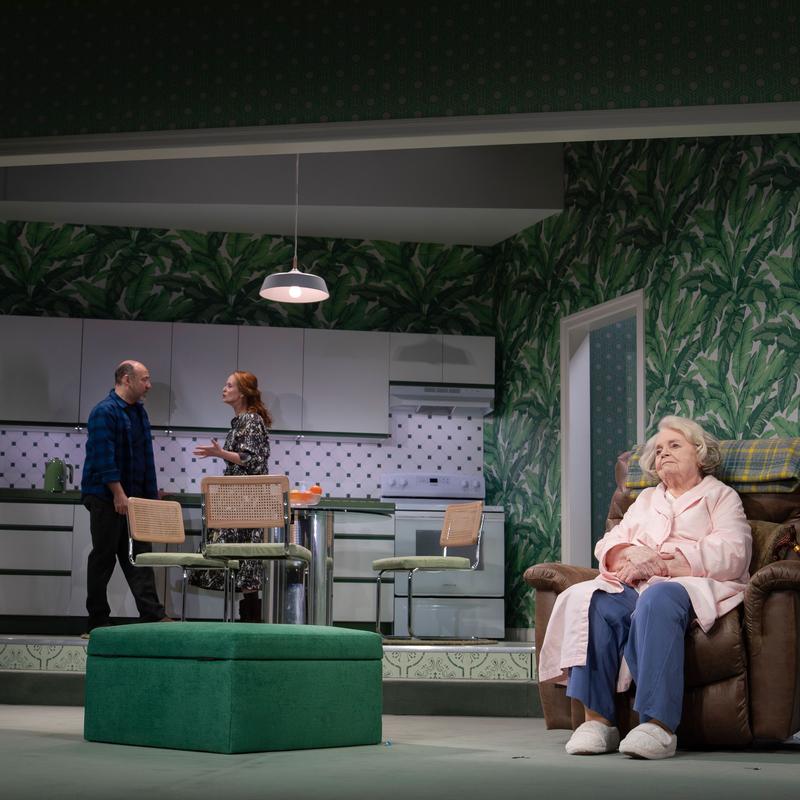
Alison Stewart: This is All Of It on WNYC. I'm Alison Stewart. What if you could talk to a loved one who has passed away or act at least with a hyper-realistic artificial intelligence version of that person? What would you decide that they should know? That's the central premise of the Broadway show Marjorie Prime. The play is set in the year 2050, and it opens with Marjorie, who's having a hard time with her memory. Her kids think it's a good idea to get a Prime, a hologram/AI designed to look, sound, and act like her late husband, Walter.
In this case, he's 30-ish and good-looking. Marjorie's daughter, Tess, isn't so sure about all of this, but Walter Prime seems to really help Marjorie, even if there are some memories that are just too painful to discuss. Of course, they do come to light. Marjorie Prime is a show about memory and grief. It was a finalist for the 2015 Pulitzer Prize Drama and is now on Broadway through February 15th. I'm joined now by the stars of the production, Danny Burstein. First time on the show, Danny. Nice to meet you.
Danny Burstein: Nice to meet you, too.
Alison Stewart: Cynthia Nixon. Hi, Cynthia.
Cynthia Nixon: Hey, Alison, how are you?
Alison Stewart: I'm doing well. June Squibb. Hi, June.
June Squibb: Hi, Alison.
Alison Stewart: June, according to the Playbill, your first Broadway appearance was in 1959, 1960. Why did you want to sign up to do a Broadway show at this point?
June Squibb: [laughs] Well, I had seen Marjorie Prime at Mark Taper Forum when it was originally done. When they asked me about this, I didn't remember, and I said, "Send me a script." I just felt the script was brilliant. I just was blown away by reading this script, so I felt this is something I could do and that I should do.
Alison Stewart: What's changed about Broadway since 1960?
June Squibb: Oh, gosh, everything, everything.
[laughter]
June Squibb: I'm a different age than I was then. We used to go out every night drinking. I don't do that anymore.
Danny Burstein: Yes, she does.
Alison Stewart: [laughs]
June Squibb: No, I don't, Danny.
Danny Burstein: [laughs]
June Squibb: Just occasionally.
Alison Stewart: Occasionally. Cynthia and Danny, you guys are regulars on the New York City stage in big productions. Danny, I think you've been in more than 20 shows in Gypsy and in Moulin Rouge. That was exciting. This is a small, and I mean this in the best way, a quiet play. Why did you want to be involved in this project?
Danny Burstein: Well, I had actually just finished Gypsy, and the rehearsals for Marjorie Prime started five weeks later. I was looking for something different to do. That's what I try to do. I try to bounce between a musical, a play, some television, and film. I just try and make the next job different from what I just did. After 11 months on Broadway, I really wanted to rest and take it easy for a little while, take a little vacation, disappear, but the script was so damn good that I couldn't pass it up. Then, knowing that June and Cynthia and Chris Lowell were going to be in it, I just knew I had to do it.
Alison Stewart: Cynthia, what drew you to the test? What drew you to this character that you play?
Cynthia Nixon: Well, I think that you can hear from both Danny and June how captivated all of us were when we read the play. I think that was a big thing. Annie Kauffman, who directed our play, she and I have known each other since we were in our 20s, when I worked on a couple of productions that she was the assistant director on. I'd always wanted to work with her. June said this thing about how I felt like I could do it.
When I read the play, I was so struck by the inventiveness of it. So much humor, so many big laughs, but also so much pain. I recognized in Tess, I actually-- unlike Tess, Tess has a very problematic relationship with her mother. I did not. My mother and I were very close. Apart from that, I recognized so much of myself in Tess. I thought, "Hey," as June said, "this is something I could do."
Alison Stewart: June, a lot of people know you from your film work, Nebraska, Thelma. What do you like about performing on stage?
June Squibb: Oh, gosh, well, the cast, having the same people around you all the time, is wonderful. The audience, you don't get that. You do to a certain degree if you've got the crew involved. Basically, the audience is different every night. It's something very exciting, and you're playing to that. You're using that. You're constantly aware of them.
Alison Stewart: Let's talk about the AI in this play. Cynthia, Tess, she's really not into Prime at first. What bothers her about it?
Cynthia Nixon: Well, a lot of things bother her about it. Tess is a person with a lot of problems in general. She's not a kind of a "go along to get along" kind of a person. She is the person who sees all the difficulties with everything. I think in the case of the Prime, who is supposed to be her dad and who looks like her dad, but a dad that was younger than a dad that she ever knew. I think two things, really.
She has always had to fight for her mother's attention. Now, she's having to fight an AI for her mother's attention. I think that we talk a lot in the play about how Marjorie is so great with men and so flirtatious and so popular with men. I think we all have a little bit of discomfort with that when we see our parents as sexual beings. For Tess, in particular, to see her mother being flirty and girlish with this young version of her father, it's all too much. It's just too much.
Alison Stewart: Jon, meanwhile, you think it's a good idea, Danny. Jon thinks maybe this is helpful for Marjorie. Why does he think the Prime will help his mother-in-law?
Danny Burstein: Well, it's not just helping his mother-in-law. Ultimately, I think he's helping his wife. For Jon, Tess, to use an oft-used phrase now, is his person. That is the person he loves and will love till the day he dies, and he knows it. He sees the Prime as not just offering emotional and psychological support, but also a conduit to healing old wounds and a way of making her healthy again, and a way of repairing their relationship. That's ultimately what his job is in the play: to help his wife heal and to make her whole and to have that kind of loving relationship that he's always wanted.
Alison Stewart: June, why do you think Marjorie wanted her Walter Prime to be a younger version of her husband?
June Squibb: I think that just the fact that he's gorgeous.
[laughter]
June Squibb: Chris is so good-looking.
Danny Burstein: Whatever.
[laughter]
June Squibb: I think it's brought up over and over in the play that she likes men, she wants to be with men, and she feels she knows how to handle men. I think that's probably most of it. I think Cynthia, Tess, does touch upon something that I think is very important. The fact that he's young enough that the pain of her life has not happened yet. I'm sure that too has something to do with it. I think that when you see Chris on stage, and sometimes when I look up at it, he looks like a portrait of a gorgeous man. This is what he is.
Alison Stewart: My guests are actor June Squibb, Cynthia Nixon, and Danny Burstein. We're talking about their Broadway play, Marjorie Prime. It's running now through February 15th. June, how would Marjorie describe her relationship with her daughter Tess?
June Squibb: I think she thinks she's fine with it. You can look at it and see the problems. I think she did not nurture Tess. She was involved with the son who had great problems. I think she felt, "This is what I should do. I should help my son." Tess is smart. Tess is bright. She can take care of herself. I think that there is reality in Tess's feelings about her mother, but I don't think Marjorie realizes that. At one point in the play, when Walter brings up the daughter, and I say, "Tess," I feel great love. I think she does not know that she has done this to her daughter, that she's not given her daughter what she needed as a child and as a young woman.
Alison Stewart: Cynthia, if I asked Tess, what's the center of their conflict? Tess, what's the center of their conflict?
Cynthia Nixon: I think that Tess would say that she never seemed to matter to her mother, that her mother never seemed to notice her or appreciate her or even maybe like her sometimes. I think sometimes, maybe particularly in earlier generations, but I'm sure even still today, you have that kind of a woman who was so much the social butterfly and the center of attention and didn't even really know what to do with another woman in the room, even if that woman was her daughter. Do you know that it's like men, like the son that June was talking about, that men are to be paid attention to and doted on, and women are there to be the person cleaning up in the kitchen kind of thing? I think that this is what Tess feels, that she can't ever find the place where she mattered to her mother.
Alison Stewart: Danny, Jon is just trying to be a peacemaker. He's trying to keep a positive spirit in the family. How does he approach his role as a peacemaker, and does it affect him?
Danny Burstein: I think it affects him greatly. He is not just a peacemaker, as we talked about a little bit earlier, and trying to heal his wife, but he's able to see both sides. He's able to see Marjorie's issues, and he's able to see his wife, Tess's issues. He sees that the Prime is a conduit to healing, and he can help if he brings this Prime into the house. He sees it as a positive. We have so many issues with AI sparking creativity and all that. Ultimately, it doesn't, of course, replace humanity. That is where he thinks he can program the Prime into having that kind of humanity and helping his family heal.
Alison Stewart: We're talking about Marjorie Prime. It's playing on Broadway now. We'll have more after a quick break. This is All Of It.
[music]
Alison Stewart: You're listening to All Of It on WNYC. I'm Alison Stewart. My guests are actor June Squibb, Cynthia Nixon, and Danny Burstein. We're talking about their Broadway play, Marjorie Prime. It's running now through February 15th. Okay, this is a little bit of a spoiler, but most people know what the show is about. They maybe have seen the film as well. Danny, Jon decides to tell Walter Prime a family secret about a son. We'll leave it there. Why does he decide that he should share this information with the Prime?
Danny Burstein: Because it is a huge bone of contention between the mother and the daughter, between Tess and Marjorie. Marjorie hasn't spoken of the son in 50 years. Now that she's, as we all know, at the beginning of the play, slipping further and further into dementia, new things are coming out because she's able to talk to the younger version of her husband. I see this as a way of opening a door to one that was shut in their relationship, in the mother-daughter relationship, a very long time ago.
Tess feels, of course, that all that anger and sadness that Marjorie had because of the son's-- whatever happened to him, I won't say too much, she feels that anger and resentment and sadness was taken out on her and taken out on their relationship. He feels that by opening that door, by allowing the young Walter Prime to talk to Marjorie about that, new pathways can open in their relationship and healing.
Alison Stewart: June, do you think Marjorie has forgotten about her son?
June Squibb: No, I think, as far as I feel, she's in and out with her knowledge, what she remembers. I think sometimes she remembers him, and sometimes she doesn't. I think, to me, it's written that way in the script where it's obvious that I am going back into that, and then other times when I just ignore that completely.
Alison Stewart: We got a text from a listener who's seen the show, and it says, "Fantastic show, unforgettable performances. This is for Cynthia and June. How did your choices differ between living and the Prime incarnations of your characters?" Because you play both, Cynthia.
Cynthia Nixon: I guess in rehearsal, what I found was that I was leaning too much into the artificiality of the person. Annie Kauffman, our director, really kept working with me to make her, at least in the timbre of her voice and the way she spoke, much more like the real Tess. There is a certain kind of a new hatch chick, particularly when my Prime first shows up, because, of course, she doesn't know anything yet about herself and the world.
I think the thing that is true about all the Primes, which is so, I think, moving to me and sad, is that the Primes are always completely 100% interested in the person they're talking to, as opposed to the human beings who have a million things to do. They're thinking about that phone call they've got to make. They're cleaning up, and they're making tea. This is one thing perhaps we can learn from AI is how AI, when it's talking to you, it devotes itself entirely to you, which is something that, in our very busy world, we're less and less able to do.
Alison Stewart: June, how did you and your AI you, Marjorie and Marjorie Prime, how did you differ a little bit?
June Squibb: Well, I think physically, I felt the Primes-- with Marjorie, I just let her go where she's going physically, where it seems she's going. With the Primes, I tried to keep a straighter back and just a body that was there and sitting and very proper and not moving that much. I think also with the voice. I tried to think in terms of-- I don't know. For me, the word "trill," but I don't know if that's a good word for it or not for what I'm doing. I don't know. It's hard to say because, for me, and I'm sure for Cynthia, too, it all just starts happening. You don't question that much when the director doesn't tell you you're wrong.
[laughter]
June Squibb: You just go ahead. Well, this will work then, and go ahead with it.
Cynthia Nixon: The Primes are very available and friendly and interested, and human beings aren't always that.
Alison Stewart: This play was performed or written a decade ago, when you think about it, and how far AI has come. Danny, what do you think about this play as prescient?
Danny Burstein: Well, it was definitely ahead of our time. I don't think 10 years ago, anybody even knew what ChatGPT was. Here we are, we have a generation of people just talking to machines and pretending they're real. Jordan Harrison definitely saw that before any of us really did and put it to the forefront. It's a very interesting question that the play asked. What would you do if you could bring back somebody that you lost? How would you want to remember them? How would you want them to remember you?
Would you tell them all the things that went wrong, and would you tell them all the things that went right? What would you fill that ChatGPT hologram person with? What kind of information? As Cynthia has said, they have your full attention. They are with you, and they are there to support you. Maybe you would just say, "You were madly in love with me," or whatever. Just say the important things that would mean something to you and help you move forward. It's really an intriguing question. Jordan dared years ago to ask those questions.
Alison Stewart: Cynthia, Danny, we're all the same vintage. I realized when this play takes place, we would be Marjorie's age, right? Did you think about that when you were preparing for the role, Cynthia?
Cynthia Nixon: No, it's very funny. I'm born in '66, and Marjorie is born in '77, so she's younger. She's younger than me. It is funny to see a person of June's age playing this person. That's how you begin to understand, like, "Oh, this really is in the future," but not hundreds of years in the future. Just a little bit ahead of where we are. The AI is such a big part of the play, but you could take the AI out and say, "The AI is like our children." It's like, what do we tell our children about ourselves and about our families? Do we tell the whole truth and nothing but the truth, or do we do a nicened-up version of ourselves and our lives?
Alison Stewart: That sounds like a Brandon Jacobs play.
[laughter]
Cynthia Nixon: Yes, exactly.
Alison Stewart: A lot of this play is about grief and memory. Danny, how do you think about grief and memory being connected in this play?
Danny Burstein: Oh, gosh. Wow, that's a very difficult question for me because I've had a lot of grief in my life, and how I choose to remember the people in my life that I was close to that have passed. You go through the normal stages, and then you find a place of gratitude. The interesting thing about Jon in the play is you see him at the very first stage. He has to put his money where his mouth is. He's the one who's advocated for the Primes the entire play. Then, all of a sudden, he's faced with it. He has to deal with the emotional ramifications of what went on throughout the play. He has to deal with it, and he has to put up or shut up. It's very interesting to see what happens and how he deals with that.
Alison Stewart: June, how are grief and memory interconnected in this play?
June Squibb: Well, I think each person in the play, funnily enough, even Walter, the AI, shows when I tell him, "I don't want you," he has the look on his face, "You don't want me?" It's wonderful. I think even he shows what grief is doing to him. I guess we all are in a way. Who knows where the dementia came from? Genes or something? We don't know what causes this.
I just think that all of us, we all-- My God, at my age, like Danny says, I've lost a lot of people. I sound like they're wandering somewhere off. No, they're dead. You go through each one of these as you do. I think that's what Jordan is showing us in the play, frankly. I think he's saying, "This is grief." We've all had grief. This is how you handle it, or this is how humans handle it.
Alison Stewart: I don't want to give away the end of the play, so I'll ask a broad question, Cynthia. What do you hope people will leave the theater talking about or thinking about? I saw it with my college roommate, and we're like, "We have to think about this a while, and we have to talk about this next weekend." I saw it on Sunday. We're going to talk about it next weekend.
Cynthia Nixon: Yes, I think it does make one think a lot about people that one has lost. I think it makes one think a lot about parent and child relationships and the troubles that parents and children have relating to each other, but also how AI is coming into our lives. This is not like HAL the computer in 2001. These are not malevolent beings. They are actually trying to help these humans heal. I think it leaves one with very much of an ambivalence about the-- this is not AI as villains. Makes you think about AI in your own life, but also what is coming in the future. Not the far-ahead future, but the future really right around the corner.
Alison Stewart: Danny, what do you hope people think about?
Danny Burstein: I hope they think about the immediacy of their relationships and how AI actually ultimately can't replace true humanity, and that our time is limited and that they had better take advantage of life while it's here.
Alison Stewart: June, do you want to add anything?
June Squibb: I just want to say, I think that it makes us feel the preciousness of our lives and our relationships, and that we have to-- I protect them, I guess, in a way. I'm not frightened of AI, but maybe that's because of my age. I think it's going to happen. I think if we could use it in this way that Jordan's describing in the play that that would be great. I don't think it will ever replace humanity. I think that we, as artists, will always have to have the human part of us.
Alison Stewart: The play is called Marjorie Prime. My guests have been June Squibb, Cynthia Nixon, and Danny Burstein. The play is running through February 15th. Thank you for your time today.
June Squibb: Thank you.
Danny Burstein: Thanks for having us.
Cynthia Nixon: Thank you.
Alison Stewart: There's more All Of It on the way.