
'Maintenance Artist' Spotlights the First Artist-in-Residence for the NYC Department of Sanitation
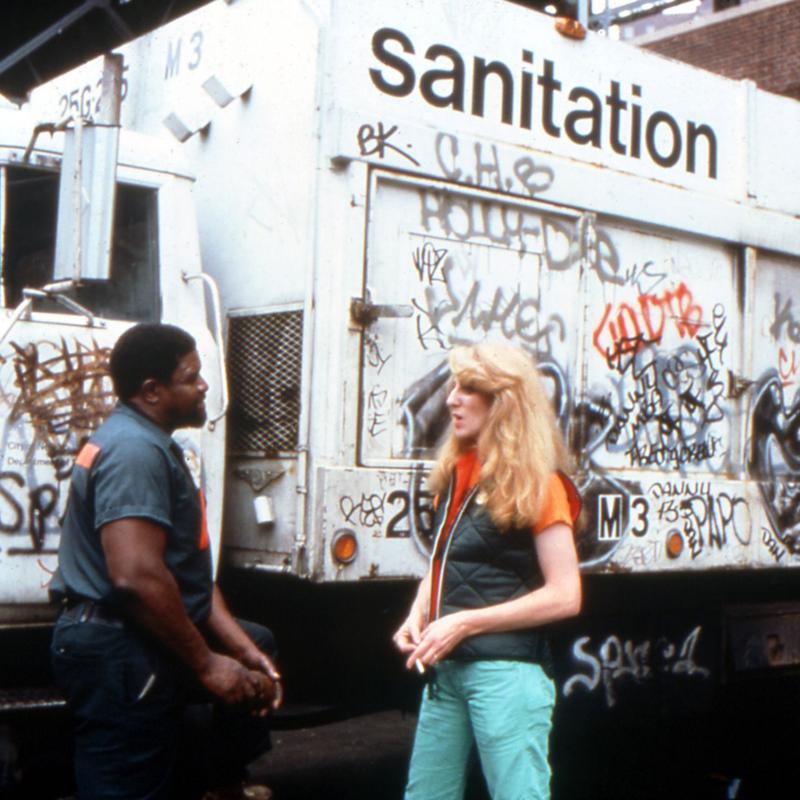
Alison Stewart: This is All Of It on WNYC. I'm Alison Stewart. This hour, we're devoting to art. Mierle Laderman Ukeles is the official unpaid Artist-in-Residence at the New York Department of Sanitation, a position she's held for almost 50 years. In the late '70s, New York's Department of Sanitation was in trouble, much like the city itself. Garbage was piling up on the streets after years of layoffs, a major strike, and neglected infrastructure. The public took out their frustration on the garbage men, as sanitation workers were known then.
The NYC officials couldn't have predicted that a champion turning around public opinion would be an artist. In 1977, Ukeles believed that the maintenance workers were underappreciated by society, much like women were. To her, workers were heroes and artists themselves. She wanted to change how people thought about waste and those who pick it up. She dedicated her practice and really her life to what she called maintenance art.
A new documentary about Mierle is aptly titled Maintenance Artist. It features archival footage of her time with sanitation workers and interviews with her present day to reflect on her work. The film opens at the IFC Center tomorrow. With me now is director Toby Perl Freilich. Welcome to WNYC.
Toby Perl Freilich: Thank you. Great to be here.
Alison Stewart: The film is inspired by Mierle's concept of maintenance art. It was her manifesto that she wrote about in 1969. How would you describe her vision then?
Toby Perl Freilich: I'm glad to use the word "vision" because I think of her as a visionary. What happened was, like many women in the '60s, she had a child. She was married. She suddenly felt as if her body was divided into two. She was the artist here half the time, and she was a mother and a house cleaner there. She had, as she describes it, an epiphany. She sat down and wrote her manifesto basically in one sitting.
Alison Stewart: Wow.
Toby Perl Freilich: In it, what's important to emphasize is it was a three-part manifesto. It began in the home, as she said, like her, and then she understood that all over the city, all over the world, there were people just like her that she called maintenance workers, people like sanitation workers, the people who keep things going. Then there was the earth itself. This was during a time of a burgeoning consciousness in the '60s about the environment.
Tomorrow's Earth Day. I wanted to emphasize that. She understood that all of this fell under the rubric of what she calls care, which is a huge issue in art today. It was really visionary on her part, very prescient, that she understood even back in 1969 that care could be a category of art as well.
Alison Stewart: People might hear art and sanitation workers and think that's an interesting combination. How did Mierle wind up with the idea to pitch herself as the Artist-in-Residence to the Department of Sanitation in '77?
Toby Perl Freilich: I always say, she didn't make art with garbage. She made art with people. She made art with the people, in this case, who took care of the trash. It grew directly out of a show she had at the Downtown Whitney Museum in 1976, where she did a building-wide work with 300 cleaners and maintenance workers. It was actually the American Express building. It was at 55 Water Street. The Whitney was just one floor of that or more, I am not sure.
The show was reviewed by David Bourdon, the Village Voice. This was the time, as you pointed out, of a dramatic fiscal crisis in the city. He said maybe the Department of Sanitation workers should call what they do art and apply for a grant to the National Endowment for the Arts so that they can pay the sanitation workers. She cuts this out, sends it over to the reigning commissioner of sanitation, and says, "How about it?" He calls, actually, and says, "How would you like to make art with 10,000 people?" She said, "I'll be right over."
Alison Stewart: It's interesting. What did the maintenance workers think of her when she would show up?
Toby Perl Freilich: Imagine them folding their arms in front of their chests and rearing back and saying, "Who is this chick? Who is this crazy chick?" Especially the notion of art in the context of the sanitation department. One thing that I love about Mierle's work, and it's important to emphasize, is its durational aspect. She didn't just parachute in and do a project. She spent a year and a half researching what these workers did, what was their skill set, and what was bugging them.
What was making their job so much harder? So that by the time she did her first work for the Department of Sanitation, which was to spend 11 months going around to all 59 sanitation districts and shaking the hands of each of 8,500 workers and saying, "Thank you for keeping New York City alive," she already knew something about them. By the end of that essentially two-year or more process, they understood exactly what she had done for them, and they came to really regard her as a champion.
Alison Stewart: It was interesting. That was the touch sanitation performance.
Toby Perl Freilich: Correct.
Alison Stewart: It was interesting watching the film because towards the end of that, there was one or two gentlemen who weren't quite sure what she was doing, and like, "What do we get out of this?" What do you think the sanitation workers got out of it?
Toby Perl Freilich: First of all, they got dignity, they got respect, but more than that, they got noticed. I think that anyone who does maintenance work, whether in the home or outside the home or wherever, what you want is appreciation. It's not a glamorous job. You want to be noticed, and you want to be thanked. It's very simple. I think that they understood that she was really in there with them, and she was granting them a visibility that they had not had.
Alison Stewart: We're discussing a new documentary about Mierle Laderman Ukeles, the longtime Artist-in-Residence of New York City's Department of Sanitation. It's called Maintenance Artist. The film opens at IFC Center tomorrow. My guest is Toby Perl Freilich. Let's talk about feminism in her work. How does she display feminism in her art?
Toby Perl Freilich: I think of her work as starting as a feminist cri de coeur, a sort of battle cry, saying, "The work that I do and that women all over the world do, it should not be taken for granted," that not only should it not be taken for granted, but that it's essential work. It's not paid, it's boring, but it should be recognized, even if it's not compensated. It started really as a deeply feminist statement.
I like to say that in some ways her work started on the New Left and then moved towards the Old Left. Why? Because by the time she gets to the Department of Sanitation, she's crossed that bridge of gender, and she has said it's not about who's doing the work. It's about the work itself, which is a very Marxist, Old Left notion. She began with a very powerful feminist statement. Now, in the film, we get into the fact that there were a lot of feminists who were very critical of her work.
Alison Stewart: What was their issue?
Toby Perl Freilich: Their issue was that you're not working with women. You're working with 8,500 men. How can you call yourself a feminist? She was saying, "It's not about who's doing it. It's about the work itself." She says she got very needed support from two very well-known women artists of the time, Hannah Wilke and Ana Mendieta, who said, "You go, girl." They said, "What you're doing is essential. It's terrific. Keep at it."
Alison Stewart: I keep thinking when you said essential workers, it just keeps popping in my head during COVID.
Toby Perl Freilich: Yes.
Alison Stewart: The essential workers.
Toby Perl Freilich: Yes.
Alison Stewart: People understand what that means now. They might not have understood six years ago, but they do now.
Toby Perl Freilich: They really do. She was commissioned to do a work during COVID that thanked all the essential workers, which we cover in the film. She said, "The healthcare workers were truly heroic and got the necessary recognition, the recognition they deserve." People were applauding them. She said, "Here were these sanitation workers who are showing up for work every day, picking up garbage," at that time, we didn't know, "that might have had contaminated material." In some sense, they were risking their lives to keep the city going.
Alison Stewart: What was it like to be Mierle in the '70s, given the time, being an experimental artist during the '70s?
Toby Perl Freilich: I think Mierle was part of a cohort of female performance artists who were feeling their way. I think if you really look hard at what they were doing, they didn't have money. A lot of the works that they did, of necessity, in some ways, were performance works, which didn't cost anything. Whatever little money Mierle might have raised to, let's say, do what she was doing, she used to hire photographers and videographers to document what she was doing, as did many of the other artists, like Hannah Wilke, like Ana Mendieta, like Suzanne Lacy.
What Mierle was doing was slightly different, again, because she was calling attention to a type of work. Now, they all supported each other. She once said to me, "I think of the work that Hannah Wilke, let's say, was doing or Ana Mendieta as pain-filled, because it emphasized the violence that was being committed against women, the objectification of women."
She said, "You need to remember that it was also very joyful, that they were going out there and they were doing something new, and they were able to use their bodies to express what they were doing in a very celebratory way." I thought that was very beautiful, that it wasn't-- Mierle was part of that, but again, slightly set apart, because her work was so about the city too. She was a real pioneer in this city and in a lot of different understandings of urban settings.
Alison Stewart: Let's listen to a clip from your documentary, Maintenance Artist. This is to put Mierle's story within the context of the '70s and how New York was changing, especially right here in SoHo, where we're broadcasting from. We'll hear first from Guggenheim curator Nat Trotman, and then Columbia professor Julia Bryan-Wilson. This is from Maintenance Artist.
Nat Trotman: What happened was this particular constellation of different conditions that aligned. The rise of a youth subculture driven by anti-war protests, by civil rights.
Julia Bryan-Wilson: It was an incredibly fertile period for thinking through the intersections of feminism, art, and labor.
Actress: Wait, it's a housing campaign.
Julia Bryan-Wilson: All of these liberation movements really fed a sense that to be an artist was also to take a political stand and to do something that might help the world be free.
Nat Trotman: There were a lot of younger artists who wanted to resist artists like Jackson Pollock, like Andy Warhol, who were beginning to be associated with celebrity and with cultural power, but also with money. How better to resist than to make art that had no object whatsoever?
Alison Stewart: Mierle, she wasn't interested in money, was she?
Toby Perl Freilich: Of course, she was interested in money, but it's not like she went chasing after it. In fairness, she was also married, and she was fortunate in that sense. Her husband was extremely supportive of her work, always. Someone had to put food on the table. She was also applying for grants during that time, and she was working all the time, all the time.
Alison Stewart: You mentioned this in the documentary, that she was a working mother, and sometimes the kids went with her to galleries, and sometimes they were left at home. How difficult was it for her to balance her life in that time?
Toby Perl Freilich: I think it wasn't something she talked about, but I think it was extremely painful and difficult. I can say that because I hadn't intended to interview her children until later on, when a few people who saw rough cut said, "What about her kids? What about her kids?" I said, "God, you'd never ask a male artist, if they were painting children or if their children were in their work, how did the kids feel?" I thought it was very sexist to do that.
Then I was won over, and my brilliant editor, Anne Alvergue, said we got to interview the kids. In the end, I did. I thought when I would suggest it to Mierle that she would be very upset about it. She said, "They're very busy, but if they want to do it, that's okay." I think she said, "They'll probably say I was never there." I think she anticipated-
Alison Stewart: Interesting.
Toby Perl Freilich: -that they wouldn't be as forthcoming as they were, as you see in the film. I don't think she quite expected that. What I was happy about is when her family saw it, the daughter said to me, "This film is a gift to our family," and that was very moving to me.
Alison Stewart: I think it was interesting that you interviewed the children, especially given the time. Maybe now it would be like, "What are you talking about?" Given the early '70s, that was a big deal.
Toby Perl Freilich: Yes, it really was. These kids, I think, it was much harder on them than they actually expressed. I think they're a very close family, and you get a sense that one of the daughters says, "We were latchkey kids." I'm sure at the time it was very, very difficult for all of them, but there was a redemptive moment for them. Whenever she could include them, she did.
There was the cleansing the bad names when they put all the names that sanitation workers were being called. Like 98% of them, I could not repeat on this radio station. She recreated something and had people from society erase or clean off these bad names that they were called, and she brought her kids to that. That's when they understood, "Wow, she's really--" They were already adolescents, and they understood she was doing something very important.
Alison Stewart: We're discussing a new documentary about Mierle Laderman Ukeles, the longtime Artist-in-Residence at New York City's Department of Sanitation. It's called Maintenance Artist. The film opens at IFC Center tomorrow. My guest is its director, Toby Perl Freilich. She is from a Jewish family.
Toby Perl Freilich: Yes.
Alison Stewart: What does her faith mean to her?
Toby Perl Freilich: Her faith is fundamental to her, fundamental. As she says in the film, there aren't very many Orthodox Jewish artists, and certainly not radical Orthodox Jewish artists. I think what drew me to her, particularly, was that her work was value-based in terms of its Judaism and not iconographically. She wasn't involved with Jewish ritual objects. She wasn't painting scenes from the Old Testament. What she was saying is that fundamental to Jewish belief is this notion that we are all equal. We are all created from Adam and Eve and a respect for human life, sense that every person is free, every person deserves dignity. I think that's the root of all her work, including a work that isn't ostensibly Jewish.
Alison Stewart: It's interesting because there's a piece in the documentary about work she does in Japan. It's called a work ballet. Can you describe it for us a little bit?
Toby Perl Freilich: Yes. I'm glad you raised that because Mierle did what she calls Seven Work Ballets with garbage barges, sanitation trucks, and recycling barges and trucks. Anyway, she went to Japan twice, once in 2003, because she went to a region of Japan that saw a tremendous snowfall in the wintertime. She said by the time summer rolled along, no one appreciated the fact that the snow workers are what kept the city going. Then she went back in 2012 to update that performance. That's what we highlight in the film. It's a beautiful, beautiful, delicate choreography of heavy-duty machinery.
Mierle said something in the film that's also very fundamental to her work, which is I wanted to inject art directly into the city's bloodstream of daily living. Now, think about that. It doesn't matter if that was Japan or Givors, France, where she did, or Rotterdam, that there are these people that we depend on and we rely on, without whom we could not have culture. She is saying we need to see them, we need to recognize them, we can find art and artistic value within the work they do. That was very moving to me because she has been a dedicated public artist her entire life.
Alison Stewart: What is she doing today?
Toby Perl Freilich: She works all the time. She's certainly not retired, but at this point, I think one of her most fervent wishes is that she has had a work-- She's been the Percent for Art artist at the Fresh Kills Landfill, which is now a park, since 1989. She has designed a cantilevered overlook over what are formerly wetlands, and she wants to realize that project. She's still trying to get that done.
Alison Stewart: What did you learn about her when you were making this film?
Toby Perl Freilich: The first time I proposed doing a film with her, we had a three-hour coffee, we hit it off. It was the first time we had met. At the end, I said, "I'd like to do this film about you." She said, "No."
Alison Stewart: [laughs] No, thank you.
Toby Perl Freilich: Just no. No thank you.
Alison Stewart: Oh, just no?
Toby Perl Freilich: Just no.
Alison Stewart: Oh, okay.
Toby Perl Freilich: I said, "Okay, how about if I just film you going through your archival stuff in your office to decide what to send to the Smithsonian." She said, "Okay." That was the beginning of an eight-year-long process. What I understood is that she was about two things: collaboration and transparency, and that if I wanted to make this film and keep her interested during the whole process, I'd have to be transparent and I'd have to bring her into the process. That's what I learned.
Alison Stewart: We got a text from someone that says, "Where can I see the film if I don't live in New York City?"
Toby Perl Freilich: It's been playing all over many, many different festivals. It'll be in Seattle, Atlanta. There was a RiverRun screening last night. It's going to be at the Laemmle Theatres in early May. It's going to be at the Getty Museum on May 16th. It'll have some international-- She has a big international following. Then we're hoping that it goes on streaming in July.
Alison Stewart: Knock wood.
Toby Perl Freilich: Knock wood. Exactly.
Alison Stewart: It opens tomorrow at the IFC Center. It's called Maintenance Artist. My guest has been Toby Perl Freilich. Thank you for sharing your film with us.
Toby Perl Freilich: Thank you.
Copyright © 2026 New York Public Radio. All rights reserved. Visit our website terms of use at www.wnyc.org for further information.
New York Public Radio transcripts are created on a rush deadline, often by contractors. This text may not be in its final form and may be updated or revised in the future. Accuracy and availability may vary. The authoritative record of programming is the audio record.