
Luke Thompson Falls in Love in 'Bridgerton' Season Four
Alison Stewart: You're listening to All Of It. I'm Alison Stewart. Remember that snowstorm we had a week ago? The one that caused the cancellation of our February Get Lit with All Of It book club event at the New York Public Library? Well, we didn't want to let this opportunity slip away, so we're going to have that Get Lit event this Thursday, but right here at the WNYC space in SoHo, The Greene Space downstairs.
I'll be in conversation with Angela Flournoy, the author of The Wilderness. The novel follows a group of women through their friendships, through good times and bads in New York City and LA. It's about chosen family, social justice, and navigating the challenging wilderness of young adulthood. That is happening this Thursday, March 5th at 6:00 PM. Tickets are free. They will go fast, so reserve yours now at wnyc.org/events. Again, that's wnyc.org/events, and I'll see you this Thursday.
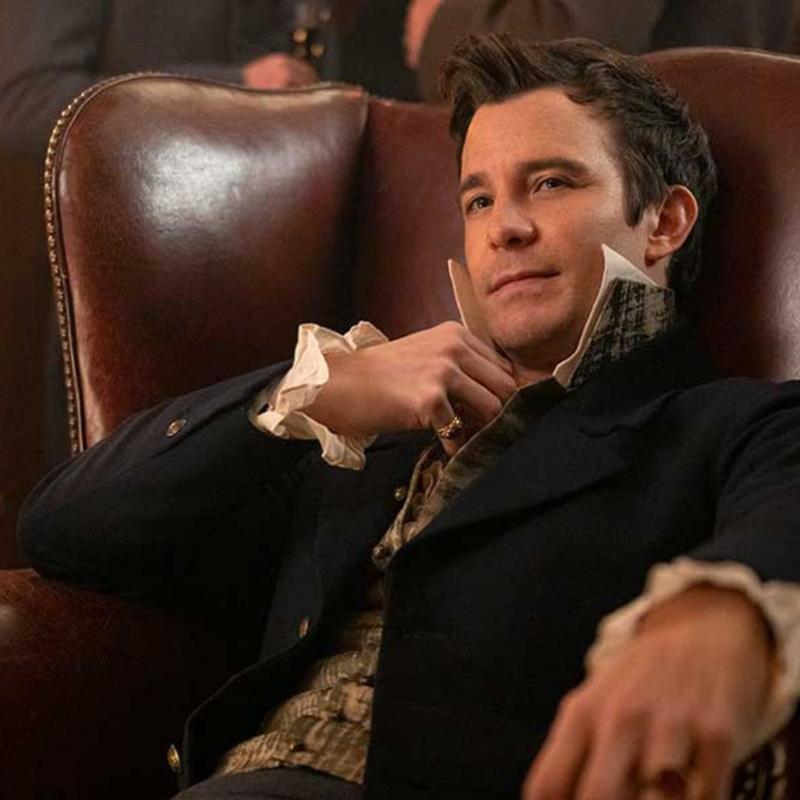
Dearest gentle reader, one of the most beloved noble families has returned. Bridgerton is back. If you're not familiar with the Regency-era drama, each season centers on a different child of the very fancy Bridgerton household. Making their debut at a formal ball in hopes of finding a prospect for marriage. This season focuses on the mischievous and artistic Benedict. It's the second eldest son's reentry into society. I said reentry because he's just not that into it, until he becomes smitten with a mysterious young woman at a masquerade ball.
[Bridgerton clip]
Benedict Bridgerton: You're not like the other young ladies, you know. It is a relief.
Sophie Baek: And what is wrong with the other young ladies?
Benedict Bridgerton: Well, I'm only-- They are--
Sophie Baek: Constantly pursuing you?
Benedict Bridgerton: [chuckles]
Sophie Baek: While I can imagine that is taxing for you, you must remember that those young ladies have spent their entire lives preparing for the pursuit. Hundreds of hours acquiring their accomplishments, endless fittings, not to mention the three hours alone it takes to do up their hair for the five or six hours they will be at this ball; all in the hope that you might simply notice them.
Benedict Bridgerton: Them? Are you not also hoping to be noticed?
[Bridgerton clip ends]
Alison Stewart: In Cinderella-like fashion, a bell rings in midnight, and she's gone. All Benedict has to go on to find her is the memory of what she wore, the shape of her lips, and the gloves she left behind. Then there's something else that Benedict doesn't know. The woman named Sophie, well, she's a maid, and it won't be the last time he sees her. Who knew that cottages were going to become the big thing in romance this year? If you know you know.
The show is a cool mix of a period setting with modern twists, including inclusivities of bodies and race, and this season, having some real talk about queerness and class differences. Actor Luke Thompson, who plays Benedict Bridgerton, is here with me now in studio to discuss Bridgerton Season 4, which is now streaming on Netflix. It is very nice to meet you.
Luke Thompson: It's very nice to meet you, too.
Alison Stewart: You got your start in theater. You went to RADA-
Luke Thompson: That's right, yes.
Alison Stewart: -to the Royal Academy of Dramatic Arts.
Luke Thompson: I did.
Alison Stewart: What were you doing before the Bridgerton script came your way?
Luke Thompson: Oh, a lot of theater, basically. Yes. I did mostly theater for the first, I want to say, good five, six years in my career. I've always been interested, I think, in-- My first job was at the Globe, Shakespeare's Globe. Then I went on from that to do a couple of Shakespeare plays also, the Almeida Theatre, and that was much more a modern-- There was Hamlet, but they were set modern. I feel like I've always been very interested in how you take these really old texts and try and make them sing again, and try and tap into why they've lasted and not try and just do a traditional retelling, just reiterating again, again the same old things until they get very boring.
I do feel, in a strange kind of way, Bridgerton inscribes itself in that, because it is something that takes, as you say, the trappings of Regency and all of that, but is always most keen on talking about just the human soul, and particularly also, just representing the modern world as it is as well. It's this fine balance, I think, of being a little bit modern as well as traditional, if that makes sense.
Alison Stewart: Yes. It started in December of 2020, and since the show follows all of his older siblings, we've gotten to know Benedict.
Luke Thompson: That's right.
Alison Stewart: You've gotten to know Benedict. What was Benedict like when we first met him back in 2020, and then how has he evolved into Season 4?
Luke Thompson: Well, he's been-- [chuckles] He hasn't evolved in that so far-- Well, obviously, in Season 4, he does, but he's someone who's very- he's got a very good customer-facing front.
[laughter]
Alison Stewart: "Hi, how are you? What can I help you with?"
Luke Thompson: I think he's a very amenable and open and sensitive person, first and foremost. I think we've seen him in the last few seasons almost a little bit on the periphery of his own life. He's always going off, doing escapades, meeting people, and he hasn't really found his place, I think. I guess what's interesting, I always find, with this character is that he's someone who-- It's interesting to make him the romantic hero. He goes on the opposite journey that a lot of romantic heroes go, particularly Regency romantic heroes.
A lot of it is about these very rigid and stern men being softened by women. That's often the trajectory. With Benedict, he's not. He's very soft, often too soft. Actually, a lot of this season is about seeing that that's all a little bit of a cover, maybe, and that he's maybe terrified of really giving everything to someone, which is, let's face it, what falling in love is. It's really opening yourself up to someone and letting go a little bit.
I think what's fun is that, as I say, he's-- It was really fun as an actor to play with the fact that he's got this shiny front that we've explored for the last three seasons, and now we get to make him essentially fall apart for Season 4.
Alison Stewart: It's interesting. I think in Season 4, he has kind of ennui about the whole thing. He's like, "Oh, this again."
Luke Thompson: Exactly.
Alison Stewart: "I got to do this again. I'll just show up. Maybe I'll show up late. I'm not sure if I'm even going to show up."
Luke Thompson: Exactly. It's exactly that, yes. That's where he starts. There's a little bit of Romeo and Juliet in there, isn't there? The idea of Romeo doesn't want to go to the party, and then that's where he meets Juliet. It is. Yes, I think there's an element of that.
Alison Stewart: Listeners, do you have a question for Luke Thompson? He plays Benedict Bridgerton on the show Bridgerton. It's now streaming on Netflix. When he meets this woman at this ball, he becomes fascinated with her and quickly. Why is he so fascinated with her, and why does it happen so quickly?
Luke Thompson: I think there's a lovely symbolism in the fact that they are two characters that are quite guarded, but they meet masked. It's quite Shakespearean, actually, this idea that a boundary, like a mask, is actually something that can make someone feel much freer to be themselves. It's like when you meet a stranger; sometimes you talk to them in a much more open way than you'd ever talk to someone that you really know. There's that element.
Also, I think Benedict is used to being in the world of the Ton and seeing the world of the Ton as a world of networking, where everyone's just slightly looking over their shoulder to see if there's someone more interesting to talk to at these parties. It's a detail from the book. I think [crosstalk]--
Alison Stewart: That's LA.
[laughter]
Luke Thompson: There you go. You said it, not me. Actually, I think what's lovely, and it's a detail from the book, is that in the book, he sees Sophie looking at this chandelier. Obviously, because she's never been to one of these before, she's just completely transported and beaming at the idea of even being there, and I think he picks up on that because I think there's part of him that's actually-- there is a big part-- He's a fantasist, Benedict.
He loves wonder, and he loves the- I don't know, being in big stories, so I feel like he sees that. The thing that's interesting is that's not necessarily the biggest part of the Sophie character. Sophie is actually- she has this small part of herself that likes to dream, and Benedict is a dreamer, really. I guess he spots something like that at the ball, yes.
Alison Stewart: Meanwhile, while he's searching for this woman without a glove, he becomes interested in Sophie the maid. They have a will we, won't we, we can't, we must [unintelligible 00:08:35] affair. She's played by Yerin Ha. What did she bring? What unique skill did she bring to her character?
Luke Thompson: So many. I think she's an extraordinary actress, and I'm really glad that she's getting her flowers and her moment right now because it's such a particular role. I think it demands quite a lot of-- I think what she has is this real-- and it's weird because it sounds like maybe it's not a word that always has positive connotations today, but she's serious, I think, as a character, and I think she doesn't mess about.
She lives in the real world, Sophie, I think, and she's very loath to let herself dream and let herself go, essentially, but she does have this spark. She is sparky, and she does have that sense of humor. It's just that she's also very, yes, serious. I think it's a very particular concoction of qualities. Yes, I just think-- We did the audition on Zoom. The chemistry read on Zoom.
Alison Stewart: On Zoom?
Luke Thompson: Yes, turns out you can.
Alison Stewart: You can get that to go on Zoom.
Luke Thompson: Well, it's funny. I think [crosstalk]--
Alison Stewart: Oh, that's interesting.
Luke Thompson: Well, it's just-- Look, auditions are so artificial anyway. The setup of, "Okay, stand here and let's see if this works," is so strange anyway, that often there are loads-- The fact that it's a Zoom call is just yet another obstacle. When you can feel like you can actually talk to each other despite the obstacles, that's when you know that there's something. I also think we've all gotten a little more versed in Zoom since the pandemic, do you know what I mean? I think actually we're more able to come across on Zoom, I think, than maybe we used to.
Alison Stewart: For a little while, though, it felt like Zoom was a barrier, but I guess we got past it.
Luke Thompson: We got past that, yes, maybe a little bit. I think we're just more used-- and it's also because we film ourselves all the time. I just think we're more used to that whole thing. It was a wonderful audition. I, obviously, don't have a say. I'm not a casting director, but you just know when it's-- When you've found the person you're looking for, you just know, I think, and yes, you could feel it in the room, I think.
Alison Stewart: We've got a question for you. Listener says, "What are you doing in New York City? Are you going to do a play here?"
Luke Thompson: I'd love, absolutely love to do a play in New York. That would be the dream. I haven't managed to yet. There are always possibilities, and then it never quite worked out, but I'd absolutely love to. I'm [crosstalk]--
Alison Stewart: Have you seen anything?
Luke Thompson: You know what? This time around, I haven't. When was Merrily We Roll Along? I've lost complete track of time. Merrily We Roll Along was about a year ago when I last went to the show. That's the last time, I think, I went to Broadway. There's so little time on these press tours, annoyingly, but yes, Merrily Roll Along blew me away. I thought it was wonderful.
Alison Stewart: We're talking to Luke Thompson. He's here with me to discuss Benedict Bridgerton's character on Bridgerton. It's now streaming on Netflix. If you'd like to ask him a question, the phone lines are open. 212-433-9692, 212-433-WNYC.
The showrunner of Bridgerton said that a lot of this season focuses on the idea of intimacy and pleasure. What have she and the rest of the crew done to create an atmosphere that allows you as an actor to be comfortable on set?
Luke Thompson: You mean in terms of intimacy scenes, specifically?
Alison Stewart: Yes.
Luke Thompson: I think Bridgerton has been a bit of a trailblazer when it comes to this, I think. Look, I think the thing-- It's, for me, stranger what used to happen before than what happens now. As in I just feel like by having an intimacy coordinator on set, which is a new thing that they now do, which, essentially, it's similar to having a fight director, but for a sex scene.
Alison Stewart: She's a choreographer.
Luke Thompson: Yes, she's a choreographer. I think what that does is it's about taking those scenes seriously and treating them in a grown-up way. Because you'd never say to two actors, "Okay, there's a fight scene, so just have at it." Yet, sex scenes have been a bit more loose and a little more gray area.
Also, the problem is, I think a lot of that is about ego. Because actually, actors need to be told often that what feels good doesn't necessarily look good, and so actually you need an outside eye. Sometimes the director is not necessarily-- the director has got other things to think about. I think to really zero in on the story beats of an intimacy scene is really great. Look, obviously those scenes are all about trust.
I was lucky because I'd been working with Yerin for a while, and so we developed a bit of a shorthand and that helps, obviously, with the intimacy coordinator, but sometimes sex scenes, you come in and you're doing them with a day player who's literally just there on that one day or two days on set. You need that third person to liaise because otherwise, they could feel a little bit like they have to agree to stuff that they don't necessarily want to do.
Broadly, I just think I understand-- Actually, honestly, I don't understand this whole idea of, "Oh, they wreck some sort of spontaneity." Because actually, the whole idea of acting is you're given a structure to be spontaneous in. It's not just like, "Oh, I'll just do whatever." Yes, I just think it's part and parcel of an effort, I think, to take those scenes seriously. I think it's very important, particularly with a show like Bridgerton, where sex and intimacy are incredibly important, a huge part of the show that needs to be, yes, just taken seriously.
Alison Stewart: Want to take a call?
Luke Thompson: Yes, why not?
Alison Stewart: Let's talk to Cecilia in Highland Park. Hi, Cecilia. Thank you so much for making the time to call All Of It.
Cecilia: Hello, Alison. Hello, Luke Thompson-
Luke Thompson: Hello, Cecilia.
Cecilia: -or Benedict, if I may.
Luke Thompson: [chuckles] Yes, you may.
Cecilia: I have been indulging myself in Bridgerton. My partner, now my husband, as of last October, says, "Have you been Bridgertoning again?" The screener-- Let me just preface this by saying I had total knee replacement last Wednesday, and I'm recovering from it. The first day was great, then the block wore off and I'm crazy, but-- I've been telling everybody I'm drowning my sorrows in Bridgerton. I've been having one Bridgerton episode, and I've worked myself up to where I was at Episode 4. Now I'm on-- Sorry, Season 4. Now I'm on Episode 5.
Have you had anybody-- This is my question, the screener made me ask you. Have you had anybody else tell you that they use the Bridgerton scenes in their intimate life?
[laughter]
Alison Stewart: Oh? Oh, wow. Did not see that coming. I did not see that coming.
Luke Thompson: I wish people would tell me more. They haven't. I haven't had any interactions like that, sadly. Yes, it's funny. I wonder whether people would-- I'm trying to think of a time when that maybe-- Yes, I think I remember-- You know what? The main thing I remember, actually, it's not necessarily the intimate scenes, but I remember people often-- I remember someone coming to me during the pandemic. She was a care worker during the pandemic and saying she watched- Bridgerton carried her through in a way. Because I think it's such a positive show, and it's got so much- it does sort of whisk you away.
As I say, it's just really nice, Cecilia, to hear that that's what it does, because I think that's what this show is for, I think, is just to bring a little bit of sunshine, a little bit of escape to your life. I don't know about intimate scenes, sadly, but I can let you know.
Alison Stewart: One thing, I think, the show does- several things it does, besides being a romantic period piece, is it brings up subtler issues in a really smart way. One way I thought this season was Benedict's queerness. It comes up in a discussion with Sophie as they get to know one another. Let's play this clip. Because Benedict has been with men, he's been with women, and he is clearly not ashamed of it. Let's listen.
[Bridgerton clip]
Benedict Bridgerton: Society's rules make little men out of all of us, or little women, as it were. Society should not be allowed to dictate the rules of how one lives life or who one loves. Well, I am capable of caring for you just as I have cared for women I've known who are of the Ton, just as I have cared for some men whom I've known intimately, and I refuse to be at all ashamed about that.
[Bridgerton clip ends]
Alison Stewart: What did you think when you read that?
Luke Thompson: Yes, I think it's a really lovely scene because I think, again, it feels very true to Benedict in the sense that it's quite an atypical "coming out" scene. I think the thing that's so lovely about Benedict as a character, particularly as a male character, actually, is that he really doesn't seem-- and throughout the last few seasons as well. He's not someone who is stressed about sex. As a man, he's not someone who--
I think male sexuality can sometimes feel quite boxy. It's like either you're this or you're this. Part of those stories, often, is about someone working out who they are and fighting repression. Obviously, there's huge value in those stories and those stories exist. I think what's lovely and distinctive about Benedict is that it doesn't seem to have, for him, a huge bearing on his sense of identity.
Actually, what I love about this scene specifically is that although, as I say, he is coming out to Sophie up to a point, I really believe him when he says, I don't think there's anything to be ashamed about. I think he does it as a gesture to Sophie in an attempt to be open and honest with her rather than to get something off his chest, maybe. I just find that quite refreshing, particularly for a male character. I think that's a really nice-- yes, it's a nice distinctive touch, I think.
Alison Stewart: Let's talk to Sana, who's calling in from Brooklyn. Hi, Sana. Thanks for taking the time to call All Of It. You're on the air with Luke Thompson.
Sana: Hi, Alison. My name is Sana, like the sun. Luke, I'm a huge fan of your acting, so it's really great to be able to ask you a question.
Luke Thompson: Hi.
Sana: I was also wondering about the last three seasons, Benedict has been this artsy, bisexual. He seems a little lost and maybe not quite fulfilled, but he's just doing his thing. Then we see him in this season kind of latch onto this one woman, and it feels a little out of character, and you just get swept up in the Bridgerton universe. It wasn't like a gap in the storyline that really bothered me too much, but I am curious what you have to say about that and maybe any insights you have on that Benedict transformation.
Luke Thompson: No, that's really interesting. It's interesting, the out of character thing, because I think the most interesting moments in life are the moments when we act out of character. I think those are always the most exciting moments. Obviously, we put a lot of value on self-knowledge nowadays, but often I think you can be surprised by yourself.
I think if you're referring to in terms of the last few seasons, I truly do believe that Benedict could have ended up with a man or a woman, I think. I also think that what's refreshing is that sex, for him anyway, is explored as a force that actually seems to be- that he's exploring. Actually, because it's something that he's not worried about and he feels very comfortable in, it protects him from falling in love in a weird kind of way.
Actually, I think, yes, it's that saying, love is where it falls, and I think it just so happens that it's Sophie. I think the journey that he goes on with Sophie is really, really interesting. As I say, I think it's really refreshing to have a story where a character does have experiences with men and women, but it doesn't become a defining element of that particular story. It's part of his character and that's it.
Alison Stewart: I'm speaking with actor Luke Thompson. He's here with me now in studio to discuss Benedict Bridgerton's character on Bridgerton. It's now streaming on Netflix. Another issue which really touched me is class, how class dictates who we should marry, who we should be with, and it leads to your now infamous line of, "Won't you be my mistress?" To Sophie.
Luke Thompson: Fantastic accent, by the way. I feel like you're whipping it out a couple of times.
Alison Stewart: Thank you very much.
Luke Thompson: It's really Impressive, yes.
Alison Stewart: Why did he think that was the right thing to say?
Luke Thompson: [chuckles] I don't know if it was the right thing to say.
Alison Stewart: But he thought it was.
Luke Thompson: Yes, it came out-- Look, I think what's lovely about it is that it's a controversial moment, and I know that it upset a lot of people, and I think that's good.
Alison Stewart: It was great.
Luke Thompson: Yes, I think it's a good thing because, again-- It ties into what we were just talking about. I think Benedict, so far we've experienced him as quite a sensitive and tuned in and open character. To have him in that moment, when he's faced with someone that he really likes, do something which could seem completely out of character, but I think actually is betraying the fact that he is scared of giving someone everything. I think it is maybe quite a male thing, like trying to compartmentalize his life and be like, "Right, well, okay, maybe you can be my mistress, and then we can separate all this out."
Obviously, that's not falling in love. Falling in love is joining all the dots, I think. He's a character who- he lost his dad and had to watch his mom mourn his dad. You can see why he's probably not had a shining example, a very happy example of what it means to love someone, because you bet everything on someone and then you lose everything.
I think it's one of those lovely, controversial moments. Again, I welcome any kind of reaction to it. I think anyone's entitled to think whatever they like about it, to be honest. I'm more interested in other people's responses than in mine, to be honest, but, yes, it's a wonderful moment, I think.
Alison Stewart: Let's talk to Suzanne, who's calling in from Philadelphia. Hi, Suzanne. Thanks for calling All Of It. You're on the air with Luke Thompson.
Suzanne: Hi, Alison. Hi, Luke.
Luke Thompson: Hi.
Suzanne: First of all, just love your show. Love both shows. The question that I would have for Benedict, or Luke, as you play him. I looked at you this season as you finding a mirror of yourself; the person of you that you were so afraid to become vulnerable enough to be out there. Did you see that happen or did it hit you like a ton of bricks? It seems like it did when you saw her from across the room. I do think that she was all that you wanted to be, and you were kind of overwhelmed by the fact that she was a maid and that that kind of [unintelligible 00:24:01]. Could you speak to that?
Luke Thompson: Yes, I think it's a wonderful analogy. Thank you. That's absolutely right. I think meeting someone and finding someone like that is like coming face to face with a mirror, both in the sense that you see yourself reflected, as in they make you see you in a totally different way. The most interesting thing about love, I think, is that it is absolutely-- You're right. It's finding someone who sees you and accepts you.
The most interesting thing about love, I think, is that actually also it's finding someone who, through who they are, stretch you out of yourself. I think that's always the most interesting thing. Maybe I say that because I'm an actor, and I'm interested in the idea of stretching out of yourself and who you can become rather than just settling with who you are and being in your own patterns. I do think that's right.
I often think of Sophie and Benedict as a bit of a yin and yang situation. I think Sophie, her major color is being more of a realist, and then she has this little spark of fantasy about her. Benedict is this fantasist, and he does have this small part of him as well that does want to be more serious and knows that that is what life is about, ultimately. They bring out that aspect in each other.
Actually, I think the mirror analogy is even better, so yes, I'm going to ditch the yin-yang. It's a shame. It's the end of the press tour, otherwise I'd have run with that, but yes, it's a beautiful analogy.
Alison Stewart: All right. Because of this thing. This is my phone. The algorithm knows that I have been researching you and has sent up [crosstalk]--
Luke Thompson: Oh, no. Yes, so now that's it.
Alison Stewart: All over the place.
Luke Thompson: Yes.
Alison Stewart: I've learned so much about you. I learned that you're part Indian. I learned that you grew up in France.
Luke Thompson: Correct, yes.
Alison Stewart: You speak French fluently.
Luke Thompson: I do speak French, yes.
Alison Stewart: I did not know you play the piano.
Luke Thompson: I do play the piano, yes.
Alison Stewart: How did you start playing the piano? You play beautifully.
Luke Thompson: Thank you. Yes, no, I started playing it quite young. At one point, I maybe even wanted to be a pianist, I think, growing up. I really love classical music. I think there's something about this. It's so epic and generous, and I was quite an epic child in the sense of-- In my head. It was all very big in my head, I guess. That kind of music always fit me, I guess.
Also, I think I've held onto it because being an actor, particularly before Bridgerton, I think, you can spend days and days and days waiting for the phone to ring, and you can feel totally out of control in terms of your life. You're waiting for people to give you permission to do your job, and that can be horrendous. Actually, to have something that I could sit at the piano in my flat and just play for one, two, three hours, and just do something that's for me and that's just creative, I guess, and just for me, yes, it's been a real godsend. Yes, it's been nice also to slowly start including it in work as well now.
Alison Stewart: Bridgerton is in its Season 4. It's streaming now on Netflix. We've been talking to actor Luke Thompson. Thank you for being with us.
Luke Thompson: Thanks so much. It's really nice to chat, yes.