
Love, Brooklyn' Nominated 5 Times At NAACP Image Awards
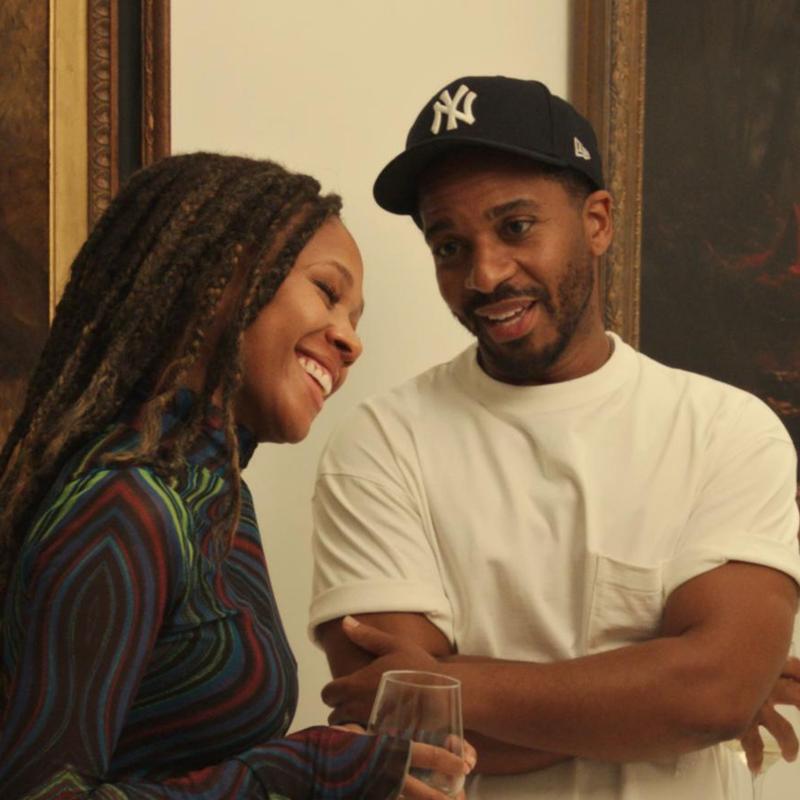
Alison Stewart: This is All Of It on WNYC. I'm Alison Stewart. We're closing out the show today with an NAACP Image Award nominated film that hits close to home. Love, Brooklyn uses brownstone Brooklyn as a backdrop to investigate a changing city and changing relationships. Each of the three main characters has at least one thing making them look back or keeping them from moving forward. Roger, played by André Holland, is trying to write about gentrification, but he can't get past the first page and uses drinking, smoking and flirting as a way to mask his writer's block. Roger also finds himself torn between two friends/romantic interests. First, there's Roger's ex girlfriend Casey, played by my next guest, Nicole Beharie. Casey is an artist and gallery owner. She inherited the space from her grandmother, but she's having trouble selling pieces in a changing Brooklyn. Meanwhile, Roger's current muse Nicole, played by DeWanda Wise, is the widowed mother of a young girl and she's still trying emotionally to stay afloat.
Love, Brooklyn is nominated for best Independent Motion Picture at the NAACP Image Awards. The film was directed by Rachael Holder. In her feature debut. She's nominated for Outstanding Breakthrough Creative in Motion Picture. I started by asking Nicole how she would describe her character, Casey.
Nicole Beharie: Casey was a gift to me because I've oftentimes been in dramas or in stories that are a little bit-- not that this isn't serious, but just deals with heavier fare and she's a light hearted, go-with-the-flow advocate for artists much like yourself, Alison Stewart. I don't know about the light hearted part, but the advocating for the arts, which is something that I love that you guys do here. She just wants to see her artists that she represents paid and well taken care of and as the community's changing, trying to figure out what that looks like and is surprised that she's not able to support herself. She has this relationship with Roger that is-- Is it on again, off again, or is it just complicated? I don't want to give too much away.
Alison Stewart: Rachael, there's not a love triangle, but they're all bouncing off each other. These three people are experiencing life and they're experiencing it with each other. How would you describe the relationship between Casey and Roger and Casey and Nicole?
Nicole Beharie: The way that I saw it when I read the pages for the first time was this movie felt like two women deciding whether or not they wanted to be with a man. What was funny to me and light hearted was that they were deciding in front of him and that this wasn't conversations that they were having with their friends or their therapists or their mothers. They were talking directly to him and giving, and not to be cheeky. They were just being really honest. It was obvious that they had done the work needing to do some more-- One of them needed to do a little bit more. I feel like it was just a really cool way into a romance where the women had the power.
Alison Stewart: Nicole, Casey and Nicole, they know about each other a little bit?
Nicole Beharie: Yes, I have to say too, I am Nicole Beharie.
Alison Stewart: Sorry.
Nicole Beharie: Nicole is played by the wonderful Dewanda Wise-
Alison Stewart: It gets hard.
Nicole Beharie: -character.
Alison Stewart: You're right.
Nicole Beharie: She's incredible in this. I'm going to throw that in there.
Alison Stewart: Thank you. I appreciate that. It's been messing me up a little bit.
Nicole Beharie: It can be confusing. People are like, "With Nicole--" and then I'm [unintelligible 00:04:07]
Alison Stewart: The two women in this film, they are similar in some ways, but they're also at different stages in their life. Nicole, how do the women move through the world differently?
Nicole Beharie: Oh, that's interesting. I don't know. I can speak to it a little bit. I think Rachael created what that fully is. The interesting thing about Nicole, the character, is that she's a mother, and that they have very strict boundaries. Whereas the relationship with Casey and Roger, the boundaries are nebulous and a little mushy. It's like they don't know what it is, but it seems like Nicole is being very definitive about what it is and what her expectations are. She seems to understand more how the world is changing and have made more peace with things moving forward in a way, but she's also mourning.
It's hard for me to talk about-- This is me from the outside because that's not my character, but looking in, she feels like a more grounded choice for him than Casey because Casey's probably seeing other people as well and not certain as to whether or not she's staying put. What's going to happen with the gallery is a big deal for them. Paying the rent, just making ends meet is a big deal. I don't know if she has the space in her mind, to maintain a relationship in the same way.
Alison Stewart: Rachael, what do you think about the way that the two women move through the world differently?
Rachael Holder: Nicole played by the wonderful Dewanda Wise, I feel like her character was less of a moving target physically, but emotionally was. I felt like Casey, because they had all that background, they had a historical background, their chemistry was born years before the movie starts, she was always comfortable physically close to Roger and then could also comfortably be at a distance and then still in his head.
While Dewanda's character, Nicole, would-- while she was physically comfortable with him as well, she was emotionally and mentally at a distance from him and was purposefully making sure that her heart and mind would be that way. Whereas with Casey, she was just like, "Let's see how I feel this morning when I wake up, where my heart and mind will be." That was the difference between the two.
Alison Stewart: Let's listen to the way they talk about the relationship. This is a clip from Love, Brooklyn. It's Roger and Casey, and they're talking about Roger's dating life. Let's listen.
Casey: You seeing somebody, right?
Roger: Who business is that but mine?
Casey: Tell me. Tell me about her.
Roger: What do you want to know? Her name? Her name is Nicole.
Casey: Nicole?
Roger: Yes. You do not know her.
Casey: How do you figure I don't know her?
Roger: I know.
Casey: It's Brooklyn. There's a lot of people I know.
Roger: I know who you know, and you don't know her, but she cool. She's cool. She's an open person, honest, super honest, radically honest about what she wants and needs to a fault sometimes, but I guess she has to be. She's got a little girl. Her husband died in an accident.
Casey: Jesus.
Roger: I don't know what's going to happen, but for now we're seeing each other and it's good.
Alison Stewart: Nicole, the actor, what was interesting to you about the way that they talked and about how it evolved in that 60 seconds?
Nicole Beharie: I don't know. What is interesting? It's just familiar. It goes from playful to, I think, some things are revealed about Nicole or who he's partnering with that makes it unusual for what she's expected of him, that he's engaging with someone that comes with as much stuff and that that's a little bit more serious than she's accustomed to. It changes the tone in that sense.
It's been a while. We shoot these things a year ago or whatever. I just love how they banter and how they know each other. He knows where she's going and what she wants to hear and she can tell when he's withholding. Those type of relationships, those long standing friendships are just golden in this day and age when there's so little connection. I can see why they want to hold on to each other, even if it's a little toxic.
Alison Stewart: It's interesting watching that clip because I looked at your boots and they're Prada boots. You're on the grass. I was like, "Ooh, she's got a gallery but she can afford Prada boots. Does that say something about her? I don't know."
Rachael Holder: They're vintage.
Nicole Beharie: Consignment. You got to figure it out. [unintelligible 00:09:55] the city.
Rachael Holder: Thrift store.
Alison Stewart: It is true. I'm speaking with actor Nicole Beharie and director Rachael Holder about the film Love, Brooklyn. Rachael, a review of the film in Essence described it as a coming of age story about adults confronting the reality of making tough decisions through unexpected change. That phrase, "coming of age story about adults," does that ring true for you?
Rachael Holder: Yes. I feel like adults, we're always coming of age, we're always growing hopefully. Hopefully we don't stop doing the work until it's over. Can I just circle back to the grass scene for a second?
Alison Stewart: Sure.
Rachael Holder: I want to shout out our cinematographer, Martim, for that moment because we can't see it, I'm just hearing it for the first time and it's making me focus on the picture more than I think I normally do when I watch it ironically. That shot that day, we had lost a location that was supposed to be in a restaurant and we decided to, that day, shoot it on the grass.
Martim is just a stunning, amazing cinematographer. The way that he worked with light is just-- the beauty that he brought to this was so defining. I just wanted to shout that out, how beautiful that moment was visually.
Alison Stewart: What was that like for you, Nicole, to have to switch gears like that? You're not going to be in a restaurant, now you're going to be-
Nicole Beharie: It was a crazy day because then after that it ended up raining, so the scene is actually shorter than the-- There was a lot more scene, but we ran out of light. I wasn't going to say this, but now that she's revealed, hence the Prada boots, because the outfit was for a different locale for a [inaudible 00:11:51] We weren't supposed to be wearing that in the grass. I wasn't going to say that, but now that that's been revealed, that makes more sense, right?
Rachael Holder: Yes.
Alison Stewart: It's all becoming clear.
Nicole Beharie: It's all becoming clear, but this is movie magic, right?
Rachael Holder: Yes. Independent movie magic.
Nicole Beharie: It was beautiful. André is the most flexible, capable, generous actor, so we got to just be. In a way, being outdoors and everything other than the constraints of like, "We're losing light and time. Are they going to get the full story?" I'm always very concerned with that as an actor, it tells the story, even though there are bits missing and there are little contextual things that change like, you noticing the clothing is a bit off. You wonder about stuff like that. It happens. It was a gift and it was lovely to be outside in the grass. I don't remember the last time I just laid in the grass and looked up at the sky like that on a set.
Alison Stewart: Rachael, you filmed in Brooklyn. People are recognized as your characters are walking down the street. What makes this a uniquely Brooklyn story?
Rachael Holder: Someone else was talking about how we didn't go to all the cliche, iconic spots of Brooklyn. We were finding the spaces that were beautiful to us. Because I have grown up living in Brooklyn, being in Brooklyn my entire life, there were unexpected places- I guess unexpected to other people, spaces that were really beautiful and defined Brooklyn for me.
I think the parks are really defining. Brooklyn has the most beautiful parks. One of the north stars with this movie was to create an energy in the pace and sound and look that would leave an audience feeling like they'd spent time in nature. I think that Brooklyn is a wonderful place to, as Nicole, the actor, just said, lay in the grass and look up at the trees.
Alison Stewart: Nicole, your character has inherited this space from their grandmother. She has a certain feeling about it. Was it a dream come true for her to have this gallery, or does she have to make this gallery work, or maybe both?
Nicole Beharie: I love how you phrase that. I think it is both. I think it's a dream come true until it's not, until you change the thesis that we were talking about, that coming of age as adults, how we continue to change, how the environs continue to change, and how we react to that. It is something that she very much wants to make work. We talk about gentrification, but also there's just legacy in these communities and these old buildings, all the restaurants and the cafes, going into places and people know your name or even your family name, that unity from having decades of being anchored there. I think it's more about that even than the selling of art. It ends up being about something more than skin deep.
Alison Stewart: Rachael, I have to ask you, I watched it two or three times. That was Lisa Lucas. You have Lisa Lucas in this film. Is that right?
Rachael Holder: Oh, yes. [unintelligible 00:15:34]
Alison Stewart: For book nerds, we all know Lisa Lucas as a publisher, as this great person. How did you get her in your film?
Rachael Holder: André. How do we get anybody in our film? Who's André? That was solely him. It was an idea that he had. I don't want to give too much away about what she does, but it was André.
Alison Stewart: She's playing her part. Art is a big part of this film. Rachael, did you have an art director? Did you pick the art yourself? How did that come up on the screen, the various art-
Rachael Holder: We had an amazing production designer, Lily, who scoured the Internet with a reference point from my art decks for the film and found known artists and then aspiring artists to work with. It was important to us to center artists of color. She was wonderful in finding the art and also just making the art of our locations, like every room. Even when we had to pivot and start over on the day, she was able to make-- come alive and feel lived in in a way that that would normally be done in a full build-out.
Alison Stewart: There's this reference in the story of Lot's wife from the Bible, and she's turned to a pillar of salt by looking back at the destruction of Sodom. It's a piece by Henry Tanner, and it's about this lesson of, "Do you look back? Do you not look back?" Nicole, there's a moment in the cab, do you look back to see if he's there? Do you not look back? Why was this an important part of Casey's growing up in this film, this idea of, "Do you look back?"
Nicole Beharie: You know what's crazy? I can be honest about this, there's always something in a piece of that you work on that stays with you that was for you. For me, that was the thing that was for me was like, "Wow," this story about becoming a pillar of salt when you're saved from a thing or when something is changing. I just love that she didn't and then at the last second she can't help herself or is trying to hold on to the thing. We all can understand that.
For me, I love that bit of allegory and the way that the painting looks. Apparently, there are a few paintings of the same biblical reference, but that concept. Even as we're navigating the world that Nicole, the actress, is in, the way that Hollywood is shifting the political landscape, everything that's happening, it's like, "Do you continue to try to hold on to what was or see things the way that you saw them, even if it was just a year or six months ago?" I love that. Again, another beautiful gift in this piece. Sorry, I'm getting all touchy feely, but that is how I feel about it.
Rachael Holder: No, that was great.
Alison Stewart: It's what public radio is for. Get all as touchy feely as you like. Two final questions. Rachael, it's your feature directorial debut. What do you know now that you didn't know at the beginning?
Rachael Holder: What do I know now? Oh, my gosh, so much. What's interesting to say aloud is what my mind is trying to find right now. The way that I describe television directing versus feature directing is, playing scales on a piano is television directing, and feature directing feels like a song, something that I have to do in television directing because you're basically carrying out someone else's art and keeping the boat afloat.
Feature directing, you are-- it's more yours, but it's also a plane that's being built while flying. I guess, one of the biggest lessons is the constant rewriting and how it can be thrilling. I guess the biggest lesson is to not be afraid of the rewriting that happens at every stage. Writing is rewriting. Especially in filmmaking, especially in creating a song, you're always starting over a bit to make it better, to make it more understandable, to make it what it should be. I think that's one of my biggest takeaways.
Alison Stewart: Nicole, you were great in Ms. Juneteenth. We're going to see you on The Morning Show soon. What does a part need for you to say yes?
Nicole Beharie: Oh, man. I guess it has to be something that I feel like is global or relatable on just a human level, even if it's very specific to someone like myself to play it, and then the people. It's always the people. I always come in loving the people and wanting to do the best possible job. It's usually from that hard space, either from admiration. In this case, it was like, I knew Dre really well. Rachael and I had had some great conversations about what this would be, so I was like, "Yes, I'm in, let's do it," and did everything we could to make it happen.
Those are the things for me, and then a good script. That goes without saying. something that I feel like is asking a question, and this one is very clear. I guess that's the idea.
Alison Stewart: That was my conversation about Love, Brooklyn with actors Nicole Beharie and director Rachael Holder. The film has been nominated for five NAACP Image Awards, including Outstanding Independent Motion Picture.
By the way, I interviewed André Holland when he was in studio with Tarell Alvin McCraney for the revival of the play The Brother Size, which ran at The Shed in 2025. I got to briefly ask André about Love, Brooklyn, what was hard about working on the film, and why the heck his character never rides in the darn bike lanes.
André Holland: Oh, man. Producing. It wore me out, but I'm so proud of the movie and so proud of what we made and ready to do it again strangely.
Male Interviewee 2: Nice.
Alison Stewart: Except the bikes, man. You were not in the bike lanes.
André Holland: Everybody says that-
Alison Stewart: You were not in the bike lanes.
André Holland: Okay, to be fair, Alison, there aren't that many bike lanes in Brooks, so maybe we need to start a petition for those bike lanes. You know what I mean?
Male Interviewee 2: There you go. Urban development right there.
André Holland: Yes.
Alison Stewart: That is All Of It for our NAACP Image Award nominee show today. The award show will air live on BET and CBS this Saturday at 8:00 PM. I'm Alison Stewart. I appreciate you listening, and I appreciate you. I'll meet you back here next time.