
'Liberation' On Broadway
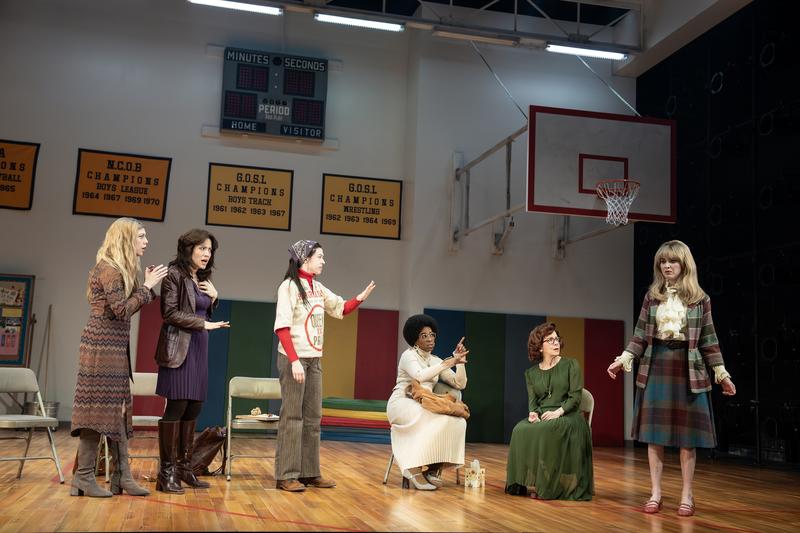
( Photo by Joan Marcus )
Alison Stewart: This is All Of It on WNYC. I'm Alison Stewart. This week feels like it went by in a blur, in part because it was a pledge drive week, which is always an extra-busy time for us, and also because we had amazing guests on the show. Just think back to Monday. Steve Martin and Alison Brown were live in studio, and they brought their banjos. We talked with Ethan Hawke about his role as Lorenz Hart in Blue Moon. We had 10 student journalists on to talk about the issues facing their high schools and the podcasts they made about those issues, and we had the leads and directors from Ragtime in studio yesterday.
If you missed any of those conversations, go back and listen to them wherever you get your podcasts. You can also find them on our show page at wnyc.org, where we also have transcripts. Thank you to everyone who donated during WNYC's Fall Pledge Drive. We appreciate each and every one of you. Now, let's get this hour started with some Liberation.
[MUSIC]
Liberation is coming to Broadway. Opening night is scheduled for Tuesday, October 28th. The play, which is by Bess Wohl, takes us back to a 1970s Ohio gym where a woman's consciousness-raising meeting is taking place. Nothing too formal. It was set up by Lizzie, who's looking for women who want to change the way things are. We get to know Lizzie quite well because she has a dual role in the play. We see her in the '70s trying to keep this group together, and we see her in the present breaking the fourth wall, talking to us, the audience.
Lizzie has questions about her mom. She wants answers from the women who knew her mom in the 1970s when she attended these meetings. One woman named Celeste, a Black graduate student, has returned home to care for her sick mother, but she's also brought some secrets. Liberation is running at the James Earl Jones Theatre through Sunday, January 11th, so this is your chance to get tickets. In the spring, I spoke to playwright Bess Wohl as well as Susannah Flood, who plays Lizzie, and Kristolyn Lloyd, who plays Celeste. It's when the show was off-Broadway.
I started by talking to Susannah about being the first actor we see on stage when the play begins casually, and she speaks directly to the audience. I asked her how that entrance affects the way the audience settles into the show.
Susannah Flood: A lot of people don't know that the show is starting. There have been people who've vocalized that confusion in different ways throughout. It's the second time where I've been in a theatrical moment where the lights are up on the audience. I do think that that causes them to feel a part of the moment, to braid the present, the actual present moment in which the audience is seeing the show, into the context of the show. I think that that gives them permission to relate to it, to internalize it from the go. Even yesterday, there was a woman. I get to this part. It's just a little bit of exposition that we're in Ohio. There was a woman in the back.
At this point, the lights changes. She's just like, "Woo-hoo." She's like this person, whoever this person is from Ohio. They're feeling some pride. It sets up a conversational mode. I'd be curious how you guys feel. I think that that means that when we get to the later revelations in the play, people feel that they can talk back to the play throughout. When we talk about McGovern, when we talk about Nixon, when we talk about even the no-fault divorce law, especially people who live through that era, then feel that they can express even words, language out loud in the theater, which is a tradition that doesn't really belong to the theater but could and should.
Alison Stewart: Kristolyn, do you and the other actors watch backstage to get a vibe on the audience?
Kristolyn Lloyd: Absolutely.
[laughter]
Susannah Flood: I didn't know that.
Kristolyn Lloyd: Absolutely. We watch you on the monitor. We try to listen for what they're saying, who might be the person who's taking this opportunity to talk to you about themselves.
[laughter]
Susannah Flood: Yes.
Kristolyn Lloyd: It's always really fun for you to start out. You do such a great job.
Susannah Flood: Thank you.
Kristolyn Lloyd: You're welcome.
Susannah Flood: Kristolyn is the first person who comes on. When the women start coming on, Kristolyn is the first person who walks on. I always feel like, "Phew," yes. The cavalry.
Alison Stewart: Bess, did you always start the play that way with Lizzie speaking?
Bess Wohl: I did, to a degree. I've written 25 versions of this play and drafts of this play with other titles and other approaches. Actually, having the play start with Lizzie speaking was the thing that cracked it open for me. Having someone in the present come in and say, "Here I am with you and we're going to do this together," and bringing the audience in that way. It allows us also to look at the past in relation to the moment we're in now. Lizzie is not me. It's not an autobiographical play by any means, but Lizzie does stand in for a person trying to make a play for the audience and with the audience, and ask big questions together. I wanted this to feel as much like a happening as like a play. A thing in real-time that we're making and discovering with the audience.
Alison Stewart: How does it feel to play the dual roles, Susannah?
Susannah Flood: I actually don't experience them as different, to tell you the truth. I experience the questions of the play and the dilemma of Lizzie, the mom, and Lizzie the daughter as a comparable dilemma. In fact, there's a section at the end of Act 1, where the character, Susan, talks about the idea of artificial wombs, and we get into a debate. It used to be that all of that entire conversation belonged just between her and Lizzie, the daughter, the narrator that you meet at the beginning of the play.
In rehearsal, we discovered it was better actually to keep the first half of that scene in the past so that all of the women could be talking about that together, especially as we've gone on this debate about what does it mean to have a child and to be a woman in the world. Not just a woman in the world doing a job and getting paid for it, but having a vocation, by which I mean something that you think you're put on the earth to do that you love, that is a craft that you are going to practice over your whole life.
You can probably relate to that, Alison. That that is a tension inside of a person. How do you balance those things? I feel that debate starting for Lizzie, the mom, and it, over the course of the scene, just spills over into the present version of Liz-- by which I just mean Susannah myself. This is the question that is on my mind all the time now. I don't actually experience them as that. It doesn't feel like a dual role. It feels like one continuous role.
Alison Stewart: Kristolyn, you play Celeste. This Radcliffe grad comes into the gym, a boy's gym, I should mention. She comes to Ohio to care for her sick mother.
Kristolyn Lloyd: Yes.
Alison Stewart: Why do you think she shows up to this group?
Kristolyn Lloyd: I think she's at her wits' end. She implies that she has four other people who could be taking care of her mother, but it has fallen on her. I don't imagine that she's at the top of the birthing order or at the bottom of the birthing order. I think watching my grandmother slowly go from Alzheimer's and what a long journey that was, and having an aunt who was the caregiver, and how grief can just-- It sucks life out of you. I think she's at a point where she's like, "I need something to keep me going. I need some remnant of my New York life and myself, who I discovered in New York after leaving Ohio. I need that here," or she's going to drown.
My parents needed me to go back to Texas right now [chuckles] for a long period of time to take care of them. I can understand why Celeste gets to the point where she's like, "I don't care that they're all white women. I am going to this group. I need to find my people. It may not be skinfolk. It might be on another level.
Alison Stewart: How does she feel that she's in a group of white people?
Kristolyn Lloyd: Oh, othered, from the beginning. You'll see throughout the show, there's another Black character that shows up. You get to see the tension between what Celeste is trying to hold on to, the freedom that she's finding in this group, and the strength and the confidence that she's finding with fighting these things. A lot of people, after the civil rights movement, it got so quiet. Everyone was so tired. Everyone was burnt out. Our leaders had been assassinated. Around the '70s, you notice the Black Panther Party starts doing more stuff involving community because the fight had just drained everything out of them.
I think there is a rejuvenation with being in this group for her, while also a conflict of race and conversation in that social aspect.
Alison Stewart: Bess, you said this isn't an autobiographical play, but there are some tokens to your past. Your mom worked for Ms. magazine. What specifics did you pull from your mom or the women she grew up with that you used in the play?
Bess Wohl: Yes. When I was a child, my mom worked at Ms. I looked up to all of her friends and to her. I really idolized them. I saw them as these incredible, larger-than-life women who were engaged in this really important fight. I think that sense of possibility and of activism that I learned from them was something I really wanted to represent in the play. Thankfully, my mother is still with us, unlike the mother character in this play, which I'm so grateful for. There's a conversation in the play that the narrator of the play never got to have with her mother that she has toward the end of the play. That was a conversation that I actually was able to call up my mother and have with her.
Alison Stewart: Oh, my gosh.
Bess Wohl: Then I put that conversation into the play. It was just incredibly meaningful for me through the act of writing this play to have the conversations I wanted to have with my mother and to ask the question of like, "Can we see our mothers as people beyond the function they have in our lives? Can we see our mothers as full human beings?" That's a conversation that the play is really in dialogue with, and that forms the heart of this piece for me and is a very personal conversation between me and my mother.
Alison Stewart: Are there any women in your life that remind you of the women that you're playing in the '70s?
Susannah Flood: Oh. Well, I keep on my dressing room table a picture of this woman who was like a grandmother to me. This is weird. In the words of the play, this is a little bit weird. I've never said this to anyone, but it's true. This is true. My mom's first mother-in-law was like a grandmother to me growing up. She and my grandmother are both captured in this photo. Neither of them are here anymore, but they both lived through this era and had very different responses to it.
My actual biological grandma was living in the Upper Peninsula of Michigan, and the movement didn't touch her up there. My surrogate grandmother, she reformed her life after her children were teenagers. They both are responsible in different ways for me, feeling like I could be an actor. I guess I dedicate it to them, though, and I hold them in my mind. To this question about conversations never had, I do wish that I could. I remember my mom's siblings are spread out over a wide range.
The eldest, who was really close to my grandma, once told me this story that was told to her by one of my grandmother's friends who said that, "I think if Lillian had been able to choose her life, basically, she would have done something more like what Susannah was doing," which, my grandma, she never got to see me on-- We lived in different places. I guess I find the fact of their historical presence to be an organizing principle.
Alison Stewart: How about for you, Kristolyn? Is there someone in your life?
Kristolyn Lloyd: Yes, there are two people that I constantly conjure when I'm in the show. They're both alive, which is beautiful. One of them is my dad's mother, who raised her five kids on her own because my grandfather died when my dad was seven. She never remarried after that. She's 95 now, and her mind is still there, but the movement never touched her. When I talked to my mother about the movement, it never touched Beaumont, Texas. It never touched Freeport, Texas. My grandmother, we have very different political and religious beliefs. She's very Christian, and I am not. A lot of her views aren't feminist.
Watching her spend, from what I know, her entire existence, to me, without a husband, was pivotal. I did not have a lot of role models growing up in Texas, of women who didn't get married and didn't have kids before the age of 25. I was in 13 weddings by the time I was 27.
Susannah Flood: Oh, my God.
Alison Stewart: 13?
Kristolyn Lloyd: Yes.
Alison Stewart: Wow.
Kristolyn Lloyd: The youngest was an 18-year-old friend of mine who got married right out of high school. I didn't have a lot of examples, except for my grandmother, who didn't have a husband, and my theater teacher in high school. Her name is Alison Frost. She was probably one of the first feminists I ever encountered. I remember one of the biggest things that stuck out to me when I first met her was when I asked her about doing Grease at the school. She cussed Grease out up and down and was like, "I am never doing that effing play." She was like, "It has nothing good to help women out."
I was like, "What? Oh. Oh, my gosh. Wait, what?" It really clicked this thing in me. She cast me as Hamlet in my senior year, which was another big thing to do. It was a very feminist move of hers.
Susannah Flood: Totally.
Kristolyn Lloyd: She inspired me to continue acting on a much more specific and intentional level. Everything that I try to do once I got to New York, I do very specific plays. I choose my projects. This one was perfect. Perfect timing. I think that those two women have-- it's the reason I'm still going. My grandmother has never seen anything I've done on stage. She saw me in a soap opera because I was on one for three years.
[laughter]
Kristolyn Lloyd: For her, that was like, "She made it. My granddaughter has made it." I was literally on my way to rehearsal for 1776, a Broadway show I was leading. She's on the phone with me, and she's like, "So, when are you going to choose your second career?" I said, "What?"
[laughter]
Kristolyn Lloyd: She said, "You know, something that you--" I said, "Well, what do you think I should do? You seem to know me so well." She said, "Well, what about a teacher or a secretary?" I was like, "Girl, woo, we've got to get you up to New York. We got to. Just so you can see that there is a career to be had for a Black woman who has no kids and no husband." It scares my grandmother to death.
Susannah Flood: When you play Hamlet, she's coming.
Kristolyn Lloyd: Right?
Susannah Flood: She's coming.
Kristolyn Lloyd: She's coming, yes.
Susannah Flood: Yes.
Kristolyn Lloyd: [unintelligible 00:16:49]
Alison Stewart: Like a soap opera. Come on now.
Kristolyn Lloyd: Bold and the Beautiful, baby.
Alison Stewart: See, that's for Grandma.
[laughter]
Kristolyn Lloyd: Bold and the Beautiful. Did it for you, girl.
Alison Stewart: All right. These women are all coming to this meeting, Bess. Why do you think they keep coming back to this meeting?
Bess Wohl: It's a great question. I think it's really the friendships. I didn't realize I was writing about this when I started, but we really discovered in rehearsal how much this play is about friendship between women, which is something that I know I personally crave so much and hold so dearly. I think they start to become the only people they can tell certain things to. I think there's a loneliness that's being soothed by the group and a feeling of solidarity that's being created by the group that keeps them coming back.
Then I think the play also delves into the complications between women and their friendships. What are they not telling each other? What things can they not get beyond, no matter how hard they try? Ultimately, to me, this story is so much about the sacred nature of female friendship.
Alison Stewart: Where does Celeste fall on the feminism range? Is she a radical, or does she believe in doing it slow motion? What does she think?
Kristolyn Lloyd: She believes in putting in the work and taking the risk. The sacrifice is necessary, which is where her and Lizzie differ. I think because Black women know that the sacrifice is necessary. It's not as scary. I think because of the way privilege is set up and race, that we just have less to lose. I think she struggles with it when it comes to her sexuality, which I can completely understand as someone who came out when she was 36 as bisexual. Holding onto that is such an identity. I think that's the one place where she hadn't examined and hadn't really gone into depth with herself. We see the results of that in the show.
Alison Stewart: I know you've had after-show meetups with the audience for audience questions. Bess, what kind of questions do people have? What are they interested in knowing about the play?
Bess Wohl: Oh, people always surprise me with their questions as much as I think I know. A lot of people want to know about the process of making it because the work that's happening on stage with this cast is so brave. They're really ripping their hearts out for you every night. How we could have gotten to that point with the trust with each other and in the work, I would say, is the thing that people often want to know about. What process did you go through to create an environment where people felt safe having these conversations and going to these incredibly raw, emotional places? It's really a credit to our director, Whitney White, who is just extraordinary.
Kristolyn Lloyd: She's fun. She's good.
Bess Wohl: She's a good one. She really is absolutely a visionary. She created this environment of safety and trust in the room, and then to our amazing company of actors who also trusted each other to go to these places that, frankly, I haven't seen on very many stages. To me, that's part of what's radical and revolutionary about this play.
Alison Stewart: Part of it is that, for at least one part of the play, the cast is nude. Was that always part of your script?
Bess Wohl: It was. It was. I knew that I had to go there in the play in part because when I researched real consciousness-raising groups, and they called them rap groups in the '70s, it was one of the things they did. It was something that a lot of women from that era who I spoke with were really, really proud of and really, really felt like an important part of their process. In a play that's so much about intimacy and about trust, it felt like a very natural expression of that trust.
We worked with an incredible intimacy coordinator named Kelsey Rainwater, who was very careful about making sure that everyone's boundaries were respected. It was a important and very brave part of the process for everybody. I feel like in some ways, it's the heart of the play.
Alison Stewart: Was this your first time being nude, either of you?
Susannah Flood: No, unfortunately, but it's definitely the best time.
Alison Stewart: Oh, good.
Susannah Flood: Yes. My parents were acting teachers.
Alison Stewart: Oh.
Susannah Flood: Yes. Yes, yes, yes. Family guild.
[laughter]
Susannah Flood: My dad always said that acting is controlled humiliation, which gave me a-- honestly, I don't feel that this part of the play, Kristolyn, you jump in here, is actually the scariest part of the play.
Kristolyn Lloyd: No, the scariest part is different for everyone. That's not my scariest part. This isn't my first time being nude. I did it for a Dominique Morisseau play called Confederates at the Signature a couple of years ago. I showed my breasts, and it was a very political form. When I saw this in this script, I was like, "Okay, baby, let's do it. Let's do it."
[laughter]
Kristolyn Lloyd: My parents are not actors.
[laughter]
Kristolyn Lloyd: They are an electrical engineer and a math teacher.
Alison Stewart: Kristolyn, what do you hope people, after they see the play, go have coffee, go have a drink, what do you hope they have conversations about?
Kristolyn Lloyd: Who they are. I hope they're having conversations about who they are. I hope they're having conversations about what they believe and how they want to carry that into their everyday life. I've invited my mother and her sisters and all of my female cousins because I'm like, "We need to have more conversations about this as women." My female cousins are also a lot more liberal than the moms we grew up with, so I'm hoping that that is what it inspires in men and women.
Alison Stewart: How about for you, Bess?
Bess Wohl: I agree with Kristolyn. I hope that people find the courage to have a deeper level of intimacy in the conversations that they do have as well. So much of this play is about how true can you be to yourself and how truthful can you be in your relationships, and can you have the conversations that matter before it's too late, before it's too late on a personal level with the people you love, and before it's too late for us as a society? The time is now for us to be talking about these things, and you can't wait. I hope that it lights a fire under people to do that kind of deep work.
Alison Stewart: Any thoughts, Susannah? You're last.
Susannah Flood: Well, I guess the thing for me is about the heroism of-- my journey through the play has a lot to do with children and mothers. When I became a mom, I was astounded by what I had taken for granted in my friends who had been mothers, about what they were accomplishing just on a daily level, getting through the world. I think that there is a level of heroism in that. I'm not talking about a sentimental version of that word. I'm talking about an actual chivalric going out into the world and doing something concrete. I think that that is underestimated as an action.
I want more claiming of the power of that in our political leaders. I want nobody to feel emasculated by owning that. I want that to be claimed as a real positive, forward-footed value. That's not to think of motherhood as a kind of passive inside-the-home thing, but the actual heroism of it, because I think that that is a paradigm shift that would lead to a lot in the world.
Alison Stewart: That was my conversation with playwright Bess Wohl, and actors Susannah Flood and Kristolyn Lloyd, who star in the Broadway show Liberation. It opens next week.