
Leslie Jones Finds the Humor in Life with New Comedy Special
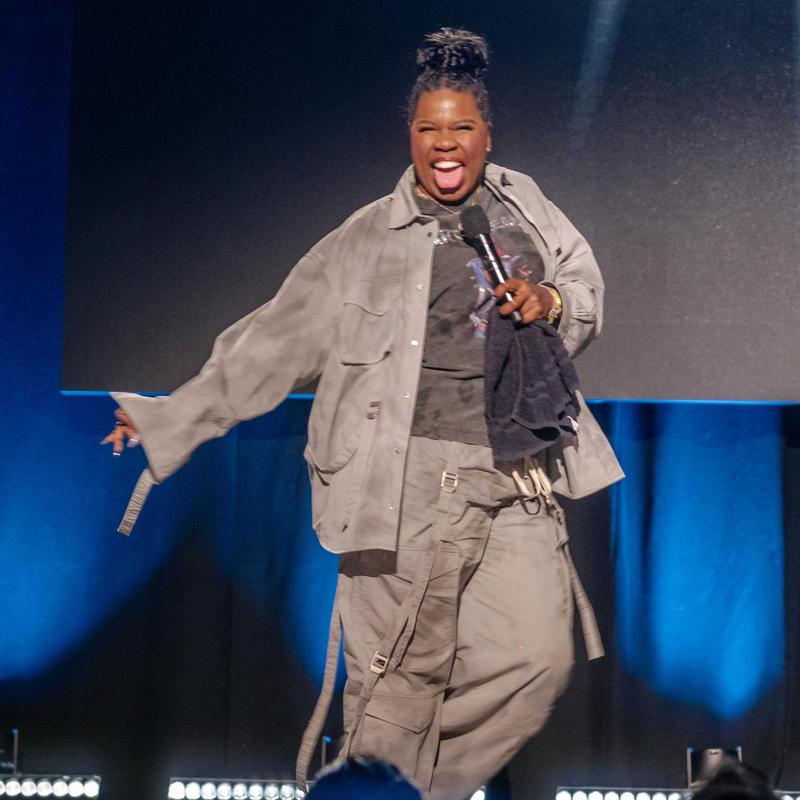
Alison Stewart: This is All Of It on WNYC. I'm Alison Stewart. Leslie Jones is back with a new special titled Leslie Jones: Life Part 2. In it, she jokes about what life is like as a grown woman in a world full of not grown people. Her life has changed. She's learned from it, and she is spreading the wealth. She talks about wishing she had been discovered in her 20s or 30s, rather than in her 40s, what it might have been like. [Comedy - Leslie Jones: Life Part 2: Leslie Jones]
Leslie Jones: When I still had my whole ACL, you know what I'm saying?
[laughter]
Leslie Jones: When my meniscus was meniscusin, you know.
[laughter]
Leslie Jones: They caught me when I was 47, but it was fine. I was still good, but I think about all the youth and energy I had in my 20s and 30s, and then my smarter, much more educated mind steps forward and go, "Thank God. Thank God you didn't make it in your 20s and 30s, because you was a hoe.
[laughter]
Leslie Jones: And you was a dumb hoe at that. You was.
[laughter]
Leslie Jones: I'd have burned through Hollywood.
Alison Stewart: [laughs] The Daily Beast says, "Leslie Jones has been a comedic force of Nature for nearly 40 years, and in her new standup special, Life Part 2, she displays more bravado, and confidence on stage than ever. Leslie Jones: Life Part 2 is streaming now on Peacock. We are happy to have her in studio. It is so nice to meet you.
Leslie Jones: Wow. Wow. That's crazy, so they liked it? Okay.
Alison Stewart: They liked it.
Leslie Jones: That's insane.
Alison Stewart: I went back this morning, and I watched your special Problem Child from 2009 to 2010.
Leslie Jones: Wow. You went back?
Alison Stewart: I went back.
Leslie Jones: Wow.
Alison Stewart: A lot has changed since then.
Leslie Jones: A lot.
Alison Stewart: What was going on in your life when you did that first special?
Leslie Jones: Oh, wow. Okay, so that's when I did the Katt tour. Not a little heat under me, but I was starting to get real managers, and agents, and stuff, and I started to have to move a little bit different. I had an kind of like an assistant. It was very odd, but I knew that I was really funny, and I knew that the material that I was going to be doing was like 20 years in, so I knew it was tight material. It was just about me looking tight. Like me looking like an actual comedian, because usually, I just wear T-shirts and jeans on stage, and don't look like this is a show, so I wanted to look like-- My whole idea was that I wanted to look like an FBI agent.
Alison Stewart: Oh, you did.
Leslie Jones: I looked like a FBI agent, right?
Alison Stewart: Black pants, black vest, guns out.
Leslie Jones: Guns out. Now that I look back on it, I go, "That is so funny." I was just now really getting my momentum as I had already been doing comedy almost 20 years.
Alison Stewart: Yes, so you were in the vezone at that time, right?
Leslie Jones: Oh, I was a beast. I was a samurai at that time. I'm still a samurai. I'm just a very veteran samurai now.
Alison Stewart: I was going to ask you what has been the biggest change in terms of your perspective, and the kind of things that you like to talk about now?
Leslie Jones: Right. Oh, so when I first started, I always tell comics this, you have to go through becoming a comic. In your first couple of years, you are just like an infant. That's when you do the sex jokes, and the fart jokes, and all the immature stuff.
Then you gradually learn how to be on stage. You gradually learn that, do you need to hold the mic? Do you need to sit down? What's your voice level? Are you going to be physical? All that stuff is in the first 10 years. People think that you're fun, you are, you're funny, but are you a professional? J. Anthony Brown told me this because I remember asking him, I said, "When will I know that I'm exactly funny? When will that come?" He said, "10 years." I remember bursting into tears because I had only been doing it three years, and I was like, "Are you kidding?"
Alison Stewart: Yes.
Leslie Jones: He was like, "I'm just being honest,' and he was right. I'm glad I accepted it, too.
Alison Stewart: That's interesting. You had to learn the performance of it a little bit.
Leslie Jones: You had to learn how to be on stage. You had to learn how to, like, because at the time I was still rehearsing, I still practiced every day. You have to learn how to know who you are as yourself to be able to-- I'll put it like this. It's like learning a song. You have to learn the song before you start doing ad-libbing. You can't just ad-lib, right?
Alison Stewart: One thing I noticed in the old special versus now, in the old special, you talk about being single and a new one you're like, "I'm good.
Leslie Jones: So good.
Alison Stewart: "I'm all good."
Leslie Jones: Yes.
Alison Stewart: How long did it take you to realize that?
Leslie Jones: Oh, girl. I just realized that in the last two years. The last two years, real talk because I just turned 58, so it was already starting when I turned 55. It was already there, but I still had a little hope. At 55, I was like, "Okay, it could happen," but eventually, especially in menopause, I don't want nobody near me now. Like, if you touch me while I'm hot, I will beat you into the next day. Like, I just had a hot flash on the view, and Whoopi Goldberg had to fan me down. Now, am I going to get a man that's going to fan me down? No.
Alison Stewart: Would he be a good man if he did?
Leslie Jones: He'd be a good, and that's another thing. Like, I don't get the celebrity groupies. I don't get the good ones. The men get all the good ones. Colin Jost married Scarlett Johansson. Why am I not married to Idris Elba? Why is that not happening? I was a Ghostbuster. I was a damn Ghostbuster. Do you understand me? I was on Saturday Night Live. How am I not getting the good DMs instead of Pokey Joe, which I don't mind dating somebody that work at Bucky's just like, but can I get somebody that work at least at a studio than behind a camera?
Alison Stewart: I just want a couple of options.
Leslie Jones: Options?
Alison Stewart: I just want a few options.
Leslie Jones: Please.
Alison Stewart: Good.
Leslie Jones: Googly goo.
Alison Stewart: We got a text that just said, "I just need to say, Leslie Jones is a national treasure."
Leslie Jones: Who text you that?
Alison Stewart: I don't know. You want his number?
Leslie Jones: Is it?
Alison Stewart: Get that number.
Leslie Jones: He's a national treasure. National. When they call me that, I always think of Rushmore, and I be like, "So does that mean that they're going to put me up there on Rushmore?" Oh, I'm a national treasure. Does that mean that they're going to protect me at all costs?
Alison Stewart: There you go.
Leslie Jones: Yes.
Alison Stewart: Get that number. My guest is Leslie Jones. Her new comedy special is Leslie Jones: Life Part 2. Chris Rock, in a phone interview with the New York Times, said, "Leslie writes these well-crafted jokes, and makes it seem effortless when she's performing. She's really genuine, so you leave her shows with a sense that you really got to know her."
Leslie Jones: That's a beautiful man.
Alison Stewart: It's a beautiful statement.
Leslie Jones: Whenever y'all read me stuff like that, I'd be so happy because I'll be like, "Dang, I don't even know if they like the special or not." For him to say something like that for somebody I look up to, that's, oh.
Alison Stewart: It's a good quote because it talks about how you craft your jokes. What's the process for crafting a joke?
Leslie Jones: I love to tell stories. I love to tell stories, and I love when people tell stories, and you feel like you're there. That is my main thing. John Ritter was one of my favorite people actors because he was so physical. That's where I got my physical. Him, and Lucille Ball. The physicality of comedy is always a great way to show a story. I always want people, from the beginning to the end of the story, I want it to be a nice build. I want it to be a payoff at the end, but you have to have patience to take them through that step. It's just the art of writing a great peace.
Alison Stewart: How do you know whether the audience is okay to hear the story?
Leslie Jones: Well, see, that's our job as a comedian, isn't it? It's our job to make them ready. You know what I'm saying? If I'm funny enough, you going to be right along with me, so it's your job to come out. I always tell people, "Don't get too cocky. It's your job. Come out and show them that you're funny." Doesn't matter if they already know you funny. Prove it. If you go to a comedy show, and somebody came up, and then they BS the whole person, you're going to be like, "Oh, are they actually funny?" You know what I'm saying? I just need y'all to know that y'all dealing with funny person, so anything that I say on this stage is going to be funny, and it's going to be helpful, and you're going to think, "But you're going to laugh." That's my job. My job is to make you laugh. My job is not to teach you anything. I'm supposed to make you laugh. Now, if you learn a lesson in laughter, great.
Alison Stewart: Yes. What environment do you like to try out your jokes? Some people go to clubs at night. Do you do it?
Leslie Jones: I do it everywhere.
Alison Stewart: Everywhere?
Leslie Jones: Everywhere. I try it on the street. I try it with my friends.
Now, in this stage of my comedy, I love doing all new stuff. If I got some new jokes, that is my jam, and my writer, Lenny, he has to give me permission, because if he goes, "Hey, go have fun," then I get to do all the stuff that's been going through my head, but then he'll be like, "Stick to the list." Then I have to do the jokes that we need to work on.
Alison Stewart: Oh, so the jokes you have to work on are the ones you have to do first?
Leslie Jones: Well, the jokes that I have to work on, I have to work it into my set. If he has A list, he usually has it in the order he wants me to do it in, but he has them all together to where if I did jump around again, knowing the song, I know the song so I can ad-lib.
Alison Stewart: So you're very physical-
Leslie Jones: Very.
Alison Stewart: -in your comedy, you are in it. Was this always your style?
Leslie Jones: Yes. I love it. I think it's hilarious. Slipping on a banana will always be funny. Do you understand? Slipping on the banana will always be a joke, and it will always work because people love action. People love movement. Whenever I go to a concert or anything, if they're not moving around and dancing, I'll be like, "Do you like your own song?" You know what I'm saying? Like, there's comics that can stand in the middle of the stage, and be so funny. Me, I got to use that whole stage. I want this person on this side to feel it. I want the person in the middle to feel it. The people on the balcony to feel it, so yes, I love having a big stage that I can run around because it's just hilarious. It's hilarious watching someone do that.
Alison Stewart: How did you not trip on those pants?
Leslie Jones: Lenny hates that outfit so much.
Alison Stewart: She's got these pants with these cool straps, but I was like, "Is she going to make it? Is she going to be okay?" [chuckles]
Leslie Jones: I always wear stuff that I can move in, so those were pants that had been tested, so I knew I was okay, but Lenny was like, "I hate that outfit." [chuckles]
Alison Stewart: [chuckles] I was just worried about you.
Leslie Jones: I know. Everybody, do.
Alison Stewart: I was just worried about you, that's all.
Leslie Jones: Everybody do.
Alison Stewart: You did make a joke about possibly injuring yourself on stage.
Leslie Jones: Well, what did I say?
Alison Stewart: [chuckles] You said, like, you have to take a lot of Tylenol.
Leslie Jones: Oh, well, this is the thing. This is when I was talking about the-- I got to take my 800 sometimes. You know I'm 58.
Alison Stewart: Right. Got your Advil, right?
Leslie Jones: Now, you remember how when you used to hit your hand on the door, and be like, "Oh, I'm good." I hit my hand on the door now, "Take me to hospital. I think I've busted a vein in my hand." You know what I'm saying? I am precious now. I didn't used to be as precious as I am, but, yes, I got that 800, and then the older I get, the higher the dose is going to be. I'm going to have 1200 in a minute.
Alison Stewart: We're talking to Leslie Jones. Her new comedy special is Leslie Jones: Life Part 2. You can stream it on Amazon. Why is it Life Part 2?
Leslie Jones: Because it is the second part of my life. It's me talking about, just like you said, I'm just over it. It's the second part of my life. This part of my life is me living the benefits of the first part of my life, like the 20s, and the 30s, and the 40s. How I worked so hard to get where I am, 50s and on, is just a celebration of what my life was going to be. That's what every human needs to understand. You do not need to be a millionaire at 25. Your brain is not even fully adjusted, or developed. You will lose every cent. You do not want to become a headliner before you need to become a headliner. People are always trying to rush to the end of fame, and don't understand that the journey to it is the best part of the game.
Alison Stewart: It also sets you up for when it happens.
Leslie Jones: Absolutely, because you're ready. You have a foundation. Why would you want to be a headliner when you don't have enough jokes to be the opener?
Alison Stewart: Yes.
Leslie Jones: Yes.
Alison Stewart: In your special, you remarked that a certain joke is better among Black audiences. How do you suss out a crowd when you're able to look at the crowd, and you look at the crowd, and you're like, "Am I going to do this joke? Is this going to fly? Do I do it anyway?"
Leslie Jones: I write all my jokes for everyone. Most of my jokes can go across the board with everyone. Only reason I would change my material is if they telling me, "Hey, you need to be clean. Hey, these are children. Hey, these are this, this, and this." Then I won't do the hardcore stuff. I'll do the fun stuff. You know what I mean?
Alison Stewart: That's interesting.
Leslie Jones: You know what I'm saying? Most audiences, I write for everybody.
Alison Stewart: Do you ever change up your set because you get a vibe off the audience?
Leslie Jones: Oh, I love it. I love when they give me a vibe, because I go, "Oh, y'all not into this? Oh, so I'm going to talk about everybody in the audience until y'all pipe up. Yes, you better pipe up, or I'm going to talk about that damn sweater. Yes, I'm going to talk about that sweater. You, and everybody at that table don't like you because they would have told you not to put that sweater on.
Alison Stewart: It's so true.
Leslie Jones: Then they, like--
Alison Stewart: I saw you when Caroline's was still--
Speaker 2: You saw me at--
Speaker 1: Caroline's long time ago.
Leslie Jones: Baby, you talking about crowd work.
Alison Stewart: Honestly, you put the mic up, you put the cord on the mic over your shoulder, you walked off the stage, [chuckles] and every table got hit, and it was really funny.
Leslie Jones: Oh, man. David Spade saw me at the comedy store one night, and I was doing crowd work, and I came off. He was like, "I have been in this business for-- I've never seen anyone as confident behind crowd work as you are." I got that from JB Smooth. JB Smooth said, "Say the first thing that comes to your mind, because it's usually from God." I have said some crazy thing first, and I'll be like, "That's how I know God got a good sense of humor," because it was something that flashed in my head, and I swear it'd be like, "Say that. Say it right now. Say it right now," and I would do it, and it would rip.
Alison Stewart: On this show, your executive producer, you worked with Jesse Collins Entertainment?
Leslie Jones: I love Jesse.
Alison Stewart: It's amazing. There's the Emmys, there's the Grammys.
Leslie Jones: He's one of the best in the business.
Alison Stewart: Super Bowl Halftime show.
Leslie Jones: He's one of the best because he understands his clients. He understands the people he works with. He is just so calm. I love Jesse.
Alison Stewart: How has your sense of production changed when you were working with Jesse?
Leslie Jones: Jesse, make it look good.
Alison Stewart: Yes.
Leslie Jones: Jesse, make it look good. Jesse makes sure that I'm comfortable. He makes sure that I got what I need. For Time Machine, he helped me with Time Machine. I got the directors from Game of Thrones to do that. He got them all, they were, like, looking at my set and they was like, we need more than four cameras. We need nine cameras.
Alison Stewart: Oh, that's interesting.
Leslie Jones: Yes, and Jesse was like, "We'll make it happen because I'm very physical."
Alison Stewart: Why did it feel like this was the time to release an hour long special?
Leslie Jones: I had been doing it for like two, maybe two and a half, three years, and everybody was like, "Yo, you need to get a special out. I like to work on my material till it's ready. There's a couple of jokes in Time Machine that I really wish that I wouldn't have said them then because they would be so beautiful now. They didn't get the time to develop like they needed to.
After the Time Machine, I told my writer, we will not do another special until my jokes are ready. We got to a point, and Lenny was like, "You're ready." I'm always impressed when a comic can come out with a special in a year, but everybody must understand that comic had that 30 minutes before, so like have 45 minutes of extra material that I can use, but you want to mix it in with the new and stuff. It's not like I want everybody to know that they didn't take it yet. That's well worked out material.
Alison Stewart: I'm speaking with Leslie Jones. Her new comedy special, Leslie Jones: Life Part 2 is streaming now on Peacock. This is a serious question.
Leslie Jones: Okay. Oh, serious.
Alison Stewart: Lorne Michaels was SNL. You said it was very hard for him because he had to figure out how to make something that was smart, and that people could laugh at in California, or in Montana. I was watching the show this fall, and I realized there are No black female characters on SNL. What is missing from the conversation from the show by not having a Black female cast member?
Leslie Jones: I just think that they don't get to see Black women like they get to see white women. Does that make sense? I don't want it to sound racist. I want people to understand that white female comics, and sketch artists, they're just so much more available. I can't explain it. Like, they're in the right places. Black artists don't get to get in those places sometimes. You know what I'm saying? Like, so they don't get to get in front of Lauren unless somebody like Chris Rock told Lauren about me. Lauren didn't know about me. Chris Rock told him about me.
Then he sent out his people to search. He takes suggestions from everybody. We all texting them going, "Hey, go check out this girl. Hey, go check out this girl. Go check out this girl." It's about getting that even kill of Black artists in the place that they can be seen. This is why I'm glad you asked that, because Black women get, like, Kim Whitley told me this, and I really wish I had followed the advice when she told me this. "Start doing all clubs. Don't just do Black clubs. I know Black people love me. You got to try your stuff out in white clubs so you can get white comics to hit your jokes, to give you tags. White comics, you got to go to Black clubs, so Black comics can hit your jokes so they can be worldwide. Then when you're in that, you start talking, everybody starts talking. We need more Black women to just take the step to get into the right place to be seen. [coughs]
Alison Stewart: You need to have--
Leslie Jones: Excuse me.
Alison Stewart: Oh, no problem. It's like. Sounds like accessibility.
Leslie Jones: Yes.
Alison Stewart: Big issue.
Leslie Jones: Exactly. And I think that they don't get to see the great ones as much as they get to see the white ones. I just don't want that to sound racist, because I have nothing against, white comedians, white women. I just know that they we don't get to get seen as much as they do.
Alison Stewart: A lot of young artists are starting on TikTok, and do comedy that way. I'm curious what your thoughts are on that. Do you need to be in a studio? Do you need to be-- Oh, he's making her cough.
Leslie Jones: [coughs]
Alison Stewart: Oh, oh.
Leslie Jones: Well. All right, I would say this.
Alison Stewart: Take a sip of water.
Leslie Jones: If you're on TikTok, and I remember that got big because of COVID. If you're making people laugh at the material that you're doing on TikTok, why would you go to a club, and do different material? That's the problem with TikTok comics. Y'all think that y'all regular comics. I've given a spot to a comic because I was like, "Oh, you're so funny. Oh, this is great." I just expected him to go up, and do what he does on TikTok. He came with regular jokes. First of all, don't nobody know you. Second of all, you're not funny enough to do that. You a new jack. You just learn how to get this stuff done on a platform. It's completely different when you're on a stage in front of people.
Alison Stewart: Yes.
Leslie Jones: Another thing, what it goes back to? Do the work. If you've never been on stage before, I have no respect for you. I'm sorry. Don't come up to me and say, "I want to be a comic when you've never performed before. What I did, Just went-- What I did, I just went up, and I definitely didn't ask nobody what to do if I wanted to-- I went and did it. Stop talking about doing it and do it. These TikTok artists, Oh, God. Let me say this in the nicest way that I can. Chris Rock had a great joke about this. He was like, the reality stars think that they're, like, real movie stars. You go, that's like comparing a doctor to a chiropractor. A chiropractor would be like, "I almost lost him on the table." "No, you didn't. On a folding table. What you almost lost. Whenever TikTok comedians come up to me, I give you your love for what you did on the Internet. That's a good. That's a great thing, but you're going to have to follow me. That's not going to be easy with them little TikTok jokes. I just want them to do real work. Don't call yourself a comic if you haven't did what comics need to do.
Alison Stewart: What are you going to do next?
Leslie Jones: Ooh, girl. The sky's the limit. I got a couple of shows that I'm about to do that we're releasing. I'm on a lot of cameo roles on a lot of things. I don't know if I can announce this yet, but I got a little TV show coming out.
Leslie Jones: I got a lot of good stuff coming out. I might be doing a play, so.
Alison Stewart: Wow. A play in New York?
Leslie Jones: Yes. That would be hot, right?
Alison Stewart: That would be great.
Leslie Jones: Yes. Would you come?
Alison Stewart: Of course, I would come, and I would have you back on, and we would talk to you as an actor.
Leslie Jones: Oh, my God.
Alison Stewart: [chuckles] Leslie Jones: Life Part 2 is streaming on Peacock right now. It has been a pleasure to have you in the studio.
Leslie Jones: Oh, my God. I knew it was going to be a good interview. I knew it. I was telling him, I was like, "This going to be a good interview." I could tell.
Alison Stewart: Thanks, Leslie. Hey, calling all at Gen Xers, the New York Times style magazine is just pub an issue. Making a case that Gen X is the greatest generation. We'll talk about it after the break.