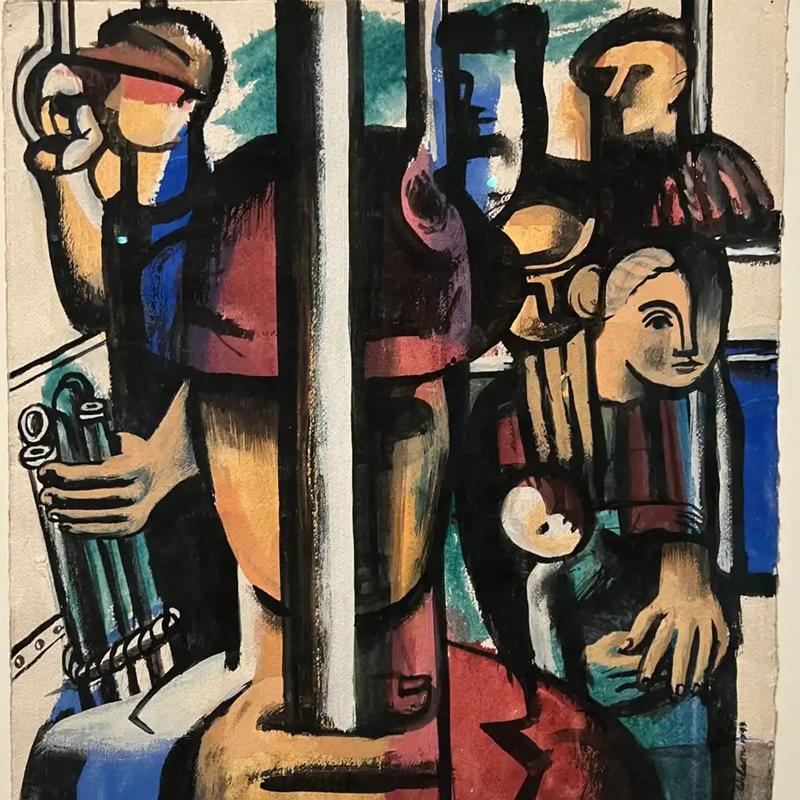
Allison Stewart: This is All Of It. I'm Allison Stewart with a last call to catch a powerful exhibit at the Met. It's called Witnessing Humanity: The Art of John Wilson. It's open only through this coming Sunday, February 8th, so go see it while you can. Born in 1922 in the Roxbury neighborhood of Boston, the late artist John Wilson dedicated his life and career to capturing certain hypocrisies that Black Americans have faced, particularly double standards during the wars and the civil rights movement of the '60s. Witnessing Humanity: The Art of John Wilson is a collaboration between the Museum of Fine Arts in Boston and the Met here in New York.
When it first opened here at the Met, I spoke with co-curators Jennifer Farrell and Leslie King Hammond, who is also the founding director for the Center of Race and Culture at the Maryland Institute College of Art. I started by asking Jennifer why she wanted to bring this show from Boston to New York.
Jennifer Farrell: It's actually very funny because the curators from Boston and I had separately proposed the show to our respective directors, and we hadn't known about the other show because it wasn't official. We were probably around the same month or so. Edward said maybe even the same week that we proposed our exhibitions. I remember telling Max, "If we don't do it, someone else will." Then, we found out about each other, and we decided to join forces. We decided that Boston was really able to delve into Wilson's relationship with the city: being born in Roxbury, living for many decades in Brookline, studying at the School of the Museum of Fine Arts, as you mentioned at Tufts, and then later teaching at Boston University.
Whereas, for people in New York, it might be more of an introduction or an in-depth look at an artist for whom maybe they only know one section of his work and not the full range over the course of over six decades. It's a little bit different focus in the two venues. We overlap a lot on the works that were included, but there are some different works in this show.
Allison Stewart: Wilson also made a lot of art about parents and their children, fathers and sons, mothers and daughters, Black families. Jennifer, why do you think this was an important subject for him?
Jennifer Farrell: His father had a key role in his life. He came from a very supportive, very tight-knit family. A lot of portraits in the first room are of his brothers, of his sisters, as well as of himself and Roxbury, which he describes as a portrait of a neighborhood. The family was really foundation. He, as Leslie said, would use his family as subjects. He would often tell them to stop what they're doing and pose. It was, I think, really a challenge to this kind of representation in art, where so often it's mother and child; so often it's the white mother and the white child.
Here, he's showing not only Black parents, such as in The Incident and with Mother and Child, but he's also showing fatherhood. That was on the cover of The Reporter, one of the father and children. He made it in sculpture. He made images in drawing. He made them very large, Father and Child Reading, which is outside of the public library at the Roxbury. We only have a small maquette in the show. It really is showing this incredible connection within his family and within his community. He also did illustrations for children's books that speak about families as incredibly strong units within the Black American family.
Allison Stewart: If there's one piece of art, one piece in the show that you'd like people to spend five extra seconds in front of, not your favorite, but one that you think maybe you should take in a little longer, what piece would that be?
Leslie King Hammond: I am just driven by the fact that he is one of the few, especially African American artists, who ever did father and son. Rare, rare, gifted. I stand in front of it, and I get palpitations every time because it reminds me of him talking about reading, sitting on his father's lap when he's a young boy, and sharing that moment. That's why we have those images in sculpture, in prints. While I love everything, that one emotionally resonates with me.
Allison Stewart: How about for you?
Jennifer Farrell: I would say Adolescence. We have both the drawing and the prints. You see him, his technical process, of the young boy, both alienated and connected to his environment, with the books under his arm. As Leslie said, the importance of education. John was also a teacher for many decades at Boston University, in addition to the work at the high school and middle schools in New York City. That idea, the way he addresses a viewer, the fact he refers to it as a self-portrait, and I think that resonates with so many feelings people have today within their community.
Also, as you talked about labor, of the inequities that are present in certain communities, that all comes through in that piece for me. It's actually was incredibly successful shortly after he made it. He sold it to Smith College, who also purchased and displayed My Brother, which is our signature image, while he was still in school. MoMA also bought the print for Adolescence. It really struck a lot of people at the time it was made, but I think it continues to be an incredibly relevant piece.
Allison Stewart: That was my conversation with Jennifer Farrell and Leslie King Hammond, co-curators of the exhibition Witnessing Humanity: The Art of John Wilson. This is your last chance to see it at the Met. The show's last day is this Sunday.