Kennedy Center Cancellations and Art in the Second Trump Administration
Alison Stewart: This is All Of It. I'm Alison Stewart, live from the WNYC Studios in SoHo. Thank you for spending part of your day with us. I'm really grateful that you are here. On today's show, three of the stars of the movie Sinners will be joining us: Delroy Lindo, Miles Caton, and Saul Williams. We'll talk about their roles and music. Saul Williams is actually nominated for a Grammy this year in Spoken Word. That should be interesting. We'll also celebrate a very important New York City holiday, National Bagel Day, and that is our plan. Let's get this started with a conversation about how President Donald Trump is trying to remake the culture.
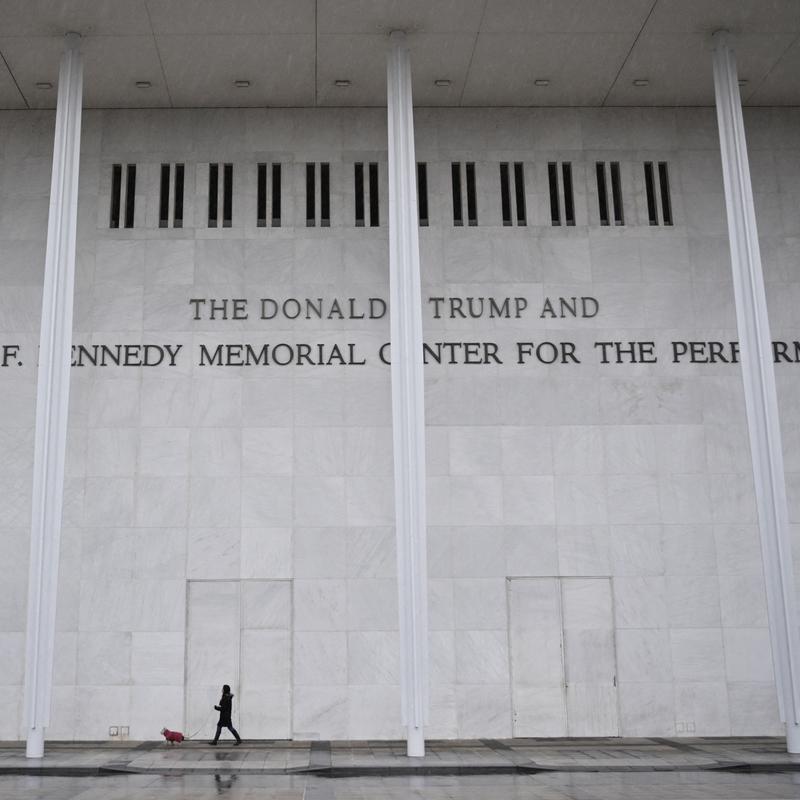
In his second term, President Trump has focused attention towards artistic and cultural institutions. A month ago, the Kennedy Center Board of Trustees, most of whom, 14 to be exact, had been appointed by Trump, voted to rename the John F. Kennedy Memorial Center for the Performing Arts to include his name. It is now the Trump Kennedy Center. President Trump has said that, and this is set in context, "Because I want to make sure it runs properly. We don't need woke at the Kennedy Center. Some of the shows were terrible; it's a disgrace that they were even put on. So I'll be there until such time as it gets to be running right."
In response, many acts and artists have canceled planned appearances at the Trump Kennedy Center, like Rhiannon Giddens, Stephen Schwartz, Béla Fleck, and Issa Rae. It was just announced that after 23 years, the MLK celebration Let Freedom Ring was relocating to the Howard Theater. NPR cited costs as the reasons. We'll talk with the reporter in a moment. These changes aren't just happening with the performing arts. Under pressure from the Trump administration, the Smithsonian has decided to hand over documents related to the content in their museums.
The institution faced threats from President Trump to potentially cut their federal funding. Joining me now to discuss all of this is Elizabeth Blair, a correspondent for NPR. Hi, Elizabeth. It's so nice to speak with you.
Elizabeth Blair: Hi, Alison.
Alison Stewart: Listeners, what do you think of those who decide to pull out of shows at the Trump Kennedy Center? What decision would have you have made? Give us a call at 212-433-9692, 212-433-WNYC. Listeners, what have you thought about President Trump's handling of arts and culture in America? Are you for it, or do you think there's a smarter way to fight back? Our number again is 212-433-9692, 212-443-WNYC. Elizabeth, why do you think President Trump has decided to dedicate so much time and so much energy towards the Kennedy Center?
Elizabeth Blair: I think President Trump has always loved arts and entertainment. I mean, he did host The Apprentice on TV. I attended the Kennedy Center Honorees press conference that he held. He said he was 98% involved in choosing the honorees, which is unprecedented. He was clearly very excited to talk about Sylvester Stallone, for example, and how he loves Phantom of the Opera, Michael Crawford, with another one of his selections. He loves entertainment, and he was never shy about saying so.
Alison Stewart: Can you fill us in on the Let Freedom Ring relocating to a new location after two decades? It's your name on the byline.
Elizabeth Blair: Sure. Georgetown University has sponsored that event, Let Freedom Ring, since 2003. It involves local gospel singers and singers from Georgetown University. It was a stunning event. Aretha Franklin, Chaka Khan, Roberta Flack was at the very first one. Very, very well attended. It also became a fundraiser for the Kennedy Center. Georgetown University is saying they're moving it to Howard Theater to save money. If you heard the piece, Marc Bamuti Joseph, who is a former Kennedy Center employee, he said it wouldn't be appropriate to have it there.
Even though Georgetown University, which produces the event, is saying this isn't political, I think some people feel it's not the place for that celebration right now.
Alison Stewart: Big picture. What do you think President Trump understands about the power of the arts?
Elizabeth Blair: This is a really interesting question because on the face of it, of course, entertainment, commercial entertainment, has great influence. You can see that in how he goes after late night TV hosts. I think that when he says, for example, that the Smithsonian promotes anti-Western values or that the Smithsonian doesn't do enough to celebrate American culture and American history, that tells me maybe he hasn't been there so much because anyone who has been there knows you have Dorothy's ruby slippers, Dorothy who were in The Wizard of Oz.
You have Abraham Lincoln's top hat. You have the Wright Brothers' 1903 flyer. There's much at the Smithsonian that celebrates American invention, culture, and personalities. With the Kennedy Center, I think same thing. You could say some programming was woke, but there was so much programming that was, I would say, very patriotic. It's a mixed bag, I would say.
Alison Stewart: We're discussing President Trump's approach to the arts in his second term, including his decision to add his name to the Kennedy Center. My guest is NPR correspondent Elizabeth Blair. Listeners, what have you thought about President Trump's handling of arts and culture in America? What do you think of those who decided to pull out of shows? Was it the right thing to do? Maybe you like the way the president is handling it. Our number is 212-433-9692, 212-433-WNYC. Let's talk to Mac, who's calling in from Brooklyn. Hi, Mac, thanks for making the time to call All Of It.
Mac: Thank you for talking about this. I actually told the screener I had an opportunity to talk with some folks who worked at the Kennedy Center and actually interviewed for a whole personal project, but without getting into that or who they are, one thing that struck me when we asked one particular head of a program, and if she thought it was going to go down this way, you saw this coming down the pike on in February when the takeover happened and then you kind of knew something was happening.
Did it play out like you thought it would when she was released, and she said actually, no, she thought it was going to be like more evil, like more mustache-twisty. Actually, the administration just doesn't know what they're doing. The taking over of certain programs is more ham-handed than anything else. It's just like kind of d dumb. It's not informed. When whole entire programs are being taken over, they're not being like replaced with some other agenda. They don't have an agenda. They just don't know what they're doing.
Alison Stewart: Mac, thank you for sharing that information. I want to talk to you, Elizabeth. How has the leadership at the Kennedy Center changed since Trump took office?
Elizabeth Blair: Sure, a lot. I mean, the new president is Richard Grenell, who was a former ambassador to Germany under President Trump's first term. He's a diplomat. To Mac's point, the relationships that it takes to run a performing arts institution, to run anything in the performing arts need to be strong. They need to be deep. That is what the Kennedy Center had. Very deep relationships with artists, with agents, with promoters, with entire companies around the world. I do think that with so many departures, the current leadership might not have so many of those relationships. I think that is partly why so many artists have canceled.
Alison Stewart: There was a vote to put his name on the building, but it wasn't a unanimous vote because there were congressional members who are also part of the Board of Trustees. What happened there?
Elizabeth Blair: Well, as you say, one of those was Congresswoman Joyce Beatty of Ohio, who is a member of the Board. She said when this vote was taken, she tried to weigh in and that she was muted. She has filed a lawsuit against President Trump and others. To rename the Kennedy Center requires an act of Congress. That's not what has happened here.
Alison Stewart: The president has been renaming things recently. There are gold names identifying where things are. Recent signage has where the Rose Garden is installed. It says the Rose Garden script in gold. What are these renovations? What kind of renovations does he have about the Kennedy Center? Is he going to revamp it? What's going to happen there?
Elizabeth Blair: It is true that the Kennedy Center had millions and millions of dollars in deferred maintenance, and he is right about that. As you may know, under his domestic spending bill, the one big, beautiful bill, the Kennedy Center is getting $257 million for repairs, maintenance, and restoration. One thing he has done is that there are these gold pillars. It's a big, very large, white, very stately building that had these gold pillars, and the pillars have been painted white. That was one of his decisions.
Other changes-- Honestly, I think that President Trump loves the Kennedy Center. It's very regal, with chandeliers and red carpeting and very, very high ceilings. I think that the deferred maintenance is probably a real issue and that he is promising to take care of that.
Alison Stewart: Let's take a few more calls. Frederick from Princeton. Hi, Frederick, thank you for taking the time to call All Of It.
Frederick: Thank you so much for taking my call. You would have to go back a little bit in history and just understand the Weimar Republic. The Weimar Republic was thoroughly artistic. Hitler came in and had to change that. The same is going on here with Trump. Trump's whole idea is control and to take over of everything, not even just the United States. I mean, it's world events. What does he not want? If we go back to Bertolt Brecht or even go back to Walter Benjamin, the idea was that the arts could be signified as the lie that tells the truth.
It's a production, so it's not really real, but it's telling the truth. What does Donald Trump want? He doesn't want the truth. He wants lap dogs. That's it.
Alison Stewart: Thank you so much, Frederick. Let's talk to, I believe, it's Rob, is calling in from LA. Hey, Rob, thanks for calling All Of It.
Rob: Hey, how's it going? I just thought, as someone who's a creative, works in the creative field, it's a classic case of somebody who will never be on the inside of this industry. They'll never create. They'll never create something meaningful that is worthwhile. All they can do is destroy and put their name on something that really isn't theirs. Same thing of AI taking over Hollywood and making TV-- It's people coming into an industry that they'll never actually be able to create anything meaningful. All they're trying to do is destroy something that's beautiful, that is like your previous call said, which is the truth.
Alison Stewart: We're discussing President Trump's approach to the arts in his second term. My guest is NPR correspondent Elizabeth Blair. A lot of artists and acts have canceled their scheduled appearances at the Trump Kennedy Center, including Issa Rae, the touring cast of Hamilton, musician Béla Fleck, composer Stephen Schwartz. What have artists and acts shared about why they've decided to cancel their performances?
Elizabeth Blair: I mean, in short, they disagree with a lot of what President Trump-- a lot of his-- the fact that he wants to eliminate DEI, diversity, equity, and inclusion, in cultural programming. A lot of artists disagree with that. Back to my point about relationships, President Deborah Rutter and Board Chair David Rubenstein, they've been there for many years and had strong relationships with many of those artists, in addition to other staff at the Kennedy Center. I think the way it was handled really was off-putting for a lot of artists.
There's a trust issue. Hamilton canceled, producer Jeffrey Seller and Lin-Manuel both said not only did they not like what this administration is doing with the Kennedy Center, they were worried about contracts not being honored, contracts that had been previously negotiated. There was a guitarist who performed, Yasmin Williams, who the current president, Richard Grenell, had some Log Cabin Republicans show up at her gig and heckled her. They heckled her. There's certainly some fear there, too. Am I walking into a place that will really be welcoming?
Alison Stewart: Let's take a few more calls. We've got some good ones. Jono is calling from the West Village. Hi, Jono. Thank you so much for taking the time to call All Of It. We appreciate it.
Jono: Of course, this is a great segment to dovetail on exactly what was said about feeling welcome in a building when we go and participate and consume arts. New Yorkers have been sort of cringing and swallowing hard whenever we walk into the Koch Theater in New York City, K-O-C-H. These are villains of the day, these high finance brothers, but they gave millions of dollars to a beautiful building in which art takes place. It just speaks to the bigger idea of what patrons are.
If we want to unpack the moral value of someone who's actually footing the bill, this is different because the Kennedy Center is a national resource and sort of speaks to a national arts idea. As far as where money comes from and what we want to see, it's a fraught issue. I'm just glad to listen and contribute this little idea right now.
Alison Stewart: Jono, thank you so much for calling in.
Elizabeth Blair: That's a great point.
Alison Stewart: Yes, that is a great point. Let's talk to Randy from Hastings-on-Hudson. Hi, Randy. Thanks for calling in.
Randy: Thank you for taking the call. I don't think this is new with Trump at all. I'm old enough to have seen this been going on since the 1960s. It's an ongoing thing that the conservative political class in America. It's just frustrated beyond their wits over the fact that they can keep winning elections, but they keep losing the culture. It's, I think, a natural thing because artists are, by their very nature, more iconoclastic than not. Art is something that challenges, and the last thing that the conservatives want is anything to challenge. The culture wars got named during the 1980s. Here we are 40 years later, it's still going on.
I think it's just a matter of the fact that culture is always going to move. The arts, let me not say culture. The arts are going to move in a more liberal and inclusive direction, and conservatives are always going to be frustrated by it. Since they can win elections, they'll try to use legislation to legislate the arts, and it's never worked. I'm curious to know what your guest would have to say about that.
Alison Stewart: What do you think, Elizabeth?
Elizabeth Blair: I would like to say that at the Kennedy Center, I've been there many, many times under Republican administrations, and they seem to welcome and enjoy the artists, even if they know the artists might not agree with them politically. This is a narrative that the current president, President Richard Grenell, keeps repeating, which is these artists are canceling because they don't want to perform for Republicans or that they're under the pressure from lefties. Again, that just does not square with the fact that President Bush attended Kennedy Center events.
Hamilton performed a private concert for President George H. W. Bush because he was too ill, this was right before he died, to go to the Houston Theater, where they were performing. Jeffrey Sellers told me that was a great moment in his life for all of them to perform for President George H. W. Bush. I agree with the caller what he's saying, but this is unusual, that there's this narrative saying, "Oh, they won't perform for Republicans." That's just not true.
Alison Stewart: Elizabeth, I wanted to get your take on folks who are fighting back creatively via URL names. The Trump Kennedys Center website looks official until you read a little deeper in, and you read at the end. It's a parody. It says, "Welcome to the TrumpKennedyCenter.org, a National Cultural Center dedicated to legacy, loyalty, and the careful presentation of history. Here, tradition is preserved, narratives are curated, and performances are elevated beyond mere art. What is remembered matters. What is omitted matters more. We invite you to experience culture as authority, pageantry as truth, and excellence as defined by those in power."
Then it goes down a little bit, and it says, the Epstein Dancers are slated to perform. It was purchased by a TV writer for South Park who predicted months ago that this was going to happen. First of all, has the White House responded to this website?
Elizabeth Blair: Oh, that is a very good question. To be honest, I do not know the answer to that. It is satire. It is American satire.
Alison Stewart: Well, it's American satire. Will it work? Does this have an effect on people calling attention to the culture issue, or is it just a way to blow off steam?
Elizabeth Blair: Or preaching to the choir kind of thing?
Alison Stewart: Yes.
Elizabeth Blair: This is a good question. I mean, maybe it will reach some people, maybe it will confuse some people. I will try to find out if the White House or if the Kennedy Center has responded to this at this website. Actually, I take that back. I think that we would need to check this, but I do think there they have the satirist Toby Morton, I believe is his name, has been told to bring it down. Apologies for not knowing the answer to that.
Alison Stewart: That's okay.
Elizabeth Blair: It is amazing.
Alison Stewart: Let's talk to Rachel in San Diego. Hi, Rachel. Thanks for calling All Of It.
Rachel: Hi, thanks for taking my call. I was just saying it's very simply about erasing history. What Trump is doing with the Kennedy Center is a classic disinformation propaganda machine which to control the narrative. We see this in appointing TV announcers, reality TV hosts, and influencers in the Trump administration. It's a means to control the messaging, to appease the base while suppressing dissent. We've seen this historically from Voltaire through jazz; suppressing the voices of artists is a way to control the message.
Alison Stewart: Thank you so much for calling in. Yes, this brings us to the Smithsonian part of this conversation. President Trump's attention has turned towards the Smithsonian. Earlier this month, the Smithsonian Secretary, Lonnie G. Bunch III, he's a D.C. stalwart, the original director of the Smithsonian African American Museum, announced the Smithsonian would be turning over some records to the White House. Why is this happening? What kind of records are they turning over?
Elizabeth Blair: Well, very quickly, after President Trump took office, he issued an executive order calling out the Smithsonian, saying that it was promoting narratives that were harmful to Western values. The Smithsonian does receive federal funds, and the White House wants an extensive review of all wall text, digital materials, and educational materials to make sure that they are in compliance with this executive order. I think that it's quite a gargantuan task for the Smithsonian. They only asked for eight museums, but each one of those museums is vast.
They may tie this to funding and threaten their federal funding if they don't comply. The Smithsonian has said they will comply. They will turn over information to the White House on a rolling basis.
Alison Stewart: I'm curious, Lonnie Bunch is not a babe in the woods. [chuckles] He's been in this business for a very, very long time. Is he playing the long game with this?
Elizabeth Blair: I have tried to interview Lonnie Bunch a few times around this, and I think maybe wisely, he is not. He is just keeping his conversations with the administration and with the Board of Regents. I don't know. Honestly, I don't know. The Smithsonian is such a vast, vast institution.
Alison Stewart: Huge.
Elizabeth Blair: 21 museums and research centers. I do think there would be a real uproar if the White House were to pull funding.
Alison Stewart: In your reporting, is this at all connected to the 250th anniversary of the American Revolution?
Elizabeth Blair: Yes. The White House has said, "We want to be sure that the Smithsonian is very much part of our America 250 celebrations." I'm sure the Smithsonian will tell you they are absolutely planning to be a part of those celebrations. Curators want to tell the full picture of American culture and history. They haven't always, and there's been some writing of history for them. Again, back to what I said earlier, there's so much at the Smithsonian that celebrates American culture and history, but there's also much that shines a light on things that have been ignored in the past.
Alison Stewart: My guest has been NPR correspondent Elizabeth Blair. We were discussing President Trump's approach to arts in his second term. Thanks to all of our callers who called in, and thank you, Elizabeth.
Elizabeth Blair: Thank you, Alison.