
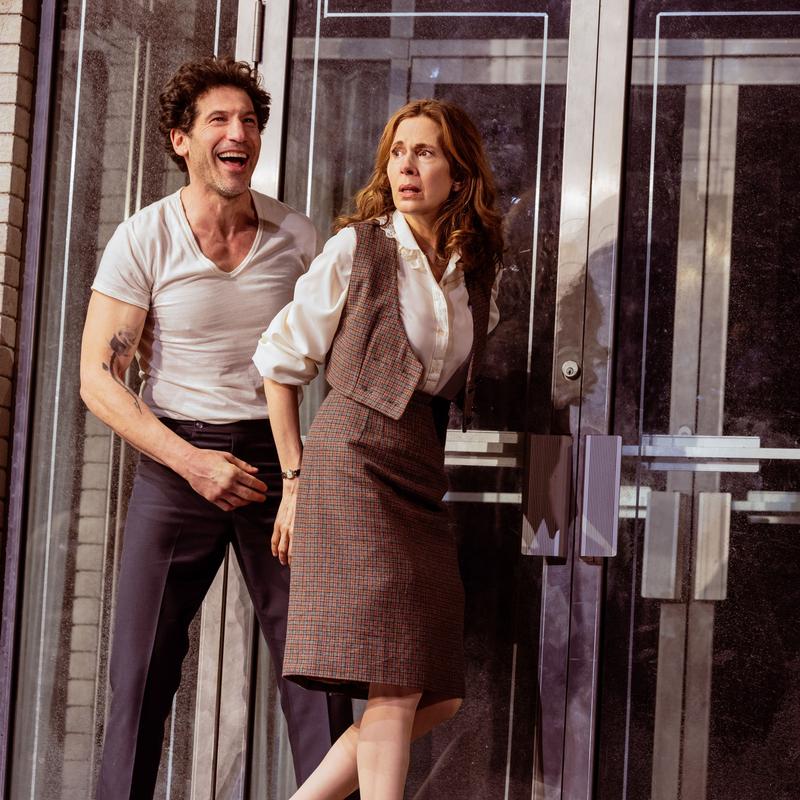
Jon Bernthal and Jessica Hecht Star in 'Dog Day Afternoon'
Alison Stewart: This is All Of It. I'm Alison Stewart, live from the WNYC Studios in SoHo. Thank you for sharing part of your day with us. I'm really grateful that you're here. On today's show, artist Julie Mehretu joins us to preview her new exhibition, which opens next week at the Marian Goodman Gallery. We'll talk about the people who actively shun popular culture with Atlantic writer Anna Holmes. That's coming up. Now, let's head to Broadway and Dog Day Afternoon.
[music]
Alison Stewart: Right now, at the August Wilson Theatre, the Broadway stage has been transformed into a 1970s bank on a sweltering summer day in Brooklyn. What seems like an ordinary shift changes when bank robbers walk through the doors. This is Dog Day Afternoon. The stage version of the 1975 Sidney Lumet film stars Emmy-winning actor Jon Bernthal as Sonny. He's a Vietnam vet who has hatched a plan to rob a bank for very personal reasons. Sonny has brought his friend Sal along with him. Sonny can be reasoned with. Sal, not so much. Sonny's master plan goes south fast.
One bank teller, a woman named Colleen, tries to wrest back some of the control of the situation. She's played by Tony Award nominee Jessica Hecht. Colleen quickly develops a rapport with Sonny, as she tries to make sure the rest of the employees get home safely and maybe even get Sonny what he wants. After shots are fired, it becomes more difficult for Sonny and Sal to see their way out. Dog Day Afternoon is running now, and I'm joined now by actor Jon Bernthal. It is nice to meet you.
Jon Bernthal: So nice to meet you, too. Thanks for having me.
Alison Stewart: Welcoming back to the show, Jessica Hecht. Hi, Jessica.
Jessica Hecht: Thank you for having me.
Alison Stewart: Dog Day Afternoon is based on a real story that was turned into a film. When you first saw the film, what did it leave for you? What did it leave for you as an actor?
Jon Bernthal: Oh, wow. For me, look, indelible, right? I think for so many, so much panic and so much spiraling and reeling. I think at its core, it really is a love story. It really is about the lengths that we'll go to for love. I really think that at the kernel of this play, I think that's really what it is. I don't think that this is just a representation of the movie. It's a real story about real people. I think it's very paramount and very much our jobs to honor those people and honor for me, honor that love.
Alison Stewart: What did you think about the film when you first saw it as a viewer and then as an actor?
Jessica Hecht: Well, when I first saw it, I think I was quite young, so [chuckles] I reflected on it probably just based on the stuff that was polarizing and scary and reactive. When you see things before you're an actor, you have a whole different viewership. When I watched it, actually several years ago, that was a moment of character actor, a kind of abandon of these actors, who were probably known quite a bit for stage as well.
They were able to make these parts iconic because of the detail. When I look back, and I see Penny Allen, the great actress who played the head teller in the film, and Marcia Jean Kurtz, and my friend Carol Kane, the nuance of what they could do with those parts and the freedom that he allowed was really inspirational. I think that's what we've tried to infuse the play with a little bit as well.
Alison Stewart: It seemed like it was so alive.
Jessica Hecht: Oh, good.
Alison Stewart: You know what I mean?
Jessica Hecht: Yes, yes. The film. Oh, I thought-- obviously, I thought you-- [laughs]
Alison Stewart: The play as well.
Jessica Hecht: Yes, the film was genuinely alive in iconic 1970s. You think about all those films, The Taking of Pelham One Two Three. They're just totally free.
Alison Stewart: Jon, you're a trained actor, a theater actor, but it's your first time on Broadway?
Jon Bernthal: Oh, yes.
Alison Stewart: What's different about Broadway?
Jon Bernthal: Oh, man. Look, I think for the theater in itself, I really believe that the theater, not to be too grandiose about it, but it really did save my life. Moving to Russia as a young man and training over there, I was really shrouded in a culture where theater is vital and where the ability to have a public gathering is so sacred, because that's not something that everybody can do. Especially, it was palpable in the time that I was in Russia, that was not just a rite.
It was something that was enormously sacred, enormously rare, and something that people had to fight for. All my teachers came from that world. I love that there's nowhere to hide. I love how dangerous it is. I love the communication with the audience. I love that we can really hold a mirror to society. I love that in this piece specifically, we get to really talk about how far we've traveled since 1972, and also the fact that maybe we haven't moved even a bit. There's been no distance, and how harrowing that is. I'm so thrilled to be here. I'm so thrilled every night that I get the shot.
Alison Stewart: This is your 12th Broadway show. Is that true, Jessica?
Jessica Hecht: Yes, or maybe almost my 13th.
Alison Stewart: It's amazing when you think about that. What does a part need to have for you to get excited about it?
Jessica Hecht: Oh, gosh, that's such a gift of a question. It has to have language that I think I can figure out and have an experience with. I think the truth of acting for me has to do with the way people talk. I was so gifted to do several of Arthur Miller's plays, which are on the one side of the spectrum where he's trying to approximate real people the way they really speak in these subcultures. Then I'm so grateful to have something written by Stephen or something written by Sarah Ruhl where the language is a kind of poetry. I can figure that out and find a real person who speaks that way.
Alison Stewart: My guests are actor Jon Bernthal and Jessica Hecht, who are in the new Broadway show Dog Day Afternoon, based on the 1975 film about a Brooklyn bank robbery gone wrong. It's running now at the August Wilson Theatre. Okay, Jessica, imagine what Colleen's day was like before the bank robbers showed up. What is it like?
Jessica Hecht: [laughs] Well, she fed her bird and her cat. Those are her two creatures she takes care of. She had a very long day of catering to customers that she has history with. She was hit on by a few of the gentlemen who come in. She just thinks she's five minutes to go before she can get out of there and take care of her animals. It's a very detail-oriented job. She's very customer-friendly and very serious about the fact that most of the women that work there are capable of doing much more than work at a bank. She's a little bit frustrated with the limitations of her job.
[laughter]
Alison Stewart: What's going through Sonny's mind before the show starts, before we see him?
Jon Bernthal: Oh, boy. I would also like to say in Sonny's mind, robbing a bank is also a very detail-oriented job.
[laughter]
Jon Bernthal: Unfortunately, he's surrounded himself and found partners who don't share that same unbelievable attention to detail. I think at the core of the piece, again, it's a love story. I think what's going on with him is doing this for Leon. I think he realized he's made just an unbelievably grave and an awful mistake in not seeing and fighting for the love of his life, and for the love of his life to be exactly who they are and to be who they are and let them walk in the shoes that they want to walk on this planet.
He's reeling from that. He's heartbroken. I believe that love can cause the most grandest of gestures, and I think that's what this is. I think he's singularly focused, but there is history of him working in a bank as well. I think he feels like he's got this all tied up and that he knows exactly how this is going to go, and then it's just a comedy of errors after that.
Alison Stewart: Jessica, the relationship between Sonny and Colleen is kind of tricky. What does Colleen see in Sonny?
Jessica Hecht: Oh, she finds him to be quite cavalier. There's aspects of his charm that seem old school to her and a desire to do this without too much stress. I think she fantasizes that he is somehow like a Robin Hood in his best moments, and maybe a potential drinking partner.
[laughter]
Jessica Hecht: She gets frustrated that he reveals himself to not be as fine a planner as she hoped. She really feels that. She says at the end, "You're not selfish. You're actually doing this for love, and you're letting your emotional state control you." I think she prides herself on having self-control. That is like his flaw. She gets through a lot of crap in her life without breaking down. I think that she really sees somebody who's heroic in that way until the end of the play, when he can't meet that expectation.
Alison Stewart: What does Sonny see in Colleen?
Jon Bernthal: Oh, boy. Her strength, her sturdiness, her unbelievable ability to not be carried away with emotion, her bravery. [clears throat] Excuse me. She's so solid. It's such a joy for this whole process to work with Jessica. I just can't tell you. She's just been such a lighthouse, such a pillar to look at just in terms of her talent and her grace and her wisdom. There's a lot of the actor, too. I think it's equal parts, an unbelievable person, unbelievable performer. I think Colleen is everything that Sonny isn't, that she knows how to regulate her emotions, and maybe even to a fault. Maybe he just wants to break that up just a little bit and get her to feel just a little bit, and maybe he can get a little bit of a win there.
Alison Stewart: Sonny's a veteran. How do you think that factors into his character?
Jon Bernthal: Look, I think there's a lot. I think there's a lot of this piece that explores masculinity. I think as a father of sons, that's something I'm very, very interested in exploring. I try to do that with all my work of different kinds of men, and what it means to be a man. One of the real joys for me in this piece is to have my sons, to have all my kids, but my sons especially, to see this brand of love, and that a man can be a soldier, and that a man can be a loyal friend, and that a man can act from his heart and act with passion. A man can have any kind of love under the sun, and that it doesn't define us. It doesn't define character, and that love is love. It was a real joy for me to be able to bring my sons to this piece.
Alison Stewart: My guests are Jon Bernthal and Jessica Hecht, who are now in the Broadway play Dog Day Afternoon. It's running at the August Wilson Theatre. I want to talk about the set. The set is dynamic. It's by David Korins, who's done 20 shows, including Hamilton and Dear Evan Hansen. The set, it rotates. On one side is the bank, and then it rotates, and you go to the outside area. How does the set help you get into character and help tell this story? We'll start with you, Jessica.
Jessica Hecht: Oh, it's meticulously designed, and so you're in a space that really-- so I was seven, 1972, when this would have-- so it brings me back to going to the bank with my mom. The specifics in the detail, unparalleled, the way David works. You are immersed in this. Then, as it moves, you really feel this transformative power that you can be in this space and be completely true to what your character would do.
Then there's this theatricality that the set literally lifts you into, and you will suddenly be transformed to another place. It also makes the other characters look incredibly cool and sexy as they swagger around. There's a moment when Jon walks from one space to the other, I won't tell you the moment, where you are watching somebody take over a situation. That is all under the foundation of these rooms that David has provided for us. It's pretty exhilarating. It's like a ride. You have to use your core a lot.
[laughter]
Jessica Hecht: A lot of moving, yes.
Alison Stewart: Really? Are you serious?
Jessica Hecht: Yes. At one point, our director was like, "Jessica, just tighten your core when it moves." I was like, "Oh, God, I'm showing myself." He goes, "No, it's not that you're slumping. It's that I don't want your body to move so much as this--"
Alison Stewart: That's so interesting.
Jessica Hecht: It throws you. Jon never looks like he's being thrown for a ride. To me, I look like I'm about to be. [laughs]
Alison Stewart: Is there any period of the '70s, the costumes, the writing, the music, that really gets to you, Jon, that puts you in the mood?
Jon Bernthal: Oh, I think all of it. Once the music, there's so much great-- I just feel like it was this apex of culture with the movies, with the music, with the clothes. The clothes are so detailed and so beautiful and so wild and so expressive, so much. As soon as that music pops on from the beginning, we're right there. I think what's even more interesting for me, because the film is so iconic and the story is so much a part of all of our upbringings in our hearts and our souls, is that when we do actually go and bring the audience in.
There is this really, really just fun scene with Jessica and I and the audience and involving the audience, and you get to look out at the audience, and the lights come up. The audience is really given permission to respond and become a part of the show, and become the crowd. Again, a testament to the genius of the set. It's all so inclusive. You can see the joy of everybody else coming into the '70s. It's really real. It really happens in this piece. You can see these folks light up.
Alison Stewart: Well, we're talking about the Attica.
Jon Bernthal: Yes, that's what we're talking about.
Alison Stewart: Everybody knows what we're talking about. We come on the stage, and the fourth wall breaks a little bit because Attica starts. I was like, "Am I supposed to chant this now?" I wasn't quite sure if I was supposed to. People around me started chanting, so I was like, "I'll do it, too." I wonder, what is that moment like for you?
Jon Bernthal: You go.
Jessica Hecht: It's why you do plays. It's why you do plays. First of all, Jon sets it up magnificently because it goes from being this street piece, what we're trying to have this insular dialogue, and then it goes into classical theater where he's speaking to the audience about ideas and about who we are as people and what we should be doing with our lives. I'm totally carried away as a character, but also as an actor, listening to him.
You get high off the fact that you're in an oratorium. You just experienced what theater was built on. The idea that there could be call and response within a piece that wasn't available to you, and that somebody who's sitting there, some very bright, cultured person, is suddenly screaming, "Attica," [laughs] is just an awesome accomplishment. Jon and I always rate the audience when we leave based on their Attica. [laughs]
Jon Bernthal: It's a giddy moment of joy afterwards.
Jessica Hecht: We're like children. We're like, "We did it."
Jon Bernthal: I also think right at that moment, too, with all that going on and this just invitation that's accepted night after night of the audience to get so involved and to become so childlike and, yes, to really, really discuss a Trojan horse. What I think develops into a really cogent way of, again, showing how far we've come, but these are the same issues that are playing us. You can see that realization in the face and in the souls of the audience.
It's also the moment in the play where Colleen and Sonny really become joined, because it's also really about these two people. We do it together. She's so into it. She's the one that really gets the audience on board, and she's the one that says, "Attica." It treats the source material with such sacredness. At the same time, there's an irreverence and an originality to it that I so love. We have so much fun doing it. The audience, it's a really fun part of the show.
Alison Stewart: We're talking about Dog Day Afternoon. We'll have more after a quick break. This is All Of It.
[music]
Alison Stewart: You're listening to All Of It on WNYC. I'm Alison Stewart. My guests are actors Jon Bernthal and Jessica Hecht, who are now in the new Broadway play Dog Day Afternoon. We should say that Sonny's partner, Sal, is played by Ebon Moss-Bachrach. You guys are friends. How did you end up in the play together?
Jon Bernthal: Oh, gosh, yes, we've worked together. My first gig ever was understudying him in an off-Broadway play in 2002, Lanford Wilson's the Fifth of July. It was such a joy for me as a young actor. I was the understudy for all the male roles. Just to go every night and to be able to sit in the audience and not have to pay for a ticket and just to watch, I was filled with such joy. Ebon just struck me as such a dynamic and interesting performer. He always works on the off-rhythms. He always approaches things from this totally unique and slanted take. Then, from there, we worked together in various TV projects. We did a film together. We just wrote something together, and it made it. It's going to come out soon.
Alison Stewart: Oh, that's exciting.
Jon Bernthal: Yes, and I love him. I love his family. Since we were working together so much, he knew. He kept really up to date with how this was. He just started asking me about it. Of course, it was just such a thrill for him to sign on. He's just a guy. I trust him so much. Again, like Jessica, equal parts, insanely incredible artists, and beautiful human being. Those are the folks I want to go into battle with.
Alison Stewart: Jessica, Sal has a more dangerous energy than Sonny does. He also really, really does not want to go back to prison. How does Colleen grapple with the fact that Sonny can be reasoned with, can be talked with, while Sal is a little more of an uneven character?
Jessica Hecht: Oh, it's such a good question because you think that somebody can be a hero in many situations, but the actual ability to deal with somebody who potentially is mentally ill is terrifying. I think she tests him a lot throughout the play until he has one moment where he proves himself to be truly unstable. That's when she really gets scared. She wants him to be accountable as well. She's very religious, so I think she prays a lot. [laughs] That she has been around people who are unstable her whole life.
It's so funny. The backstories that we all engage in to figure out the justification for our dynamics with people. I know Ebon quite well as well, not as well as Jon, but I did the Three Sisters with him many years ago with Maggie Gyllenhaal and her husband Peter. Ebon has a kind of truth as an artist in terms of allowing language also to speak about what's going on inside of him. You feel that when he says he's one step away from killing himself. I think that's what keeps Colleen in relation to him for the rest of the play, yes.
Alison Stewart: Jon, we don't know that much about the backstory between Sonny and Sal. What conversations did you and Ebon have about the relationship before that day?
Jon Bernthal: So many. Look, these are real people. More than anyone, I think that's something Ebon just keeps trying to drive home. Let's represent these people. Let's honor these people. It's a really good question. There was also a book that I read that's pretty pulpy, the Dog Day Afternoon book. That is not necessarily truer to life than the film, but it's another take. It was informative. It's interesting because I think when you talk about friendship, and you talk about good friends, as Ebon and I are, we really are brothers, there is a level here of manipulation.
There is a level here of betrayal. These things really are being explored. Sal provides a certain service. Sonny is very much using Sal. He does have this ability to say what he wants. It's a question that comes up, is if you're really acting out of the goodness of your heart, if you're really acting and fighting and striving and yearning for love, does that make it okay to manipulate somebody and bring them into something that's dangerous for them, and calling on their worst and most hardened characteristics?
I do believe that there is this life that I imagine and that I've read about, and I'm so interested in, about the West Village in the late '60s and the 1970s. Such a rich history of people really finding themselves for the first time to go to a place where they can really be their true self, and the unbelievable freedom of that. I do believe that that's the world in which Sonny and Sal really knew each other and bonded.
Coming from the world that Sonny comes from, which is much more regulated, so many eyes on you. You behave a certain way. A man is supposed to be one way. A woman's supposed to be another. So archaic. I do believe that in this burst and beauty and bliss of the freedom that they shared in the '70s, that's really where that relationship was forged. It doesn't necessarily make it any less of a betrayal or any less manipulative, even if you have an ability to really speak from your heart and get people to do what they think is the right thing to do.
Alison Stewart: For those who know the story, part of it is rooted in gender and sexuality. There are issues at the forum from politics today. There's a trans character who is central to this story, and the way we think about and what we've learned about mass incarceration and gender roles, I think, in 2026. What do you think of the production of Dog Day Afternoon? Why does it make sense in 2026?
Jessica Hecht: Oh, it makes complete sense. Apart from the obvious, which is that we sadly have not moved forward as much as any historian would have hoped, I think that the story of abandon and the story of what one might do for a political or social impact has not changed, both from the violent things we see on our streets to the compassion people are expressing towards one another out of desperation. Also, this actual play is just full of a kind of ritualized abandon that we go through as a cast, and the music and the way in which we say, "We are ready to break through something. We are ready, and we need to. We need to have empathy for people." I think the play is infused with that messaging.
Alison Stewart: What do you think, Jon?
Jon Bernthal: I totally agree. I think it's so much about the haves and the have-nots, about the forgotten. I think Stephen is singular in his ability to write about the kind of forgotten and overlooked New York. Again, we've traveled so far, and we haven't gone anywhere. I think there are so many things that both bring up-- there's a section in the play where John Ortiz's character, the detective, talks about that. They're right on the cusp of fingerprint identification in terms of law enforcement.
Now, we have cameras everywhere. We can catch criminals. That seems so archaic. Yet, we are dealing with the same things, with armed people on the streets taking shots at people, with people not being able to live their true selves without people being able to love who they want to love, without prejudice, without discrimination, without brutality. We're right there.
I also just think that this idea of the good guy versus the bad guy, the haves and the have-nots, being forgotten, saying, "Hey, today, I'm making a stand. Today, I'm going to be heard," I think that is so much at the core of his writing. I think it's so much at the core of this specific cast and this specific production. We are out there holding our fists high, and we are going for it every single night. That's really what's at the core. We're going out there with a bit of a chip on our shoulder.
Alison Stewart: There are a lot of adjustments that are made to the script throughout the whole process of the film, and some internal disagreements about what changes should be made. How do you work through those changes when you're putting up a show?
Jessica Hecht: Oh, you cling so tightly to your scene partners. I think that's the essential thing. There's something extremely unique about the way Jon works because he's spent so much time recently on film. To be really fluid on stage requires tremendous skill and a kind of lack of ego. I think that to be really in collaboration with changes, you have to be in collaboration, actually, with your scene partner.
Not as much as with the writer, as much as what can you say to one another? Jon figured that out with every single person who had changes. I will say also that you rely on your director. We had an extraordinary director in Rupert Goold, who told us what to be mindful of and not to worry about the picayune line, whether we got it right, but to worry about the picture, the show. He's an incredible craftsperson, Rupert, and I think that we owe him such a debt of gratitude for his service, his craft, his old-school craft.
Alison Stewart: We've realized, I've seen the movie a million times. I know what's going to happen at the end, but there are audiences who don't know what the end is, right?
Jessica Hecht: Most. [laughs]
Jon Bernthal: Absolutely.
Alison Stewart: Which is interesting to think about. Did you think about that as the creative team? There are people coming in who don't know the end.
Jon Bernthal: I think we really want this piece to stand on its own. That's for sure. We want it to be its own thing. That's for sure. I think it had to be, based on just Stephen's take and Stephen's writing and Stephen's brand, for lack of a better word. What hits me every single night, you can hear a palpable gasp in the audience when Sonny says he's a homosexual. At first, you guys don't know what this-- Also, I find that so unbelievably refreshing because what we're also seeing night after night is it's folks who have never been to theater before.
We are bringing in so many people who have never done this before. That is such a thrill for me as somebody who didn't grow up going to the theater. I'm completely in love with it, and I'm completely in reverence of its power and its necessity. The fact that folks are coming in night after night to see something that they don't know what they can expect, and they're walking away so happy, is a real joy. It's a real thrill for us.
Alison Stewart: Jessica, what does this play capture about New York and New Yorkers?
Jessica Hecht: [laughs] That we really care about each other, that we'd fall on a sword. It just recaptures the whole subway mentality. [laughs] I know I'm not supposed to swear, but just don't mess with this car of people. That's what it tells everybody. I love that we have people coming in who are New Yorkers, and you're like, "This is what we're made of, man." [laughs]
Jon Bernthal: That's right. That's right.
Alison Stewart: Jon, what do you hope audiences leave the theater talking or just thinking about?
Jon Bernthal: Oh, I love the way that audiences are leaving the theater. I think, again, not a spoon-fed way or a preachy way, but to get us to really look at where exactly we are right now. I think, for me, again, what's fundamental for me specifically about Sonny, and I think with everything that's happened in this process, for me, Sonny is a man who is up against it.
He's a man who has been told to sit in the corner and shut up, and he's not going to do it anymore. He's going to fight for this love, this beautiful love that might not look like love to somebody else, but you better believe it is love. I love that audience is at the end of this piece. The kernel of this piece is about community. It's about love. It's about coming together to fight. In this unbelievable crisis is a beautiful opportunity.
Alison Stewart: The name of the play is Dog Day Afternoon. It's at the August Wilson Theatre. Jon Bernthal and Jessica Hecht, thank you so much for coming in.
Jessica Hecht: I just adore your show. I'm so sorry to be so fangirly, but thank you for doing what you do for New York City. [laughs]
Jon Bernthal: I've definitely been saying that for many years now. I can attest. Thank you so much for having us.
Jessica Hecht: Take good care.
Copyright © 2026 New York Public Radio. All rights reserved. Visit our website terms of use at www.wnyc.org for further information.
New York Public Radio transcripts are created on a rush deadline, often by contractors. This text may not be in its final form and may be updated or revised in the future. Accuracy and availability may vary. The authoritative record of programming is the audio record.