
Jeff Ross's One-Man Broadway Show Comes to Netflix
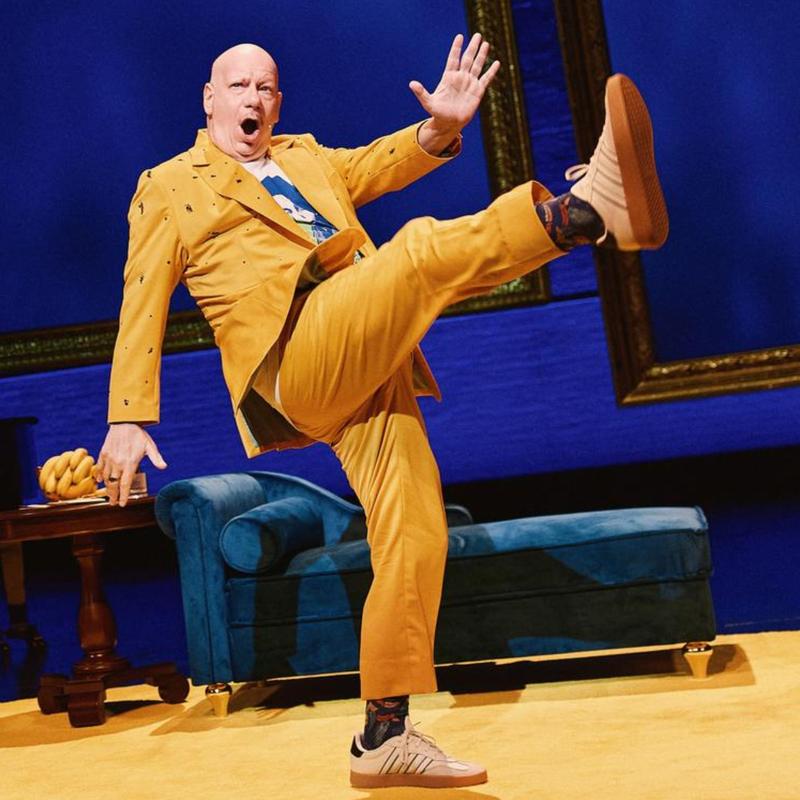
Alison Stewart: This is All Of It on WNYC. I'm Alison Stewart. You might expect that a Broadway debut from Jeff Ross, a man known for comic roasts, would be full of jokes, but his show, Take a Banana for the Ride, is also full of a deep appreciation for life. That is because Jeff Ross has survived the dark times with humor as an aide. He grew up in Jersey, where his parents ran a catering hall until his mom grew ill and died when he was 14.
His dad did his best with the kids and tried to live life without his wife, using cocaine as a way to cope. He passed away when Jeff was 19. Since then, Jeff has battled cancer and lost three of his closest friends within a few months. Jeff Ross: Take a Banana for the Ride is available to stream now on Netflix. When he joined us in our public radio station to talk about it, we actually began by taking a trip down memory lane to when Ross was an engineer at Boston Public Radio.
Jeff Ross: Yes. This is my people.
Alison Stewart: You were like Juliana.
Jeff Ross: Hi, Juliana. Way to go.
Alison Stewart: Did you really work as an audio engineer in public radio?
Jeff Ross: Oh, my work study job was editing audio tapes with a razor blade and chalk, the way it's meant to be done, and then I was the fill-in board operator for Car Talk and Morning Edition. Shout out to my NPR people all over the East Coast. [chuckles]
Alison Stewart: Nice. When you were in school, what did you want to do? Did you want to be in radio? Did you want to be a comic? What did you want to do?
Jeff Ross: I didn't even dream of being a comic when I was in college. I wanted to write, and that took me, before even that, to radio. I was music director and a DJ in my college radio station, WTBU in Boston, which was on carrier current. My sister and her friends would fax requests. It was really primitive.
Alison Stewart: I was music director at WBUR in Providence.
Jeff Ross: Oh, wow. Pretty cool. That was my dream to just be on the radio. I tried to get jobs coming out of college, and it didn't really click. I wound up making training films for a health and beauty aids company here in Manhattan, and my heart wasn't in it. My pal Mark, who I'd gone to college with, said, "I think you should take this comedy class. It's right near Port Authority. It'll be convenient," since I was still living in Jersey with my grandfather, and that was it. I was in love.
Alison Stewart: In your bio and Playbill, it said that you started--
Jeff Ross: Can you say that again, slower?
Alison Stewart: In your bio in Playbill-
Jeff Ross: Wow, that's so cool.
Alison Stewart: -you said, "I first started writing and performing at an early version of the show almost 30 years ago, but I didn't quite have the emotional fortitude to finish it." 30 years ago, getting the way back machine, what was your original goal when you were writing it?
Jeff Ross: It was one of those happy accidents where the alternative comedy scene was popping up in New York. We were not using microphones. We were using new spaces that weren't comedy clubs. It was more for our community and a way to try different things. I wasn't really popping as a traditional comic. We would do storyteller shows. Michael Ian Black would sell stuff from his apartment, and Marc Maron would just tell a story about a trip he took. Janeane Garofalo, David Cross were all doing what we called alternative comedy.
I didn't want to be left out. I told a five-minute story about my grandfather picking me up at Little League practice. An executive saw that, and said, "That was really good. How many of those do you have?" I said, "I could probably string three or four together." He goes, "If you can get a half hour together, I'll come see it, and I'll book you at the comedy festival in Aspen for HBO," because that was a big deal. My goal was to tell these stories in a convincing way and maybe get some traction for my career because traditional microphone, punchline standup wasn't quite taking off for me. It was really just a way to express myself and get seen.
Alison Stewart: What made you bring it back to life?
Jeff Ross: I did it 20 or 30 times in a couple of years back in the mid-'90s, and I found myself cranky and confused and just headachy afterwards. I wasn't trained to leave it in the dressing room. I knew the show was good because people would constantly bring it up and say, "Oh, I still have a tape," or, "I still have the old poster from that old Take a Banana for the Ride show," and was basically a tribute to my parents and my grandfather, my pop Jack, who I lived with during my open mic days. I would act out his voice, and I played film clips of him. I wear his ring to this day. It's a steel bolt-
Alison Stewart: So cool.
Jeff Ross: -from a captured Nazi U-boat from World War II. He was a shipbuilder in Baltimore, and he stole a bolt and made a ring out of it. It wasn't till decades later, when I lost three pals, Bob Saget, Norm MacDonald, and Gilbert Gottfried, right within eight months, that made me look back at the old show and go, "What was I talking about back then about mourning and resilience and how to get through it?" Now, I learned that I can make a silly bruised banana suit, wear that, and when the show's over, take it off, leave it in the dressing room, and then be myself. Go out to dinner and then put it back on when I get back to the Nederlander Theater the next day. I've gotten a little more thick skin, if you will.
Alison Stewart: You work with Seth Barrish, the co-founder of the Barrow Group. He's a well-known director and an actor. He's your dramaturg. He helps shape a show. How did he help you shape the show to be a Broadway show?
Jeff Ross: Interesting. I wanted to have experts help me along. I came into this very humble, knowing Broadway expects an elevated experience and a story. I designed the show more like a concert originally, where I have a love letter, a new bit, an old bit. I don't want to say borrowed because I would be reading my parents' love letters, but it was like an Italian wedding of sorts. Something new, something old, something borrowed. I was always patterning it off Bruce Springsteen concerts.
He would do two slow ones and three fast ones, then a sad one, then a sing-along, then he'd put the lights on, and everybody would sing along, and then he'd go back to-- I always liked keeping people on their toes. I wanted the show to feel like a roller coaster, a roaster coaster, if you will, of emotions. As I thought about elevating it to Broadway, I realized a story, making it literature, if you will, a play, stuff I grew up on, the stuff that I love, was going to be important to the audience, and also a fun experience for me to elevate the show. Seth listened to my stories about my colonoscopies, about my family, and our director, Stephen Kessler, and I got a lot of very useful knowledge from Seth Barrish, who has directed so many great plays.
Alison Stewart: It's interesting because it does have a beginning, middle, and end to it as opposed to just story after story after story.
Jeff Ross: Yes. That was the goal. Originally, I'm not sure it did. It had a little bit of that, but Seth helped me carve out what the core story should be, and mostly really helped me with what he called the landing. Getting the end of the show.
Alison Stewart: A good chunk of the show is about your parents, Marcia and Ronnie.
Jeff Ross: Yes.
Alison Stewart: In the movie, you say your mom looked like Delta Burke looks-wise, but in terms of her personality, her spirit-wise, who would have played her in the movie?
Jeff Ross: In a hypothetical movie, you're talking about right now?
Alison Stewart: Yes.
Jeff Ross: Oh, my God. I look at my mom, and I go, "Sophia Loren's dead, so she couldn't do it." My mom was that rare beauty that was also sharp. She would act out stuff at her B'nai B'rith meetings, and she would write me funny letters from the hospital, and I'd write her funny letters back when she was sick. The hospital was far away. Boy, that's a good question. For some reason, Marisa Tomei jumps out at me. I love Rachel Bloom. She would be great.
Alison Stewart: Oh, she'd be great.
Jeff Ross: She would be great as my mom. Boy, this is a fun game. I never thought about this really before.
Alison Stewart: You were living in Jersey. A good part of the show, you talk about your mom, your dad. Actually, you read their love letters on stage. What went into that decision?
Jeff Ross: [laughs] They're not here to stop me. I definitely sometimes feel like it's intrusive to their--
Alison Stewart: Beings, wherever they are?
Jeff Ross: My sister will occasionally say, "I don't think mommy would like you saying this line or that line." My sister was just here for a couple of weeks for the opening of the show. I said, "I've seen other celebrities--" Not celebrities, but you'll see a Lucille Ball movie about Lucy, and I go, "Oh, yes, they probably wouldn't like all of that either," but sometimes their story serves a greater good, which is helping living people understand their lives a little bit better. I do think my parents would appreciate that and endorse that. It gets very intimate, and sometimes it's hard to read that stuff.
Alison Stewart: Do you cry?
Jeff Ross: I do cry during the show sometimes.
Alison Stewart: I always wonder if you get emotional or it distance you from being a performer when you're on stage, and you're discussing stuff that is really very personal.
Jeff Ross: I know most actors, they get to take the costume off, and the wig off, and the microphone and they go home. I take some of it off, but I leave with my real dog, my real family, my real memories. I'm living in the character. In fact, I emptied my storage unit when I got to town, so I'm living with my grandfather's false teeth in a box next to me and his union card and my parents' love letters, 30 of them, piled high. When I'm feeling it, I break them out, and I read it and it helps me understand the show and the character better. I don't use all of it in the show, but it keeps me very grounded into what I'm doing and why I wanted to keep their spirits alive. It's a lot.
Alison Stewart: What did you want the staging for the show to look like?
Jeff Ross: I always knew it should be simple and not too on the nose. Beowulf Boritt does a lot of big Broadway shows and feel very lucky that he took this one on. It's a credit to the material. I was so flattered that he looked at it and said, "Yes, I have an idea." We went back and forth a couple of times and came up with something I think was inspired by a picture I showed him of my great-grandma Rosie from the 1950s, looking like the Queen of England with a mink stole and a gown, and a rose in her hair. It was on a big, gold, ornate frame. That became a series of 24 circular frames that make this beautiful family album that you see when you come into the theater.
Alison Stewart: Where do you keep all those photos when they're not on stage?
Jeff Ross: In my kitchen, in my living room, on the dog bed, in the bathroom, in the closet, in my pockets. They're everywhere. I'm not organized. The fact that the show got finished is a miracle.
Alison Stewart: A lot of the show is about you and your grandpa. You mentioned him early, Grandpa Jack. He would say, "Here, take a banana for the ride."
Jeff Ross: Yes.
Alison Stewart: That is his way of saying, "I love you."
Jeff Ross: I love that.
Alison Stewart: Why did he show his love that way versus just saying, "Hey, I love you?"
Jeff Ross: He was a retired construction worker from the Bronx. A tough guy. A world beater, he called himself. For that type of guy, he was very vulnerable. He would give you the hug and the big wraparound pat on the back, but men don't always talk like that. That's one of the fun things about doing it on Broadway. It allows men, mostly who are afraid to be vulnerable, to be vulnerable. I look out at the crowd, and I see guys tearing up. I'm seeing a lot of father-son groups coming to the show, and also daughter-father groups coming to the show. It's a multi-generational thing.
Right before I started the Broadway run, I was going through my parents' stuff, and I found a letter my dad wrote to me the day I graduated high school. I'm 17, and he lists 17 things he's proud of. For a guy that I lost suddenly from a cocaine binge, I guess, he almost knew he was going to be gone. He wrote me this beautiful letter that gives a crescendo to that part of the show. I think it's resonating with guys. Broadway, there's a lot in there for the ladies, but I think I worked really hard to make sure my roast fans and dudes were seeing something-
Alison Stewart: Your dudes?
Jeff Ross: -that they might not see at Mamma Mia, or whatever.
Alison Stewart: You do manage to get your roastmaster on in this show. At the end, you come off the stage, you walk around the audience. What's the premise of this?
Jeff Ross: As much as the show-- and it really means a lot that you came and you're speaking as an eyewitness, so you know what's happening. I talk about my own life, but throughout it, I don't say, "Me, me, me, I, I, I." I go, "When you go through stuff like this, and some of you people know that, it becomes hard to get close to people." I want it to be inclusive, where if I talk about my grandfather, I want you to see your grandfather. If I talk about my dog, I want you to see your dog also. I don't hit you too hard with the photos. I want it to be where you can see your own life in my story.
Then at the end, when I'm done talking about my life and my experiences and my mechanisms for survival, I just leave the stage, and I put on a bag of bananas, and I say, "Who's going through something intense? Who's celebrating something? Who's just gross? Who just needs attention?" People start popping up around the room, and they earn their banana with an insult. I give away free produce at the end, and I make the point that it's not just the fight, it's the army, and the audience is part of my army.
They give me purpose, a reason to be healthier, to eat less red meat, to get out of bed, to do these eight shows a week. If it was all about me, Alison, I would be bored already, but because it's about the audience and this immersive, interactive finale that the show has every night, it feels like the fireworks at the end of a show. I'm all in. I can't wait to get to work tonight.
Alison Stewart: Are there any good stories that are good for public radio that you can share?
Jeff Ross: About what?
Alison Stewart: The people you run into in the audience?
Jeff Ross: Oh, yes. I had a lady there with her son, and she was very emotional after hearing my bout with colon cancer. She stands up, and she's already been crying, and she bravely says, "My husband has had Alzheimer's for two years." Her son is holding her hand, and he's a big, tall, gangly kid with long hair and a little goofy. I let her talk about-- I asked her her husband's name, and I dedicated the show to her husband. Then I said, "But quite frankly, looking at your son, the fact that your husband has Alzheimer's seems like the least of your problems, lady."
Now her son is laughing hysterically. They both get bananas. We all hug, and we're having these really sweet moments inside this caustic comedy moment. It really is the yin and the yang, the sweet and the sour, whatever you want to call it. People are laughing and crying at the same time, which isn't attractive, but it's very cathartic.
Alison Stewart: That was my conversation with comedian Jeff Ross. His one-man Broadway debut, called Take a Banana for the Ride, is available to stream now on Netflix.
Copyright © 2026 New York Public Radio. All rights reserved. Visit our website terms of use at www.wnyc.org for further information.
New York Public Radio transcripts are created on a rush deadline, often by contractors. This text may not be in its final form and may be updated or revised in the future. Accuracy and availability may vary. The authoritative record of programming is the audio record.