
Howard University's New Podcast 'On The Yard'
Alison Stewart: This is All Of It. I'm Alison Stewart, live from the WNYC studios in SoHo. Thank you for sharing part of your day with us. I'm really grateful that you're here. On today's show, we'll get some tips for handling professional rejection and how to use it as an opportunity. We'll also hear from the original cast of Broadway's Operation Mincemeat, who exit their roles later this month. We'll check out a Harlem gallery show featuring the work of two close friends. That's all coming up. Let's get things started with a dive into the archives of Howard University.
A new podcast mines the archives of Howard University to tell the stories of the people and movements that shaped history. It's titled On the Yard. Through photographs, letters, rare books, film, and everyday objects housed at Howard University's Moorland-Spingarn Research Center, the show explores the lives of historical figures, their ideas, political and social movements. For example, a recent episode examines what Gordon Parks's work reveals about the 20th-century Black experience. Another episode reflects on the tenure of Howard University's first Black president, Mordecai Johnson, as well as an episode on the legacy of student protests.
On the Yard is out now. You can listen wherever you get your podcasts. Joining us to discuss is Benjamin Talton, host of On the Yard and Executive Director of the Moorland-Spingarn Research Center. Ben, welcome to All Of It.
Dr. Ben Talton: Thank you, Alison.
Alison Stewart: Also joining us is Dana Williams, Professor of English Literature and Dean of the Howard University Graduate School, who is featured on the episode of On the Yard podcast about protest. You may remember her from her appearance on this show for her excellent book, Toni at Random. Hey, Dana.
Dana Williams: Hey, Alison. Glad to be here.
Alison Stewart: It's nice to talk to you again. Ben, the Moorland-Spingarn Research Center at Howard University hosts one of the largest archives in Black history in the United States. When you think about the research center, what are some of the most noteworthy items you have? Just to give people an example.
Dr. Ben Talton: First of all, Alison, let me just say I'm a huge fan of your show. I'm a member of WNYC, a proud New Yorker. This is an honor. My wife is smiling. Yes, I'm a Howard alum. I spent a lot of time as an undergrad at Moorland-Spingarn. That setup you did for the podcast was beautiful, by the way. Hopefully, we could just crib it and just use it always.
Alison Stewart: It's yours.
Dr. Ben Talton: That was absolutely perfect. The Moorland-Spingarn Research Center, for New Yorkers, we could say it's like the Schomburg. That's our sister institution, but at a university. We're the university's archive. We say we're the largest privately owned repository of books, ephemera, and artifacts on the global Black experience. We're proud to say in the world, so many gems. It's hard to pick one or two. We could say Frederick Douglass was one of the longest-serving members of our board of trustees, iconic abolitionist, writer, essaysist, most photographed person of the 19th century. We have some of his papers downstairs. I'm sitting in my office on campus right now. I can go two stories down and have my hands on handwritten notes from Frederick Douglass.
We also have collections from Paul Robeson, Lucy Diggs Slowe, the first African American woman dean of any university in the country, and also organizations like Jack and Jill of America, AKA Sorority, Incorporated, Congressional Black Caucus, TransAfrica. You see, I do this for a living, so I can go on and on. We have countless gems downstairs in our archive. I'm very excited to bring some of these treasures to the public through the podcast.
Alison Stewart: Why did you decide this was the right time for the podcast to start?
Dr. Ben Talton: Good question. I don't have a perfect answer. All I'll say is, I'm a historian. Dana and I have been speaking about this for four years. I'm a historian. I could write a book on Howard's history. Very few people get their history from books written by people like me. Dana and I always talk about: how do we get Howard's history, Howard's culture to our students first and foremost, and then to the wider public? We have a beautiful exhibition on Gordon Parks's photographs in our museum.
We have the podcast. We have the International Black Writers Festival. We have public speakers who come to campus. We want to work through a multiplicity of ways and venues to get our materials to the public. The podcast, I thought students first, but Howard as a window to the global Black experience. Podcasts are popular these days, so let's go for it.
Alison Stewart: Dana, let me ask you, why did you think now was a good time to start a podcast?
Dana Williams: It was so important for all of the reasons that Ben mentions, but top of mind for me, too, is we're at a time when opportunities to access our history are shrinking instead of growing, unless you make them publicly accessible. Everyone can't come to Howard's campus to Moorland-Spingarn, even as the campus is open. There are people who work in our public service unit who cringe at the fact that the campus is that accessible, but we are excited about it as academics. We want people to come in, but everybody can't come in. Everybody can hear about what's there and learn a lot. My own experience with it, for instance, as I was working on the Toni at Random book, when I went to look for Toni Morrison at Howard from '49 to '53.
Discovering the James Butcher papers and seeing pictures of her on the stage as an actress literally blew my mind. Had I not been in Moorland-Spingarn and seeing that, I would not have known, had not an archivist pointed me in that direction. The podcast gives us the opportunity really to say, "Here are all of the gems that are there, and anything that piques your interest, take a listen and see what you can find."
Alison Stewart: Ben, explain to people why it's called On the Yard.
Dr. Ben Talton: Most universities have a quad, and we have an iconic quad. We call it "The Yard." It's right in the middle of campus. The buildings around it were designed by African American architects, Albert Cassell, Hilliard Robinson. It's the central meeting place for students. It's where homecoming takes place. It's when sororities and fraternities have their probates. When they come out in the spring, this is where they come out and show themselves to the public. It really is the center of campus. We used to say that when we were undergrad, "I'm going to meet you on The Yard." "Where are you going to be?" "I'll be on The Yard." "Where's it taking place?" "On The Yard." The idea is to bring The Yard, which is the center of our campus, to the world.
Alison Stewart: Dana, what does The Yard mean to you?
Dana Williams: All of those things. I'm almost getting goosebumps as I think about it. It's this sacred place. I'm remembering too, the year that Kamala Harris was the commencement speaker, beautiful address, incredibly remarkable. Then Eleanor Traylor gives this address, where she talks about "The Yard," and the place goes wild. It's like this funny moment where Kamala Harris is like, "Who's this woman? How did she upstage me?" I thought about that most immediately because all of the things that The Yard means to people, it's the convening space. As Ben said, the sororities and fraternities there on Fridays at noon or Wednesdays, if it's Pretty Wednesday, the Diaspora Tree, where the Caribbean students are. It's really a global place.
It reminds me too of that notion that we see in Kwame Ture's Stokely Speaks, where he says, "At Howard, you got everything and its opposite in the African world in one place." On The Yard, you see everything and its opposite. You got students who could pay everybody's tuition. You got students who don't know where they're going to make it through the rest of the week. The Yard is a place where all of those folks come together, and we get to have ciphers and hash out ideas. You got the swing from conservatives to the most radical working out ideas, really, in the interest of the global Black community.
Dr. Ben Talton: I get goosebumps, too. I think about every major figure in America. That's an exaggeration. Many major figures in American history have spoken on The Yard, literally on The Yard, Muhammad Ali when he's protesting Vietnam, Rankin Chapel, which is on The Yard, Martin Luther King, Kwame Nkrumah, first president of Ghana. Graduation takes place on The Yard if it's not raining. It's an intersection into all facets of American and global history.
Alison Stewart: We're talking about a new podcast that delves into the archives of one of America's most prominent Black research institutions, Howard University. Historian and host Benjamin Talton and Howard University Graduate School Dean Dana Williams join us to talk about the history of the institution and their new podcast, On the Yard. Ben, when Howard started in 1867, what kind of institution was it?
Dr. Ben Talton: Howard was founded by the Congregational Church in DC in 1867. Many, we call HBCUs were founded in this era. This is post-enslavement. Some were founded earlier than that, but many founded the question of, "What do we do with the formerly enslaved?" Being in Washington, DC makes it unique because we're in the capital city, and we also are designated by congressional act to exist. One of two universities, with Gallaudet, to have that designation. We are founded, and to shorthand, we could say we're founded out of racism because this is before the 14th Amendment, which allows for birthright citizenship and due process under the law. "What do we do with the formerly enslaved? We don't want them in our white schools, so we have to create alternative schools for them."
HBCUs really grow out of white racists, to be frank. Howard was founded to educate the formerly enslaved, to educate and be nurses, ministers, doctors, to lawyers to the formerly enslaved. As we always say, "Howard was founded to educate Black people, but not to educate Black people about Black people." That's why our episode on "Power of Protests" we speak about the second founding of Howard University in the 1960s, when the students are deciding, "This is the type of students we want to be, this type of citizenship we want to have, and this type of university we want to have."
Alison Stewart: It's interesting, Howard did not have its first Black president until 1926. Dana, it was Mordecai Wyatt Johnson. What were his priorities as a leader?
Dana Williams: Really, a lot of the things that are still emblematic of the place now. Excellence across multiple academic disciplines. He wanted to continue the range. Howard is one of the few in the city founded as a university to begin with, not as a college, because they wanted the range of different disciplinary specificities, a med school, a dental school, a law school, a theology school, and then liberal arts education. I think the classical training that Mordecai Johnson had received himself is the expectation for the training that he wanted for students at Howard. Academic excellence, yes, but then operational excellence as well.
I think there was also an impulse to ensure that Howard could serve the needs of the communities that it served and was in community with. Then I think we also see the first turn towards the global under Mordecai Wyatt Johnson.
Alison Stewart: That's very interesting. Let's listen to a clip from the podcast. This is Dr. Krista Johnson, Professor and Director of Howard Center for African Studies, describing Johnson's influence on the university's curriculum. This is from On the Yard.
Dr. Krista Johnson: I think it's important to recognize and understand that the founders of Howard University they weren't progressive in the sense that they believed that Black people had any history worth teaching, or that this was going to be a place where we could educate Blacks about their own culture. That wasn't part of the initial agenda. It was really only until Mordecai Johnson came in as president that you built up a critical mass of faculty and also discipline, certainly in the social sciences, where the Black experience was put on the agenda as an intellectual site of study, but also a source of knowledge for the Black community and for academia broadly.
Alison Stewart: Ben, where did Mordecai Johnson look for talent for faculty members?
Dr. Ben Talton: One of the issues that we had in the mid-20th century into the 1960s, is that many African American intellectuals didn't have anywhere else they can go except for Black universities. They couldn't teach at white universities. Howard, being the most well-endowed private, being in Washington, DC, we benefited from the location to attract these talents on here. Not to say that there weren't already very talented people here, but he almost tripled the size of the university, quadrupled the size of the budget, really, as Dana's saying, purposely made it an international institution. He was very deliberate about Howard being the center for the study of Gandhi's nonviolence.
He's going to build that up through hiring Benjamin Mays to be Dean of the School of Religion and Howard Thurman to be Dean of Rankin Chapel. These are all folks who are global in mindset, very Pan-Africanist, but also have a valorization of what Gandhi's doing in India as a model for what African Americans are going to do in the 1960s. In fact, I'm talking about On the Yard before Mordecai-- Well, no, this is during Mordecai, the first lunch counter sit-ins were launched from The Yard. This is a group of women, mostly freshman members of the NAACP chapter here on campus, marched down to U Street in the neighborhood of Shaw, which is predominantly African American, but the lunch counters were still segregated.
This is in 1943, so 17 years ahead of Greensboro. This is under Mordecai. They're taking him seriously. He's saying, "We're the center for the study of Gandhi's nonviolence." "Well, let's put that into action." Then we run into some tension because we get federal appropriations. You have these young ladies on U Street protesting segregation, screaming equality, and then members of Congress don't like that too much. That becomes a problem for Johnson. He handled it very savvy. He doesn't shut it down, but he just gives advice that "Let's protest, but let's not put the university's funding in jeopardy." It's a complicated space that he had to occupy.
Alison Stewart: Let's talk about your episode on protest, which was excellent. It's interesting because we have a call on Line 1, and James went to Howard in the '60s. James, do you want to start us off telling us about your experience at Howard? James? You there? Are you there? No, James is not there. James will be there in a second, and James is going to go. Hey, James. We're having difficulty with our board.
Dr. Ben Talton: I would love to hear from James if he was on campus in the '60s.
Alison Stewart: He said he was there during the time of the demonstrations, and he remembered how it was handled much better than the Columbia demonstrations at the time. Dana or Ben, would you explain what happened during the 1960s demonstrations?
Dr. Ben Talton: Go ahead, you take that, Dana.
Dana Williams: Well, it was a battle for the soul of the university in some ways, where the students were reflecting what was happening in the country, where you saw what some people tried to depict as these stark divisions. I would argue that they never were as stark as SNCC, the young folks, and the elders. I think everyone was clear that you had to have people on both sides. It was a good cop, bad cop situation. The students insisted they wanted a Black university, which meant that they had to study topics that were of relevance to what was happening in the world, as African countries are declaring their independence and throwing off imperialism.
"What does it look like to continue to be in a colonialist model of education on paper or formally?" To be clear, it was always happening in both places on campus. One of the things I've done with some things from Moorland-Spingarn, for instance, with the med school, as I think about medical humanities work, is how we foreshadowed some of the disciplinary so-called innovations because we didn't have a choice. Textbooks for medicine would talk about what happens when your skin turns pink. Well, Black people's skin doesn't turn pink, or at least some shades of us don't. What we would see happening is we would follow the traditional textbook, but then we also had the external thing that was happening.
Part of what the students were asking for in that protest is, "We don't want that thing to be on the periphery. We want to be the center of the space." I also think about it in the context of the way Du Bois described it, where you're the center of the world. That doesn't mean anybody else is on the periphery. It just means your home space should be valued and completely privileged. Faculty were supportive, administrators were supportive, but you also had to figure out how to do the thing that Ben mentioned before. "How do you navigate that in a world that's on fire and expecting you to toe the line?" Students said, "We don't want to toe the line."
What administrators and faculty were able to do is to say, "This is your university at the end of the day. We have to make it what we want it to be." It's a little bit different from the Columbia moment in the sense that I think you had administrators who were either publicly or secretly supporting and ensuring that the moral conscious stayed at the center. There was never an equivocation around, "No, we will not be this." It was, "How do we negotiate being that thing that we want to be?"
Alison Stewart: Actually got Ben back up. Got Ben back. We got James back.
Dana Williams: Not Ben back, James.
Alison Stewart: James, are you there?
James: Yes, I am. I went to Howard in '67. I started in '67, and we had a campus takeover by the students in 1968 at the same time, if not before, Columbia University. One of the triggers for taking over, besides the Black historical perspective, was that there was mandatory ROTC, Reserve Officer Training Corps, for all Black males on campus. We didn't mind having the option of participating in military training, but to make it mandatory right at the time of the Vietnam War was a trigger for many of the young men who may not have been very articulate with regard to Black history in itself.
What I liked about our takeover, I worked on the switchboard, was that, as opposed to Columbia, where there was a decimation of the campus itself, we strove to keep the campus unharmed. We didn't break windows; we tried to upkeep the buildings that we had taken over. It was very enlightening in that environment, and Washington, DC, taking over the university for those legitimate reasons.
Alison Stewart: Thank you so much for calling in, James.
Dr. Ben Talton: I love that.
Alison Stewart: Ben, what's your response?
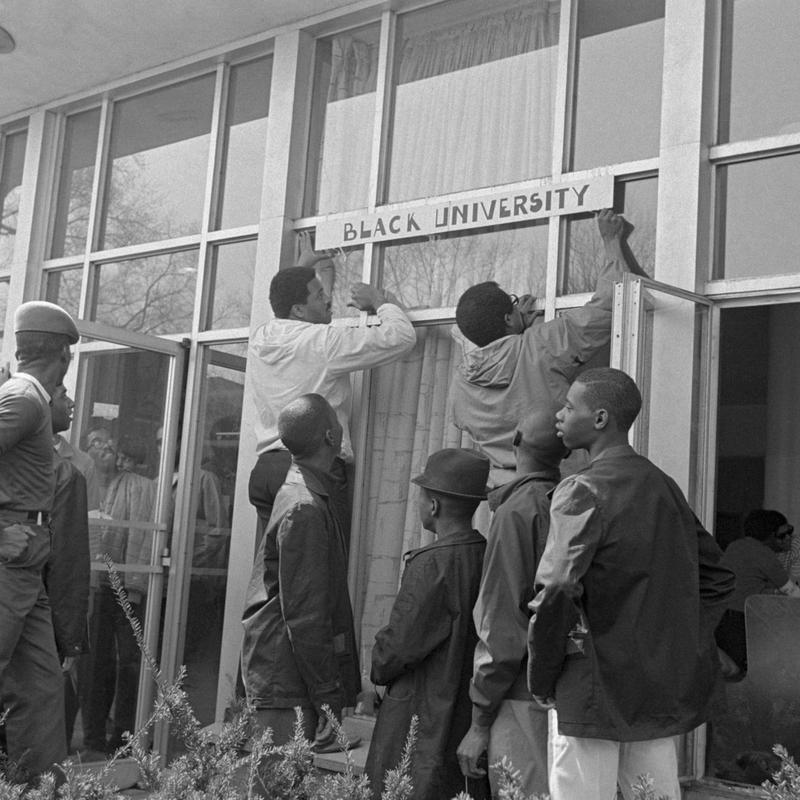
Dr. Ben Talton: Thank you, James, for that. For context, we're in the James Nabrit year. This is the second Black president. We're talking about Mordecai Johnson, first Black president. In '60, he leaves, and James Nabrit comes in as the second Black president. What James points to, and I've heard different iterations of this, it's just how well organized these protests were. People had roles, they had meetings, they had study groups, and they had trainings, and also the idea that there's so much respect for the campus not to break windows, not to do graffiti on buildings. Where they put up a sign on the building, "Black University," they were declaring, "We're renaming this Howard University Black University." It was a declarative statement, but also the different forms that these protests took.
It wasn't just '67, '68. Dana could speak better on this than I can. First of all, Howard, as I alluded to with Pauli Murray and Co., Howard has a long tradition of protest on The Yard. We think about the two-year campaign to get a homecoming queen that was allowed to wear her unpermed hair, Robin Gregory in '66. That was a two-year campaign, I believe, by law students. You think just wearing your natural God-given hair was a form of protest. Also, some of the classes that professors were offering. We're the first university to consistently teach African history as a class.
Leo Hansberry, the professor who taught this class, got pushback from the university, but the students demanded it. Students were enrolling in it. The protest, let's just say it's a 30-year process. It's taken all sorts of forms. It's not just taking over buildings. It is that. It's teaching classes. It's wearing the clothes that you want to wear and the hair that God gave you out of your head.
Alison Stewart: Has working on this podcast challenged your thinking about anything in thinking about the school and thinking about the curriculum? Have you had to stop and think, "Wait a minute. Let me rethink that." Dana?
Dana Williams: I'll say yes. It has changed me in two ways. As an administrator, I struggle to really walk that line. Fundamentally, I'm probably more radical than even my parents would have been excited about, so trying to find ways to support the students, but also being mindful of what our limitations are. A big part of it for me in terms of the change is I move towards transparency and as much information gathering and say, "Let's get the best folks in the room and let's find a solution." That's my disposition. The other part of it that changed me is I am challenging myself to stop the dodges. Here's what I mean.
One of those classes that came out of the '67, '68 protest was an intro to humanities course where we read the "Great Books." The Great Books did not include any books outside of traditional Western culture. They reorient the syllabus to say, "We're going to make sure that the Great Books also include other books from other traditions." To be clear, it's never just Black. It was like, "We have to have Native cultures, we want to have Asian cultures, we want to have African cultures included." The thing that has challenged me is to gain some content mastery over those things as well, so that I don't have to do dodges, like, "We can't read everything, and we can't know everything."
We can at the very least do something other than gesture towards something like, "Oh, well, we borrow this from South Asian cultures," or "We see reflections of this story from beginning to end." I'm challenging myself now to read more of that literature so I can be a better teacher, so that students aren't just saying or hearing me talk rhetorically, but they understand what it means to have that information in their arsenal.
Alison Stewart: How has it changed you, Ben?
Dr. Ben Talton: I'm a historian already, but it really made me appreciate Howard's history. I've grown frustrated with coming up with ways to get that out there. I wish history was part of the fabric of this university. It's not. In these conversations, more and more administrators, faculty, and even students, I was just meeting with a group of students just before we went on, are really trying to grapple with this history and bring it more to the fore, so just raising that awareness. You think about what happens to an institution if it's not aware of its path, even an individual.
Just grappling with the different ways in which we can get this information out there and remind them how important it is. These two students were in here, and Dana, you would love this because they want to celebrate '68. They did not know I was coming on this show today, because I have interns and they have to do an end-of-year project, and their project is going to be a Black university. "To what extent are we living the legacy of '68? How successful have we been and how much further do we have to go?" I said, "That's wonderful."
Dana Williams: Nice.
Dr. Ben Talton: Even in my frustrations, the students are everything.
Dana Williams: "Our job is done."
Dr. Ben Talton: "Our job is done for the moment."
Dana Williams: "For the moment." That's another thing, Alison, that I think is a part of the commitment to faculty at Howard, is jokingly we will say, "Our job is done," and it's for the day. That's it, because we can't just hand this off to students and say, "We did our part. Good luck." No, we're in community with them. We're walking, trying to improve the world with them.
Alison Stewart: Well, as a Howard adjacent--
Dr. Ben Talton: I'm sorry.
Alison Stewart: No, go ahead.
Dr. Ben Talton: Again, how do we bring this history to the fore and show its importance just walking around this campus? People come to DC, and they'll do a Black DC tour, but Howard's not on it. Howard is, I would say, along with the Frederick Douglass house is at the center of not just Black history, but American history. Our goal is not just with this podcast and these exhibits that we do in the museum, is to really mark out the campus as historic spaces: the buildings, the iconic Yard, and the individuals that were there. Five of the Divine Nine sororities and fraternities were founded at Howard University. We need to celebrate that history, not just on the days of the founding, but 365 days a year.
Alison Stewart: I was saying, as a Howard adjacent person, I'm so excited for this podcast. Congratulations on it. My guests have been Benjamin Talton and Dean Dana Williams. Thanks for joining us.
Dr. Ben Talton: Thanks, Alison.
Dana Williams: Thanks, Alison, and you're Howard family. You're not Howard adjacent. Come on through.
[laughter]
Dr. Ben Talton: Come on, Bison.