How Toni Morrison Brought Diverse Voices Into Publishing
Alison Stewart: This is All Of It on WNYC. I'm Alison Stewart from the WNYC studios where we're all braving this winter storm. Again, we wanted to remind you that our Get Lit with All Of It Bookclub event with Angela Flournoy at the NYPL has been canceled, so don't go. In fact, don't go anywhere if you don't have to. Please be safe, check in on your neighbors and settle in for a great hour of radio.
Today, we're revisiting my conversations with nominees at the 57th Annual NAACP Image Awards. You can watch them on CBS and BET. There have been some important announcements about the awards. The NAACP announced that Colman Domingo will be presented with the President's Award. It's for special achievement and distinguished public service. A$AP Rocky will receive the Vanguard Award for fashion, saying that he has, "Consistently challenged convention and reminded us that fashion is a powerful form of storytelling."
Viola Davis will be honored with the Chairman's Award. The Chairman's Award honors individuals who, "leverage their platforms to ignite and drive meaningful change." Coming up this hour, we'll talk to Nicole Beharie about the nominated film, Love, Brooklyn, which uses Brownstone Brooklyn as a backdrop to investigate a changing city and changing relationships.
Now, the NAACP recognizes excellence not just in films, but also podcasts, digital content creators, documentary filmmakers and books, which brings us to our next nominee, Howard Professor Dana Williams. You may have heard her on this show recently talking about the HBCU's first podcast called The Yard. She's also an author and she wrote about another author, Toni Morrison.
[MUSIC - Luscious Jackson: You and Me]
Alison Stewart: One of the interesting things about the NAACP Image Awards is that they don't just honor performers on the screen, but it also honors books. For example, the biography autobiography categories features books by Michelle Obama, Vice President Kamala Harris, Lionel Richie, and Dawn Staley, but also a book about Toni Morrison. Not about Toni Morrison, the writer, but the editor.
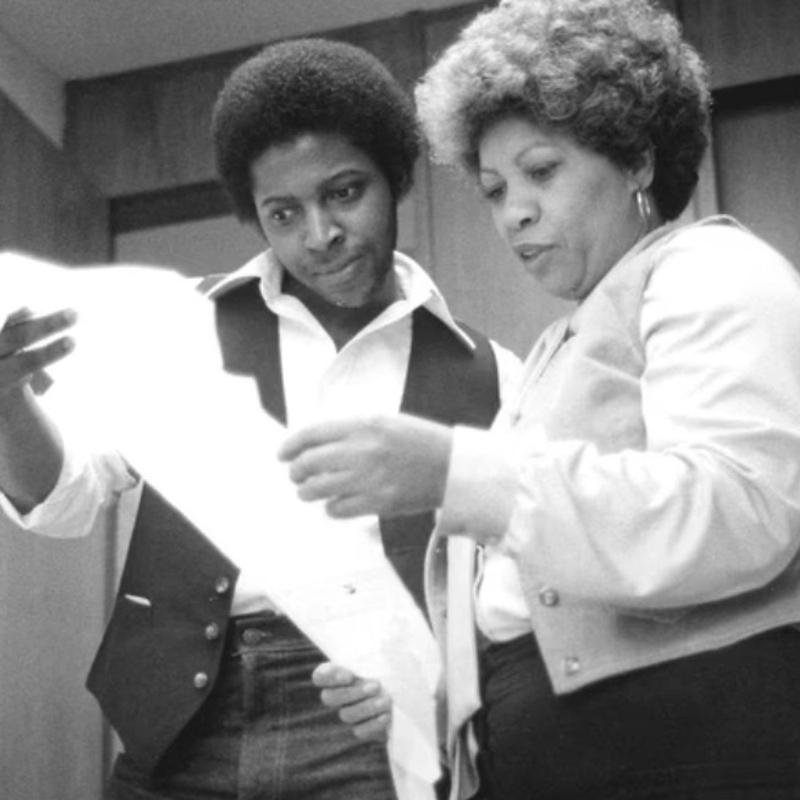
Before she was a famous writer, Toni Morrison was a senior editor at Random House, the first Black woman to hold that title at the company. She edited Muhammad Ali, Angela Davis, and Huey Newton. Before she passed, Toni Morrison picked my next guest to tell a story of her editing career. Dana A. Williams is a professor of African American literature and dean of the graduate school at Howard University. Her NAACP Image Award nominated book is called Toni at Random. Dana joined me in studio around the book's release and I started by asking her how she found out that Toni requested her to write this story.
Dana A. Williams: It was an interesting situation in the sense that she knew that I was working on the book. Actually, she knew that I had the idea for the book. She said, "If there's anything that I can do to be supportive, let me know." I said, "All right."
I do my interview, the first one with her at Princeton, and I want to talk about the fiction writers, because that was the plan for the book initially. "Let's just talk about these writers in this fiction and see if I can make these connections with Morrison." She then starts talking about Muhammad Ali, Angela Davis, Black Book, you name it, everything except fiction. How do you tell Toni Morrison, "Hey, this is not what we agreed on." [laughs] She was also such a great storyteller, so I just went with it.
Then the next time we had a conversation, she talked about the fiction writers for a short period of time, but then continued to talk about cookbooks and anthologies. I thought, "Maybe I'm supposed to be doing something else." It was several interviews in that I realized, "All right, I'm supposed to do this book on the larger editorship and not just on this thing." I appreciated the fact that she didn't say, "Ma', am, this is what you're going to do, but just let me find my way into it." Then once I got there, we chuckled like, "You finally got it." [laughs]
Alison Stewart: She was being an editor. [laughs]
Dana A. Williams: Absolutely. She was editing me. She was literally editing me, and I didn't know it.
Alison Stewart: All right. So once you all settle on what the book is going to be, what did you see as your job? What was expected of you on this assignment?
Dana A. Williams: One of the things that we started with was just really figuring out who should be on the list. She literally had a partial list. Then as I began to do research, I was like, "Oh, there's this book. Is this your book?" She's like, "Oh, I forgot about that book."
Alison Stewart: Oh, wow.
Dana A. Williams: The first thing we had to do was get a comprehensive list. Once we got that comprehensive list, we really decided to just tell the story the way that the story evolves in my narrative framing, if you will. The upside of it, too, was she was supportive, but not very hands off. She didn't say, "This is what we're going to do. This is how we're going to craft it. It was my book, my thing to do."
I had to find ways to tell the story so that it was accessible, but also so that it showed the full depth of the work that she had to; everthing from paying attention to covers, making decisions about titles, thinking about length, thinking about the cost of the book, who are the writers that she's going to recruit. It was really trying to find a narrative arc for the story that would make it really interesting for the reader. Of course, there's lots of B roll that my editor and I are saying couldn't make the book.
Alison Stewart: When you went through Toni Morrison's archives, first of all, what access did you have to her archives?
Dana A. Williams: The Columbia Rare Books room has the Random House archives, and so that's where I spent most of the time. You have to make the request to see whatever is available and accessible at any given time, but the team there, shout out to Tara Craig, was just great in terms of making sure that I could see anything that was relevant. Then her archives at Princeton were also a part of the conversation.
Then I also wanted to make sure that I got the other part of the conversation. If I'm looking at what came in the archive or the letter that came to her from June Jordan, I also went to Harvard to see what June Jordan sent and what she wrote back. Same thing with Toni Cade Bambara at Spelman, Lucille Clifton at Emory. I was trying to make sure that I saw both sides of the story, because the one thing you don't want is to miss something really important. That was a big fear, but I'm over it.
Alison Stewart: [laughs] What was a realization you had about Morrison's editorial process from researching her archives?
Dana A. Williams: That she was strategic in every way. I guess I should have known that because I think she is a strategic writer. We do away with the beginning, middle, end of the story. She tells us the story up front and then says, "Now I'm going to explain how this happened." I knew that she wasn't a traditional kind of writer. I didn't think about her as a traditional editor.
When you think about the fact that she was literally writing people who were teaching an MFA program saying, "If you got a really interesting student, send me their manuscripts." That's how she discovers Gayl Jones. Then trying to figure out, "How am I going to get Gayl Jones attention? Which of these manuscripts should I put out first? Who's the best person to try to pitch this to in terms of a review? What does the COVID need to look like?"
There are pieces of correspondence where she's literally working with a designer to talk about color, the color of the book. She says, "My last book was purple. This book can't be purple because if it ends up in the window and people are picking it up, their eye won't stop on it." She was meticulous and paid attention to details in ways that you think about for a writer, but as an editor, just really incredible.
Alison Stewart: My guest is Dana Williams, professor of African American Literature and dean of the Graduate School at Howard University. We're discussing her book, Toni at
Random, a history of Toni Morrison's work as an editor in publishing. You go back a little bit, you tell us a little bit of bio. She was born in Ohio, Chloe Woodford, in 1931. When you think about her childhood and her education, how did that inform her as an editor?
Dana A. Williams: I think she was curious even as a young person. I think she was paying attention to what was happening in books and wondering why certain images weren't there. She was very clear about that, even when she was at LW Singer, as an editor, that she wanted to make sure that certain books got published. Then I think just being a reader, having worked in a library, really trying to figure out-- and there's a chapter, in one of the chapters I call Finding Her Form. I really do think she was trying to figure out what art form was most important for her.
There's this beautiful line in Sula where essentially we hear that had she been a dancer, had she been a writer, if she had an artistic form, she would not have self destructed. Something similar happens in jazz. What we see Morrison doing as a child is figuring out what artistic form is going to work for her because she wanted to be a dancer. Then by the time she's at Howard, she's doing a lot in the theater and being an actress.
Then she knows that she wants to write, but editing becomes a part of that form as well. I think growing up in Ohio around the full range of types of people meant that she could hear sounds and process and begin to think about what difference means and how you appeal to different people's sensibilities.
Alison Stewart: What was going on with Toni when she learned about this opportunity at Random House?
Dana A. Williams: It was interesting. At the time, she had just finished teaching at Howard in the Department of English, where she taught humanities courses and English courses. She was still doing some work in the theater and working with young people and poets, a group of philosophy students who dubbed themselves the Howard Poets. Her time at Howard was up.
There was, and still is to some degree, a limit to the amount of time that faculty can be in an instructor position before they have to go into a tenure track position. She had not really tried to earn the PhD, so the seven years ended and it was time for her to find something else to do. She's divorced, she has one kid, and she's pregnant with another, so she has to go home to recalibrate and figure out what her next move will be.
Then the way that she tells the story is not one, not two, but three copies of the same New York Review of Books comes to her home, her mother's home. We talked about it a little bit and laughed to say they had to find her. There was probably a forwarded address. [chuckles] She gets the copy, and she decides, "I think I can do this job because I know what good textbooks look like, so I want to try to do some work with textbooks."
She starts at LW Singer, a really small textbook company that Random House acquires, and then, because she was memorable and impressive, when the executives from Random House come down to see who they're going to move to the Manhattan office, she's one of the people who gets an invitation to move.
Alison Stewart: You wrote about Random House. This is interesting. "By the time Morrison joined Random House, the firm was caught in the crosshairs of the failed attempts at racial integration that characterized the 1950s and Black people's growing intolerance for the slow pace and modest gains of the civil rights movement." What was the publishing industry like when she started at Random House?
Dana A. Williams: The mainstream publishing houses, including Random House, overwhelmingly, were focused on issues that were of interest mainly to mainstream White people. It was also at a time when Black publishers were still in their heyday, so most of the literature and most of the social commentary was published by independent Black publishers.
What she was trying to figure out how to do was how do we get the attention that we need so that there is this mainstream opportunity that's there, but that is mindful of everything from congressional hearings about representations of Black people in books in public schools. The way that Texas buys books and the way that California buys books essentially dictates-
Alison Stewart: Huge.
Dana A. Williams: -how everybody else comes to know and understand the world. It's just fascinating to me that this single person thought, "I can change that. I can do textbooks that I can convince school districts to buy," because there was actually a congressional mandate to try to do that.
Alison Stewart: My guest is Dana Williams, professor of African American Literature and dean of the Graduate School at Howard University. We're discussing her book, Tony At Random, about Toni Morrison's work as an editor in publishing. We'll have more after a quick break. This is All Of It.
[music]
Alison Stewart: You are listening to All Of It on WNYC. I'M Alison Stewart. My guest in studio is Dana Williams, professor of African American Literature and Dean of the Graduate School at Howard University. We're discussing her book, Tony At Random, a history of Toni Morrison's work as an editor in publishing. You interviewed a few authors that Toni Morrison edited at Random House. What did they tell you? What was their perspective of working with her?
Dana A. Williams: I appreciated so much how generous those authors were. In part, they said it was because Morrison had been incredibly generous to them with her time and her talent. Everybody said she made the book better. I know that's what you're supposed to say with your editor. When they gave me very specific examples, I could understand a little bit differently.
I talk a little bit about this particular story in the book with Angela Davis. The reticence that Angela Davis had about writing the book was the fear that it would have to be a tell all. That the only reason that the industry wanted it was because they wanted her to tell stories and secrets. She really wanted to continue to fight and be an activist in the movement. Morrison made sure that she could tell that story, and that was a fight. It wasn't easy because the industry did want to tell all. She said, essentially, "This is the book that she's going to get, and I'll guarantee that it's good. You'll get some information that you wouldn't otherwise."
I think Angela Davis was very clear that Morrison's prodding saying, "Angela, what did the room look like? What did it smell like? Describe it." What did you feel like? You're giving us facts. You're reporting. I need you to feel. Literally tell us what you experienced so that we can be there with you." I heard that over and over again, even with fiction writers.
When I talk to John McCluskey, who is delightful in every way as a fiction writer, and the way that he described the questions that Morrison asked. There's a really wonderful personal anecdotal story, too. He had driven up from the Midwest to have his meeting with her to talk about the contract. She asked basically, "Are you ready to go to lunch?" or, "Let's go somewhere?" He said, "My wife and my son are in the car." She just stops doing everything and goes downstairs to say hello to them because it was not just work for her. It was, "How do I interact with people on their own terms."
She got on a bus to go see William Hinton because he didn't really want to go to the city. I learned a lot just in terms of who she was as a personality with those editors, with those writers, rather, that she worked with. They appreciated how she would probe and prod until they got to where they needed to be.
Alison Stewart: How did she do with new writers, people that she found?
Dana A. Williams: That was fascinating, I think, because as a new editor, she didn't have a list. It takes a while for you to build your list. She's looking for writers, and sometimes people find her. The one who comes to mind most immediately is Leon Forrest, who is one of my favorite writers, I must say. Really, the way that I describe Leon Forrest to people, and they're like, "Leon Forrest, who's that?" I'm like, "Toni Morrison was his editor," and that gives him his [unintelligible 00:16:51] few days.
She finds him because her editor at Holt Rinehart, where she had done the Bluest Eye, says, "I like this book, but I don't exactly know what's happening in this book. I know somebody who might," and so he sent it to Morrison. That's how she kind of discovers Forrest. The editor had told Forrest, "You might want to talk to someone who may know what's going on. Here's her information." Morrison gets it. He gets Morrison's information.
Here's the thing that tickles me. Back in the day, you just called somebody. You picked up the phone, you called, and you said, "Hi. This person said to give you a buzz. Can you talk or can?" She says, "The next time you're in town, let me know." He was an editor for Muhammad Speaks out of Chicago, and he was in the city reviewing a Melvin Van Peebles play and says, "I'll be in town. Can we meet?" They meet, they talk, they discuss.
I think she was very generous with young writers, in part because she was a young writer herself, but also if she admired what you were trying to do, this non traditional way of writing, it was experimental, but then also books where she was clear. She wanted books of fiction that she edited to be similar to the ones that she did, and not in terms of style, but they had to talk to the audience.
The understood reader was a Black reader. That was really important that it wasn't someone who was writing for people who didn't see them. I think she was really attracted to writers who did that kind of work. Of course, she talks a lot about that's what she wanted to do. Being attracted to writers who do that is just really important.
Alison Stewart: We should point out that she is writing her own books at this time. How did that work? Did she write them for Random House? Gottlieb was her editor, right?
Dana A. Williams: Yes. She talked often about the benefit of having an editor on one floor and her being on another floor, like in-house. It was clear also that there would be somewhat of a conflict if she had an editor who was at Random House, so he gave her the choice-- Bob Bernstein gives her the choice to say, ""Do you want to work for Knopf or do you want to work for Random House? Who do you want to publish with and who do you want to be an editor for?" She decides, "I'll edit at Random House and I'll publish at Knopf."
Alison Stewart: In what ways do you think her experience as a writer helped her as an editor?
Dana A. Williams: Oh, I think the one that struck me the most immediately was Creole Feast, a cookbook that she worked on. People have talked about this. People who do food studies work and people who read literature pay attention to small things like recipes in the middle of a novel. In paradise, you learn how to make something in Song of Solomon. She goes into these details about how to make biscuits or a pot pie or whatever it is that she's making. Then I see her notes for Creole Feast, this cookbook of these chefs in New Orleans, and I go, "Oh, my goodness, this is how she--" She's a great cook, too, right?
Alison Stewart: Yes.
Dana A. Williams: Also, understanding how you take a recipe and make it narrative, because the chefs sent her ingredients and that was it. She's like, "Wait, I can't make a cookbook that says, 'A pinch of salt. Put a little salt. Boil for a while.' What order does this go in?" She tested a lot of the recipes for that collection also to say, "Hey, literally, I tested it, and these bars aren't holding up." [laughs]
The experiment of, like, "What do I do? In what order?" that was one way. Then I think there are just some nods here and there. One of the writers that she edited, Henry Dumas, was from Sweet Home, Arkansas, and so we know Sweet Home is the place in Beloved. When she read Leon Forrest, she thought, "If I want to think about how to write a sermon, I read Leon Forrest." I tend to think about Baby Suggs and the clearing and relation. I think it was a give and take. I think she learned as much as an editor as she did as a writer. I think she learned as much from her writers as they did from her as their editor.
Alison Stewart: Let's talk about her work with Muhammad Ali. What made Ali's memoir a unique challenge for Morrison?
Dana A. Williams: One thing was it was a book that she inherited. That always complicates relationships with authors. If you don't sign the person and you don't have the benefit of knowing personalities and all of the players early on, it can be tricky. She had to navigate that space. He also had to have, obviously, a writer. When he signs the contract for the book with much fanfare, everybody is excited.
Muhammad Ali is in the public imagination because he's been stripped of his license to box and he's going to tell the story. He's a larger than life figure just in a general sense because of his well known bravado. He gets his license back, which means he's no longer sitting down writing and working with his writer to make sure that he tells the story. He's back in the ring. They are years and years and years behind this contract that they've paid this big advance for. They're looking to her to say, "Should we just abandon this?" and she's like, "No. Let's hang in here. I think I can get what we need done."
Then he essentially says, "I know how I want this story to end. It will end with me restoring my title as heavyweight champion." When that's the case, one of the first telegrams that he sends is actually to his publisher to say, "I told you. Now we can end this book the way that we want to end this book." The journey really began to make sure that the book could be put together while the energy was still high."
When he reclaims his title, not a single chapter is complete, so then she has the writer come to New York. They work together for a month on the book nonstop, and then they're able to put the book to bed and to get it out with a 100,000 copy print run that sells out fairly quickly.
Alison Stewart: She wasn't that into sports, though.
Dana A. Williams: No.
Alison Stewart: Which is interesting. Which is interesting because it also shows to be a good editor, you don't necessarily have to be into the topic.
Dana A. Williams: That's right.
Alison Stewart: You just have to be a very good editor.
Dana A. Williams: That's right. You have to know what questions to ask and you have to anticipate what the reader wants. The piece that she does in promo, which was also a big part of her editing work after the book came out, she was really, really working public. Then she has this piece that she puts in the Times because by now she's somewhat of a famous writer, Why the Crowd Roar? She's like, "I'm not really that into sports," but this is a book that I'll stop to read.
Alison Stewart: What do you think Toni Morrison's legacy is in publishing as an editor?
Dana A. Williams: I don't think it's an exaggeration to say that she midwifed a whole generation of writers, writers that we might not have otherwise seen, certainly writers that would not have gotten the kind of attention. I don't know that Gayl Jones gets the kind of attention that she gets absent Toni Morrison, and that's because of personality.
I tend to think that Toni Cade Bambara would have been a shining star no matter what, just because she too had the kind of personality that people were drawn to, but I don't know that someone else would have taken a risk on publishing a collection of short stories. Short stories don't make money in publishing in the same way that novels do. I don't know that anyone else would have been able to convince Toni Cade Bambara to write a novel. I think the legacy that she leaves will be related to those books that she's able to publish with a certain level of excellence and with the expectation of greatness among the people she worked with.
Alison Stewart: That was Howard professor Dana A. Williams discussing her book Tony At Random, about Toni Morrison's years as an editor in publishing. The book is nominated for an NAACP Image Award in the outstanding literary work of autobiography and biography.
[music]
Alison Stewart: We'll go next to the story of another writer, Love, Brooklyn stars Andre Holland as a journalist struggling to find his voice and a love triangle he's caught in along the way. I'll speak to Nicole Beharie, who stars in the film, as well as director Rachael Holder.