
How to Combat Seasonal Affective Disorder
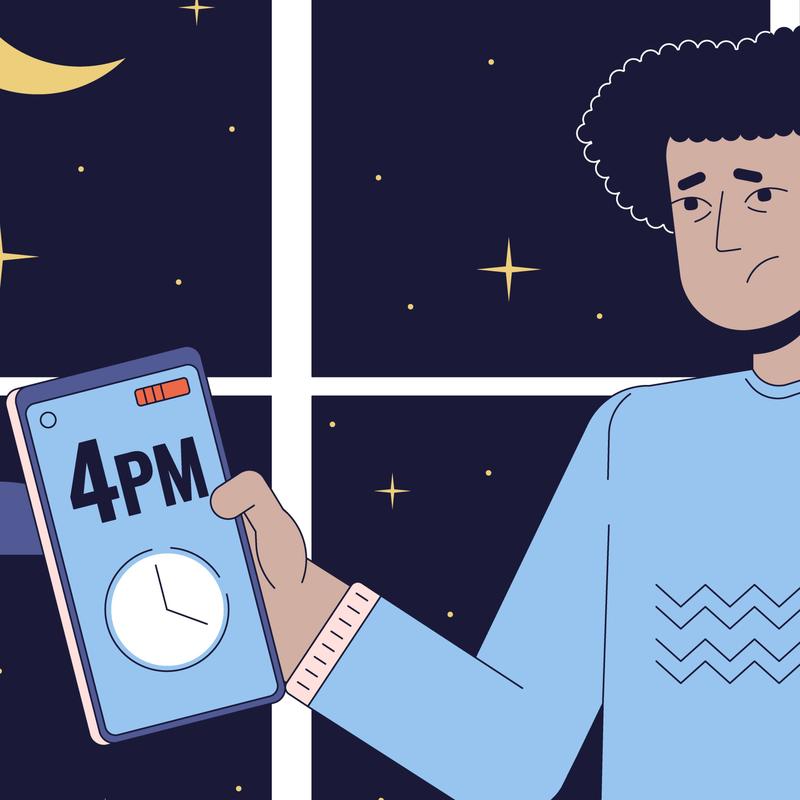
Alison Stewart: This is All Of It on WNYC. I'm Alison Stewart. The last few weeks have been especially cold, snowy with shorter days. That means a lot of time spent indoors. This time of the year can feel-- I think the technical term is "blah." For some, that shift can bring on seasonal depression, also known as seasonal affective disorder. Today, we're talking about what causes it, how it affects our mood and our energy, and most importantly, practical ways to cope. Here to share a few tips is Dr. Paul Desan. He is a psychiatrist and an associate professor of psychiatry at the Yale School of Medicine. Dr. Desan, welcome to All Of It.
Dr. Paul Desan: Well, thank you for having me.
Alison Stewart: Listeners, we want to hear from you. How do you cope with seasonal depression during these long, dark winter months? Have you tried light therapy, adjusting your sleep schedule, getting outside more? What's made a real difference for you? Call in or send us a text at 212-433-WNYC, 212-433-9692. Okay, just so we're on the same page, what exactly is seasonal affective disorder?
Dr. Paul Desan: Well, I'm always delighted when I'm invited by any journalist to talk about seasonal affective disorder. I think it's a very important public health problem, and there isn't sufficient information and understanding out there among the general public. In fact, a lot of people feel worse in the winter. If you hand out questionnaires, 90% of people feel worse in the winter. For some people, they feel so much worse. It amounts to what psychiatrists would call an episode of clinical depression. At the latitude we're at now, I'm in Connecticut, maybe we estimate 3% or 4% of people have an episode of depression every winter. Well, that's a major public health problem.
Alison Stewart: How is it different from other forms of depression?
Dr. Paul Desan: Well, that's interesting. People with the full episode of seasonal affective disorder, they tend to be a little distinctive. They tend to sleep more. In depression, usually, people complain of insomnia. In winter depression, people often report sleeping earlier in the evening, oversleeping, taking long naps, which isn't their typical pattern. The other difference is people tend to complain of increased appetite, maybe food cravings for carbohydrates or fats, comfort foods. Whereas in normal depression, it's more likely that people lose appetite and lose weight. The overwhelming symptom that is really common in winter depression is lethargy and fatigue, a loss of energy.
Alison Stewart: Who is at the most risk for developing seasonal depression, or does it not care? It could just hit anybody.
Dr. Paul Desan: Well, as I said, we think it's a basic human pattern. Of course, distance from the equator is very important. Here at our latitude, as I said, we think people with the actual full syndrome is 3% or 4%. If you go further north to Maine or Canada, a lot of our research we've done in Northern Europe because the incidence is higher. The further you are from the equator, the more likely you are to have a seasonal effect. It's the light-dark cycle, we think, that controls how human mood reacts in the winter. Another factor is gender.
Alison Stewart: Gender.
Dr. Paul Desan: Women are much more sensitive to the effect of season. Just in the population at large, if you hand out questionnaires to unselected people. Women are three times more likely to have seasonal affective disorder. Moreover, women who have seasonal affective disorder are more likely to have premenstrual mood changes. Women who have premenstrual mood changes are more likely to have seasonal affective disorder. For some reason that we don't understand, women seem to be more susceptible.
Alison Stewart: I was curious about, many cultures have longer days than we do, right? [chuckles] Are they more accustomed to it, or do they have built-in methods of handling? Folks in Alaska, for example.
Dr. Paul Desan: No, we think that seasonal affective disorder is more common the further north you go.
Alison Stewart: Really?
Dr. Paul Desan: It's an interesting question that certain genetic backgrounds might be more or less sensitive. Maybe if someone is from a particular ethnic group that has lived in those latitudes longer, maybe there's some diminished susceptibility. We don't have good research. Frankly, we don't have good research about ethnic and racial factors in medicine at all. As long as I got your attention, I'll make that free sermon.
Alison Stewart: Amen. [chuckles]
Dr. Paul Desan: No, I think even the polar explorers talked about the horror of being in darkness for half the year, and how they felt reborn when the sun returned.
Alison Stewart: Can seasonal affective disorder vary from year to year?
Dr. Paul Desan: Well, in psychiatry, everything adds up. People have different things going on in their life and how they respond. For example, I've had patients who changed jobs that were mostly indoors to jobs that were mostly outdoors. That had a profound effect on their mood. In general, people tend to feel the same way. They get to that point in October and November, right around the time we change clocks, and it hits them. The reason I'm really happy to talk to any public outlet about seasonal affective disorder is people tell us that they had this problem year after year, decade after decade in their life. In fact, there is a therapy that's very safe and practical.
Alison Stewart: We'll talk about that in just a moment. We're discussing ways to cope with seasonal affective disorder, known as seasonal depression in some folks, with Dr. Paul Desan, an associate professor of psychiatry at the Yale School of Medicine. Listeners, we want to hear from you. How do you cope with seasonal affective disorder during these long winter months?
Have you tried light therapy, adjusting your sleep? We want to know. 212-433-9692, 212-433-WNYC. We got a text here that says, "I have been trying to figure out what's wrong with me because I have summer seasonal depression, and I'm happier in the darkness and winter. My psychologist, when diagnosing my depression, said I should do a blood test to see if my vitamin D levels are higher in summer, or maybe I'm a vampire. What can you say about people who have summer seasonal depression?"
Dr. Paul Desan: Well, summer seasonal affective disorder is much rarer, but it's very real. It hasn't been nearly as much researched as winter seasonal affective disorder because it's harder to get the patients. They're simply rarer. Absolutely, I would like that person to pursue psychiatric care. It's not in your head. Some people really do have an inverted kind of seasonal rhythm and really are more susceptible to the onset of depression in the spring and the summer.
Alison Stewart: Let's talk to Amy, who's calling in from Princeton. Hi, Amy, thank you so much for taking the time to call All Of It. You're on the air.
Amy: Hi. Great topic. I have lifetime experience with this. I grew up in California, closer to the equator, lived most of my life in New York City with, of course, the bright lights at night. I've been living in the country for past two decades. The person who said about the summer seasonal affective disorder, I really relate to. I've solved a lot of the winter one for myself. The best thing I can recommend is natural daylight when it's dawn, or if you don't get up at dawn. Then, as soon after, if you have a dog, that's helpful. Just take them out.
You're not going to like it. Take off your glasses, even if they're prescription. Also, do it again in the evening at dusk. It really sets the circadian rhythms. I think when I deal with the summer stuff, for me, that's become a bigger issue. Because now that I'm more in the Northeast, sometimes in the Berkshires, which is further north, wow, you have to really figure out a blackout situation for your windows because it stays late so long. It's a real thing. I've been working on it, and I've had a lot of success with other ideas, too.
Alison Stewart: Thank you so much for calling in, Amy. This text says, "When my husband was ill, he couldn't go outside. I bought him a HappyLight, and that helped him feel a lot brighter." We've been talking about light. You've often spoken of the use of light therapy, Dr. Desan. Tell us a little bit about how light therapy works.
Dr. Paul Desan: There's been quite a bit of research with very interesting conclusions. Bright light is very helpful in seasonal affective disorder of the winter type. The body is most sensitive first thing in the morning. The listener who called in is one of those examples where people try things on their own, and they rediscover what millions of dollars of research has shown.
Alison Stewart: [laughs]
Dr. Paul Desan: The original work, they tried to treat seasonal affective disorder with bright light in both the morning and the evening for many hours. Turns out that that works. That turns the winter light dark cycle into the summer light dark cycle, but you don't have to do that. We think the consensus of experts shows that a half an hour of bright light, 10,000 lux, first thing in the morning. As the caller mentioned, you want to be as early as possible, certainly before 8:00 AM. That fixes the vast majority of people with seasonal affective disorder of the winter type.
Alison Stewart: You should do this in the morning. How about in the evening?
Dr. Paul Desan: Well, you can do it in the evening. Light is probably helpful to you anytime. Sometimes when you do it in the evening, that interferes with sleep. The research really suggests that minute for minute, the exposure in the morning is more likely to be therapeutic. I'm not going to say we have patients who do light all day or do light only in the evening. For the initial therapy, I think you should try the thing that research has suggested is the most potent, and that's exposure to bright light.
Now, you really want a proper device. You want a device that will give you 10,000 lux. Lux is a measure of how bright light appears to the human eye. That's like being outdoors in July and midday. You really want a device that's large and bright. If you go to Amazon, you're going to get some devices that are kind of marginal. A little small and a little dim. They won't really give you a convenient 10,000 lux. Now, if I'm telling you to sit in front of this for 30 minutes every morning, you want a comfortable kind of therapy you can really incorporate into your life.
Alison Stewart: We are discussing ways to cope with seasonal affective disorder with Dr. Paul Desan, associate professor of psychiatry at Yale School of Medicine. We'll have more of your calls and more with Dr. Desan after a quick break. This is All Of It.
[music]
Alison Stewart: You are listening to All Of It on WNYC. I'm Alison Stewart. We are discussing ways to cope with seasonal affective disorder, also known as seasonal depression, with Dr. Paul Desan, an associate professor of psychiatry at the Yale School of Medicine. Doctor, this text says, "I have always been affected by winter seasonal affective disorder ever since I moved to the northeast of the US. I am from the tropics of the Philippines, where I never experienced this. This year, I am taking vitamin D and K supplements. I think it's really helped me. It's also helped me to socialize in the daytime." That's Erica calling in from Brooklyn. There's two things there. One, what is the role of social connection?
Dr. Paul Desan: Well, that's a great question. When people get depressed, they tend to withdraw from activities that make them happy. They tend to sleep more rather than get out of bed and actually do something. They become exposed to less light. In psychiatry, everything adds up. There's the biological signal of light. This caller, by the way, tells us something that I've heard many times. When people are living at a latitude close to the equator, they don't feel any seasonal problem.
When they shift to the northeast, they do, so absolutely. One approach to depression is to make sure you don't stay in bed. You get up, and you go out. The previous caller mentioned walking the dog at the crack of dawn, getting every bit of that natural light. Some people don't need to actually purchase a light device. They make sure they get up and get out. For people who really have seasonal affective disorder, we recommend a proper light treatment device. Turns winter into summer.
Alison Stewart: Let's talk to Sarah, who's calling in from Brooklyn. Hi, Sarah. Thank you so much for taking the time to call All Of It. You had a question?
Sarah: Yes. Thanks so much for taking my call. Yes, I definitely struggle with this. One of the things I struggle with some of the remedies you guys are recommending is that I work shift work. I work nights. My circadian rhythm is constantly shifting between nights and days. I was wondering if you had any tips for people who do shift work and also struggle with these seasonal problems.
Dr. Paul Desan: Well, that's a tough question. Now, I have had some patients who have seasonal problems who are able to do shift work. I've had some patients for whom, obviously, the light-dark cycle was really important. They had real trouble with shift work. I hope you could work it out. We do think that bright light, first thing in the morning, helps people to shift their circadian rhythm. Some people use a light device to help them adjust when they have to shift between a midday or an evening or a night shift.
Alison Stewart: This said, "I pulled over to hear this segment on SAD. I've had SAD, seasonal affective disorder, for decades. Finally, medication Wellbutrin helped me, plus setting the alarm for early morning, and making myself get up and get out. Also, early AM exercise where I have to show up. Mine is Pure Barre. Thank you for the segment. Until meds, I would sleep or hibernate for 15 hours plus from October to April." That's Margaret calling in from Syosset. What's the role of exercise here?
Dr. Paul Desan: Well, I think that caller has really hit the nail on the head. First of all, I'll make a remark about medication. We always prefer to try light. We try what the patient wants. Usually, the patient prefers to try that first. For some people, antidepressants are very useful in winter depression. Wellbutrin is the one, the best, supported by research by us and by others. Other antidepressants probably work, too. The other thing that the caller has emphasized is not giving in to staying in bed all day, but getting up and especially getting up early and getting out and being active. I talked about how sometimes people's common sense and common experience rediscovers what millions of dollars' worth of research has shown.
Alison Stewart: A lot of people have been calling in and asking, "Where do I get the lights? Do LED lights count? What about my office lights?" When we're talking about the light that we should get, where should we go for them, those kind of lights? Is there something that we should ask the retailer to make sure we get the right kind of light?
Dr. Paul Desan: Well, one thing you can do is google Yale Winter Depression Research Clinic. On our webpages, you'll find some devices that have been objectively measured and met the standards suggested by experts in the field. We have no income from any particular device, so we tested and published. You can read the whole paper if you want. That's referenced there, too.
What you want to do is you want to get something that's big and bright enough that you can comfortably sit in front of it at arm's length. If you go to a big-box store and you buy a little, tiny light box, it's really just a spiral fluorescent bulb and a piece of plastic. You hold your eyes 6 or 7 inches away from it. That's 10,000 lux. But that's not a convenient therapy. Get yourself a really good device.
Alison Stewart: The next question I want to ask goes back to our person who had SAD. She says she takes vitamin D and vitamin K. Are those realistic standards for people? Will that help your SAD?
Dr. Paul Desan: If you have vitamin D deficiency, I think the research is a little controversial, but it probably does predispose to depression. However, we think that seasonal affective disorder for most people is not related to vitamin D, is not related to vitamin D. There was one trial of giving vitamin D for seasonal affective disorder. It didn't work. The other thing is vitamin D lasts a long time in the body. It doesn't really change that much that quickly. People get these changes very, very suddenly in October, November, December. It takes a while to build up vitamin D in the body. I would push people more towards looking into light as an approach to their winter depression.
Alison Stewart: We're discussing ways to cope with seasonal affective disorder, also known as seasonal depression, with Dr. Paul Desan, an associate professor of psychiatry at the Yale School of Medicine. Listeners, we'd like to hear from you. How do you cope with seasonal affective disorder during these long winter months? Have you tried light therapy, adjusting your sleep schedule, getting outside more, leading into your community? What has made a real difference for you? Our phone number is 212-433-9692, 212-433-WNYC. Doctor, how does alcohol or caffeine affect seasonal affective disorder?
Dr. Paul Desan: Well, I'm glad you asked about alcohol because that can be a very destructive influence. Some people, when they feel depressed, they drink more. That causes them to feel yet more depressed and pull away from yet more activities. In psychiatry, everything adds up. Healthy activities are better than intoxication.
Alison Stewart: What about alcohol? Excuse me, what about caffeine?
Dr. Paul Desan: Well, I do think some of our patients in the winter, not only do they drink more, but they also use more caffeine in an effort to wake up. There's a diminishing return. You're much better off treating the underlying condition with light than trying to take a stimulant that will temporarily wake you up. I like coffee, so I'm not going to be too critical here. If you really have a serious problem, go for the light treatment.
Alison Stewart: Let's talk to Maria, who's calling in from Manhattan. Hi, Maria, thanks for calling All Of It.
Maria: Hi. Thank you. I'm interested in the connection between seasonal affective disorder and ADHD. I've always had really bad seasonal affective disorder, like to the extent where in the summer, even if it's a rainy day, I'll feel it. Light therapy has just never worked for me. One, like my circadian rhythm, because of the ADHD, is so late anyway. I tend to be a night owl, but I hate the feeling of sitting close to those lights. For me, the only ways that I've been able to cope are travel. I make sure to get outside because that's the only time it's bright enough.
Dr. Paul Desan: You can have the greatest therapy in the world, but if it doesn't fit into somebody's lifestyle, it's not going to work. If you don't like sitting in front of a light, well, maybe I will push you to get up and enjoy natural light being active early in the morning. The experience you're having of feeling worse even in overcast days during the summer, that's very diagnostic. Many of our patients with seasonal affective disorder, especially more severe variants, they're sensitive even to a run of a few dark days.
Alison Stewart: Let's talk to Boom in Lakewood. Hi, Boom, thanks for calling All Of It. Oh, Boom has dropped. I did have a question. If someone is listening to this and they're really in the thick of it, like they really have this depression, what are three things that they can do so that tomorrow can be a better day?
Dr. Paul Desan: Well, I think everyone has things that sustain them. Very often, that's our friends. In winter, people tend to hibernate. Let's get out there, and let's do the things that really are going to sustain you. I guess a couple of people have talked about getting up in the morning and getting exposed to light. Well, you may not quite be able to buy a light device, but let's not give in to sleeping 15 hours a day. Let's see if we can get you active again.
Then, finally, I do want you to get as much light as you can, even if you're not using a medical-grade light device. Are the lights fully on in your place of work? We do have some people that treat their seasonal affective disorder successfully just by having a bright light next to them during the day? It's probably several hours' worth of not quite as bright light compared to a half an hour of very bright light. It's a trade-off.
Alison Stewart: We have one final question from somebody listening. It says, "What is the role of a spouse of someone with SAD?"
Dr. Paul Desan: Well, you tell your spouse to get going and get treatment. Don't say it's normal to feel worse in the winter. Say, "I'm going to try all of these different things that I and the listeners have talked about and get out of it, deal with it."
Alison Stewart: We are discussing ways to cope with seasonal affective disorder, also known as seasonal depression, with Dr. Paul Desan, an associate professor of psychiatry at the Yale School of Medicine. Thank you so much for joining us today.
Dr. Paul Desan: My pleasure.