How Sam Rogal Finds the Humor in 'The Power Broker'
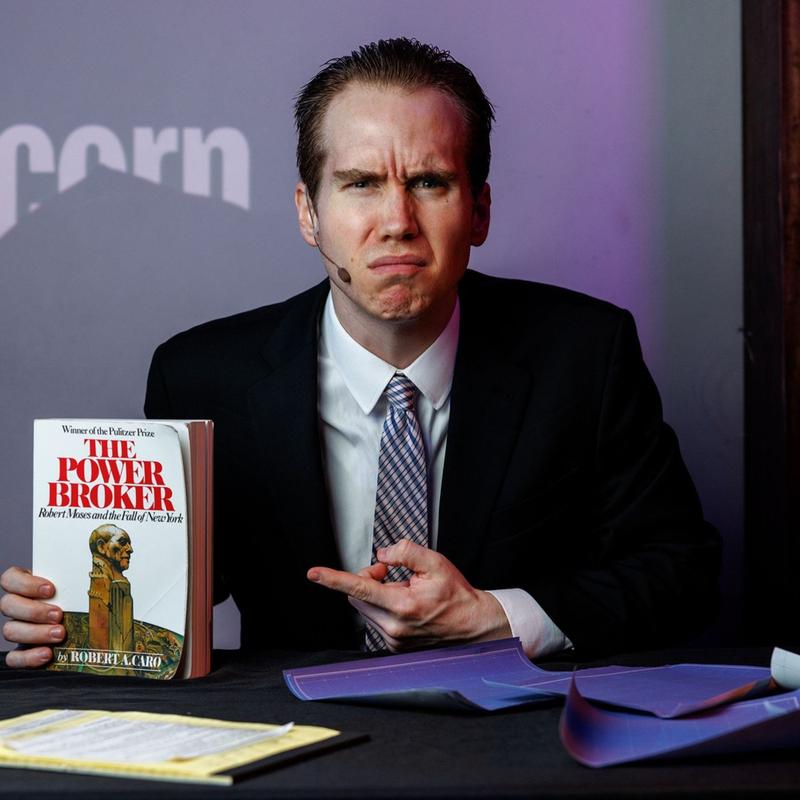
Alison Stewart: This is All Of It on WNYC. I'm Alison Stewart. If you've read The Power Broker, or even if you haven't, you probably know Robert Moses as the powerful New York urban planner. Now imagine Robert Moses as a late-night talk show host Sans power. That is the premise for the monthly comedy show The Power Joker, a Robert Moses comedy special hosted by my next guest, Sam Rogal.
Sam is an improv comedian who plays Robert Moses as he interviews guests and musicians as if he was like Stephen Colbert or Johnny Carson. Past guests have included then mayoral hopeful, Zohran Momdani. How could Sam possibly make urban planning funny? You will just have to find out for yourself. The next show is on March 22 at 5:00 PM at Caveat in NYC on the Lower East Side. Put me on the list. To preview the show and discuss his monthly series. I have now with me, The Power Joker himself, Sam Rogal. Nice to meet you, Sam.
Sam Rogal: Nice to meet you. Thanks for having me.
Alison Stewart: Before we go any further, have you read The Power Broker?
Sam Rogal: Yes, I have. Don't worry.
Alison Stewart: I had to ask. We had to ask.
Sam Rogal: I understand.
Alison Stewart: What is your Power Broker origin story? When did you get excited about it?
Sam Rogal: I read the book right when the pandemic started, as many people did. I had a lot more time at home. I thought, why not read a book that is too heavy to bring on the subway? For any New Yorker who reads that book, first of all, obviously, it's an incredible book deserving winner of the Pulitzer Prize, but it will make you furious. It will boil your blood and curl your toes. Because so many of the issues that we face in terms of transit, specifically every day, were caused by Robert Moses.
Then, a few years later, my producing partner on the show, Evan Barden, read the book along with the 99% invisible read along that they did in 2024. He came to me with this idea and was like, "Wouldn't it be funny to have this guy who was so powerful and controlling have to get like laughs in a late night talk show style show?" I was like, "I like that idea."
Alison Stewart: Why did you see potential in that idea?
Sam Rogal: I think it's just the juxtaposition of his policies with a modern audience, I think, is just funny on a base level. You mentioned Stephen Colbert, and I think that's a really apt comparison of, it's very similar to the Colbert rapport. Where Steven is the villain of that show. I think I'm the villain of The Power Joker, and I'm also the butt of all the jokes, because we want people laughing at Moses and at his policies.
Alison Stewart: Part of this conceit is that he has lost his power.
Sam Rogal: Yes.
Alison Stewart: Where did you get the idea that Robert Moses would lose his power?
Sam Rogal: He did in real life, and he's also dead.
Alison Stewart: He's dead.
Sam Rogal: I also think that the wins have-- The book itself, Caro's book, changed a lot of people's opinions about him. Prior to that book coming out, he was seen as a positive figure, I think, in New York. It took that book exposing him. For him to have to deal with that, deal with the public's swing towards one time a hero and then becoming a villain.
Alison Stewart: Why did you decide on a late night talk show as opposed to a morning show or an afternoon show? I don't know why a late night talk show?
Sam Rogal: I just think the idea of him having to do a monologue and bring on a guest who he just fundamentally opposes. Like you mentioned, we had Zohran on our May show, and basically all of Zohran's policies are the antithesis of everything Moses stood for. Just an exact opposite. Just putting them together on stage, we thought would be funny, just basically.
Alison Stewart: Who did you model the character after? Aside from Robert Moses, what other characters did you bring into the mix?
Sam Rogal: Carson's a good comparison. Like a '50s Borscht Belt comedian kind of a style. Moses himself, we watched some old interviews with him, and he's laid back, and he doesn't have a big personality, at least in his public facing Persona. We needed to make him a little more bombastic and a little more energetic, and something that matches my strengths as a performer as well. That was our approach to the character.
Alison Stewart: We are discussing The Power Joker, a Robert Moses comedy special, a monthly show at Caveat NYC on the Lower East Side. My guest is comedian Sam Rogal, who plays Moses and is one of the show's creators. You can catch the next show on March 22nd at 5:00 PM. Okay, walk us through the format of the show.
Sam Rogal: Great. It's very similar to a late night talk show. We usually start with a sketch, like a little cold open, something related to whatever the topic is that we're discussing that night. Then we play a one-minute-long video that just explains who Moses is, the book, Robert Caro. Just to allow anyone in the audience who is not familiar to get the baseline. I like to say, though, that our audience is very educated.
Alison Stewart: I would imagine.
Sam Rogal: When Caro comes up in the video, he always gets an applause break. I think we might be the only comedy show in the city where Robert Caro gets applause every time. He is also obviously our dream guest to have on the show. He's a very hard man to get in touch with, but fingers crossed there. Then I will come out, I'll do a short monologue that's a little more topical, just like some jokes about what's going on. We'll do a little crowd work. Then, typically, we'll have a couple of comedians who are our guests who will do five-minute pieces again, either connected to the theme or connected to urbanism in general. Then we have a longer interview with whoever our guest is.
That's a basically traditional interview, except that I, as Moses, I'll be Mosesy during it.
Alison Stewart: You'll be Mosesing.
Sam Rogal: Yes, exactly. Then we usually have a musical guest, and we play a game, and our big thing is having a call to action.
Alison Stewart: Interesting.
Sam Rogal: Our guests will bring something connected to their topic, that is like, "Hey, if you want to help this right now, here is some cause that needs your voice, your support, your donation, whatever. Here is something where your voice can really have a big impact today," with whatever the topic is.
Alison Stewart: One of your recent shows was low level politics.
Sam Rogal: Yes.
Alison Stewart: How do you decide on your themes?
Sam Rogal: A lot of times, we build the theme around the guests that we book. We have a list of themes that we want to do in the next year, but oftentimes we're just like, "Hey, let's see whoever we can get, and then build a show around them." We were lucky to have Luke Olson on that show, who's a district leader, which is a position I had never heard of. He was able to educate people on what's going on with this current election year in New York.
Alison Stewart: It's interesting because urban planning, even for the biggest nerds, it can be dense for most people. How do you go about making it fun, making it accessible for folks?
Sam Rogal: I think we don't want to be condescending or preachy in the show or anything. We assume that they have a base level knowledge, but our guests are often really good at explaining what they're an expert at. Then to make it fun, I, as Moses, can also be an idiot, can also not really know what's going on, and have to have things explained to me. Yes, that's the approach that opens the door for people.
Alison Stewart: One of our listeners called in to say that Robert Moses was on the Tom Snyder show in the '70s.
Sam Rogal: I'm sure he was.
Alison Stewart: That's really interesting that he would put himself in that position.
Sam Rogal: I believe he even had his own TV show. He had a public access show for a little bit as well.
Alison Stewart: The show describes you as someone who read The Power Broker before it was cool. Well, that's a discussion in itself. No, it is. When do you think that shift happened? Because for a while, everybody was starting to reread The Power Broker or read it for the first time.
Sam Rogal: I think I think again, 99% invisible played a role in that in 2024. I think even before that, with the way the federal government has been in the last 10 years or so, I think people have wanted to go back a little bit and see if they can dig up what happened, how we got here. I think, especially in New York, with New York politics, Moses played a really big role in that. I'm not surprised that there was a big explosion of interest in the book. There's another show at Caveat that is about The Power Broker as well. That's also popular. It is this wave of interest in him. I know that they're trying to make a Netflix television show based on the book as well.
Alison Stewart: Matthew Reese, right?
Sam Rogal: Yes, with Matthew Reese. Also, Matthew Reese, if you're listening, hey, come on the show and promote it.
Alison Stewart: I have a question. This is the serious question out of this group, is that Moses could be a mean figure. He was especially racist towards Black and Brown New Yorkers. How do you consider that history as you were looking for humor, or if you're looking for a subject to discuss?
Sam Rogal: There are some heavy things that are inherent with the book, and there is a lot of that history, and we try to handle it as delicately as we can and also allow people more educated than us to be the ones to really delve into it and discuss it.
Alison Stewart: Interesting. Who's your audience?
Sam Rogal: It's a really eclectic, diverse group. We get a lot of teachers, a lot of people who work in accessible and affordable housing, come to our show.
Alison Stewart: Oh, interesting.
Sam Rogal: We have some urban planning students. We had a big group of urban planning students come. We also have other fellow comedians and people who are just interested in comedy show up. Yeah, it's a pretty diverse group. Evan used to fly outside of the transit museum, which had a big Moses exhibit recently. I think it's still going on. We just got people from kind of all walks of life who are interested in urbanism.
Alison Stewart: We are discussing The Power Joker, a Robert Moses comedy special. It's a monthly show at Caveat on the Lower East Side. My guest is comedian Sam Rogal. Am I saying it right?
Sam Rogal: Rogal. Yes.
Alison Stewart: Rogal, who plays Moses and is one of the show's creators. You can catch the next show on March 22nd at %:00 PM. In the month before the show, what kind of prep are you doing?
Sam Rogal: Our focus really is about making the show funny. That's what the creative team wants to do. That's me, Evan Barden. We also have some other comedians who fill out the show. Will Jacobs, who plays Nelson Rockefeller on the show, who is the one man who took Moses down. We also have Adrienne Ianniciello and Fallon Boles, who are Swiss army knife people who can play Jane Jacobs, his wives, other people, like his brother. All those other characters from the book that come up to give the show some arc as well.
Alison Stewart: You have to appeal to people in the audience on a general level, but like you said, you have a lot of people who are interested in deep cuts on The Power Broker. What are some examples of some deep cuts that you've gotten to?
Sam Rogal: I always have a yellow legal pad with me on the show, which is something that Moses used throughout his career. It's like a little nod again. We like to pull little tidbits from the book, like things between him and Rockefeller, things between him and all the mayors, all the different mayors and governors that he worked with, and those he clashed with and agreed with. We had someone who played Fiorello LaGuardia on the show. Things like that that allow those who have read the book to feel welcome as well.
Alison Stewart: How much do you use physical comedy in this show? Because he always describes this in a certain way.
Sam Rogal: Some. I do the monologue out standing on stage. I am a very physical person. I'm a big gesturer, as I'm sure you're seeing live right now. I allow my body to radiate comedy during the show as well.
Alison Stewart: There's a musical aspect to the show. What role does music play in The Power Joker?
Sam Rogal: That's more just to break up the show again. Have the show match the format of a late night show that has a musical guest. Just to give people a little bit of a breather. It's a 90-minute show, so we want to give people a little bit of a break and just relax and listen to some good music.
Alison Stewart: Where were you when you found out Zohran Mondami would be on your show?
Sam Rogal: It's a fascinating story. We asked him in February of last year when he was polling at 6% and at that time was seen as, oh, an outsider candidate who's going to get a chance to put these ideas out there, and maybe in the future we'll see him. We were a little surprised he said yes then.
Alison Stewart: You were like, "Is that you? Are you punking me? Is that him?"
Sam Rogal: Literally. Then, between February and May, as we all remember, he became a very legitimate candidate all of a sudden. We were so worried that he was going to drop out. Because we were like, "He's going to have to do actual important stuff now." I thought he was going to drop out until the moment he walked in the door. Hey, he kept his commitment. He spent a full hour with us. We did a mock debate on stage, where we'd ask a question, he would answer it, and then Moses would respond, as to how Moses would feel about whatever the policy he was talking about. He had a lot of fun with us. He was fantastic. It was so cool to have him.
Alison Stewart: If you had to have a list of guests you'd like to have on your show, now is your time.
Sam Rogal: I know. We definitely want Caro. Again, that's our really big one. We've been trying, trying. I would love to get Colbert on as well because our show is so styled after him. Seth Meyers would be great, too. Basically, anyone connected with the city. Lin-Manuel Miranda is another person we've really wanted because all of his stuff is so about New York. In the Heights is about how that neighborhood functions. Even Hamilton, he talks about putting the city together a little bit and the city's economy and things like that. He really loves New York so much that we'd love to have him on as well.
Alison Stewart: What is something that you haven't been able to accomplish with the show and that you're really working on?
Sam Rogal: We want to expand, and we want to grow, and we want the show to be accessible to people who live outside of New York as well. We really want our Internet presence to be a little stronger. We want to get our YouTube channel a little stronger, a few more followers. We'd love to in the future be able to take this show to Philadelphia and do a Philadelphia show, take the show to Toronto and do a Toronto show. Do shows about these other cities and allow them to have the same experience.
Alison Stewart: Do you think Robert Moses is that well-known that you could take it around the country?
Sam Rogal: That's a great question, but probably not. I don't know. Maybe. I think, again, the book is getting more popular. He is getting a little more known. I think the success here leads us to believe that there is a population out there who are familiar with the book and familiar with him, and are interested in just how your city functions on a basic level.
Alison Stewart: We had a text regarding his public access show. It said it was a disaster. According to Caro, he ignored his guests and just lectured in monotone to the camera.
Sam Rogal: I am not at all surprised about that. He is not a charismatic. He's not Mr. Personality. You know what I mean?
Alison Stewart: All right, your next show is on March 22. What is planned?
Sam Rogal: We have Jane August, and it is a show themed around New York museums. Jane is a person who had a big social media project a few years ago, where she went to all 150 museums in New York. We're going to talk about what role the museum plays in the city, what museums are thriving, what museums need your help, and just how museums bring people to New York. Then we also have a show, April 11th at 7:00 PM, and that is our New York and movies show.
Alison Stewart: Oh, cool.
Sam Rogal: Where our guests are Griffin Newman and David Sims from the BLANK CHECK podcast. David is a film critic for The Atlantic. Griffin is an actor. They both are New Yorkers. We're going to talk about how the film industry, again, how it buoys New York, what the process for filming in New York is like, how it helps the city, and how it brings attention to it.
Alison Stewart: The show is called The Power Joker, a Robert Moses comedy special. It's at Caveat on the Lower East Side. My guest has been Sam Rogal. Thank you so much for being with us. The next show is on March 22nd at 5:00 PM. Thanks, Sam.
Sam Rogal: Hey, thank you.