
How Jesse Jackson Shaped New York Politics
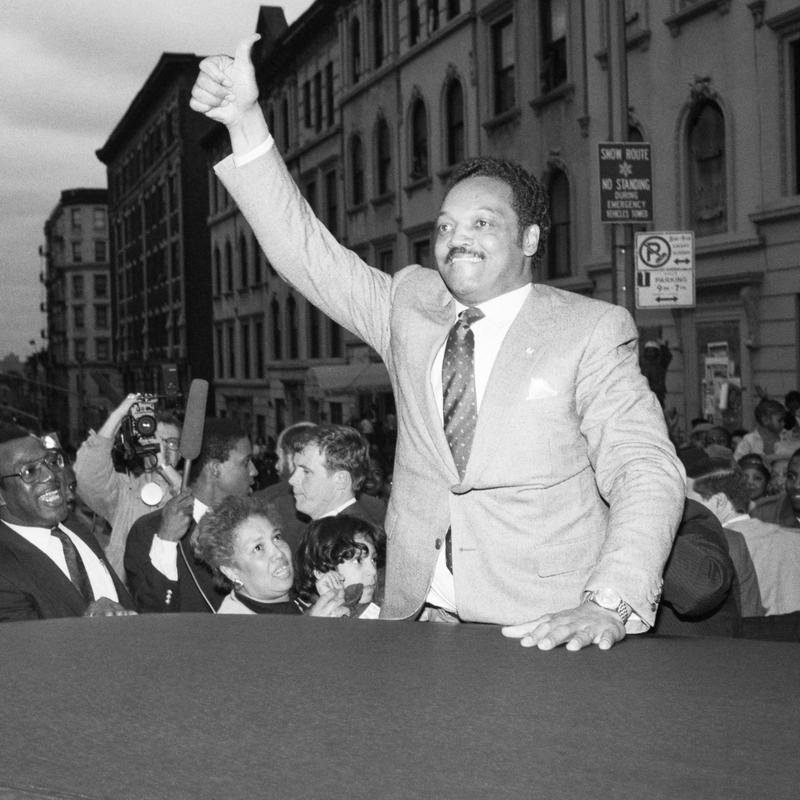
Alison Stewart: This is All of It on WNYC. I'm Alison Stewart. Reverend Jesse Jackson passed away last week at the age of 84. New Yorkers, especially those living here in the city in the '80s, remember him as an influential figure. Jackson ran for the Democratic presidential nomination twice in the 1980s. Here he is at Concord Baptist Church in Bed Stuy in December of 1983, speaking directly to people in poverty and telling them to stand together as he prepared for a year of campaigning.
Reverend Jesse Jackson: Poor folks, stop looking for Santa Claus to come from North Pole once a year. Nobody, including Santa Claus, will save the poor for the poor, but the poor. [applause] When the poor come together, they ain't poor anymore.
Alison Stewart: Jackson lost both races in '84 and '88, but he won New York City in the 1988 primary with a record turnout of minority voters who were part of his Rainbow Coalition. Experts believe that his campaign paved the way for New York to elect its first Black mayor, David Dinkins, just a year later. Arun Venugopal is WNYC Gothamist senior reporter on the Race and Justice desk. He recently wrote an article called From Dinkins to Zohran: Jesse Jackson's New York City Political Legacy. He's here now to reflect on the leader. Hi, Arun.
Arun Venugopal: Hi, Alison.
Alison Stewart: Listeners, we want to get you in on the conversation. Were you in New York in the '80s? [unintelligible 00:01:47]. What do you remember about Jesse Jackson's campaign for president, especially how he campaigned here in the city? Call or text us now at 212-433-9692, 212-433-WNYC. Did ever meet Jackson while he was campaigning or see him speak? Our Phone number is 212-433-9692, 212-433-WNYC. How important was New York to his campaign for president?
Arun Venugopal: It was very important, Alison. At the time, as you mentioned, there was this record turnout. They really mobilized communities of color specifically and other communities around this working class appeal that Jesse Jackson had, and in a way that I think people who are younger or who are just thinking about the present day can maybe really relate to. We have a mayor in Zohran Mandani who really recalibrated what electoral politics could look like.
He reached out to communities that were seen as invisible or just unreached, and drove those people to the polls. That's really what happened in 1984, 1988. That came on the heels of Jesse Jackson's connection to other issues about poverty, about apartheid, that he really connected in New York City with, issues of their time. In some ways those are the things that really paved the way for future politicians, including people like Mamdani.
Alison Stewart: Jesse Jackson ran for President twice in '84 and '88. He never won the Democratic nomination. It was Mondale in '84 and Dukakis in '88. He did make a big impact on the country and especially New York state. What was going on in the city that led to him having the amount of support that he had?
Arun Venugopal: I think a couple people come to mind. One is David Dinkins, who was the Manhattan borough president in the late '80s, and who helped run Jackson's New York campaign. He was the co-chair of that campaign for the whole state. Then people like Bill Lynch, a legendary political advisor who were also very much involved and helped identify these overlooked invisible "communities" that really had suddenly understood and recognized and appreciated the stake that they had in this race. They drove them to polls. That in turn really paved the way for Dinkins own run in '89, which he became the first non-white mayor in this city's history.
Alison Stewart: Do you think it's true that Jesse Jackson had an influence on him being mayor, Dinkins being mayor?
Arun Venugopal: Oh, absolutely. When you speak to experts who've really study this, there was a very much a connection. It was both his influence and his involvement in that race, but it was also the timing. We tend to tell ourselves New York City is always ahead of the pack. In many ways when it comes to this machine politics, it's held back by many forces in terms of democracy writ large.
I grew up in Houston, which had a female mayor in the early '80s in Kathy Whitmire. I don't think we've had any mayors who are female mayors in this city since then. At the time, other cities like Los Angeles, Chicago, they were all electing Black mayors. On the heels of this re-energized electorate, driven through these campaigns, 1984 and '88, through Jackson's campaigns and really mobilizing a lot of communities across the city, across the five boroughs, suddenly David Dinkins appreciated that he did have a chance and he proved that he was right.
Alison Stewart: How involved was Jesse Jackson in the Dinkins' administration at all?
Arun Venugopal: What's interesting about this is that Jackson had politics that were a little more, I guess, to the left, if you will than Dinkins himself had. There was some distance. Dinkins kept his distance from Jackson. There are certain issues that at the time were, I guess, considered more provocative and controversial, such as Jackson's support for the Palestinian cause which is, of course, a perennial issue and one that's really come to the fore in this city in the last two or three years.
I suppose that was an issue that was sensitive at the time, especially people like Rudy Giuliani really tried to make hay out of some of Jackson's statements in Jackson's connection to people like Louis Farrakhan, who was the head of the Nation of Islam at the time. These were sensitive at that time, just as they are to some extent today.
Alison Stewart: We're reflecting on the Reverend Jesse Jackson's impact on New York politics. My guest is Arun Venugopal, WNYC and Gothamist senior reporter on the Race and Justice desk, who recently wrote the article From Dinkins to Zohran: Jesse Jackson's NYC Political Legacy. We're also hearing for you what you remember about Jesse Jackson's campaigns for president in the 1980s. Did you see him speak? Our phone number is 212-433-9692, 212-433-WNYC. Let's go to Eleanor in Manhattan. Hi, Eleanor, thanks for calling All of It.
Eleanor: Hi, thanks for having me on. I wanted to talk about the time I heard Jesse Jackson speak with my daughter. She was going to Barnard College. It was in the late 1980s, maybe 1989. There was a Parents Day where a parent went on campus or both parents, and there were scheduled activities, and you walked around and saw things. We went over to campus of Columbia University, and Jesse Jackson was giving a speech, I believe on the steps of the library talking about anti apartheid issue, which was a big issue at the time.
We just stopped in our tracks to listen. He was such a galvanizing speaker. I think we didn't attend the next scheduled event that we were supposed to attend because we were enraptured listening to him speak. I'll always remember that.
Alison Stewart: Eleanor, thank you so much for calling. Let's talk to Patrick in Manhattan. Hi, Patrick, thanks for calling All of It.
Patrick: Thank you so much for taking my call. I am calling from Manhattan. My name is Patrick Gaspard and I had the good fortune of working on Jesse Jackson's campaign in '88, I should call it being a part of Jesse Jackson's movement in '88. I was also a very, very young staffer for Mayor Dinkins' campaign at '89 and his administration. I just heard you ask whether or not Dinkins would have won if not for Jackson's run. The answer is absolutely, positively no way. There's no way.
This city was really divided. Profound polarization, much of it along racial lines. There were communities that people like me just could not ever think about stepping into. Like Bensonhurst. The city is much changed now. Jackson's run was a bridge across communities, and it gave us a sense of what might be possible if we organize and we're strategic. We pushed back against really troubling, disconcerting projections that were coming from Mayor Koch then in his third term. If not for Jackson's run, there was no way we win an '89.
Alison Stewart: Patrick, thank you for calling. This text says, Arun, it's funny, it says, "This may sound trivial, but I remember him on SNL reading Dr. Seuss's Green Eggs and Ham and realizing he could read anything and have you wish to storm the citadels. [laughter] His voice was so moving and powerful." It's interesting because he did use popular culture early on. He was on Sesame street in 1972. What about Sesame street captured New York at the time. What was Jesse Jackson trying to communicate by being on Sesame Street?
Arun Venugopal: Oh, it is an incredible thing to watch, Alison, to watch that clip. I was so moved by it. It's funny. Sesame street is both a mythic place and it's quintessential New York. It's gritty. You've got Oscar the Grouch. It's all the people that we know, and it's got all these kids from different backgrounds, and him going on there and just telling kids and having them participate in this chant about you can be on welfare, but but you matter. You are important. How you can be poor, you can look different from all the others. The camera is just scanning past all these kids of different backgrounds. I am white, I am brown, I'm Black. They're all chanting this along with him.
I've never seen anything like it. That was just soon after the creation of the show which was very much a product of the Great Society and LBJ and all the promise of public media. You see how someone like him identified that promise and really went to town on in a way that you see these-- Kids who are old enough to realize that they're part of something really, unlike anything else. It's very moving. I think everybody should really go if they want to understand Jesse Jackson's power. It's not only to see him or hear him talking to adults about apartheid [unintelligible 00:12:05], it's about to make people realize that no matter what their age is, that they matter.
Alison Stewart: Let's listen to a little bit of it. This is Sesame street from 1972 with Jesse Jackson.
Reverend Jesse Jackson: I may be poor-
Gathering: I may be poor-
Reverend Jesse Jackson: -but I am-
Gathering: -but I am-
Reverend Jesse Jackson: -somebody.
Gathering: -somebody.
Reverend Jesse Jackson: I may be young-
Gathering: I may be young-
Reverend Jesse Jackson: -but I am-
Gathering: -but I am-
Reverend Jesse Jackson: -somebody.
Gathering: -somebody.
Reverend Jesse Jackson: I may be on welfare-
Gathering: I may be on welfare-
Reverend Jesse Jackson: -but I am-
Gathering: -but I am-
Reverend Jesse Jackson: -somebody.
Gathering: -somebody.
Reverend Jesse Jackson: I may be small-
Gathering: I may be small-
Reverend Jesse Jackson: -but I am-
Gathering: -but I am-
Reverend Jesse Jackson: -somebody.
Gathering: -somebody.
Reverend Jesse Jackson: I may make a mistake-
Gathering: -I may make a mistake-
Reverend Jesse Jackson: -but I am-
Gathering: -but I am-
Reverend Jesse Jackson: -somebody.
Gathering: -somebody.
Reverend Jesse Jackson: My clothes are different.
Gathering: My clothes are different.
Reverend Jesse Jackson: My face is different.
Gathering: My face is different.
Reverend Jesse Jackson: My hair is different-
Gathering: My hair is different-
Reverend Jesse Jackson: -but I am-
Gathering: -but I am-
Reverend Jesse Jackson: -somebody.
Gathering: -somebody.
Reverend Jesse Jackson: I am Black-
Gathering: I am Black-
Reverend Jesse Jackson: -brown-
Gathering: -brown-
Reverend Jesse Jackson: -white.
Gathering: -white.
Reverend Jesse Jackson: I speak a different language-
Gathering: I speak a different language-
Reverend Jesse Jackson: -but I must be respected-
Gathering: -but I must be respected-
Reverend Jesse Jackson: -protected-
Gathering: -protected-
Reverend Jesse Jackson: -never rejected.
Gathering: -never rejected.
Reverend Jesse Jackson: I am-
Gathering: I am-
Reverend Jesse Jackson: -God's child.
Gathering: -God's child.
Alison Stewart: We got this text. It says, "Regarding Jesse Jackson, he did so much for the Black community and our entire society at large. Sadly, much of his good efforts were forever marred by his reference to Jews." We have to have this part of the conversation. The Washington Post Replacement reported that Jackson referred to New York and to New Yorkers by using an anti Semitic slur in a private conversation. The New York Times said Jackson thought those conversations were off the record. How much work did he do to repair his reputation with Jewish voters?
Arun Venugopal: A significant amount, Alison. He spent years trying to undoing the damage. I think it probably depends on who you speak to, if it was effective. There are definitely people out there, including Jewish New Yorkers, leaders who felt that he acquitted himself. He took that political capital. They had the access to people in power. He went to world leaders with significant Jewish populations and spoke up for the need to protect persecuted populations.
He also invoked language that was meant to, I guess, address this in terms of speaking up for the need for Zionism, for instance, and things that perhaps at the time were complicated given that he had been so vocal for the Palestinian cause as well. In terms of many Jewish New Yorkers and people across the world who were really hurt by the comments that he made, he did spend a lot of his energy undoing the harm.
Alison Stewart: Considering his legacy and his political message, what lessons do you think there are for New York politics and life today?
Arun Venugopal: It is interesting to-- One of the quotes that really stayed with me from someone I interviewed for the story, Jeanne Theoharis, distinguished scholar at CUNY, who said one of the shoulders that Zohran Mamdani stands on is Jesse Jackson's. She also referred to Jesse Jackson as the Bernie Sanders of his time. There are all these crumbs from the heyday of Jesse Jackson's political career in the 1980s to now that you could say lead us down the path to the present moment where--
I say this again as a kid who grew up in the suburbs of Texas, never really heard much about democratic socialism, whatever, but because of what-- Zohran Mamdani built upon the legacy of Jesse Jackson, now these ideas have taken root, really, in the public consciousness across the country, across the world. I was traveling last year well before he was elected, and people in different places, Turkey, in Heathrow Airport, in Texas, everybody was talking about this person, Zohran Mamdani, because New York City provides that springboard for ideas, for good and bad. When you think about Occupy Wall street, it started right downtown that launched a conversation about inequality the same way in which Zohran Mamdani has taken ideas that are seen as threatening to some people, ideas about economic inequality, but also about racial coalitions changing the thing. A lot of people say you have to really look at the roots of that. For many people, Jesse Jackson was right there at the beginning.
Alison Stewart: My guest has been Arun Venugopal, WNYC and Gothamist senior reporter on the Race and Justice desk. You should read his piece From Dinkins to Zohran: Jesse Jackson's NYC Political Legacy. Hey, Arun, thank you for your time today.
Arun Venugopal: Thanks a lot, Alison.