
How Edgar Allan Poe Revolutionized Horror Writing
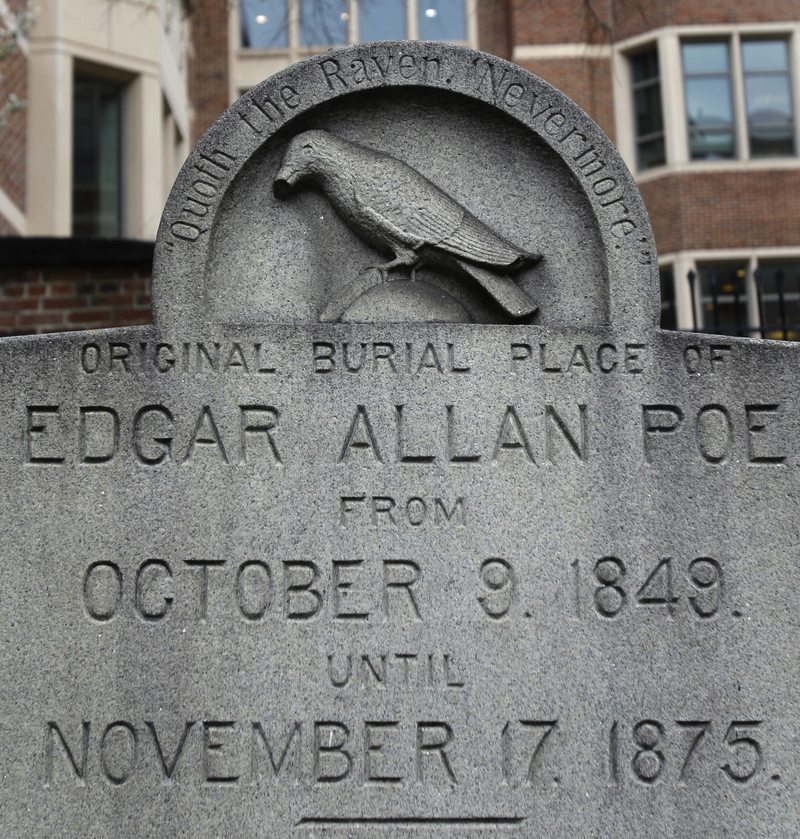
( Rob Carr / AP Photo )
Alison Stewart: This is All Of It on WNYC. I'm Alison Stewart. Now a bit of verse. [clears throat] Once upon a midday talk show, before we hear Sean Carlson read Poe, Halloween tradition, you know, if you have tuned in before, hear about the works enduring, of bleak Edgar, dark and churning; how he sets the tone for wording tales that chill us to the core. Every year for Halloween here at All Of It, we have a special reading of Edgar Allan Poe's The Raven. This year, in honor of the poem's 180th anniversary, we wanted to thicken up our coverage a bit with a deeper look at Poe's life, his body of work, and what made him so genius. A lot of people may be familiar with Poe's stories without ever having read them through parodies like The Simpsons' Treehouse of Horror series, which has spoofed on The Raven and Poe's short story The Fall of the House of Usher.
House: Life with the Simpsons. What choice do I have?
[thunder cracking]
Lisa Simpson: It chose to destroy itself rather than live with us. You can't help but feel a little rejected.
Alison Stewart: Or when The Tell-Tale Heart was parodied in SpongeBob episode Squeaky Boots.
[squeaking]
SpongeBob: This and this and this and this and this and this and this.
Mr. Krabs: Stop it. Stop it. Don't you hear it? Yes, I did it. I did it. I took the boots. They're here, under the floorboard. Oh, please, make it stop. It's the squeaking of the hideous boots.
Alison Stewart: If modern cultural touchstones are how you know Poe, we have got you covered with an expert on real, actual text from one of the most influential contributors to literary horror. Dr. Amy Branam Armiento is the former president of the Poe Studies Association, and she's here to share her insights. Amy, thank you for joining us.
Amy: Thank you for having me, and Happy Poe-tober.
Alison Stewart: [laughs] Do Poe scholars do anything special for Halloween?
Amy: For us, it's special all year round with Poe, but we're scattered. A few of us will send greetings via email and social media. Of course, we love Halloween.
Alison Stewart: Let's talk about a young Edgar growing up in the early 1800s, a Boston transplant in Virginia. What pushes him towards the more dark and stormy sides of life?
Amy: He, of course, had many challenges during his lifetime with losing people who are close to him. He loses his mother just before he turns three years old. The family is traveling for her acting career. That's how he ends up in Richmond, Virginia. She dies there in Richmond during a performance run. The Allan family adopts him. A little bit later, after he becomes really close to his foster mother, she also dies quite young.
Alison Stewart: Oh my gosh.
Amy: I think we all know that he's going to lose his wife, Virginia, when she is very young. She dies from tuberculosis. It's not uncommon for people to lose loved ones who are young during that era, but just so many people who are so close to him dying, it's just so much. He loves Lord Byron from an early age. Lord Byron is a dark figure in literature, so he's gravitating toward those kinds of ideas. It just becomes his life.
Alison Stewart: He was a literary critic to pay the bills. What does it tell us about his purpose when he writes?
Amy: For writing, the literary criticism, or just in general?
Alison Stewart: I'll say in general.
Amy: You're right. He was impoverished throughout his life, so there is this need to write fiction, poetry. He tried his hand at a play at one point. Definitely the literary criticism. He has a novel eventually. He's doing whatever he can to make some money, but he's also trying to hold himself to a high standard. For him, that high standard is to innovate, create, and do something original. It really bothered him when he saw derivative works or read things by people who were trying to teach a moral lesson. He just felt like that was not what literature should be doing.
For poetry, he really privileged that beauty should be the subject of the poem. Beauty could be enhanced. If a beautiful woman, for example, had just died, he's famous for saying the death of a beautiful woman is the most poetical topic in the world, which is a little problematic for me as a feminist. [laughter] As he's writing to survive, he's also trying to put out a high-quality product, if you will. He's trying to read his literary market, give audiences what they want. What they wanted was this sensationalist fiction that we love today, these horror stories.
Alison Stewart: Explain the sensationalists, what that meant for people at the time.
Amy: This is something that Charles Dickens also would do. I think today we would just call it gory stuff, graphic stuff, if you will, that we see in horror films, for example. In The Tell-Tale Heart, we have a dismemberment scene. Things like that.
Alison Stewart: Listeners, we want to bring you into this conversation. What are your favorite works by Edgar Allan Poe? What do you think makes his writing so compelling, perhaps makes it so grim? What resonates with you? Our lines are open at 212-433-9692, 212-433-WNYC, or you can ask a question of Dr. Amy Branam Armiento about Poe. She is our guest.
Where did Poe's sense of the wide world come from? Because he wrote about so many different places, about Africa. He wrote about Asia. He wrote about a whaling boat being marooned off of Antarctica. Where did this world come from?
Amy: He was certainly a voracious reader. He often reviewed novels and nonfiction works. He could imagine these places by reading about them. When he was a child, the Allan family went to England. John Allan is Scottish. He had some business affairs in that area. Poe spent about six years in a boarding school in London, or being educated in London, part of that in a boarding school. He had actually gone abroad as a young man. He liked to, like I said, read a lot about the world. Read a lot of newspaper stories as well. Many of his pieces are based on articles that he would have read in the paper, giving him ideas, if you will.
He had a great imagination and a little taste of traveling abroad as a young person.
Alison Stewart: Before he started writing, what was the concept of horror, that genre? What was it like before he started writing?
Amy: The Gothic novel is appearing in the mid-1700s with Horace Walpole's Castle of Otranto. He's inheriting the Gothic tradition from writers like Walpole, Radcliffe, and Lewis, names that maybe we don't know so much today, but he certainly knew. There was an American writer named Charles Brockden Brown from Philadelphia who was writing Gothic works. We know those influenced Edgar Allan Poe's style. Of course, Washington Irving, of The Legend of Sleepy Hollow fame, he was writing too, these Gothic works. The Gothic is definitely an influence.
When we say the Gothic, we think of castles, secret passageways, people who are maybe locked in, and they need to escape. For various reasons. The ghosts, the chains, and all those eerie sounds we might hear. That's what he's inheriting.
Alison Stewart: Let's take a call. This is Andy, who's calling in from Yonkers. Andy, thank you so much for making the time to call All Of It. You're on the air.
Andy: Good afternoon. I want to thank you both for bringing out Edgar Allan Poe. I have spent time in Poe Park in the Bronx. I really enjoy his work.
Alison Stewart: What do you enjoy about it?
Andy: It's real. It's, I guess you could say, sensational. Your guest made a comment about-- Amy, right?
Amy: Yes.
Andy: Doctor. That's the main thing, Doctor. Maybe slightly exaggerated, the most beautiful thing. I'm in the sports field, and they're calling Ohtani the greatest player ever. Please. He just started.
[laughter]
Plus, the Ravens won last night.
Alison Stewart: Woohoo.
Andy: It's scary. Some of his work, The Pendulum, right?
Alison Stewart: Yes. It is scary.
Andy: It's scary, but I think what's behind it isn't just this gory to be gory thing. I think you've cited that already.
Alison Stewart: Thank you so much for weighing in. We appreciate it. Dr. Amy Branam Armiento, former president of the Poe Studies Association. We're discussing Poe a little deeper before we hear our version of The Raven. I want to talk about the piece that people they know the name of it but they're not sure what it's about, The Tell-Tale Heart. The short version is a murderer driven crazy by what sounds like a heartbeat coming from underneath the floorboards. The interesting thing is, readers aren't told why the murder took place. Why is the why not necessarily important in that story?
Amy: It's interesting even in your characterization, because, of course, we think about the heartbeat because it's in the title, but it's the vulture eye, this eye with a cataract or film over it that actually leads him to the murder, and then the heartbeat is what gives him away. Of course, no one else can hear that heartbeat. I think that's what's so brilliant about Edgar Allan Poe. It is terrifying. Why did this person kill this old man? We don't know. He seems to have a reason that makes sense to him, but we don't see it as making sense. We being the reader. I think that's that level of terror.
I like Andy bringing up The Pit and the Pendulum because that's frankly the only happy ending of one of the scary stories. Yet when we're in that story, we don't expect a rescue. I love that story just because it's an exception. Why is this person caught up in the Inquisition in The Pendulum? We're not even sure about that. It's almost like it anticipates existentialism in Kafka, and this like, "How did I get caught up into such an unsafe situation?" That's terrifying to not have the why answered in a clear way, the question being, can I just chalk it up to maybe the murderer has some kind of mental illness?
There's space for that when you read the works. The person around him that was about to be murdered didn't realize or see any symptoms of this mental illness. It's terrifying.
Alison Stewart: Let's take a call. Lynn from Stockholm, New Jersey. Hi, Lynn. Thank you so much for calling All Of It on this Halloween.
Lynn: Actually, I'm from Clifton. I just want to say, back in the mid-80s, I moved into an apartment on 84th Street. This is before cell phones. I walked down to Broadway to call my parents and tell them everything was okay. I looked up and I realized that I live on-- 84th Street is also Edgar Allan Poe Street. That his family had a farm on 84th Street on the West Side.
Alison Stewart: Is that true?
Amy: I don't know New York very well, but I can tell you where places are that we know he rented. He lived on what is now 85 West Third Street in Greenwich Village. I'm not sure if that's about where we're at.
Alison Stewart: No, but I know exactly what you're talking about.
Amy: That house has been torn down. Again, he never owned a home. They rented. The New York University Law School buildings, or one of their buildings. Maybe this caller is talking about the Poe Cottage out in Fordham in the Bronx, but they moved often. They had to rent many, many places. Often, he would try to establish himself in a city, so they do a quick short term rental. Then once he got the hang of where he was, they'd move again, sometimes driven by the rent. Then, once his wife became ill, they would end up living farther outside of the city for her health. Also, it was cheaper. I apologize that I don't know the exact location.
Alison Stewart: It's okay. A source said it's like nabbing a rental in Manhattan. It's not an easy process. Poe had to move to the Upper West Side to escape the rents around Washington Square.
Amy: Exactly right. Exactly right.
Alison Stewart: What would you recommend to someone who is now eager to read Poe? What short story?
Amy: I always recommend The Tell-Tale Heart. Many people who know Poe know him from that story. It is what sealed the deal for me to become a Poe scholar. I just love that story. If you haven't read The Tell-Tale Heart, please do so. Then, of course, The Raven, which you're about to have the recitation of, and Annabel Lee. Those two poems are really fun. The sound is really fun. In the meter, you can practice your own parody like you began with. That's fun sometimes as well.
I recommend, if you already know those works, maybe checking out some of the other horror stories that aren't read so often, like his story called The Black Cat. Hop-Frog is also a favorite of mine. The Fall of the House of Usher. If you want a funny one, a dark comedy, I recommend The Cask of Amontillado. There are a lot of little jokes in there. Again, they're dark because it's a horror story. If you like dark humor, definitely recommend that. If you feel okay about the pandemic situation, you can revisit that kind of world. The Masque of the Red Death is fun as well.
Alison Stewart: We've been talking about Edgar Allan Poe with Dr. Amy Branam Armiento. Thank you for joining us.
Amy: Thank you.
[music]
Lucy: She's going to ask us something on Edgar Allan Poe. I know it, I just know that any moment now.
Sally Brown: She's going to call on me and ask me something I don't know.
Alison Stewart: Hopefully, after that conversation, you're not as worried as Peppermint Patty or Sally Brown about getting called on to ask about Poe. Hopefully, you have a little more to ponder, going into our traditional Halloween recitation of The Raven by Sean Carlson.
[thunder cracking]
Sean Carlson: Once upon a midnight dreary, while I pondered, weak and weary,
Over many a quaint and curious volume of forgotten lore,
While I nodded, nearly napping, suddenly there came a tapping,
As of some one gently rapping, rapping at my chamber door.
"'Tis some visiter," I muttered, "tapping at my chamber door,
Only this and nothing more."
Ah, distinctly I remember it was in the bleak December;
And each separate dying ember wrought its ghost upon the floor.
Eagerly I wished the morrow; vainly I had sought to borrow,
From my books surcease of sorrow, sorrow for the lost Lenore,
For the rare and radiant maiden whom the angels name Lenore,
Nameless here for evermore.
And the silken, sad, uncertain rustling of each purple curtain
Thrilled me, filled me with fantastic terrors never felt before;
So that now, to still the beating of my heart, I stood repeating
"'Tis some visiter entreating entrance at my chamber door,
Some late visitor entreating entrance at my chamber door;
This it is and nothing more."
Presently my soul grew stronger; hesitating then no longer,
"Sir," said I, "or Madam, truly your forgiveness I implore;
But the fact is I was napping, and so gently you came rapping,
And so faintly you came tapping, tapping at my chamber door,
That I scarce was sure I heard you," here I opened wide the door;
Darkness there and nothing more.
Deep into that darkness peering, long I stood there wondering, fearing,
Doubting, dreaming dreams no mortal ever dared to dream before;
But the silence was unbroken, and the stillness gave no token,
And the only word there spoken was the whispered word, "Lenore?"
This I whispered, and an echo murmured back the word, "Lenore."
Merely this and nothing more.
Back into the chamber turning, all my soul within me burning,
Soon again I heard a tapping somewhat louder than before.
"Surely," said I, "surely that is something at my window lattice;
Let me see, then, what thereat is, and this mystery explore,
Let my heart be still a moment and this mystery explore;
'Tis the wind and nothing more."
Open here I flung the shutter, when, with many a flirt and flutter,
In there stepped a stately Raven of the saintly days of yore;
Not the least obeisance made he; not a minute stopped or stayed he;
But, with mien of lord or lady, perched above my chamber door,
Perched upon a bust of Pallas just above my chamber door,
Perched, and sat, and nothing more.
Then this ebony bird beguiling my sad fancy into smiling,
By the grave and stern decorum of the countenance it wore,
"Though thy crest be shorn and shaven, thou," I said, "art sure no craven,
Ghastly grim and ancient Raven wandering from the Nightly shore,
Tell me what thy lordly name is on the Night's Plutonian shore."
Quoth the Raven, "Nevermore."
Much I marveled this ungainly fowl to hear discourse so plainly,
Though its answer little meaning, little relevancy bore;
For we cannot help agreeing that no living human being,
Ever yet was blessed with seeing bird above his chamber door,
Bird or beast upon the sculptured bust above his chamber door,
With such name as "Nevermore."
But the Raven, sitting lonely on the placid bust, spoke only
That one word, as if his soul in that one word he did outpour.
Nothing farther then he uttered, not a feather then he fluttered,
Till I scarcely more than muttered "Other friends have flown before,
On the morrow he will leave me, as my Hopes have flown before."
Then the bird said, "Nevermore."
Startled at the stillness broken by reply so aptly spoken,
"Doubtless," said I, "what it utters is its only stock and store
Caught from some unhappy master whom unmerciful Disaster
Followed fast and followed faster till his songs one burden bore,
Till the dirges of his Hope that melancholy burden bore
Of 'Never, nevermore'."
But the Raven still beguiling my sad fancy into smiling,
Straight I wheeled a cushioned seat in front of the bird, and bust and door;
Then, upon the velvet sinking, I betook myself to linking
Fancy unto fancy, thinking what this ominous bird of yore,
What this grim, ungainly, ghastly, gaunt, and ominous bird of yore
Meant in croaking "Nevermore."
This I sat engaged in guessing, but no syllable expressing
To the fowl whose fiery eyes now burned into my bosom's core;
This and more I sat divining, with my head at ease reclining
On the cushion's velvet lining that the lamp-light gloated over,
But whose velvet-violet lining with the lamp-light gloating over,
She shall press, ah, nevermore.
Then, methought, the air grew denser, perfumed from an unseen censer
Swung by seraphim whose footfalls tinkled on the tufted floor.
"Wretch," I cried, "thy God hath lent thee, by these angels he hath sent thee
Respite, respite and nepenthe, from thy memories of Lenore;
Quaff, oh quaff this kind nepenthe and forget this lost Lenore."
Quoth the Raven, "Nevermore."
"Prophet," said I, "thing of evil, prophet still, if bird or devil,
Whether Tempter sent, or whether tempest tossed thee here ashore,
Desolate yet all undaunted, on this desert land enchanted,
On this home by Horror haunted, tell me truly, I implore,
Is there, is there balm in Gilead? Tell me, tell me, I implore."
Quoth the Raven, "Nevermore."
"Prophet," said I, "thing of evil, prophet still, if bird or devil.
By that Heaven that bends above us, by that God we both adore,
Tell this soul with sorrow laden if, within the distant Aidenn,
It shall clasp a sainted maiden whom the angels name Lenore,
Clasp a rare and radiant maiden whom the angels name Lenore."
Quoth the Raven, "Nevermore."
"Be that word our sign of parting, bird or fiend," I shrieked, upstarting,
"Get thee back into the tempest and the Night's Plutonian shore.
Leave no black plume as a token of that lie thy soul hath spoken.
Leave my loneliness unbroken, quit the bust above my door.
Take thy beak from out my heart, and take thy form from off my door."
Quoth the Raven, "Nevermore."
And the Raven, never flitting, still is sitting, still is sitting
On the pallid bust of Pallas just above my chamber door;
And his eyes have all the seeming of a demon's that is dreaming,
And the lamp-light over him streaming throws his shadow on the floor;
And my soul from out that shadow that lies floating on the floor
Shall be lifted, nevermore.
[thunder cracking]
Alison Stewart: True crime is one of the most popular genres in entertainment, but why are so many people obsessed with learning about gruesome crimes? What are the ethics of being a true crime fan? Coming up, we'll discuss it with professor and criminologist Matt DeLisi.