
How Brooklyn-based Artist Leonardo Drew Works With Paper Pulp
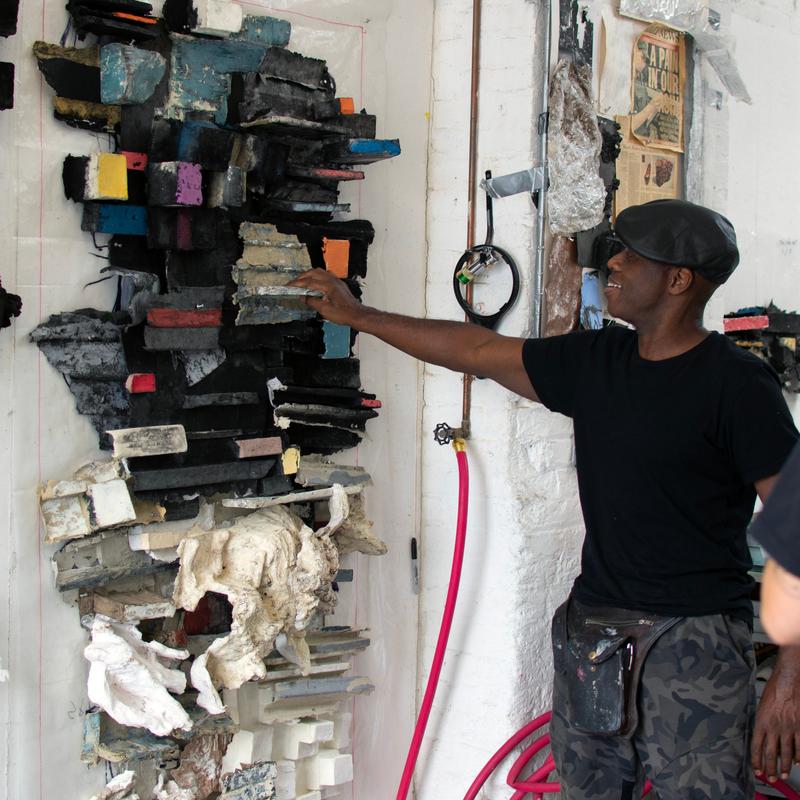
Alison Stewart: This is All of It on WNYC. I'm Alison Stewart. This spring, the work of artist Leonardo Drew is on the walls of two different exhibitions in our area. Tomorrow is the opening day of Drew's new show at Pace Prints on 22nd street in Chelsea. The show features his recent handmade paper pulp work, including pieces he called Tattered Quilts. Drew's work is currently on view at The Bruce Museum in Greenwich, Connecticut. The show is called Alchemy and displays more than innovations with paper created in the last two decades.
While Leonardo Drew maintains a Brooklyn-based studio, his hometown is Bridgeport, where he discovered an interest for art and materials. A sample of his work on view at Pace Prints is on our Instagram now if you want to check it out. I took the pictures myself, @allofitnyc, and Leonardo Drew joins me in studio. It is nice to meet you.
Leonardo Drew: It is absolute pleasure to be here.
Alison Stewart: Let's start with the Pace Prints show. It opens tomorrow. It features new handmade paper pulp works. When did you make these?
Leonardo Drew: Well, these were made over the last year, but it's an innovation that's been going on for the last 15 years. I have, I call my sisters. These are master printmakers over at Pace Prints. We've been sort of pushing the envelope in terms of what you can do with the material. Anyone that buys these things, they always think they're getting the real thing, like an actual sculpture, but it's paper pulp.
Alison Stewart: I keep saying, with paper pulp materials, please explain to us what that is.
Leonardo Drew: Well, it's just a variation of mushed paper and being able to mold it into shapes and things. Obviously, because I'm a sculptor, in my practice, the idea of being able to take paper, something that's kind of, you would think, the alien to sculpture. In the end, if you can master the ability to shape it, you can anything from it. I mean, the visuals, you would think what you're looking at is the actual wood or whatever material you're mimicking. It can be sort of realized in paper pulp.
Alison Stewart: What do you like about the medium?
Leonardo Drew: One, it's forgiving [laughs] and the wear and tear on your body. I mean, being a sculptor, I should tell you that there's a beating that happens to the body. I've already had three operations in the last three years.
Alison Stewart: Oh my gosh.
Leonardo Drew: We're talking in terms of carpal tunnel, just the abuse of the body.
Alison Stewart: I saw you in a video, you had a back brace on while you were working.
Leonardo Drew: I look like an MMA fighter, you know what I'm saying?
[laughter]
I'm ready, I'm strapped for action, you know what I'm saying? [laughs] It's a war in the studio.
Alison Stewart: Oh, that is so funny. I'm having all kinds of ideas in my head. All right, let's go back to your exhibition at Pace Prints. It's called Tattered Quilts. Why is it called that?
Leonardo Drew: That's interesting that you say that, because I'm sure I only mentioned that once in terms of the feel of what we're after, because I never, absolutely never talk about absolutes when it comes to actually what you're supposedly getting out of the work. If you're coming with Tattered Quilts, you need to erase that. [laughs]
Alison Stewart: Okay.
Leonardo Drew: Someone told you that. I think that maybe that's what you're coming away with in terms of the visuals. As a starting point, it was interesting to sort of, at least for the folks that I'm working with, to know what I was after in terms of texture, feel, and spiritual realization of what you're after. You have to actually have words and connect so that you can know exactly what you're after. The fact that I number these things is for a reason. It's so that you could have a full on experience without me telling you what to experience. Telling everyone that it's like Tattered Quilts, it's like, let's erase that right now. [laughs]
Alison Stewart: I got you. The pieces that are on view, it was kind of cool watching them put them on the wall because they're really three dimensional.
Leonardo Drew: They sure are.
Alison Stewart: They pop off and they come out at you. Why did you want to work with the paper in this way that it pops right there?
Leonardo Drew: Interesting enough, I was approached by Pace Prints 15 years ago. The fact that I have a way of twisting and forcing material to do things. They thought that if I came in, it would get the language of printmaking a lot closer to actual sculpture or painting. Obviously, there's a price point there that-- huge price points between between the two things or three things. When you talk in terms of being able to get a visual and a feel of a sculpture and have the price point of a print and then you can force an elevation in, the cost of what you're buying.
I think being able to bridge or even equal the price point of sculptures, I think that was a huge reason for-- I mean, not for me, but we'll put Pace Prints in there. I think that when it comes to being able to take printmaking to another level, this is what we were after. Unknowingly, we hear from master printmakers when they look at these pieces, they find it hard to realize that these things are prints. The fact is, we've added something to the language of printmaking because we just kept pushing the envelope. Like I said, I didn't knowingly do this. It just kind of was happening. By the time we got on the other side of this, it was like, "Okay, we've just added something to the vocabulary."
Alison Stewart: My guest is Leonardo Drew. We're discussing his two new shows of work you can see in our area. One opens at Pace Prints in Chelsea tomorrow. Another is on view now at The Bruce Museum in Greenwich through May 10th. Some of the work has color. How do you decide what color you're going to use?
Leonardo Drew: [laughs] Interesting that color actually is a new entry into what I do.
Alison Stewart: Oh, interesting.
Leonardo Drew: I started, actually, in China. I did four years of work in a foundry, in a pottery foundry in China. Working with porcelain, which this place called Zhenjiang is ground zero for that material. It's like being able to realize glazing and being able to take that material and also add it to your language, it was a journey. Now it's been a sort of super additive to what I do. Color is now a part of how I see things. Before that, though, you would have gotten a lot of monochromatic black and white things, monsters. In the end, there was no color involved. This added in the color is relatively new. I would say probably the last maybe six-ish years.
Alison Stewart: That's interesting that your travels influenced your work. You've been to, you said, China. You've been to--
Leonardo Drew: Peru.
Alison Stewart: That's Peru, Senegal.
Leonardo Drew: Everywhere, yes. [laughs]
Alison Stewart: How has that influenced you, or are those bucket list places you wanted to go? I don't know.
Leonardo Drew: I think that the idea that you can become a receiver of information, an antenna. When you're moving around, you're sort of like, there you are in that location and all these, what we say, cradles of civilization. They will feed you through your pores, through your eyes. However these things are going into you, they need to come out.
If you're an artist, if you're a musician, if you're a writer, you'll find a way to bring those things out in that language that you've mastered. The fact that we all are sort of antennas, if we become in tune with our surroundings, we'd be more sort of respectful [chuckles] of nature and all things. Travel definitely is an absolute super additive to anyone's existence.
Alison Stewart: Where have you been that has stayed with you?
Leonardo Drew: China is a big one, but I should tell you that on your bucket list should be the Nazca Lines and, obviously, Machu Picchu. These are journeys that take a physical toll on you, but in the end, they're so rewarding. You come away knowing that, one, that we are not alone in this. There's something else going on. You start to put these things together. The more things you see, the more you open up to the possibilities that we're being fed, [laughs] and that information is still there. Visiting some of these cradles of civilization, you can't help. I mean, if you're in Egypt, the same thing, you can't deny it. It's there, and it's like your body vibrates for a reason when you're in these places. On your bucket list, yes, absolutely. I can make it for you.
[laughter]
Alison Stewart: My guest is Leonardo Drew. We'll have more after a quick break.
[music]
You're listening to All of It on WNYC. I'm Alison Stewart. My guest is artist Leonardo Drew. We're discussing two shows of his work you can see in our area. One is at Pace Prints in Chelsea. It opens tomorrow. Another is on view now at The Bruce Museum in Greenwich through May 10th. That show is called Alchemy, the one in Greenwich. How did it come about?
Leonardo Drew: Well, I mean, Alchemy, I am that in the studio, so they gave it that title, but it's definitely well deserved. [laughs] The fact that there's kind of experimenting that happens and sort of forced growth because of that experimenting. Yes, it's a perfect title.
Alison Stewart: When you go on the website, the first thing you see looks like a checkered board of colored string. What was the inspiration behind that piece?
Leonardo Drew: Well, we won't say quilts. [laughs]
Alison Stewart: We won't say quilts. No quilts.
Leonardo Drew: It's possible. I'll tell you honestly, when I look at these grids, and if I were to take a step back, I know that in my past life, I'd say when I grew up in a projects of Bridgeport, Connecticut, it was these buildings. It was like they were grids. If I were to sit down and really go, "Oh, what is going on here?" I would say with almost certainty that these grids are highly influenced by those buildings, the shapes, the actual gravitas, the weight of being. There's no denying. We'll give that one to you. It's like I say grids.
Alison Stewart: How did you get first interested in art?
Leonardo Drew: Interestingly, you're born an artist. [laughs] There are artists who actually find themselves by way of, how would I say, new mediums that come about that sort of, all of a sudden, spurs a person on to realizing that they were an artist all along. I've been at this all my life, so I've been pretty much almost an addict at making things. The idea that some of my friends come about making things in their 30s, it was like the new mediums definitely came about to wake them up to that fact that they actually were artists. I think they were all born artists. It takes maybe some of us a second to realize that fact, but I am from the womb to now.
Alison Stewart: You knew.
Leonardo Drew: Yes. My mother tried to stop me, and that was not something that I would see she was successful at. Most times she's successful at things. [laughs]
Alison Stewart: Why did she try to stop you?
Leonardo Drew: Well, if you're growing up in the hood and you're thinking about, or at least she's thinking about a future. The arts. No, I don't think for any sane person, you would think the arts would be a safe place to had your bet. She was just being--
Alison Stewart: Careful about you. She's being careful about you.
Leonardo Drew: Absolutely. Yes.
Alison Stewart: Well, who was the person who said to you, "You should pursue this"?
Leonardo Drew: I have many mentors all throughout my life. Back in the projects in Bridgeport, back in the '70s, that would have been Richard Stamats and Ben Johnson and Bill Collins and Wendy Bridgeforth. Giving all those guys props because they were there and made me realize that this addiction that I had for making was something that needed to be really pursued.
I started exhibiting at 13 because of them. You now have a 13-year-old that realizes that, "Oh, I need to take this and show it." No, you need mentors people who are around you and actually feed you materials and actually give you ideas and actually gives you that this is possible to take this as a serious, as a sort of, "Your life can be this." It hasn't changed since. I've been on this journey from that point, so it's been-- yes.
Alison Stewart: I read in the early '80s, and correct me if I'm wrong, because the Internet, that you stopped drawing, is that true?
Leonardo Drew: Yes, this is true.
Alison Stewart: Why did you just make that choice?
Leonardo Drew: Well, honestly, I was approached by DC and Marvel. That would have been in 1977-ish because I remember DC had the Superman movie out with Christopher Reeve, and they were using that as the bargaining chip for me to work with them. I was already poisoned. I had seen Jackson Pollock's work, and from there, it's like took the top of my head off and I said, "You know what? I don't know what that is, but I need to investigate that."
From there, I saw the Picasso show in 1980 at MoMA, and that really pretty much cinched it. It was like, there are things that are holding you back that are crutches. It can be, at times, these things that you thought that make you an artist, being able to draw, being able to make things. I said, "Well, this is actually getting in a way." I realized that if I was going to get to that door, Jackson Pollock, understanding what was on the other side of that, I was going to have to make a sacrifice. That meant tie your hands, now figure out how to create not using all those things that were your strengths. It was several years, but it happened.
Alison Stewart: Wow. You were a strong artist-
Leonardo Drew: Yes, I didn't even know it. [laughs]
Alison Stewart: -without drawing. That's amazing.
Leonardo Drew: I look back because I have all the paintings from that time and the ones that weren't sold. My mother was wise enough to keep the best ones. We have those. Of course, we have the books, the drawings. That facility was pretty intense.
Alison Stewart: What was it about seeing a Jackson Pollock that day-
Leonardo Drew: In black in white.
Alison Stewart: -which kind of blew your mind?
Leonardo Drew: In black and white, by the way. It was like the library had this edition of Motherwell and Jackson Pollock and David Smith. It was all in black and white, though. Even in black and white, Jackson Pollock was powerful. That should say something about what's the essence of what he was doing. The fact that me as a young person was able to sort of see this as an entryway. Once I sort of entered that, we wouldn't be having this conversation now if I hadn't gone through that door. [laughs]
Alison Stewart: It's amazing when you think about-- it's like the sliding doors of it all. Turn left, turn right, what would your life be like?
Leonardo Drew: Yes, you said it, honey. You said it. [laughs]
Alison Stewart: I'm talking to artist--
Leonardo Drew: I'm still on this journey. I will tell you that I'm supercharged every day even from that. We're talking from the '70s. I'm an old dude now. [laughs]
Alison Stewart: My guest is Leonardo Drew. He's an artist. You have a studio in Brooklyn?
Leonardo Drew: Yes, Brooklyn and San Antonio.
Alison Stewart: I want to ask you about having two studios. What happens in Brooklyn? What happens in San Antonio?
Leonardo Drew: Well, in San Antonio, you can see the sky. You can see the stars. [chuckles]
Alison Stewart: It's beautiful.
Leonardo Drew: The breadth of life there is so extremely different from New York. Texas ain't New York, so I'm so thankful that something happened all of a sudden that charged me and made me make the decision to buy that. It's a small ranch, and I'm just out there by myself. I don't have assistants. It's like the idea that you can have this inward journey and even have it magnified in certain places.
Texas is, or at least San Antonio, being out there and being able to sort of have the actual atmosphere charge you and nourish you in a way that-- it's just so much more revealing than having the-- I've been in New York almost over 40-something years, and it's this constant drum beat, but there, it's like this. [laughs]
Alison Stewart: You get your nice, quiet this, but then you come back to Brooklyn, and what does Brooklyn give you?
Leonardo Drew: Well, at that point, I'm rejuvenated, I'm charged, and I can get back in and I can see things clear. With this constant drum beat, you got to know that. You don't realize it, but once you sort of find the switch to turn off, and that's what San Antonio can be. Even though I'm creating out there, too, it's something that everyone should have the opportunity to experience, a moment to be introspective. Clarity is probably the biggest gift in all this, I will tell you. Having a time to sort of reset and have that clarity reset. It's nothing like it. It's nothing like it.
Alison Stewart: What is your studio like? Do you have any rituals before you start your work?
Leonardo Drew: Well, I just get up and I go downstairs, I go to work. [laughs] That's the ritual. It just keeps you in tune. If I was a tuning fork, I would say that, it's a good idea, when you wake up, to have that. To be able to vibrate into the studio and know exactly what time it is, know exactly what you need to do. The fact that I have usually rotating seven things in the studio, I call them seven crying babies. They all need attention. You have to kind of bounce around and feed each one, and they influence each one. This is constant, absolute constant of being sort of like, "I need you, I need you, I need you." Seven crying babies.
Alison Stewart: Seven different projects going at once and you just go whoever screams the loudest.
Leonardo Drew: That's right. [laughs] That is correct.
Alison Stewart: Wow. What are you looking forward to tomorrow about your opening?
Leonardo Drew: Well, we're at 65 next month. I've been exhibiting for 13 years, so what a question. What a question. I go in and it's going to come at me. It's going to come at me, and it's always something new. Never expect it, but just go in and it's like-- because if I was asking what I was going to give is one thing, but it's great to be able to go in and actually know that someone's coming in and they're going to introduce you to something.
Alison Stewart: You'd be somebody's Jackson Pollock.
Leonardo Drew: Yes. [laughs]
Alison Stewart: I've been speaking with Leonardo Drew, his two shows. One's at The Bruce Museum in Greenwich through May 10th, and tomorrow it opens up at Pace Prints in Chelsea. Thank you for being with us.
Leonardo Drew: My pleasure, honey. Absolutely.
Alison Stewart: Coming up on tomorrow's show, it's Broadway on the Radio. We'll be live in The Greene Space with the stars of the Broadway musical Chess. I'll see you tomorrow.