
How About That Blizzard?
Alison Stewart: This is All Of It. I'm Alison Stewart, live from the WNYC studio in SoHo. I made it. Thanks for spending part of your day with us. I'm glad you are here. On today's show, Becky Robison is the author of the book My Parents Are Dead: What Now? She joins us now to talk a little bit about the process of dealing with all that stuff, making it a little bit more manageable. If you didn't get a chance to attend our sold out Get Lit with All Of It book club conversation last week, we are bringing it to the radio today. You'll hear Ocean Vuong talk about his new novel, Emperor of Gladness, as well as a live performance from musician Quinn Christopherson. That's the plan. Let's get this started with snow.
[MUSIC - Luscious Jackson: You and Me]
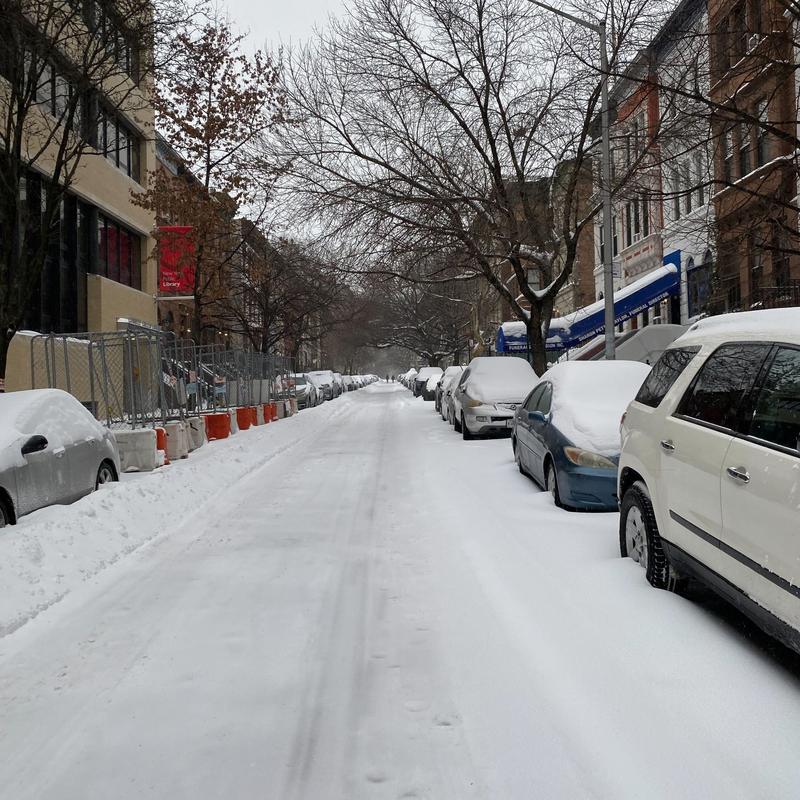
Alison Stewart: New York City's monster snowstorm delivered as promised over the weekend with 10 inches of snowfall measured in Central Park. John Homenuk is the meteorologist behind the popular social media account, New York Metro Weather, where he breaks down forecasts and weather science in easy to understand posts. He often posts what kind of weather the day would be like, like 10 being the highest, the most perfect day, it would be a 10. Yesterday, John gave the weather a 1 out of 10 and said the vibes were frozen. He's here with us now to recap yesterday's storm. Hey, John.
John Homenuk: Good morning. How are you doing today?
Alison Stewart: I am doing fine. How are you doing? I should ask.
[laughter]
John Homenuk: I am jazzed up on coffee right now, otherwise exhausted. It's been a long week, and I think we have a stretch of active weather coming up. I'm ready for it.
Alison Stewart: All right, listeners, we want to hear from you. How did you spend yesterday's big snow day? Did you go sledding? Did you stay inside? Do you have questions about the storm or meteorology in general from the man behind New York Metro Weather? Call or text us now. 2124-433-9692, 212-433-WNYC. Okay. What is your main takeaway from yesterday's storm?
John Homenuk: Yesterday ended up pretty close to forecast, right? I feel like early on there was some crazy hype about the possibility of 30 inches, and everyone's app was going crazy. One takeaway is we don't use weather apps for forecast six days in advance, snowfall, but the other takeaway is it ended up really within the line of forecast, within 6 to 12 inches. I think the storm was really pinned down five, six days in advance as being a potential 6 to 12 inch snowstorm. I thought the forecast was really good. I thought the lead time was really good. I've got to be honest with you, it was really fun to see New York City in the snow, enjoying an actual snowstorm. It feels like it's been forever.
Alison Stewart: Were there any surprises outside of our area?
John Homenuk: The northward extent of the storm was a little weak up in New England, so way up in Vermont, New Hampshire, they were expecting 15 plus inches, and a lot of areas only ended up with 8 to 10. I think the northward extent, the air was really cold, as I'm sure everyone was able to figure out, yesterday. That cold pressed the storm a little bit further south up there, but otherwise, everything went pretty much according to plan, which is pretty rare these days. It was nice to be able to enjoy it and not worry too much minute to minute about the forecast.
Alison Stewart: You said you enjoyed it. What did you enjoy about it?
John Homenuk: New York City is a really special place when it snows, and I really enjoyed watching everyone have such a good time, enjoy the snow, enjoy the spirit of the city during these snowstorms. People were sledding, taking their pets out to enjoy it, and falling on a weekend made it a little better too, a little less stressful for a lot of people. It was really nice to see everyone having so much fun.
Alison Stewart: How did the storm rank in terms of New York's recent history with storms?
John Homenuk: We're waiting for the actual final snow and sleet total to come in. Usually that comes in around early afternoon today from the National Weather Service, but I would say it ranks in the middle of the last couple of years. It's been a while since we've had 10 inches. Believe it was 2021, I'll have to fact check myself on that, was the last storm that was 10 inches or more. Going back a decade, it's only our second or third 10 inch plus storm since 2016, which is a long time ago. It's in the middle in terms of the history of New York's big snowstorms. It's not an all timer, but it was pretty consistently above what we've gotten the last couple of winters. That's for sure.
Alison Stewart: Listeners, we want to hear from you. How did you spend yesterday's big snow day? Did you go sledding? Did you stay inside? Do you have questions about the storm? I'm speaking with John Homenuk, who runs the account, New York Metro Weather, and we are taking your calls. Our Phone number is 2124-433-9692, 212-433-WNYC. The winter conditions and the extreme cold has stretched from Texas to Maine. What has caused so much of the country to get so cold?
John Homenuk: This is a really unique situation where we have a very anomalous pattern evolving across multiple parts of the world. The main thing that has affected us is something called a high latitude block. It sounds like a really fancy term, but what it really just is, is a term to describe an anomalously strong high pressure over the high latitudes. Think about Greenland or Alaska or the Arctic. When you have a very strong high pressure block up there, it takes all that air that typically resides there and dislodges it somewhere else, and that happens to be towards us.
We had this huge Arctic high pressure coming down straight from the North Pole, essentially, and we timed it with moisture trying to come out of the Baja of California and push up into that Arctic air. That created this boundary where you had moisture and lift. So you were getting precipitation and you had really cold air pressing down because of what's going on in places like Alaska, Greenland, and the Arctic Circle.
The combination of those two things led to a unbelievably large stretch of area getting involved in winter precipitation. Not to spoil anything, but that high latitude block is still there, it still exists, and we're not out of the woods yet at all when it comes to winter weather.
Alison Stewart: Oh, tell me more.
[laughter]
John Homenuk: Upcoming this weekend, we're watching the potential for another storm. The models are all over the place, but this one looks like a little bit more of a traditional coastal storm nor'easter. It's one of those boom or bust scenarios where it's either going to be nothing or a whole lot. We're still in the very early stages of it, but with that block still there, a lot of Arctic air around, the pattern is pretty volatile. We'll be watching that closely, and I suspect that we'll start to hear more and more buzz about that in the coming days.
Alison Stewart: Let's take a couple of calls. This is Christian calling in from Brooklyn. Hey, Christian, thanks for making the time to call All Of It.
Christian: Hey, how's it going? Thanks for taking my call.
Alison Stewart: Sure thing.
Christian: You asked how folks spent the day yesterday. I run a small shelter, and because of the MTA and the sanitation crews out there, I was able to get to my site when staff could not secure the site. I was working yesterday. We operate 24/7, 365, and we've been in a deep code blue for the past week. We have to be open, we have to serve people. That's what I did yesterday. What did you do yesterday? [laughs]
Alison Stewart: What did I do yesterday? Well, first of all, Christian, thank you for the work that you did. What did I do yesterday? I battened down the hatches, as they say in our backyard. I got a little worried. I thought an umbrella was going to go over, so I marched out, latched it down, took care of it. Everybody was safe. This says, went to the movies and barely managed to get there, after I went to Trader Joe's and it looked like the zombie apocalypse, empty shelves everywhere. This is an interesting question for you, John. It says, what's the difference between sleet and freezing rain?
John Homenuk: Great question. The big three confusion precipitation types, as I like to call them, are sleet, hail, and freezing rain, right? In the wintertime, a lot of people will refer to sleet as hail because that's what they know an ice pellet to be. I'll take us through a very rudimentary version of what the three are. I'm going to separate hail out right away because hail occurs in supercell thunderstorms. Hail is an ice pellet that forms in the updraft of a thunderstorm. The way to think about this is when you see those big, puffy cumulonimbus clouds in the summertime, inside of there is actually this violent process going on, where there's all this upward motion.
The ice particles in there collect and they form hail. The stronger the updraft, the longer that upward motion can fight gravity and keep the hailstone bouncing around up there. The bigger storms have bigger hail. Eventually the hail becomes too heavy and gravity wins and it falls, but the stronger storms have bigger hail. That's what hail is. Sleet and freezing rain are two totally different things. The way to think about sleet is that there is a warm layer between where we are right here and the cloud, where the snow is falling from.
If you think of the atmosphere in layers, like a cake, top layer of the cake will be where the snow falls out of the cloud, and that snowflake falls down, and it falls through this layer of air that happens to be warmer than freezing. That snowflake melts, and then as it keeps on falling down, now as a raindrop, it refreezes into an ice pellet as it gets down to the surface here, which is colder. That's how you get sleet.
Freezing rain occurs when that warm layer is just wider. The snowflake melts. It doesn't have time to refreeze into an ice pellet, so it hits the ground as rain, but then the ground is so cold that it freezes on the surface that it lands on. Hopefully, that was a little bit of a quick explainer of the difference between those three confusing precipitation types.
Alison Stewart: You're listening to John Homenuk, who runs the account, New York Metro Weather, and we're taking your calls. How did you spend yesterday's big snow day? How are we spending today's big snow day? Did you go sledding? Did you stay inside? Do you have questions about the storm? Our number is 212-433-9692, 212-433-WNYC. This text says we got more than 14 inches in Washington Heights and it is snowing now. I looked at the window, and yes, it is snowing right now.
John Homenuk: Yes, it is.
Alison Stewart: This is a great text. It says, I went on a run yesterday morning and got interviewed by The New York Times for being that crazy person running in a blizzard. I may not get over them calling me a transplant, despite me having been here 20 years longer than I've lived anywhere else. [laughs] When the precipitation switched over, mid afternoon, you're hearing the pelts on my window. Has that changed the conditions on the ground? Because our runner, I have to imagine, wouldn't be out there if it were sleeting.
John Homenuk: Yes. Sleet is more dense, obviously, and heavier. First of all, it compacts the snow down. Snow accumulation, when it's just pure snow, is a beautiful, intricate process, where the snowflakes are all-- It looks just like this white blanket, but if you really stare at it, it's all these accumulated snowflakes. When sleet falls, it kind of just crushes everything. That top layer of snow just gets compacted into this icy, caked part on top of the snow, and road conditions get pretty bad too.
It was below freezing at the surface yesterday. A lot of places were in the middle teens, 16, 17 degrees. It created a very, very icy, slippery condition across the entire area and compacted the snow down from this beautiful, fluffy snow to the snow that had this layer of caked up ice on top of it. I always joke around that sleet is my least favorite precipitation type. I think it has very few redeeming qualities.
Alison Stewart: This is a question. It says, how do meteorologists know when, where a storm is going to form? How do they know how much moisture the storm will carry before it is even formed?
John Homenuk: Great question. Someone said to me a few days ago that meteorologists really are predicting the future. I think that couldn't be more true. Luckily, we have some amazing tools at our disposal. A lot of meteorology starts with observing what's going on right now and what has happened in the last couple of days and hours. We look at a lot of satellite imagery, radar observations across the world, across the country, and then the beauty of having weather models as guidance is weather models are essentially taking those current conditions and then simulating the physical processes with numerical equations, but they just give us an idea.
We can start to formulate an idea based on what we see on satellite and radar, and with the observations, what the models say, and help us guide that forecast forward. There still is a lot of inherent uncertainty. If you think about a weather model for today, it'll probably be pretty accurate because you're starting the simulation today, but as you get out to six, seven, eight days in advance, those simulations become increasingly chaotic. We're still working on getting better at those forecasts in the extended range, but a lot of meteorology is understanding what's going on right now first and then looking at those observations and using models as guidance to project what will happen from here.
Alison Stewart: Let's talk to Mars in Brooklyn. Hey, Mars, thanks for calling All Of It. You're on the air.
Mars: Hey, how's it going?
Alison Stewart: Doing okay.
Mars: All right, cool. I spent the time just playing a lot of games, like Monopoly, which I haven't played since I was 10 years old. I'm a massage therapist, so I had gotten so many calls of people wanting to get massages, but there's no way I was going to do that. Then trying to get my dog to do whatever she needed to do is impossible, but it was just such a nice time, honestly, to just have a reprieve and have an excuse, in a way, to just chill. I don't know. That's all I did-
Alison Stewart: Sounds like--
Mars: -and cooked. Lots of cooking.
Alison Stewart: Cooked. Oh, what'd you cook?
Mars: Oh my gosh. I made a salmon with coconut milk sauteed with onions and peppers and all sorts of stuff on there. It was just great. I've never made it before.
Alison Stewart: Sounds good.
Mars: It's just a good time to be able to do nothing.
Alison Stewart: Yes. I made ground chicken chili. It was pretty good. What did you make, John?
Mars: Oh.
Alison Stewart: Did you make anything?
John Homenuk: I did not make anything. I was working all day. I was just on a coffee diet really, yesterday. It's kind of funny because when you're working these storms, it almost feels like the job isn't over for me until the last flake falls. You want to keep everyone informed on what's happening, and try to share in the experience as much, but the grind of it is not over until the storm pulls away.
Alison Stewart: I'm speaking to John Homenuk who runs the account, New York Metro Weather, and we're taking your calls. How did you spend yesterday's big snow? Did you go sledding? Did you stay inside? Did you cook? Do you have questions about the storm? Give us a call or text us at 212-433-9692, 212-433-WNYC. We'll have more after a real quick break.
[music]
Alison Stewart: You are listening to All Of It on WNYC. I'm Alison Stewart, and my guest is John Homenuk who runs the account, New York Metro Weather. We are talking about the big snowstorm, and we've got a text for you, John. It said, what made you decide to become a weatherman and at what age?
John Homenuk: Oh, good question. Thanks for the question, by the way. I've always been interested in the weather, going back as far as I can remember. I grew up on the south shore of Brooklyn in Mill Basin, and I just remember the snowstorms. I was lucky enough to grow up with Blizzard '96 and President's Day Storm in 2003. Those storms fascinated me, but then really, the thunderstorms in the summer and the movie Twister was what got me. From there it was just--
I was born at a fortunate time where as I was growing up and going into school, I was-- the dawn and the explosion of the internet. I was on all the weather discussion forums, talking to people, and utilizing the communication resources that I had. I've always been really, really into it. For me, it's been the one thing that has been a constant in my whole life. It's just my interest in the weather going back as far as I can remember.
Alison Stewart: New York Metro Weather, it started as a blog.
John Homenuk: Yes, it did.
Alison Stewart: When did you start to notice people were paying attention to your blog and your social media posts?
John Homenuk: Pretty early on. I was young, obviously, I started the blog in high school, which is crazy to think about, right? On blogspot.com I don't know if you remember that. There was some comments and interaction early on, and even the young John was able to recognize this is really cool and people are really interested in this. Hurricane Sandy was the big one. We were just kind of growing our social media presence at that point off of the blog and just an explosion of interest in it. I think people really took an interest to the briefings and the detailed information.
It was the first time that I realized that New Yorkers, in particular, they want the details, they're interested in the science. They want to know what's going on. With that storm affecting New York and New Jersey so much, the light bulb went off for me that there was an area, an opening for this, where people wanted to communicate on a personal level with the weather guy or girl and be able to understand what's driving the forecast and how it all works.
Alison Stewart: Let's talk to a couple of people who got a lot done yesterday. First, let's start with Zeke, who is calling in from Park Slope. Hey, Zeke, what's going on?
Zeke: Hey, Alison. First, I want to say thank you. I've got to tell you, the last time I called you was about how do you create a village episode. I was on that phone and I shared that with so many friends.
Alison Stewart: Oh, good.
Zeke: Everybody loved [unintelligible 00:19:06] time. It was great, because you have a whole fan base. Yesterday, what I did is I have a bunch of oriental rugs. I was cleaning them, I was steaming them with my Bissell. Then I'm in the process today now, as I'm doing some business, cleaning my refrigerator, wiping it all down, cleaning it out inside. Then I was roasting peppers yesterday. I'm going to be pickling some okra and freezing okra. I've got a whole list of kitchen-based work and house cleaning I'm going to be doing. I wanted to go outside, but I was like, "Why bother? I know what snow looks like," though I love it. I have to say, I wish it happened a bit more for kids because then when I grew up, we could count on snow days, right? [unintelligible 00:19:53] go out sledding. Today it's like, my God, it's not enough. [laughs]
Alison Stewart: Zeke, thanks so much. Click those things off your to do list. I love it. Let's talk to Stella, who's calling from the Upper West Side. Hi, Stella. Thanks for calling All Of It. You were busy as well, I can see.
Stella: Yes, thanks for having me on the show. My husband and I emptied out three or four of our closets and just went through a bunch of stuff to reorganize, and we really made a dent. We have a big pile of things that we need to donate once it's a little bit easier to get them to a donation site. We rewarded ourselves with a trip out to Central Park and watched some people ski and snowboard and sled down the great hill near our house, and found some cardboard and went sledding ourselves.
Alison Stewart: Oh, that sounds like a great day. Thanks so much for calling in. Hey, John, I wanted to ask you, for people who do want to go out in the snow and do want to sled, what advice would you give them in terms of what they should wear?
John Homenuk: Oh, great question. I'm a big snow pants person. I ski and like to go hit the slopes. I've got all that gear, and when I go sledding, I just wear snow pants. I've seen some videos that had me very concerned yesterday of people in shorts and jeans. [chuckles] I don't know why you would do that, but I'm a big snow pants person. If you don't have those, just sweatpants and a big jacket and boots. Don't let the snow get in because it gets very uncomfortable very quickly when you have snow in your shoes.
Alison Stewart: Every day you post a weather rating. Yesterday it was 1 out of 10. Today you're at 3 out of 10. How does your weather rating system work?
John Homenuk: That's a little bit of a secret I can't totally reveal, but I would say this. I think New Yorkers, in particular, they want to know, is the weather going to impact my day to day in a negative way? Can I go to happy hour? Can I go to work? What do I need to wear? Is it going to be annoying? Is it going to be uncomfortable? That's what I'm thinking about when I'm doing these weather ratings. I totally understand. There's people that are like, "Today's a beautiful winter day," but at the end of the day, if you compare today with a beautiful September afternoon where it's 73 and sunny, the two are not the same.
I always try to keep in mind what New York weather is capable of, and I think this year is a great example. We had a bunch of 10 out of 10 days in September and October where it was in the mid-60s, low humidity, sunshine, light breeze. It doesn't get better than that. New York City really in the fall and spring tends to shine. It's a bit of a rating scale for comfortability. For me, there is definitely a prime time zone that we can hit where we're in that mid-60s to mid-70s with sunshine. Feels very far away right now, but we'll get there.
Alison Stewart: This is an interesting question that we got via text. It says, how much has AI changed meteorology?
John Homenuk: Amazing question, actually. It's in the process of changing it. I would say, we could talk about this for an hour, but weather models, as they stand right now, the main ones that you know, the European model, the GFS model, they are all what we call physical models. They are numerical, they are built on equations that are trying to simulate the atmosphere. These AI models, a lot of them are built on machine learning platforms where they are trying to learn from their own mistakes, learn from mistakes of the past.
My inclination is that these models are only going to get better when paired with the physical models that we already have. If we can use these machine learning and AI techniques in addition to making our physical models better, I suspect that the next decade we will see weather prediction improve, specifically in the four, five day time frame where I think accuracy could go way up.
Alison Stewart: The government's been trying to cut funding for certain scientific agencies, including NOAA, National Oceanic and Atmospheric Administration, which provides weather forecasts. How would those cuts affect your ability to do what you do?
John Homenuk: Terribly. It would be a nightmare. There's already been some speculation about different resources and organizations that are going to be cut. I can only tell you that it would negatively impact forecasting, the ability to get information to people and the ability for us to continue to get better at this. It would be a horrendous decision.
Alison Stewart: This text says, we live up in Yorktown Heights, Westchester. We got 15 inches of snow. Yesterday we stayed in. I'd already made homemade chicken noodle soup on Friday. In addition to laundry-
John Homenuk: Wow.
Alison Stewart: -and basic house chores, I almost finished a puzzle that I've been working on during the holiday. Sadly, I could not find the last two pieces. Now I need to go through the vacuum bag.
[laughter]
John Homenuk: Well, maybe you have another snowstorm coming up to finish the puzzle, but that sounds like an amazing day.
Alison Stewart: All right, let me ask you, what does the rest of the week look like? What does next weekend look like? Then I'll let you go.
John Homenuk: The rest of the week is fine. I think we're just a little bit in between here. It's going to be cold, but there's no major storms for the next few days until this weekend. I think we do need to watch this weekend closely. As I mentioned a little earlier, it's probably going to be a boom or bust type deal, where we're either going to get nothing or a lot, but there are some signals out there for a big coastal storm Saturday and Sunday. I suggest two things. Number one, don't use the apps. They're going to show you any variety of 0 to 40 inches of snow. Just remember those are just algorithms that are not really going to guide you in the right direction.
Also, stay away from the hype accounts on social media that are going to post the big, bright graphics to try to get your attention. What we're going to do in the next couple of days is try to break down the storm threat, get some confidence on it in terms of actual numbers, and figure out where the pattern is going, and hopefully get to a better picture on where the storm is going to get ahead from there. There is a storm threat this weekend, Saturday and Sunday in particular, after a pretty quiet week.
Alison Stewart: Thanks so much to John Homenuk, who runs the account, New York Metro Weather. Thanks for joining us, John.
John Homenuk: Thank you so much for having me.
Alison Stewart: Thanks to all our callers who called in. Remember, beware of ICE.