
History of The Studio Museum
Alison Stewart: This is All Of It on WNYC. I'm Alison Stewart. A quick look ahead at tomorrow's show. Oscar-winning actor Brendan Fraser and director HIKARI will be here in studio to talk about their new film Rental Family. New Orleans bounce legend Big Freedia has released her first gospel album titled Pressing Onward. She joins us for a listening party. Chef and cookbook author Samin Nosrat will be here in studio to talk about her latest cookbook titled Good Things: Recipes and Rituals to Share with People You Love. That is coming up tomorrow.
Now, let's get this hour started with the reopening of one of the city's most beloved art museums.
[music]
The Studio Museum in Harlem is open after seven years. It has expanded, adding 82,000 square feet and seven stories. It's added a whole lot to the conversation about it. Listeners, we want to hear from you. Did you make it to the Studio Museum over the weekend for its reopening? What was it like? What art did you see? Call or text us now at 212-433-WNYC, 212-433-9692. What has the Studio Museum meant to you over the years? Any memorable work or artists you've seen there, or maybe you're an artist who has exhibited at the museum or worked there with what has your experience been like? 212-433-WNYC, 212-433-9692.
Joining us are Dr. Salamishah Tillet, Pulitzer Prize-winning critic and professor at Rutgers University-Newark, for some background on the museum. Salamishah, it's nice to meet you again.
Dr. Salamishah Tillet: Nice being here. Thank you.
Alison Stewart: Alex Greenberger, ART-- Did I say it right?
Alex Greenberger: Yes.
Alison Stewart: Okay. Alex Greenberger, ARTnews senior editor, and author of the recent story 13 masterpieces to See at the newly reopened Studio Museum, Harlem. Alex, you've seen the building. You've been to the building. Can you describe it for us?
Alex Greenberger: Thank you for having me. First of all, the Studio Museum in Harlem is such an amazing institution. I think for anyone who's been there before, probably what you'll first notice is that it's much bigger than it used to be. They have an amazing collection there, but they've not had quite as much space as they need to exhibit it. I think they've really made good use of that. It just feels like a bigger museum. It's been designed by Adjaye Associates, the new building, and it's just very sleek, very beautiful. It feels like a totally different place if you've been to it before.
Alison Stewart: Salamishah, what's been your reaction to the opening and this multi-year renovation?
Dr. Salamishah Tillet: I just feel really fortunate to have been able to chronicle the museum while it was closed and then on the verge of its reopening for Harper's Bazaar. I wrote a piece in 2021, and then I wrote a piece this fall. I just think one of the things that's so important about the Studio Museum is not only the way in which it's reshaped global art, but its location and the way in which Harlem itself has been built so purposefully in mind with the renovation and the reopening. I just think it's a monument to Harlem as well as an institution to the art world. It's really been anticipated, really exciting. I haven't been yet because I've been flying all over the country.
I've been missing. I have fomo. I've been watching everything. I've missed all the previews, so I feel bad because I've missed those. I look forward to going when it-- Because I know how much it means and how much thought and care has been put in to the design of both the exhibitions, but also the building itself.
Alison Stewart: Who was the original museum for, and who were important people in its founding? Salamishah?
Dr. Salamishah Tillet: Originally, it was opened in 1968, the way in which other institutions in Harlem were both responding to that shift from the civil rights movement to the black arts movement, the assassination of Dr. Martin Luther King. The museum initially opened above a liquor store. It was like a small location. I think its original audience were both the members of the Harlem community that were its neighbors, as well as black artists or artists of the African diaspora whose work had been highly underrepresented and underserved by mainstream institutions like MoMA or Met, or even art galleries that we could find downtown.
It's both audience, the community of Harlem, and also the artists that were producing really vibrant and dynamic work at the time, but just weren't getting their fair shake in the art world.
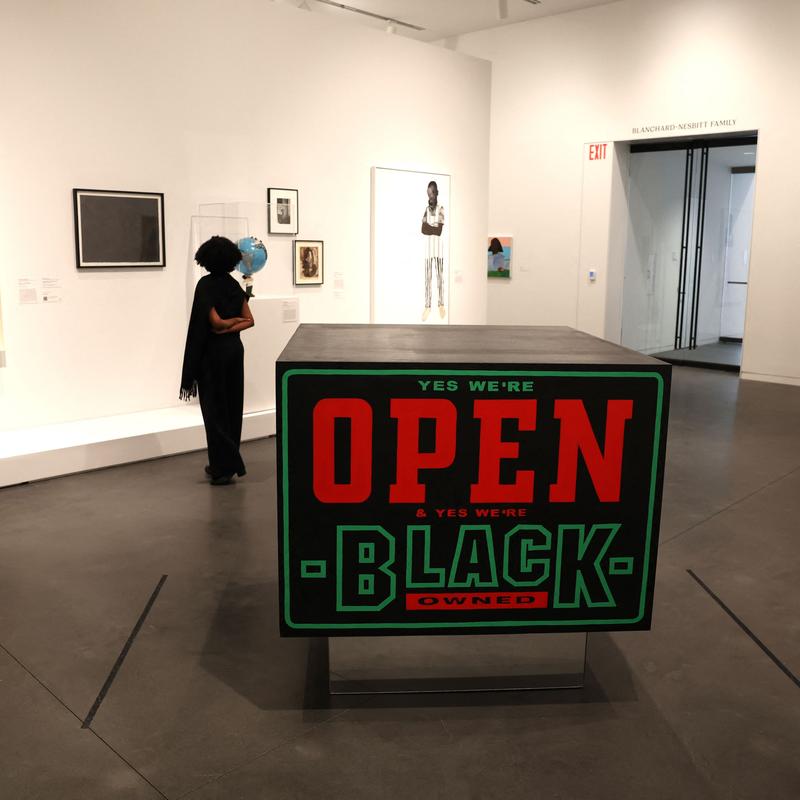
Alison Stewart: Alex, you created a list of 13 pieces to see at the Studio Museum. They range from pieces created up to last year. You start with a piece from 2021 by Lauren Halsey. It's called Yes, We're Open, and Yes, We're Black-Owned. What about this piece is symbolic for the reopening of the Studio Museum?
Alex Greenberger: I think it would really be twofold. My answer to that the first thing I want to highlight is that Lauren Halsey is one of the many artists who's passed through the Studio Museum's Artists in Residence program, which was first proposed by an artist named William T. Williams in 1968. He himself was actually in the opening rehang. I would definitely take a look at that painting.
Also, I think this piece it speaks, well, as just a mission statement of what this museum is all about. It's all about carving a space for artists of African descent, as the museum states in its mission statement. It basically is saying, we have a right to be here and we deserve this space. Now we want to show off all of our creativity, which is something the Studio Museum has, of course, been doing ever since it was opened in 1968.
Alison Stewart: Salamishah, you recently wrote that the Studio Museum is important outside of the art world. You said, "It has made art history in spaces designed for everything but art." What did you mean by that?
Dr. Salamishah Tillet: What I just wanted to say in terms of people who've come through, what I think is so fantastic about the Studio Museum and its relationship to history is just that it opened, its first exhibition was Tom Lloyd's Electronic Refractions, to a really avant-garde aesthetic at the time. Now they're returning back to that show with this opening. It's such a place that's aware of its history. I guess partly what I was saying there was that art is just of part of the identity, a very essential part, a vehicle and a vessel for the way it expresses itself. It is also about community. It's about lineage and legacy.
One of the things that was so exciting for me when I interviewed all of these curators who had come through the Studio Museum, been trained by the Studio Museum legacy, and particularly under the leadership of Thelma Golden, is just how black feminist it is. It's a community-building place. It doesn't see art and community as in competition with each other, or there's a hierarchy. It sees them as feeding off of each other. I think what all of those curators said is that not only were they made more rigorous because of their time at the Studio Museum, but they were able to take all of those lessons and deploy them in institutions, whether it be the Guggenheim, or MoMA, or even a Documenta.
The way in which the Studio Museum's central message of community art, activism, identity, and history commingle is the lesson that they take and then shape the world as a result.
Alison Stewart: Let's talk to George from Manhattan, who got to go. Hey, George, thanks for taking the time to call, All Of It.
George: Hi, Alison. I went to an opening on Monday. I'm a proud inaugural member and a sustaining member of WNYC. It was a homecoming in many ways because I had worked there in the '80s and '90s. It was not only a homecoming back to 144 West 125th street in this gorgeous, new, dazzling home, but also to see some artworks which I had worked on, presenting and recall fondly. Also, because the inaugural exhibition, I believe, is all permanent collection, but also they do a great timeline. I was able to visit or revisit publications and exhibitions I had worked on and see colleagues, including Thelma Golden.
Alison, we talked about you because we're both All Of It fans and have called in and been on the show. We send our regards.
Alison Stewart: Oh, well, thank you so much for calling in. We do appreciate it. The Studio Museum in Harlem reopened to the public on November 15th after nearly eight years of renovations. We're talking about it with Salamishah Tillet, Rutgers Newark professor and Pulitzer Prize-winning critic, and Alex Greenberger, ARTnews senior editor. We do want to hear from you. Did you make it to the Studio Museum over the weekend? What was it like? What art did you see? Or if you live in Harlem, what does the Studio Museum mean to you?
Our Phone number is 212-433-9692, 212-433-WNYC. Another piece on your list is William T. Williams and his piece, Trane. Excuse me. For those of that don't know his importance to the museum. Who is William T. Williams?
Alex Greenberger: William T. Williams transformed the Studio Museum in Harlem in his own way. In 1968, he proposed what is now the Artists in Residence Program. The Artists in Residence Program has really brought up many different generations of black artists, and their names you would know, like Kehinde Wiley passed through it, Mickalene Thomas passed through it, Lauren Halsey passed through it. It's just really been such a font of creativity. Also, alongside all of this, Williams is a really masterful abstract painter. This is a painting that pays homage to John Coltrane. The name is short for John Coltrane.
Alison Stewart: It's spelled T-R-A-N-E.
Alex Greenberger: That's correct, yes. It really just pays homage to the vibe of his sound, the improvisational, just combination of so many different things colliding together. The painting visualizes that through a bunch of different colorful planes.
Alison Stewart: Salamishah, when you think about the Studio Museum, how does it separate itself from other traditional museums?
Dr. Salamishah Tillet: I think of it as a vanguard institution. It's born out of struggle in terms of the 1968 moment. I said this earlier, that it really feels as if it sees itself as central to Harlem and shaped by Harlem. I think a lot of institutions in major cities or even local small communities don't necessarily feel as if the landscape of the place, the people of the place, the rhythm of the place, is going to shape the art that they exhibit. I think that relationship between Harlem-- Then if you talk to Thelma Golden, she talks about the name itself. Studio and artist residency being so essential to the ethos of the place, and artists interacting with curators, interacting with people visiting the museum.
Museum, as we already know what that means in terms of galleries and community education, and then Harlem. Everything is in the name itself. That distinction, I think, is really part of it. Then, the way in which it really celebrates and pushes the conversation on what African diasporic art is. It does so in order to see itself as central to larger conversations about global art. Also has changed how we think about that, regardless of what space we're in. It's hard to imagine or hard to fully quantify or qualify how impactful the Studio Museum has been in reshaping museums across the world and how it engages black artists throughout the African Diaspora.
It's pretty remarkable how which historically has been a small museum, now remade its reach, has been extraordinary.
Alison Stewart: We got a great text that says, "Camille Norment's sound sculpture was a standout for me." Alex, that was on your list?
Alex Greenberger: Yes. I love this Camille Norment work. It's essentially on a wall. There's large brass tubes that are twined with this almost wire-like brass substance. Emitting somewhere from these tubes, you don't see where the speakers are. The sounds are humming. It's almost like a chorus of people. The name pays homage to the way plants will grow in the direction of the sun. It is thinking about migrations of people and the way that black communities across the nation, but also across the world, have migrated together and come together in a space.
Alison Stewart: Salamishah, how has the Studio Museum fit into the arts ecosystem?
Dr. Salamishah Tillet: Well, fit in or central to it just depends.
Alison Stewart: Central, too.
Dr. Salamishah Tillet: I do think that, if you look at the artists that we just named have come through in residencies whose work has been exhibited as their first shows. You have people like Julie Mehretu, Sanford Biggers. Also, the curators that have just been nurtured and worked in that space. It's exemplary of how an organization that has such an important ethos of being committed to artists first, then shapes the art world at large.
I think one of the things that came up in the interviews I did with the curators is because black art is now so well represented in different mainstream institutions, and the Studio Museum is obviously mainstream, but bigger institutions. Is there a role for the Studio Museum? What this opening says is not only is there a role, but we should all be bowing down to it as a mother institution for how these larger institutions now engage what is really the most popular art today, which is art by African artists of African descent.
Alison Stewart: Listeners, we're talking about the Studio Museum opening to the public over the weekend. Did you make it to the museum? What was it like? What art did you see? Or if you live in Harlem, what does the Studio Museum and this reopening mean to you? Give us a call at 212-433-WNYC, 212-433-9692. We'll be right back.
[music]
Alison Stewart: You're listening to All Of It on WNYC. I'm Alison Stewart. The Studio Museum in Harlem reopened to the public on November 15th after nearly eight years of renovations. We're speaking about the history of the museum and the art you to see. My guests are Salamishah Tillet, Rutgers Newark professor and Pulitzer Prize-winning critic, and Alex Greenberger, ARTnews senior editor. We are also hearing from you. Let's talk to Winston from Brooklyn. Hey, Winston, thank you for making the time to call All Of It.
Winston: Hi. Thank you for the opportunity. My name is Winston Huggins. I'm an artist. I came actually to the city in 1974 from Kingston, and I brought artworks that I'd begun at the Jamaica School of Art while I was there. I lived at 93rd Street between First and York Avenues. That was my community studio gallery. Then what I actually find fascinating about it is that after going down on Friday and looking at the building, it reminded me of when I left Kingston. There used to be a sound system in downtown Kingston where I used to go to class on my way to the art school. It looks like the building today looks like a really nice big sound system speaker, and really fascinating. It's a responsive chord.
Alison Stewart: We love that. Thank you so much for calling in. Let's go back into the art that we can see. Kerry James Marshall, his piece Silence is Golden from '86. Alex, you wrote that this is a classic. How so?
Alex Greenberger: Yes, I just want to say that I said it's a Studio Museum classic. Having thought about it a little bit, I think I would just say classic period. It's from 1986. I would say it's maybe one of the best paintings of the '80s anywhere. It really is a defining work for Kerry James Marshall, who has been so influential in the way that he's thought about black figures in relation to art history and specifically the Western canon, which has long excluded them. This is a very complicated work in which there's a very dark black figure that is literally the lack of color black situated against a very dark background. It's a stereotype. All you see of this figure are really their teeth and their nails.
They're situated against this block of abstractions that's reminiscent of modernist abstraction by Kazimir Malevich and so many other white males that have really been canonized. It's saying, really, do you see me? Do you notice me in relation to all this other art? It's a question that I think many artists, after Marshall, have taken up in asking.
Alison Stewart: We've got a call from someone who is one of the first artists to be exhibited in the old museum. This is Ben Jones calling in from Jersey City. Hi, Ben. Thank you for making the time to call All Of It.
Ben Jones: Thank you. The old Jersey City Museum was where I had my first show. I think it was in 1972. It was my first solo show in New York. At that time, when I think about that, a lot of my art was very African-centered. When I look at the-- this is almost 50 years ago or 40 years ago, the evolution of the change in your work. The Studio Museum was always a wonderful, wonderful place because it let us black artists feel like we were valued. Even though many of the mainstream institutions like the Met and the Modern, as I'm from Faith Ringgold's time, we had to protest a lot to make sure that these institutions were recognizing us.
Like one of your people were saying, that now there's such an evolution of the work where black artists works are all over the place. It's wonderful the way that the museum has always tried to feature the Diaspora, not just African American artists.
Alison Stewart: Thank you so much, Ben, for calling in. Salamishah, did you want to add to what Ben said?
Dr. Salamishah Tillet: Yes. I was just thinking of two things.
One, the former caller who talked about the way it looks like speakers, and I was thinking about how the building is designed with this movement between the interior and exterior. When I had my tour this summer, about four principles or four things that were driving, like the stoop, the street, the sanctuary, and the stage. Building this place to have that movement of Harlem as embedded into the infrastructure of the building, but also a sanctuary, which is a discreet space to celebrate, a spiritual space, or a sacred space to hold black art and art from the African Diaspora. That resonates with what that caller just said, like that it's a sacred space. It's a special place. It's a welcoming [sound cut]
I just wanted to highlight the architect. The space is really moving in between all of these concepts. When you're there, you're like, "Whoa," not maybe it looks like a speaker, but there's actually a stage that's built into the floor of the building. That's what you see. It's maybe doubles as a sanctuary when you get upstairs. I just [soundcut] on how intentional everything is, too.
Alison Stewart: Alex, you included a piece from Faith Ringgold, who passed away last year. She was born, raised in Harlem. Her piece is Echoes of Harlem from the 1980s. Much can be said about Faith Ringgold. What about this piece that you chose captures the neighborhood?
Alex Greenberger: This is a very important piece for Faith Ringgold because it was one of the first of her story quilts and one of the last that she made with her mother, who unfortunately passed away. You have in this quilt paintings of people that Faith Ringgold saw throughout the neighborhood, I presume, or at least based on people that she might have encountered. It really acts as this congregation of people in this quilt, where their faces are arrayed all around it.
I just want to also underline this is a very important work within her body of work, which is, of course, it's something I grew up reading her picture books. It's, of course, made its way into mainstream institutions, mainstream in quotation marks, like MoMA, the New Museum. I think that the Studio Museum owning this work is a very significant thing because they've had it for a really long time. They were caring about this before MoMA put it in its 2019 rehang. They've really invested deeply in artists like her.
Alison Stewart: We've talked a little bit about Thelma Golden. She is a long-time director of the Studio Museum. Salamishah, what impact has Thelma had on the institution?
Dr. Salamishah Tillet: Thelma's the first to say that she's indebted to the founders of the museum as well as the curators who hired her and the directors who preceded her. I want to just say that's important. I do think what we've seen under the helm of Thelma Golden is just the massive fundraising drive to create this new space has just been extraordinary. I think over $300 million, I don't want to misquote the number, but I think it's been an extraordinary amount of fundraising that had to be done in addition to just--
What's so amazing is just how, as I said, I interviewed all these artists and curators and just, just how generous of a leader and of a director she is with her time, with her energy, and with her vision of social change. I think that it is hard to imagine this version of the Studio Museum that we've seen over the last decade and a half without it being at least part of how Thelma envisioned what the Studio Museum role could be in a 21st-century world. I think, all hail to Thelma Golden, gratitude to the team that she's been able to assemble over this time to keep this vision alive and move beyond the physical location of the Studio Museum and to other institutions as well.
Alison Stewart: Let's listen to a clip of Thelma Golden speaking about the opening. This is from a WNYC-reported piece by Hannah Frishberg that aired on NPR over the weekend.
Thelma Golden: It was always this museum's goal to be a home for black art. The collection really represents a cross-generational, amazing conversation between artists who made works over 100 years ago and artists who are making work right now.
Alison Stewart: Alex, the Studio Museum has such a rich tradition of providing opportunities for young people who are interested in art. Why can the museum be an especially helpful place for a young person interested in art?
Alex Greenberger: I think there are just so many answers to that. I think for one thing, I think if you're a kid and you go to this museum, if you're maybe a resident of Harlem, you might see, there are people who look like me in this space, not just operating it, curating the shows, staging educational initiatives, what have you, but also on the walls and seeing, like, "Okay, I matter in a space like this," because I think, as Salamishah was pointing out, for so long, museums marginalized those perspectives or chose not to put them on view at all. This was always a museum that said, "This is a perspective that matters. You deserve to be here."
I think that's the number one thing. I also saw, they've got new educational classrooms and stuff, and they're so beautiful. They are really fun. They have tables that move up and down for the kids, and they've got just-- If I was a kid, I would love going to art school there. I think it sounds so fun.
Alison Stewart: Was there a piece that I did not touch on that you want to make sure gets its due?
Alex Greenberger: No, I think that we touched on some good ones. I just would encourage people to really just explore some works you've never encountered before. Because I will say that there were some new ones for me, too. It's my job to know most of what goes on for you there. There was, for example, this incredible Haitian metal worker named Georges Liautaud, who I'd never heard of before, and I've never seen his work. It was showing an interesting major shows during the '50s, but I've just never even heard of this artist. The Studio Museum, of course, sitting there in their collection for years. That's the kind of work they do.
Alison Stewart: Salamishah, is there a piece that you want to see at the museum?
Dr. Salamishah Tillet: I guess I was just saying the refractions, too. I just can't wait. I've never saw it, so I look forward to seeing that retrospective, in a way, as part of the founding and now the reopening. I'm really excited just to be there with people, because I haven't experienced it that way with crowds of people clamoring to see art. I look forward to that as well.
Alison Stewart: My guests are Salamishah Tillett and Alex Greenberger. Thank you so much for being with us. Thank you to our callers who called in.
Alex Greenberger: Thank you.
Dr. Salamishah Tillet: Thank you.