
Graphic Memoir Explores How We Teach Medicine
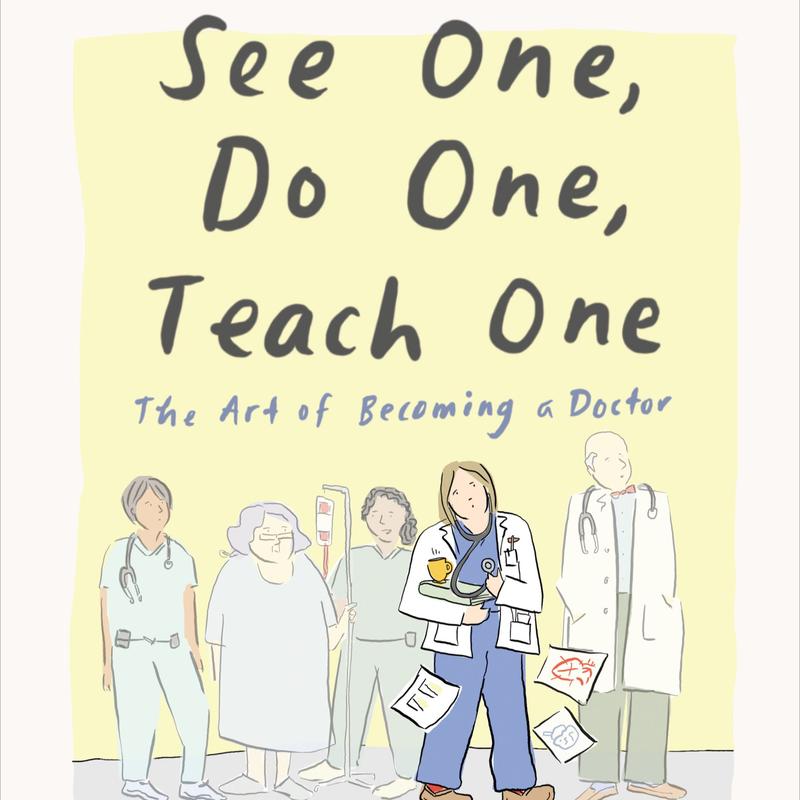
Tiffany Hanssen: This is All Of It. I'm Tiffany Hanssen in for Alison Stewart today. Have you ever wondered what it's like to train to become a doctor? A new graphic memoir from Dr. Gracie Farris takes readers on her journey through medical education from med school to residency. It's titled, See One, Do One, Teach One: The Art of Becoming a Doctor. In it, Dr. Farris, who is also a cartoonist, depicts her time as a med student at Brown University and her grueling experience as a resident.
Through her personal journey, readers get an inside look into some of the entrenched problems of medical education, including open racism, misogyny, and dehumanization. She also illustrates the rewarding parts of the experience, like helping a patient suffering from delusions and assisting in births. See One, Do One, Teach One is out today. Kirkus Reviews says the book is "an empathetic, educational, richly human entry into the graphic medicine genre." We're joined now by author and illustrator Dr. Grace Farris. Doctor, welcome.
Dr. Grace Farris: Thank you. It's an honor to be here.
Tiffany Hanssen: Listeners, we want to hear from you. What surprised you most about medical school? If you went to medical school, are you in medical school? Are you a resident? Call us, text us, 212-433-9692. What's the hardest part? What's been the most rewarding? Definitely love your experiences here from medical school and residency. Again, 212-433-9692. Call us, text us at that number, or you can find us on social media @AllOfItWNYC. Dr. Farris, so let's just start about you. When did you know you wanted to be a doctor?
Dr. Grace Farris: Oh, thanks. I did a summer volunteer experience age 14 in Austin, Texas, at a hospital where I work actually now. I just found it to be fascinating, and it's a lot of the things that are in the book. There's heartbreaks, there's really exciting cures, people walk out of the hospital feeling better, and then being in the hospital is like this tiny microcosm of the world. There's a whole community within the hospital. From that experience, I just caught the bug for medicine.
Tiffany Hanssen: Did you have an assumption about becoming a doctor that you were wrong about? Once you finally got in it, then you started digging in, did you realize that you were wrong about something that you assumed?
Dr. Grace Farris: I think I thought that I would be a gynecologist. I thought I would deliver babies. That was really eye-opening and a very rewarding part of medical school, but I didn't realize how much I would enjoy treating people across the spectrum, men and women, people who were 17 years old all the way to 102. I thought that the diversity of practicing medicine was a surprise that I hadn't been prepared for.
Tiffany Hanssen: Were you encouraged? Did you receive a lot of encouragement? A lot of times, we hear from physicians and people in medical school, in residency, you mentioned it yourself, how grueling it is. Did you find that discouraging, or did you find some encouragement along the way also?
Dr. Grace Farris: I got some good advice from a father of a friend of mine in high school, who said, "Oh, if you're going to do medicine, you should really study some other things as an undergrad." I studied languages, Spanish, which turned out to be incredibly useful, and was also just a really interesting way to think about other cultures. It wasn't discouraging.
I think that there was a lot of trepidation, especially my parents. I don't come from a health care background, and so my family was nervous about the grueling aspects of it. I think about this a lot now because I have two kids, if I would encourage them to go into medicine. I do think that if you're someone who's interested in it, it's this really rewarding career. It's definitely something to consider, and I would definitely encourage somebody if they were interested in healthcare.
Tiffany Hanssen: You are a doctor now, obviously. What area did you end up in?
Dr. Grace Farris: I ended up in internal medicine, which is medicine for adults, and I work in the hospital. I take care of patients who get so sick that they need to be staying in the hospital for a few days or sometimes weeks. It can run the gamut from just someone who has a pneumonia and stays in the hospital for a few days getting antibiotics, all the way to patients who are at the end of their life or have dementia. I get to work very closely with lots of other different types of physicians in the hospital, like heart doctors and surgeons, which is also a really interesting part of it.
Tiffany Hanssen: Talk to us a little bit about where you were in your journey when you first came up with the idea for the book, and what was it about that particular point in your medical education that made you think, "I need to write a book about this?"
Dr. Grace Farris: Oh, thanks. There are so many moments, but I did have a moment in the hospital cafeteria with a medical student I was working with, and we were talking about what he was planning to go into. He was already further along in med school, and he said, "I'm thinking about maybe--" I think he was thinking about urology, a type of surgery. He said, "Oh, Dr. Farris, did you ever think about doing surgery?" I had this cascade of memories from med school about my surgical rotation, which was a pretty intense rotation where I mostly just encountered male physicians. That cascade of memories made me think, "Oh, I would love to share the full story about that and how I went about selecting what field I would go into."
Tiffany Hanssen: Obviously, this is a graphic novel. You are a cartoonist. Did you ever think, though, at that point about just writing a straight-up memoir, or was the art always connected to it?
Dr. Grace Farris: I never thought I would get back into cartooning. I did a comic strip in college, and I didn't see that coming. There has been this great movement started by a couple of physicians and a nurse and a librarian called Graphic Medicine, which is about using comics to explore healthcare experiences. Comics are kind of this form that we start reading when we're young, and so sometimes they don't feel as highbrow as maybe an essay or something.
I love the accessibility of comics and how you're able to see what people are thinking versus what they're saying. I think even when you think about that, the way you can draw someone thinking something else, you can think about how it can have broad applications in healthcare environments where people are not necessarily saying the things that they're thinking about. I got back into comics because of the Graphic Medicine movement. I thought, "Oh, there really needs to be a graphic novel about what that journey is like to go through med school and residency." I love reading graphic novels and graphic memoirs, but there hasn't been one yet about medical school, and it would have been so useful for me in high school and college.
Tiffany Hanssen: Is that not to say, though, that you wrote the book really to sort of convince people to become doctors, right?
Dr. Grace Farris: No, no, definitely not. No, I think more to just make it a little bit more transparent. That was the early feedback I got was people didn't understand the difference between a resident or a med student. I really didn't understand the difference when I started med school. I have a memory of talking about that with another med student and thinking, "What is an intern? When do I become a doctor? When am I a real doctor?" I think trying to shed some light on that, that trajectory was one of the goals, not just to encourage people to go into healthcare.
Tiffany Hanssen: It's not just a book for people who are in med school, who are doctors, who want to become doctors. There are elements here specifically for lay people.
Dr. Grace Farris: Yes.
Tiffany Hanssen: Talk a little bit about how you made the differentiation between when you were, in the book, speaking to the med student, and when you were speaking to a lay person like me.
Dr. Grace Farris: Oh, yes. This is definitely a book for someone who likes The Pitt or Scrubs or Grey's Anatomy. I wanted it to be a book that would appeal to someone who's interested in how people go into different careers. Also wanted to show some of those early experiences and how you can be so young when you're in medical training and confronting death or other very traumatic experiences. I wanted to show how that felt and what it's like to make your first mistake as a doctor because I think, especially right now, it's really important to humanize medicine and healthcare providers at a time when there's-- I have a lot of issues with medical mistrust and authority, and so I did want to try to show that human part of the training.
Tiffany Hanssen: We're talking about a new graphic novel, See One, Do One, Teach One: The Art of Becoming a Doctor with the author and cartoonist, Dr. Grace Farris. Listeners, are you a med student? Were you a med student? We'd love to hear from you. 212-433-9692. You can call us, you can text us at that number. What were you most surprised about, about medical school or residency? What was the hardest part? What did you find rewarding? Let's bring in a caller into our conversation here, Doctor. How about, let's take James in Wayne, New Jersey. Hi, James.
James: Hey, how are you? Thanks for having me on the call. I love this conversation. I remember, like your guest, I was going to be a pediatrician, then I got exposed to other areas of medicine. So many of us that go into medicine end up in different fields than we thought we were going to go into. When my daughter was going through med school as well, one of the things I told her was, "All right, when you go into the beginning of surgery rotation or psych rotation, whatever rotation, or OB/GYN, imagine yourself not delivering your first baby, but imagine yourself delivering your 12,832nd baby. If you think you will still enjoy it, then that might be the field to go into."
Another issue that I ran into with medicine, I was going to med school to help people, and in med school I became a identify the problem, figure out what medicine to give or what surgery to indicate, and you sort of have to reeducate yourself that you're dealing with people and not just with disease entities.
Tiffany Hanssen: Thanks so much, James, for the call. We appreciate it. Dr. Farris, there's this notion that med students, residents, physicians, sometimes after delivering, as our caller said, their 12,000th plus baby, they lose sight of that these are human beings that you're dealing with. How do you talk about that in the book?
Dr. Grace Farris: Oh, yes. I think the dehumanization is definitely something that can happen, and it seems like it happens when you're more sleep deprived or stressed or having to suppress your own concerns, like hunger. I think in the book, for me, it's helpful to try to do some kind of more mindfulness activities in the moment, like the deep breathing, and then I think that sometimes having these breaks. We talk about in medicine, there's systole and diastole. Systole is when the heart is pumping, and diastole is when it's relaxing. A lot of people in medicine feel like you need both of those in your medical life.
You need to have the systole when you're working really hard and focused, but you also need this period of relaxation and diastole to reflect and try to renew your personal resources. I think that that does come up in the book. I do feel like, as you go through your career, you have these ups and downs where the dehumanization or feeling disconnected is more acute, and then surprising moments will just bring you back to what a gift it is and what a privilege it is to be a physician and be working in healthcare.
Tiffany Hanssen: You mentioned that, and you write about this. In the book, you say everything I knew about med school I'd gleaned from TV shows. I think that's true for a lot of us, not just people who are going through med school, especially with the rise of shows like The Pit, and before that, there were-- What is that George Clooney one that I'm now forgetting the name of?
Dr. Grace Farris: Oh, yes, ER.
Tiffany Hanssen: ER. Thank you. How could I forget that? You write that. Are you saying that in a derogatory way, or are you saying that just as a fact? This is our entry point for a lot of us.
Dr. Grace Farris: I think the storytelling that occurs in culture can be really powerful. I think about it, if I ever go for a run, I feel like a doctor on TV because they always show TV-
Tiffany Hanssen: Of course.
Dr. Grace Farris: -doctors running because that's a way to show how gritty and hardworking they are. I rewatched the ER pilot a couple of years ago, and it still holds up. It's so moving, and it's still very authentic, even though that takes place way before electronic medical records. They're using clipboards and papers.
I think that all of those TV shows are really powerful because they show-- I think when you're watching them, you think, "Real life is not this wacky or this dramatic," but sometimes it is. So many of those storylines, when you've been practicing for as many years, like the caller was talking about, you see everything, you see people get married in the ICU and you see people come back from the brink of death when you thought they were not going to make it. I think I love those TV shows.
Tiffany Hanssen: Part of what they're getting right is the chaos of it all.
Dr. Grace Farris: Oh, yes. The chaos, the intensity. Even in the recent The Pitt episodes, they've had a lot of very authentic feeling. I think the first episode of The Pitt, they're grappling with stuff from 2020 COVID era that's still echoing, and I think that's pretty authentic.
Tiffany Hanssen: I want to talk a little bit more about the art in the book. You are a cartoonist. Talk to us about how you think the art is additive to the memoir part of it.
Dr. Grace Farris: Oh, I think the great thing about comics is that you can have all of these elements from different genres. You can make them funny or they can have horror elements. One of my colleagues, who's at Penn State, he studied medical students drawing comics after they'd gone through their rotations and found that a lot of them would use horror elements to talk about their medical training, so like monsters and zombies. I think that the art can be used to intensify the emotions or they can exaggerate situations in a way that gets at emotions that are harder to articulate.
Tiffany Hanssen: Dr. Farris, let's bring Christina in Houston, Texas, on the conversation. Hi, Christina.
Christina: Hello, you all. Good morning. Christina calling here from Houston, from the hospital where I just underwent emergency surgery last night. I am a breast cancer surgeon. I have never even had stitches. I was terrified to have anesthesia and undergo my emergency operation last night. One thing that really sticks out to me, I had always been afraid of having students and residents and trainees be a part of my surgical care. I always thought that I would not care to have that. The team here has been so professional and just to see the young people's faces, the dedication and the interest. I'm reminded that we as patients also serve because this is how we learn, and hopefully, they become good surgeons one day as well.
Tiffany Hanssen: Christina, thanks so much and best of luck with your recovery. Appreciate the call. Dr. Farris, there is something about a teaching hospital that we talked about it in terms of The Pitt that's a teaching hospital. How do you portray the act of teaching in your book so that it may be people get to that same point that Christina got to, which is the like, "You know what? It's okay that I have a couple of students watching in on this?"
Dr. Grace Farris: I hope in the book it comes across that the students are paying the most attention or trying the hardest. They're being evaluated. They really want to do a good job. They're going to spend a lot of time. I think as a student, that was one of the great parts of being still in school was you could spend tons of time with your patients and get to know them. I just wanted to respond to what, I think it was Christina, the caller, saying--
I think for me, seeing someone who's in training to become a healthcare provider post 2020 in COVID, when we saw healthcare providers being disposable, to me, that is so moving to see people who were called to go into healthcare after that, whether it's nursing or medicine. I think when you're a patient in the hospital and you see these people who are young, who have gone into these professions, I agree with the caller that it feels like you're serving them, which is really gratifying.
Tiffany Hanssen: One of the things that you talk about in the book that is also part of being taught in medical school is dealing with cadavers. When you worked on them as a medical student, their faces and hands were covered. Talk to us a little bit about that process and why it's important and why that decision specifically is made to cover their faces and hands.
Dr. Grace Farris: Oh, yes. Cadaver labs are becoming less common because there's just so much information to get through in med school. I think the data now is that about 50% of med schools still do a cadaver lab, and some places do much shorter kind of example dissections, like the story in this book, where as four students, we were given a cadaver that we spent a whole semester dissecting different body parts. We started with the back because they felt like that was the easiest place to start. It didn't look too disarming.
They kept the hands and face covered because they felt like that was the most human part of the cadaver. It was harder for students who are mostly people in their 20s who may have never seen a dead person before. They felt like keeping those covered until the time of the dissection was helpful. I think even when we started the back, we were shaking, we're so nervous. It's just when that is the first introduction to medicine, maybe in the past, it was meant to inure you to more disturbing parts of medicine, but it definitely leaves a mark.
Tiffany Hanssen: Does it teach you something about death?
Dr. Grace Farris: I think it makes you feel more comfortable around a dead body because you're in a room for a semester with a bunch of dead bodies. Maybe in that way, it teaches you about living in that. I think there was a lot of emphasis at my medical school on what a service it was that these people had donated their bodies, and so there was a lot of emphasis on being professional with the bodies, not making a lot of jokes, and I appreciated that. I think it was a gift that the patients who had donated their bodies had given us.
Tiffany Hanssen: You talked a little bit about dehumanization that happens occasionally with medical students, physicians. Some of the harder topics that you address in the book are misogyny, racism. Let's talk a little bit about how misogyny is directed at patients and how you address that in the book.
Dr. Grace Farris: Oh, I think coming from it, as I'm now a mother, I think I did want to weave in some stories of how mothers were treated, especially during different rotations of pediatrics. Everyone calls you mom and it feels like that mom needs to be corrected a lot, or at least that's how it felt to me during the training. Then that was the same in OB/GYN. I think that that came out initially.
Then there were more overt examples where we weren't supposed to give too much pain medicine because some patients were more dramatic. I do think that that continues to come up. Some of the contraptions that they use in OB/GYN have this very medieval feel. I did want to weave in this, the motherhood experience, because that comes back around at the end and the beginning when I'm a patient.
Tiffany Hanssen: I would say contraption is a really good word to choose there for that. Let's talk a little bit about the title, See One, Do One, Teach One. Before we let you go here, it's a common expression in medicine, right?
Dr. Grace Farris: Yes.
Tiffany Hanssen: Okay. What does it mean?
Dr. Grace Farris: It's meant to describe that someone's going to show you how to do a stitch to sew up someone's laceration maybe. Then after you see one, you should be able to do one, and then the final example that you've learned is that you should be able to teach one. It sums up the unrelenting and grueling nature of medical training, which is that you need to see one, do one, teach one. Apparently, I have a friend who's in the army who says that they have a similar phrase that's called "crawl, walk, run," I think, and so it's this idea that this is the progression that you'll be on.
Tiffany Hanssen: Why did you think it was important to name the book that?
Dr. Grace Farris: I think that it also sums up the medical training culture and how you're going to get some examples of cases. Then before you even know it, you'll be with a patient who might have the example. Then also before you know that, you'll be teaching your colleagues about these cases and diseases. I felt like it encapsulated the mood of medical training.
Tiffany Hanssen: Before you know it, you're Dr. Grace Farris, who's practicing internal medicine and talking about her new book: See One, Do One, Teach One: The Art of Becoming a Doctor. The author is Dr. Grace Farris, cartoonist, author, I should say both. Dr. Farris, thank you so much for your time. We appreciate it.
Dr. Grace Farris: Thank you.
Copyright © 2026 New York Public Radio. All rights reserved. Visit our website terms of use at www.wnyc.org for further information.
New York Public Radio transcripts are created on a rush deadline, often by contractors. This text may not be in its final form and may be updated or revised in the future. Accuracy and availability may vary. The authoritative record of programming is the audio record.