
Goodbye, MetroCard
Alison Stewart: This is All Of It. I'm Alison Stewart, live from the WNYC studios in SoHo. Thank you for spending your day with us. I am really grateful that you're here. On today's show, we're going to talk about the history of lunch culture in New York. Get ready to call in and share your memories. We'll also speak with WNYC's education reporter about how the cell phone ban has impacted school lunch. Spoiler alert, it's noisy again. If you're still figuring out where to spend tomorrow night, we have some great New Year's Eve options for you. That's our plan. Let's get this started with a farewell to a New York City icon.
[music]
Alison Stewart: Tomorrow is the last day the MetroCard will be sold or refilled in New York. It's the end of an era. Think back to the early 1990s. When the MetroCard was first introduced in 1993, New Yorkers had to be taught how to use them. The rollout was slow going, but within a few years, we all knew how to swipe correctly. Yes, you had to get the speed just right, but 30 years and 3.2 billion MetroCards later, that era is ending, and the MTA is fully transitioning to a tap-and-go system.
Now, New York subway system doesn't just move people around; it also moves the culture, which is why the New York Transit Museum is marking the end of this era with a new exhibit called FAREwell MetroCard. Joining me now to talk about it is curator Jodi Shapiro. Jodi, welcome back.
Jodi Shapiro: Thanks, Alison. I love coming here and talking about all things transit.
Alison Stewart: All things traffic. Let's get in the wayback machine and go back to the early 1990s. What problem was the MTA trying to solve when it introduced the MetroCard?
Jodi Shapiro: I don't really think they saw it as so much as a problem, more as a way for them to introduce more modern technology into the system at that time. Tokens had been around since the '50s, and everyone was used to using it. Some other systems across the globe were starting to use magnetic stripe swipe cards as a fair payment system, and that was pretty much the only excuse that they needed to say, "Let's try and do that for ourselves."
Alison Stewart: What was the subway like in the early '90s? Remind people of that?
Jodi Shapiro: In the 1990s, the subway was a little bit different than we know now. The cars that have become iconic in New York, like the Redbirds and the R32 brightliners, those were still in full force. Some of the stations were a lot darker than they are now. If you've noticed, there's much, much brighter lighting in them, and there were fewer subway stations back then, too. It was a natural progression for the adoption of a new fare payment system that required some kind of technology.
Alison Stewart: The number of people taking public transit, was it lower then?
Jodi Shapiro: It was a little bit lower. It was on the rebound from the disinvestment years.
Alison Stewart: Yes. I remember those.
Jodi Shapiro: A new fare payment system was seen as a way to encourage more people to take the subway and the bus.
Alison Stewart: It was harder, though, to go from the subway to the bus back then.
Jodi Shapiro: It was. You could transfer. If you paid with a token on a bus, you could get a transfer from the bus operator. If you went from the subway to a bus, you could go to the booth and ask for a paper transfer, but that was really it. There was no way no way besides talking to another person to do it. You're a New Yorker, I'm a New Yorker, sometimes you just don't want to talk to anybody, don't want to ask for a transfer to get on the bus. That was another thing that harkened this arrival of another fair payment system: to try to lower or eliminate barriers to entry for people.
Alison Stewart: Listeners, help us send off the MetroCard. Call or text us now at 212-433-9692 with your MetroCard memories. That's 212-433-969, 221-2433-WNYC. Did you make art in the form of your MetroCard? Wait on long lines to collect the special collection cards like the Supreme-branded cards or David Bowie ones? Let us know your MetroCard memories. 212-433-9692, 212-433-WNYC. You can post a picture on Instagram of you and your MetroCard and tag us, @allofitwnyc. We promise to re-tag it.
I have a good MetroCard story. When they first came out at the Halloween parade, there were two women dressed as MetroCards, and they ran up to everybody. They went, "Swipe, swipe again," up and down the entire parade route. When you think about what it was like, the early days of the MetroCard, what were the challenges that people faced?
Jodi Shapiro: One of the things that I like to point out to people is that at the time, swipe card technology was not very widely used in the United States. If you had experience with a swipe card. It was usually because you worked in a place that had some kind of high security area, a vault, something like that. Credit cards were not really swipe cards at that point. They were some of-- It was just beginning to be the credit card technology also.
The MTA and New York City Transit decided that when they introduced this fare card, that they would have to educate the public not only about the features of the card, but how to acclimate people to using a swipe card. It seems like kind of a nothing thing to us today because we're so used to it, but it was a huge challenge to change the minds of millions of people who use your system, who are used to paying with a token. I was there, and I can't even remember how hard of a change it was. I was older when it-- I had already finished with school and everything, so I was just like a normal working stiff. It's like, "Oh, now I have to swipe. Okay."
Alison Stewart: What do I do with that? I remember going to work, like, "I don't understand."
Jodi Shapiro: Everyone had their own trick for showing the right speed and how to hold the card. There were lots of ads that the MTA made for subway cars and for buses and stations to show people you have to swipe all the way through and wait for the beep and the go and ads that showed you what to expect, like how to check your balance, because that was something that no one ever had to do before because a token cost whatever a ride was that time. It had no fluid value. You didn't have to look and see if your token was valid because you just bought it, or you had bought them.
That's another mindset that you've got to teach millions of people. Not only do you have to learn how to swipe, you have to learn how to check the balance on your card to make sure you have enough money to ride the subway. That's just a huge shift in thinking, and I think that they did a pretty great job making that mindset happen.
Alison Stewart: Let's take a couple of calls. Camilo, I hope I'm saying it right, is calling in from Glendale, Queens. Hey, how are you?
Camilo: I love you guys, and I love that you have a send-off to the MetroCard. When I heard it yesterday, my heart was heavy, and my heart is still heavy at this moment, right now as a New Yorker. The MetroCard served so much purpose in my life. It helped me transition from the underground to above ground. I was able to get a car and get insurance. Because of the MetroCard, I was able to save money. I just remember it when it became unlimited. When you can get the unlimited MetroCard, and probably as a New Yorker, the one thing you never wanted to do was lose your wallet or keys and your monthly MetroCard, because it was a nightmare. [chuckles]
Alison Stewart: Camilo, thank you so much for calling in. Let's go to Peter in Jackson Heights. Hey, Peter, thanks for making the time to call All Of It.
Peter: Hi, thanks. I'm just calling in because I remembered in the first year or two, there was a-- Initially, there were friends of mine who had dented their cards, and it became a big problem because if you dented it in the right place, little bend in it, it would pass and give you free rides. For a few months, people were learning this, and MTA had to do a big-- I don't know. They had to do a big fix of some kind to repair that, but it was a big deal for a little while.
Alison Stewart: Peter, thanks for your call. We are talking about the end of the MetroCard. A farewell to the MetroCard. There's an exhibit at the New York Transit Museum. My guest is Jodi Shapiro. She's a curator at the museum. Give us a call at 212-433-9692, 212-433-WNYC with your MetroCard memories. How long and what kind of technology had to be put in place for those cards to work?
Jodi Shapiro: The first thing was the reintroduction of electric turnstiles, which had been present in the system in the early part of the 1900s, 1910, 1920. They had been removed by the '90s, and so they had to put new ones back in because this technology runs on electricity. That meant a new turnstile had to be designed. They had to reconfigure fare control areas to put these turnstiles in. The turnstiles had to be connected to a power source and then connected into the booth so that the data that gets collected by turnstiles would go back into the booth and into the central computer system.
Then there is the whole MetroCard computer system, the mainframe system that is wherever revenue had it at that time. It all had to be connected by fiber optic or CAT cable, whatever they used, because I'm actually not sure. There had to be Software designed to process all of the transactions that MetroCard was going to make. Each individual turnstile had to report back to the central computer. This is a huge technological undertaking, and that's part of the reason why the idea for having a magstripe fare card. It was first floated in city council in 1979 by Carol Bellamy, and it wasn't a magstripe; it was just a replacement for the token.
Then, Richard Ravitch In 1983, he was the chairman of the MTA. He was the person who pushed for a magstripe card because San Francisco already had one, and Paris had one.
Alison Stewart: I was going to ask.
Jodi Shapiro: These are cosmopolitan cities that people like to visit. New York is supposed to be the most cosmopolitan, modern city in the world. We need to have modern fair payment. That's why there's a 10-year gap between the decision to have a magstripe card and the actual implementation of the first turnstiles that can accept it, because all of this technological infrastructure has to be designed, built, connected, tested, and then finally unleashed on the public.
Alison Stewart: How long did it take?
Jodi Shapiro: It took almost all of those 10 years to do all of that.
Alison Stewart: Oh my gosh.
Jodi Shapiro: There were some pilot programs, like with any fair payment system. Same thing with OMNY. There was a pilot program. I got to be a part of the OMNY pilot because I begged for it. I was just like, "Please let me try," because I didn't get to do that with MetroCard. They gave MetroCards to several sets of people, and told them how to use it, and they had to give their feedback.
The funny thing is that the people who participated in this program got 15 free tokens or something like that, or 15 weeks of free tokens. It's like hedging their bets a little bit, but it's also because they rolled out the turnstiles in small phases. The first two turnstiles that accepted MetroCards were at Wall Street on the 4 and 5, which is a former IRT service. That's all the numbered lines are former IRT. The other station was Whitehall Street, which is the N and the W now. I think it's the N and the W. I should know, but there's so much to remember.
That is a former BMT service. Most of the lettered lines are BMT, and the others are IND because our system was three separate systems that were built in competition with one another. So if you did not work or live near Whitehall Street or Wall Street, why would you need a MetroCard? That's also one of the reasons why it was a slow adoption throughout the city, because as more stations got these turnstiles and they're called AFC, which is Automatic Fare Collection, they're still in the system today. If you look really closely, you can still see that they have a token slot that's covered up.
They have the MetroCard Swiper, and they have an OMNY validator on them now. These are turnstiles that have lasted for more than 30 years, and they're still being used with few modifications. They had to change some things over the years, not just cosmetic things, but the way that they work. That's also part of our transit story. The fareboxes and the buses also had to be changed to accept MetroCards being dipped into them.
Alison Stewart: I've got a funny story of why you want a MetroCard. This text says, "As a younger single man, I was on vacation in Florida, St. Pete's. I started talking to a woman on the beach and went to buy us drinks. When she saw my MetroCard in my wallet, she told me that at least I showed I wasn't lying about being a New Yorker. The card gave me some bona fides." [laughs]
Jodi Shapiro: Oh, wow. Instant clout. That's pretty great.
Alison Stewart: Let's talk to Nini in Flatiron. Hi, Nini, thanks for calling All Of It.
Nini: Hi, Alison, thank you. I wanted to say now that I've gone to the OMNY card, I have great nostalgia for the MetroCard. Primarily because with OMNY, I can't tell whether a transfer has been used, and I don't get to read my balance. I have no idea where I am. This is not nice. I don't like it.
Alison Stewart: Good luck with the new system for you. Jed calling in from New York City. Hey, Jed, thanks for calling All Of It.
Jed: Hi. To pick up where the other call just left off, you could never tell what was on your MetroCard. I used to buy a weekly, and I had to try to keep track of how many times I had used it or-- Actually, I wasn't buying a weekly; I was buying like a 10-use or something like that. Then they used to give you a discount also, or they used to give you some extra money, and you would always have a card with $2. Not enough money to get another ride, but they always had $2 on it. Maybe you could go to the window and ask them to transfer them to it all to one card, but that barely worked. Then, of course, you're always in a hurry, and the card wouldn't work because you hadn't kept track of how many rides you had.
Alison Stewart: It took me the longest time to figure out how to balance the card.
Jodi Shapiro: Oh God, yes. The MetroCard math. I know. I remember that there used to be a website where you could figure out how much money you had to put on the card to get an even number of money so that you got exactly 10 rides or 15 or however many. Every time there was a change, when the discount changed or the fare changed or something like that, you'd have to start doing the math all over again, which is-- I would rather not spend my time doing that, and I'm sure most New Yorkers wouldn't want to either.
Alison Stewart: I'm speaking with Jodi Shapiro, curator at the New York Transit Museum. We are saying farewell to the MetroCard. That's the name of their exhibit. We'll have more after a quick break. This is All Of It.
[music]
Alison Stewart: You're listening to All Of It on WNYC. I'm Alison Stewart. My guest is Jodi Shapiro. She's a curator at the New York Transit Museum. We're talking about the fair farewell to the MetroCard. It's on its last days. The last day to buy a refill a MetroCard is tomorrow, the last day of this year. We're asking you to call in and tell us your favorite thing about the MetroCard, your favorite story about the MetroCard. Something you can tell us. Our number is 212-433-9692, 212-433-WNYC.
We got a text, Jodi, that says, "Hi. I worked at the MTA in the '90s as part of the MetroCard transition team. Tokens were, in fact, a problem. They were heavy, and transporting them were cumbersome and complicated. Also, sometimes slugs could easily be used to gain entry. MetroCards are light, and they don't have to be retrieved from the turnstiles." People had a hard time giving up their tokens.
Jodi Shapiro: Oh, yes.
Alison Stewart: People use them to barter in stores if somebody needed money. He said, "I got two Metro tokens. Can you give me however much in dollars back?" At one point, there was this idea that there would be a MetroCard mascot to get people on board.
Jodi Shapiro: Oh, yes.
Alison Stewart: What happened to him?
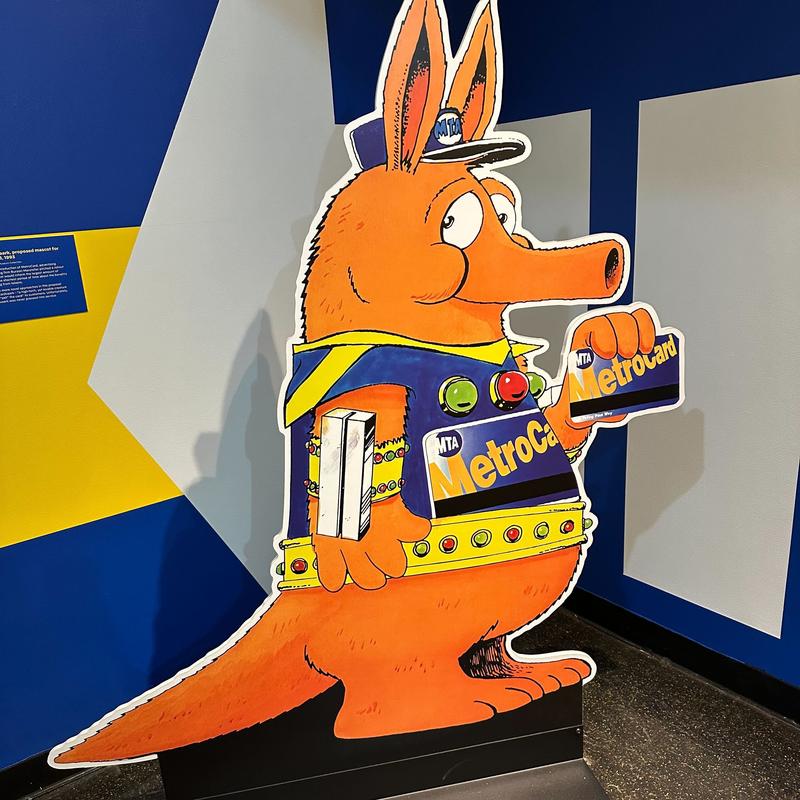
Jodi Shapiro: Cardvaark. I love the Cardvaark. We love the Cardvark at the New York Transit Museum. As part of this education program for New Yorkers to teach them how to get acclimated to a new fare payment system, the MTA had taken proposals from marketing agencies on how to try to market the card in different ways. One of these agencies proposed a mascot that was a lovable but technologically advanced creature that would teach New Yorkers how to use MetroCard and be an ambassador. That was Cardvaark. Cardvaark is, as you would expect, an aardvark. He is orange. He is wearing an MTA uniform, and he's got a swipe on his arm to teach people how to swipe.
He was just a concept. It never happened. They never did all the things that they had planned to do with Cardvaark, including making a Cardvaark suit and having someone be in the suit and go to transit hubs like Times Square, like Grand Central, like Union Square, and just meet the public and get them on board with MetroCard. He's ridiculous. He's ridiculous. I love him. When we talked about doing this exhibit at the museum, I said, "We're going to have Cardvaark, right?" Everybody was like, "Yes, of course we're going to have Cardvaark. He's there; you can meet him as a standee, take your picture with him, and learn a little bit about what could have been.
Alison Stewart: Now, the original cards were blue.
Jodi Shapiro: Yes. That was by design, no pun intended. When MetroCard was first conceived of, it was supposed to be a card that would allow discounts at one point, would allow certain number of transfers, more than just one, offer discounts and and such, and have unlimited rides. It was also intended at some point to be a card that you could do other things with besides pay for your transit, like be a calling card, which is-- That's way-- I don't know anybody who really remembers what calling cards were. You and I are about the same age, so I'm sure you do. Also, use it to pay for other goods and services.
That wasn't going to happen right away, but it was the plan, and it didn't happen. At least with the calling cards and the paying for other services, the partners that the MTA wanted to partner with, they couldn't make things work the way that they wanted to. Those ideas were put to the side, but discounts and unlimited rides were always part of the plan. It only came in 1997 because that was when there was a technological advance to encode the magnetic stripe in a different way to make that happen. Once that happened, unlimited rides started being introduced in July 4th of1997.
July 4th was the day for the 7-day and the 30-day unlimited. Discounts followed shortly after, which is what the gentleman was talking about before, like trying to figure out how much money to put on your card because you would get a discount if you did a pay-per-ride card.
Alison Stewart: Were these the Metro Gold cards?
Jodi Shapiro: Yes, MetroCard Gold. Sorry, I thought I said that. The appearance changed to indicate the change to the magnetic stripping coating, and it's much, much more flexible means of paying for it, using it. This was also the advent of multiple transfers with one swipe. That effectively ended the two fare zone that existed in many parts of New York, where people would have to take a bus to a bus to a train or a bus to a train to a bus.
You couldn't do that with blue. You could only get one free transfer, and then you'd have to pay a second fare. This was something that happened with tokens, also. It was issue that faced New Yorkers since the inception of our transit system, and MetroCard Gold basically eliminated it. There's still a couple of two fair zones that were left, and I think by now they have all been eliminated, but some of them didn't get eliminated until like two, three years ago.
Alison Stewart: Let's listen to an ad for the MetroCard Gold that came out in 1997, and listen carefully for this voice.
George Pataki: Something new has come to New York. MetroCard Gold. You can use it to pay your fare at all subway stations and on all buses, and also to transfer from subways to buses and from buses to subways free. That's right, free. We thought you'd like to hear that. MetroCard Gold, the beginning of a whole new transit system. MTA, going your way.
Alison Stewart: I'm not going to say who that is. If somebody wants to call in and say who that is, do that at 212-433-9692. We'll tell you people at the end if we don't get any callers on that one. Let's talk to Marissa in Brooklyn. Hey, Marissa.
Marissa: Hi. Thanks for taking the call.
Alison Stewart: What's your memory of the MetroCard?
Marissa: Well, I'm just about as old as the MetroCard, a little bit older, so it's been my entire life. When I first moved into the city alone, right after college, my first ever job, I was working in a restaurant, as many of us do, and I was dead broke. I think I had been gifted a monthly MetroCard by my dad, and I was, I guess, pickpocketed in the staff lockers at the restaurant. Whoever pickpocketed me stole my monthly MetroCard, and I was so bummed. Getting your cash stolen is one thing, but the monthly MetroCard really felt like a huge hit because it was just like the sense of being able to be free to move around the city.
I've always felt that way about the MetroCard, even when it's been-- maybe I didn't need it or it was tough to afford. Having the monthly MetroCard and being able to just go wherever was just a huge a huge sense of freedom in New York. I'll definitely miss that about eliminating the monthly option with OMNY. Aside from being more expensive, just that sense of freedom has been such a big bonus for me.
Alison Stewart: Marissa, thanks for the call. This text says, "Kate Spade made a card holder change purse in the design of a MetroCard."
Jodi Shapiro: Yes, she did.
Alison Stewart: "It's a lovely nod to the MetroCard and such a quintessential New York City piece. I get compliments on it all the time." Steve, he makes art out of MetroCards. This one says, "One of my favorite memories of the MetroCard was getting my green and white MetroCard in the first grade."
Jodi Shapiro: Oh, man.
Alison Stewart: Will they be getting OMNY passes? I think they [crosstalk].
Jodi Shapiro: They do, yes.
Alison Stewart: Let's talk to George in Franklin Lakes. Hey, George, thanks for calling All Of It.
George: Hi, good afternoon. I remember that sometime in the past you had conducted a hackathon for the MetroCard to see if the security could be broken. Was the MetroCard ever successfully hacked?
Jodi Shapiro: I am honestly not sure about that, and even if I was, I don't think my boss would like me to say if it was or not.
Alison Stewart: Let's talk to Tom from Brooklyn. Hey, Tom, thanks for calling All Of It. Tom, are you there? No, Tony. Hey, Tony. I'm sorry, my bad.
Tony: Tony from Brooklyn. Thank you for calling. I'm a retired transportation planner and urban rail historian. I used to work for the TA on J Street in the early '80s. From the management point of view, the MetroCard was a very good addition to analyzing ridership data, especially as it evolved into the EasyPay, where you could actually track transfers from business subway to bus and bus to subway origin-destination data. That's something that a lot of folks may not realize when-- An authority like the MTA needs to understand ridership data. It's very interesting. Now we have OMNY. [laughs]
Alison Stewart: [laughs] All right, thanks for calling.
Jodi Shapiro: Can I address what he said?
Alison Stewart: Absolutely.
Jodi Shapiro: That's actually one of the benefits of MetroCard, is that because of these turnstiles that had to be electrified and connected to the computer mainframe, is that now— and this is publicly accessible data, New York City has a data portal— you can see turnstile turns from any turnstile in the system if you know how to parse the data out. That data is analyzed very heavily by the MTA to find out which stations are the most crowded, at what times, which particular rank of turnstiles are used the most.
I'm a nerd. I look at this data sometimes for our exhibits, and that's-- On the surface, it's a way to pay for your fare, but deeper down, it is a way for the MTA to improve service. That's also another technological leap that was made possible by the implementation of this fare payment system.
Alison Stewart: We've got a [unintelligible 00:28:16] text. "I used to mail MetroCards to my European friends who loved visiting New York City; to a person. They thank me." Let's play our clip one more time. Introducing the Metro Gold in 1997.
Mandy Patinkin: Something New has come to New York. MetroCard Gold. You can use it to pay your fare at all subway stations and on all buses.
Alison Stewart: One person said it was Christopher Walken. We got many texts correct. We got one call. Nicole, who is it on that advertisement?
Nicole: It is Mandy Patinkin.
Alison Stewart: There you go, Mandy Patinkin. Thanks for calling in, Nicole. In the exhibit, you write that, or it is written that the token still remains a big part of New York City history. Do you think the MetroCard will remain iconic like that?
Jodi Shapiro: I think it will. When we first started developing this exhibit, because we knew that the MetroCard was going to go away, I didn't think that people would hold onto it as dearly as they are. I was surprised. It's different from a token. I don't know yet if it will be as instantly recognizable as a token. Whenever you go anywhere, if you see a subway token, you think New York. If you see the root indicator, which is a bullet, the E, the F, whatever, you see that, it's New York. I feel that in time, the MetroCard will be that way also. I know at least New Yorkers feel that it's on the same level as a token or a subway bullet.
Alison Stewart: Come on, what's in front-- What am I holding?
Jodi Shapiro: I know. I saw the picture of it earlier, and I was just like, "I hope she brings it, because it's super cool." You can't really see what I'm looking at, but Alison has done a cross-stitch of a MetroCard Gold.
Alison Stewart: It's beautiful.
Jodi Shapiro: It looks really, really cool. It's just seeing how it inspires people to create, how it solidifies the love that New Yorkers have for their transit system. That's one of the things through my years at the New York Transit Museum that I have learned above all else, is that New Yorkers are very, very emotionally wrapped up in our transit system. For a couple of years, I was like, "Gee, I wonder why."
I grew up here. I know why I love the subway, and I love the bus, but why does everybody else love it? Now I have learned through my work at the museum that-- I think. This is my hypothesis. It's not scientifically proven. I believe that people feel so emotionally into our system because our city would not be what it is if the system was not built the way it was. Other transit systems connect A to B. Neighborhoods that were already established. A neighborhood where people live to a neighborhood where people work.
New York, everybody was concentrated mostly in lower Manhattan, and our transportation system was built to bring people out of that. Especially the subway was built specifically to move people from Lower Manhattan to Queens to the Bronx to other parts of Brooklyn. I think whether New Yorkers realize it or not, maybe that's why they love our system so much and all of the things that symbolize that system to them.
Alison Stewart: Jodi Shapiro. She's a curator at the New York Transit Museum. The exhibit is called Farewell MetroCard. Thank you so much for joining us.
Jodi Shapiro: Thanks for having me back.
Alison Stewart: If you'd like to see my needlepoint, go to allofitwnyc on our Instagram. Do we have time for this caller? There's one last caller. Okay, caller, you get to finish us out.
Leo: Hi, this is Leo. I'm the saxophone player on camera in that commercial with George Pataki.
Alison Stewart: Oh, that's awesome.
Leo: I'm in my car, but I don't know if that's-- The other caller said that was Mandy Patinkin, but I don't think so. I think it's George Pataki because he talks at the beginning of the commercial on camera, and then-
Alison Stewart: You know what? Actually, there were two commercials, one with George Pataki and one with Mandy Patinkin. You are correct. Hey, Leo, thanks for calling in, Jodi. It was nice to see you.
Jodi Shapiro: Good to see you again, too.