
Gideon Appah's Ghanaian-Inspired Art
Alison Stewart: This is All Of It on WNYC. I'm Alison Stewart. Now, let's kick off an hour of gallery art shows in our area, two by Ghanaian artists with very different styles, and one in New Jersey by a well-known painter. Let's start with Gideon Appah's first solo show at the Pace Gallery.
Gideon Appah's first solo show at the Pace Gallery is titled Beneath Night and Day. In 2024, Culture Magazine says, "Since his arrival on the international scene at the tail end of the last decade, Appah has cemented his place as an essential alchemist of fauvist traditions, African popular culture, and relaxed portraiture." The new show spotlights works on canvas created over the past year in his studio in Ghana.
The work features fishermen, performers, the beauty of a day at the beach. Some of the works are huge, taking up an entire wall. Beneath Night and Day is now on display at the Pace gallery at its 510 W. 25th St. Location through Monday, Feb. 26. Gideon Appah joins us to discuss his career and the inspiration behind his latest work. Gideon, welcome.
Gideon: Thank you. Thank you.
Alison: So nice to meet you. You know, many of these images are inspired by your visits to the beach. Our particular beach is about six hours away from Ghana. What is the name of the beach? I want you to say it correctly, and what drew you to that beach?
Gideon: Okay. The name of the beach is Busua Beach.
Alison: Busua.
Gideon: B-U-S-U-A. Yes. I had visited there in 2022 with some friends of mine, and then I was actually struck by the lifestyle of the people. Then they were fishermen. That was actually the very first time that I had that kind of close encounter with water, getting into water, like with the sea. I also enjoyed the nightlife. They normally do a bonfire night, and everybody is so cool right there. I was liking it, liking it so much.
Then I returned in 2025. What drew me there, especially for the show, was I wanted to do a video, a film to document the scenes, so then it becomes a part of the paintings. I wanted to tell the story of the paintings through the moving stills. I was there in 2025, and then I visited first and went back, prepared myself.
Alison: Then you went again?
Gideon: Come back, [chuckles] yes.
Alison: What's inspiring for you as an artist about the beach and beach culture?
Gideon: There's the freedom, the freedom and the relaxation. The paintings I did, I was trying very much, you know, to get them in that kind of relaxed atmosphere. It's more peaceful. There's a lot of freedom. There are horses as well. There are horses and there's music there. It was very, very simple life that I experienced there.
Alison: Let's talk about a couple of paintings that are in the show. Bathers and Boats, which shows surfers, the resting with their surfboards. The boats were in the background. Actually, if you go to our Instagram @allofitwnyc, you can see my pictures that I took yesterday. They're not the best pictures, but they're good pictures. You'll get a sense of what they're about. It's this beach scene. Who are the individuals? Who are the people in this painting?
Gideon: They are from the films, actually, because I also took photographs of them from the film. They also became inspiration for other figures. I was working with both. I was first working with imagination of people, and I was also working straight from the photographs of them.
Alison: Oh, that's so interesting, so it's both memory and the actual picture of someone.
Gideon: Yes.
Alison: Oh, that's wild.
Gideon: It is both.
Alison: First, do you know how to surf, by the way?
Gideon: I don't. I'm an observer.
Alison: I am an observer. [chuckles] My guest is Gideon Appah. We're talking about his new show, Beneath Night and Day. It's on view now at Pace Gallery. The next one I want to talk about was Target Practice. It looks to be a group of people on the beach waiting to shoot an arrow at a target. What's the backstory behind this?
Gideon: I wanted to paint an activity, especially, and I did. When I went in 2023, there was that kind of activity of the locals shooting arrows at targets, you know, but very playful ones. They're not dangerous. I went back and then I really saw it as a contemporary activity at the place of the beach. Then, I did do a copy of that for the film, which we showed in the film as well. I wanted to do a painting of such. That painting was actually the film in a painting form, actually. We could say it's both ways, because also, the film did influence the painting as well, and the painting also did influence the film.
Alison: Yes, we should point out that the film is in the show.
Gideon: It's in the show. Yes.
Alison: Yes. It's called Beyond the Shadows. Why did you want to include it in the show? What do you think it adds to the show?
Gideon: I think technically it adds a lot of volume to the painting. That painting particularly is very dense. It had a lot of figures in there, and I wanted also, besides the storytelling, or the narrative part of the work, I wanted also to complete something with painting. I mean, the technique of painting or arrangement of things. Then, the circles of the targets, they just didn't become just normal targets. They became volumes of space for balancing of the paintings because I was trying to find that kind of harmony within the work.
When I painted a target, red, white, red, white, it became a repetition of color, and it occupied the right side of the work, so also, it helped to bring the work together. There was also the challenge of putting the landscape, and then the figures, everything together. I was very much, very technically, just looking at the painting, and trying to accomplish that.
Alison: In the film, it includes a voiceover poem written and performed by a musical artist. Who is the artist?
Gideon: Her name is Poetra Asantewa. She's a poet from Ghana.
Alison: Should we listen to a little bit of it?
Gideon: Yes, she did. Yes.
Alison: Let's listen.
Poetra Asantewa: To become yourself is no gentle work. The self resists, twists, even hides. Yet it is yours and yours alone to shape into something whole.
Alison: How is she able to capture what the beach, what that environment means in her words?
Gideon: She's been doing this for a very long time. She's very experienced. When we sent the video, when everything was done, we sent the film to her. Then I would say she went into a element.
Alison: Oh, that's cool. She goes into her element after seeing the film.
Gideon: Yes, yes.
Alison: Oh, that's right. Then, that's how she created the words.
Gideon: Yes, that's how she created the words. It was just a perfect match. Was beautiful thing that she did. After we listened to it, we said, "Now, this is it. This is it. I think that it's so good that we can just put it right there in the film," and it's clicked.
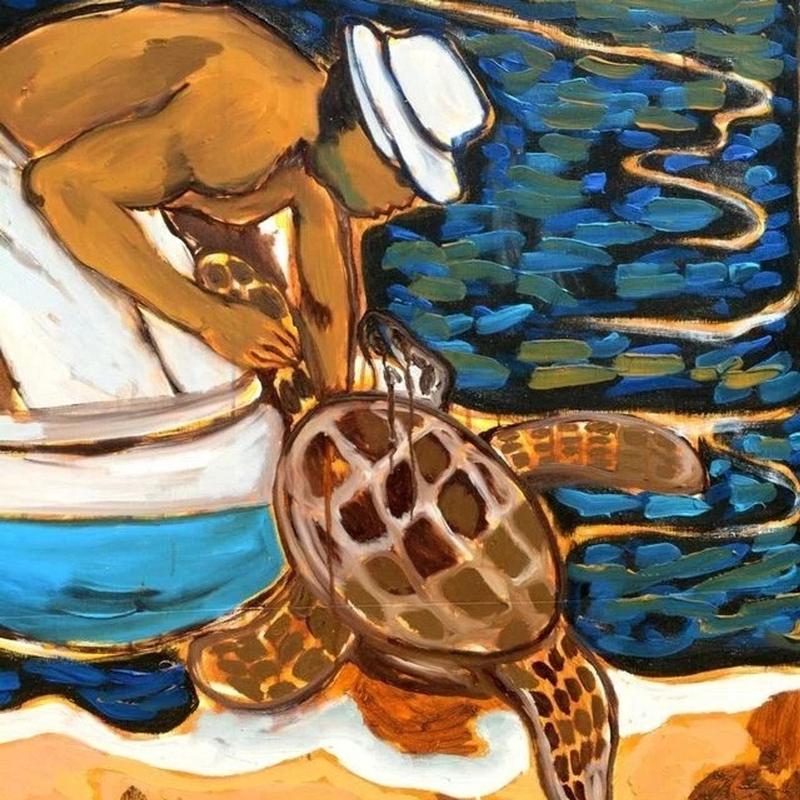
Alison: The image used on the promotion for the show is a smaller part of a larger painting. The painting is called Night Catch, and in the promo for it, it's a fisherman. He's either releasing or bringing in a turtle on his boat, but then, when you see the whole picture, it's huge. It's the boat. It's the ocean. It's a man standing in front. I think he's got a bird on his head as well.
Gideon: Yes.
Alison: There's a whole lot going on in the picture. How do you decide when to focus on one moment in a painting, or did you decide this is a whole aspect that I wanted to get this whole aspect of the beach? Did you have this part with the boat, this part with the gentleman, this part with the landscape? I'm curious about how a painting that large comes together.
Gideon: I painted that one in various steps, but it did first start with the gentleman with the bird on top of his head.
Alison: Oh, the b--. Okay, he's got that.
Gideon: Yes, it started with that. Then, after I did my visit, I saw a turtle, actually. There was a turtle on the beach, and there was this guy is trying to rescue it from the water, so I thought it was cool that I wanted to paint that.
Alison: So you put that next to the guy with the bird?
Gideon: Yes. I put that next to the guy with the bird. It just was perfect. It just was perfect for the show. It's all a part of, also, storytelling. You know, like you're telling a narration, or you're looking at the events of your travels, of what you're doing, and then you put them into a painting.
Alison: I'm speaking with Gideon Appah about his new show, Beneath Night and Day. It's on view at the pace gallery through February 28th, 2026. There's all this beautiful painting and portraiture around the beach, and how people perform at the beach. Then you turn around, and there is a picture on a black wall of, it looks to be a Ghanaian drummer.
Gideon: Yes.
Alison: Am I right, yes?
Gideon: Yes.
Alison: He's in full garb. He's got a hat. He's got a gorgeous outfit. He's got a big bow on his chest. He's playing a drum. It's titled Young Masquerade. First of all, how does this fit in with the rest of the show? Was this just a piece that you liked and you wanted in your show? I'm curious about its placement.
Gideon: No. First, it's a piece that I really wanted, and is one of the works that I really enjoyed painting because of the patterns and the colors, putting the colors and the patterns together to form the clothing of the figure. His attire or his dressing is very typical of a festival in Ghana, is celebrated by the people of Takoradi and Winneba in the western part of Ghana. They dress up like masquerades. It's a very large one. There is a masquerade, and they have a band. They have a brass band. They moved through the towns and cities, and most of the time, the children go asking for, you know, little bit of candies and things like that. It's a tradition that they do.
It normally happens in early January, early January after Christmas. It just happened like that. I, for one part, also, because I was in the Western region doing the film and I've visited about three times, I happened to see them around. It popped in my head, I would like to try to see if I can paint this thing. Also, I mean, it's one of the paintings that the background was very different. It has this-
Alison: Red,
Gideon: -red, but very toned down red because I wanted the figure to pop from the background. It was challenging. It was exciting to paint. I think that it's really have a very beautiful mark.
Alison: What of the title of the show, Beneath Night and Day? What does that mean to you?
Gideon: It means that the paintings, the atmosphere in the paintings, you can't really tell whether it's night or day. It falls within various, like the hours of the day, through darks and dawn, and throughout the mornings, and then the afternoons because most of them, the background is sometimes like maybe turquoise or gray, or is bright blue, and all that. I was painting various times of the day with various events happening.
Alison: Where's your studio now?
Gideon: My studio is in Accra, Ghana. [chuckles]
Alison: Do you miss it?
Gideon: I do, but not too much. I don't miss it so much. Yes.
Alison: What does it mean for you to have your first solo show at Pace Gallery?
Gideon: It means a lot. I was here in 2024 when I met with the Pace team, but now I got to meet with almost everybody of the Pace team, and it's a very, very big deal. It's my fourth show with Pace, so it's like a journey. I've shown elsewhere, Pace. I've shown with Pace elsewhere. Now, this is the time that I have to come to New York and show these beautiful paintings.
Alison: I've been speaking with Gideon Appah about his new show, Beneath Night and Day, which is now on display at Pace gallery at its 510 W. 25th St. Location through Monday, February 26th. Thank you so much for being with us.
Gideon: Great. Thank you.