
Gen X Icons Keanu Reeves & Alex Winter in 'Waiting for Godot'
Alison Stewart: This is All Of It on WNYC. I'm Alison Stewart. Before the break, we were talking about Generation X and why some people might consider it the greatest generation when it comes to cultural powerhouses. To follow up on that, we wanted to share an encore presentation of my recent conversation with two of the latchkey generation's iconic actors, Keanu Reeves and Alex Winter.
In 1989, the pair starred in the teen sci-fi film Bill & Ted's Excellent Adventure. Now, they are on Broadway performing in Samuel Beckett's Waiting for Godot. The action of the play is two friends who are waiting. Now, what happens when you take a classic play like this one and add director Jamie Lloyd to the mix, a man known for rethinking original texts, as was the case with Sunset Boulevard and A Doll’s House? You get a Broadway production that is both funny and heartbreaking, chic yet real, with a deep sweetness that can be traced to the actors being true-blue friends for decades.
Waiting for Godot is at the Hudson Theatre until January 4th. When Alex and Keanu joined me to talk about it, I started by asking Alex what they hoped to find when they visited Beckett's archives to prepare for the show.
Alex Winter: The characters are rooted in Beckett's own biography, his escape from the Nazis during World War II, when he was in the French Resistance, and he and his wife were living rough across the French countryside in ditches and eating root vegetables. I think we were looking for essences of the play in Beckett's life and just digging into the grand tradition of this play being put on. Jim Knowlson, Beckett's biographer, met us in Reading. We got to spend time with him. It was exploratory, using the time that we had to the best of our abilities.
Alison Stewart: Keanu, what were you looking for?
Keanu Reeves: The same as Alex. I also was cool to just see different incarnations of the production over the years and to see transcripts and annotation. It was really cool to speak with Jim as the biographer, just to see if we could-- I mean, Alex, we were always like, "Any tidbits? Any recommendations? Any advice?"
Alex Winter: Yes. With other actors who had done the play and who knew Beckett, we were doing the same. We're just kind of on a recon mission.
Keanu Reeves: We were doing forensics and creative archaeology.
Alex Winter: Yes. Then, to Keanu's point, there's an abstraction to that, too. When you look at Beckett's handwriting at the archive or see paintings based on where he was, an actor, you get abstract nourishment from that that you use in the character.
Alison Stewart: What did you learn that helped you understand the play better? Keanu, what did you learn that you thought like, "Ah"?
Keanu Reeves: I think we heard this a couple of times, didn't we, Alex? Don't forget it's a comedy, and don't forget the violence.
Alison Stewart: Okay. Alex?
Alex Winter: Those counterpoints. I think that the fact that the play is beautiful and it's written with a great deal of momentum and energy and wit and tragedy and sadness, I think that generally what we were getting was to make sure all of those things got played, because that's what the text is.
Alison Stewart: Alex, it's interesting you said that you also went to UCLA to look at the archives, and you had spent several years researching this. Aside from rehearsals and all this, why did you spend so much time rehearsing and getting ready for Beckett?
Alex Winter: Because we had the time, which is so rare in our industry, unfortunately, now. Keanu had brought this idea to me almost four years ago, and then he and I embarked on it. I make documentaries. I'm a research fanatic. We had time, so we used it, and it was to our benefit. We took clowning classes. We took butoh dance classes. We did a lot of prep. We met when we could and did script analysis with the play every few weeks in the lead-up. All that time we were talking to Jamie because we had Jamie on board already, so it wasn't like we were-- We weren't working on this every day by any stretch of the imagination. This was a drop in and out kind of thing, but it was serious.
Alison Stewart: It was sort of lurking in the back of your head, it sounded like.
Alex Winter: Yes, and fun. Yes, and a lot of fun. Keanu and I were having a lot of fun. I think part of the joy of the two of us doing this together included this prep, the fun of diving into the world of Beckett, and not just, let's just show up on day one rehearsal, do a play, and then leave. There's joy in that experience as well.
Alison Stewart: Keanu, when did you first read Beckett?
Keanu Reeves: In the fugue of memory, I would probably say around 17.
Alison Stewart: Did you understand it?
Keanu Reeves: As much as someone who's that young can understand it. I mean, there's definitely themes in it that echoed some Dostoevskian literature experience, exposure. It's probably the same time that I was reading Oberon. What else is there? Rhinoceros. One exchange that always stuck with me was, "Let's go. We can. Why not? We're waiting for Godot." Just from a kid. I just love that for some reason, the energy of that text and what it meant. Because I think as a 17-year-old, I was waiting, too.
[laughter]
Alison Stewart: Waiting for something.
Alex Winter: We're still waiting.
Keanu Reeves: I was trying to go, "Let's go. We can. Why not?"
[laughter]
Alison Stewart: My guests are Keanu Reeves and Alex Winter. We are talking for Waiting for Godot at the Hudson Theatre through January 4th. Alex, you have been on Broadway since you were a child. What has changed and what hasn't changed?
Alex Winter: The play itself, doing it with Keanu in a very modern interpretation, about right now. The times have changed, I've changed, and this is a monumental work that we're doing. Other things have really not changed. Backstage right now, it feels very similar to the way I grew up backstage in a dressing room for years and years and years, with the smell of a Broadway house and the teamsters and the stagehands and all of that community. That community is the same. I love it. You kind of plug back into that world. It feels like home.
Alison Stewart: Keanu, this is your Broadway debut, yes?
Keanu Reeves: Yes.
Alison Stewart: Had you been asked before?
Keanu Reeves: No. Not quite asked. There has been opportunity-- I'll just say no.
Alison Stewart: Okay, we'll go with that. Then why this play?
Keanu Reeves: Because it's fantastic and I get to do it with Alex Winter.
Alex Winter: [laughs]
Alison Stewart: What makes it fantastic? I'm curious.
Keanu Reeves: It's a beautifully written play, the themes that are in the play. It's wonderful roles for artists to play, to discover the themes of existence, relationship to personal God, interpersonal dynamics, friendships, master servant. Textually, the alliterations, the repetitions, the play in it. It's thrilling to perform. It's constantly revealing. There's always more to think, feel, find out, do. It's a profound work of the nature of being alive and dying and waiting for some answers for something. What do you do? What do we do? What do we do?
Alison Stewart: Alex, practically, what did you consider when you said yes before doing seven, eight shows a week? Because a theater actor's life is hard.
Alex Winter: Well, yes, we're doing eight shows, the standard run. I just considered mundane, practical considerations, what I had on my slate. I had a film coming up I was going to do. I've got kids. I have a family. How will that work? Fitness. I immediately started circuit training the next day. [laughs] Physical fitness, stamina, eating well, eating healthy. Keanu and I have talked about this. We could have done different play. There are great plays with two people, like Rosencrantz and Guildenstern. We could have done something else.
I think that Keanu and I are wired similarly. We like risk. We're not similar in all ways. That is a way in which we are similar. I think the challenge of this, of knowing that I would need to go get my head around how to meet this challenge, was enticing to me because I've always loved this play very much, and I love Beckett in this era of theater very much. I knew that it was similar to doing Shakespeare; you're signing onto something very intense. I had to get my head around that in a practical way.
Alison Stewart: Keanu, what do you know about being on Broadway that there's no way you could have known before you had done it?
Keanu Reeves: What do I know about Broadway now that I've done it that I couldn't have known about it before I did it?
Alison Stewart: Yes.
Keanu Reeves: Probably the culture that Alex speaks about. I feel like it's almost like the culture stays the same, and us artists who come to these theaters, pop in and out. It's like we're the new show, but this culture is existing there. They've all worked with each other, they all speak to each other, all of the various theaters, production companies. It's very strong, it's very present. I couldn't have known that without actually being in it.
Alex Winter: I would say not that we are these characters because we're really not. In subtle ways, this play represents more, in my opinion, on an abstract level, the way we actually interrelate than, say, Bill & Ted, which does, in other ways, is about play, and they're very childlike, and there's a lot of us in Bill & Ted. Keanu and I get together. We have humor, we laugh a lot, but we can both be independently quite serious-minded, veering on, I want to use the word dark, but certainly contemplative people.
I think that there are times when we're just sitting there riffing at the beginning of Act 1, Act 2, and it could really just be the two of us having a conversation about life and happiness and what do these things mean and how does it work and how do we live. Again, it's a little abstract. I wouldn't say that we're these guys; these guys are very specific.
Alison Stewart: What do you think about that, Keanu, about your friendship and what it allows you to do on stage?
Keanu Reeves: Yes, I agree. I think knowing each other, we had a trust and confidence in our art practice through our friendship. We've worked together. We've maintained or have a friendship over 30-some odd years. We've collaborated and worked together over that time. I thought it brought a joy in the research, it brought a shorthand, and it really just reaffirmed our simpatico aspect to the artistic endeavor.
Alex Winter: What's been fun for me, and I wouldn't say surprising, but I am grateful for it, is that it's a challenging play and you're never done doing it. Every day you do it is different and challenging for all of us, for Brandon Durden, Michael Patrick Thornton, who are amazing, for all of us. Because Keanu and I have known each other so long and know each other so well and have worked together performatively as well as have a friendship, it's helpful because we'll come off stage sometimes and have an idea.
We're just constantly, always thinking, but we're thinking in somewhat of a unified way. Not all the time. Sometimes it's something I need to do, or he needs to do, or whatever, but I know that I trust him and vice versa. Our brains are always thinking on how to make those things work. That is very much informed by the length and the history of the relationship.
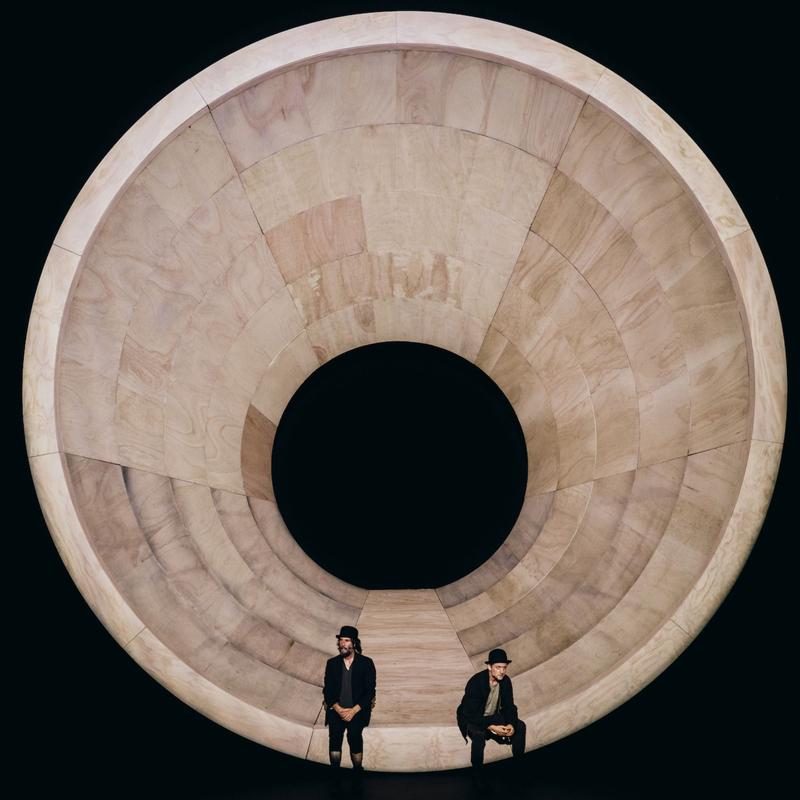
Alison Stewart: Let's talk about the set, Soutra Gilmour. Some people have said it looks like a cone, like a canal.
Keanu Reeves: I'm going to do a kind of Waiting for Godot production sound design. However you're going to describe that, I'll just kind of-- [hums] Go ahead.
Alison Stewart: Sounds like a woofer. It felt like the inside of a ear canal to me. You actually go to our Instagram, @allofitwnyc, you'll see it. It's beautiful. First of all, how do you navigate a set like that? Because it looks like it's on a tilt.
Keanu Reeves: Yes, it's a rake stage.
Alex Winter: Rake stage and a curve, too.
Keanu Reeves: It changes perspective, too, right? There's some perspective shenanigans going on.
Alison Stewart: Seriously, how do you navigate that, Alex?
Alex Winter: Every minute I'm not on stage, I'm in some form of physical therapy. [laughs]
Alison Stewart: You would have to be.
Alex Winter: Yes. Vladimir is an extremely physical role. They both are. All four of them are. We're never on a flat surface at any point.
Alison Stewart: Ever.
Alex Winter: I don't want to be. [crosstalk]
Keanu Reeves: Wait, wait. There's a flat surface. The center of the stage is flat. I mean, it's angled, but it's flat.
Alex Winter: It's angled. That's what I mean. My heels are actually kicked up. I went through this with--
Keanu Reeves: Yes, that's true.
Alex Winter: When we're sitting, is actually when we get rest. When we're sitting at the top of Act 1 and Act 2, we are--
Keanu Reeves: Speak for yourself.
[laughter]
Alex Winter: It's quite physical. I like the physicality. I don't want to shy away from it. I like that these characters are almost feral because you don't know how they're living, being rough. You realize once they get up in that tunnel with Pozzo and Lucky in Act 1, there's kind of a primal aspect to these guys because they've been living this way for so long. It's nice to use all of the set and to use it almost like some kind of primate, but your body has to be tuned to do that.
Alison Stewart: Your director, Jamie Lloyd, he's known for Sunset Boulevard, A Doll's House, which was amazing on Broadway, but he takes his modernity and he applies it to the classics. Keanu, what do you think is different about the play in Jamie Lloyd's hands?
Keanu Reeves: Text-wise, Alex, correct me if I'm wrong, but oftentimes, even in the description, there's a lot of, in parentheses, silence and-
Alison Stewart: So true.
Keanu Reeves: -pauses. Jamie really was promoting the idea of pace and speed with some silence punctuation following text. Really, I would say if you looked at it from that point of view, that would be the major change is just the pace of the production.
Alex Winter: Yes, I think Jamie is-- One of the reasons we were so enamored with him was a lot of his work is so rich and deep with Shakespeare, with Pinter, whether it's ultra-modern play. He did Lucy Prebble's play recently in the UK, and here, I guess. He has a deep affinity for tech. He's not just Mr. Modern Guy. He's not just throwing stuff out for the sake of it. We knew that he would really dig into the meanings and themes in Beckett, but embrace--
He has a statement, so I'm not throwing him under any bus. He said this publicly, that he wanted to embrace directing this version of the play as if it was new, as if all the stuff hadn't come before, and someone just handed him a script and said, "Do you want to do this?" and he said, "Yes. How would I stage it?" I think that's the right way to come at the play. I think that it cements it to the times while being-- I mean, the Becket estate has been approving of his changes, which are radical, and they're quite strict. They have felt that Jamie's got a good grip on the text. It's been really liberating to work with him. I mean, he's truly phenomenal.
Alison Stewart: Oh, my gosh. A Doll's House, when the whole back of the theater opened, and Jessica Chastain walked out, it was amazing.
Alex Winter: Yes, I got to see that. Michael Patrick Thornton was in that, who was our Lucky, who was amazing.
Alison Stewart: The last time I talked to two actors about Waiting for Godot was in 2023, when Michael Shannon and Paul Sparks did it, and they're friends as well. They described the characters as Tigger and Eeyore was the way that they described their characters. Alex, how would you describe your character?
Alex Winter: Vladimir is, not to be precious, but he's multitudinous. He's searching. He is very close to giving up faith, but he is still holding on to a shred of faith and the possibility of there being some form of salvation, spiritual or otherwise. That drives everything with him: his physicality, his energy, his love of Estragon, his fear of losing Estragon. To me, that's kind of Vladimir's world. He's on his feet more than Estragon, but I think a lot of that energy is driven by the searching.
Alison Stewart: How about for you, Keanu?
Keanu Reeves: When I've been doing it, I get the Tigger aspect of it. For me, if I had to go from there, it was just that there is an energy that the character Estragon has. He's always kind of, "What do we do? Let's go." I think he's less of a philosopher. I think maybe there's a kind of natural-- Like, he just wants to be happy. He wants to wander in the Pyrenees. He's concerned about being punished or saved, but he doesn't have the search for faith quite that I think Vladimir has in the same way. Would you agree with that, Alex? I would say that.
Alex Winter: Yes.
Keanu Reeves: These two forces, I think, are working with, together, apart. I think there's a tension between these two world points of view of being. One's like, "Stop. Let's just go," and you're like, "No, wait. Let's figure out where we're going and why we're doing it, and what does it mean?" I'm like, "Let's just go, man."
[laughter]
Alex Winter: That is true. Yes, there's a lot of temperamental differences between the two of them.
Alison Stewart: For some people, this may be their first exposure to Beckett. After they see the show, Alex, they go out for coffee, they go out for a beer. What do you hope they talk about?
Alex Winter: We've been hearing such wonderful things about the audience experience from everyone, from Beckett. We got a note from Jim Knowlson, Beckett's biographer, of an actress who had done Beckett for years and was just really taken with the play, and then people who have never seen Beckett before, ever. Honestly, I credit that to Beckett himself, just because the text is so profound.
Alison Stewart: You're good in it, too. I'll just say that for you.
Alex Winter: Okay, thank you. [chuckles] Thank you. I do think that there is a modernity and a momentum and a tenderness to this production that is accessible for some people that didn't find the play accessible before, which makes me very happy. When people are coming back over and over again, we're getting people who've seen it four or five times. The lobby, from what I hear from my moles, is a combination of questioning every single thing about life, to I have no idea what the hell is going on, which is good.
Alison Stewart: [laughs]
Alex Winter: That's a good thing. I think that it is inspiring questions in people, and people often ask us in interviews or whatever, like, "What do you say the one thing--"
I'm like, "That's what makes it a great work of art, is it is so brilliantly interrogating so many core ideas of humanity." They're specific ideas. It's not the whole ocean, but it's not leaving you with a hard answer.
Alison Stewart: That was my conversation with actors Alex Winter and Keanu Reeves. Waiting for Godot is playing at the Hudson Theatre through January 4th.
Alison Stewart: That is All Of It. I'm Alison Stewart. I appreciate you listening, and I appreciate you. I will meet you back here next time.