
Gaten Matarazzo on Growing Up as Dustin on "Stranger Things"
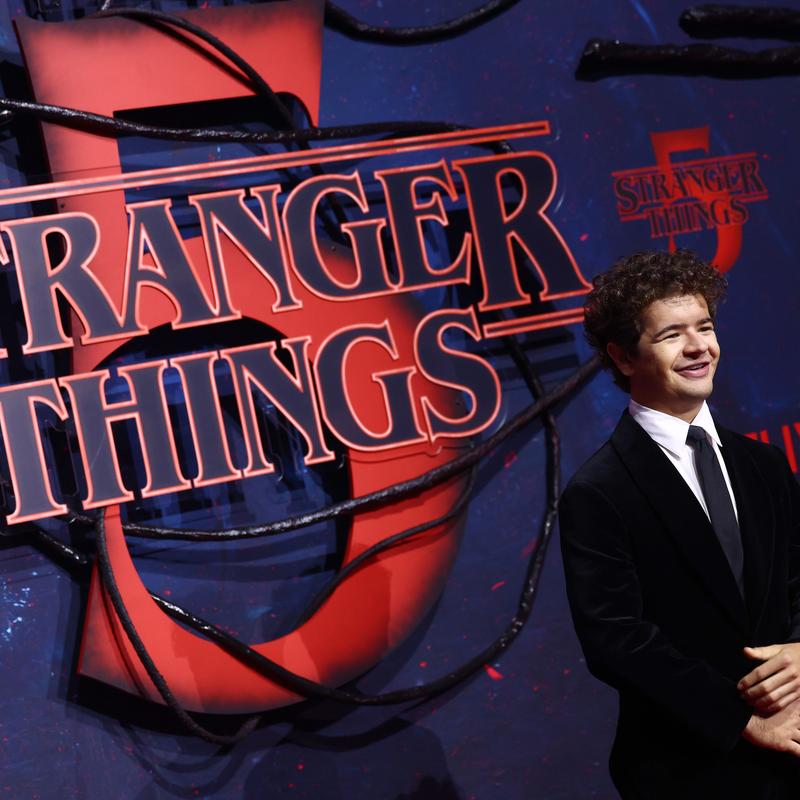
David Furst: This is All Of It on WNYC. I'm David Furst in for Alison Stewart. Our next guest is a key part of one of the most popular TV shows of the last decade. One of a group of characters from Hawkins, Indiana, that a generation of viewers has grown up with. Gaten Matarazzo is Dustin Henderson on Stranger Things. You may know Dustin as a nerdy, funny jokester, but in season five, Dustin is in a different place. The smile is gone. He's in a fighting mood as he processes his grief from what happened in season four.
Dustin remains a key part of the group of characters fighting Vecna in the Upside Down, all the while basking in the '80s nostalgia of the Stranger Things universe. The first part of the final season is out now on Netflix. The second part drops on Christmas Day. The finale is on New Year's Eve, and Gaten Matarazzo is here now in the studio. Welcome.
Gaten Matarazzo: Thank you so much for having me on, Chris. I appreciate it.
David Furst: It is great to have you with us. Let's talk about season five. How would you describe Dustin's state of mind to start this final season?
Gaten Matarazzo: Oh, man. It's certainly a shift from what we'd seen from him in the prior seasons, which is really fun to play. It's something new and something that I was warned about going into the early writing process of the show, which is really fun. I think it makes sense. I think a lot of kids who go through a grieving process tend to have a very dramatic, purposeful shift in the way that they behave or present themselves.
A lot of times it's, whether it's a coping mechanism or it's a wall being built up, I think it's a really interesting light to see him in, considering he's usually known as being a glue figure for the group that's around him, and he loves very fiercely. I think that's part of the reason as to why he finds himself in a pretty dark place is because he loves so fiercely. The more you love, the harder you grieve. That's a place that he's been settling into, which is tough to watch.
David Furst: You've been exploring this character for quite some time now, a big part of your life. What has been your favorite part of playing Dustin through the years?
Gaten Matarazzo: Oh, man. I think, weirdly enough, it's just the consistency of it. It's really hard to-- It's not very often that working actors get to be a part of something that runs as long as this and gives you an opportunity to work on a character and learn from a character over the course of around a decade. It's incredibly rare, and it's an absolute treat. I don't think I'll ever be able to have as much time with a character as I have had with Dustin specifically.
Also, being able to play him through my formative years and through his formative years has been a real blessing that I'm going to miss tremendously, and already do. It still feels very present. We haven't finished the release, and we have a lot more to do as far as promoting the show and people still seeing the rest of it, but it will definitely be a tough thing to let go of consistently.
David Furst: Absolutely. I'm sure. Listeners, if you'd like to join this conversation, we would love to hear from you. This is your chance to talk to Gaten Matarazzo. If you have a question about Gaten or about his character, Dustin, in Stranger Things, call us or text us, the number, 212-433-9692. That's 212-433-WNYC. Without giving too much away, what can you tell us about the issues that Dustin is trying to work through this season?
Gaten Matarazzo: Oh, man. That's tough to do. [laughs] I'll have to teeter a bit of a line there, but I'll try it. Oh, man. I think he comes from a very good place, and he has very similar goals to everybody else around him. I think the only way I can go into explaining what season five looks like is if I spoil season four a tad. Should I not do that? Maybe what I will say with being vague is that we end season four in a very different situation, where we've clearly pretty much lost. That's rare and new. As far as the previous three seasons have gone, they usually end on a bit of a high note. There's some optimism with a little bit lurking that leads into the crux of the next season. In four, really, everything has gone wrong.
That's where we pick it up. He shares a common goal of trying to pick up the pieces of what's been lost in the last season and trying to get ahead and thrive through the biggest challenge they've had to deal with. He's doing so in a way that is quite inflammatory, and it's not very productive because he doesn't really have much of a concern for working alongside his friends. There's a lot of juxtaposition between. They all have the same goals, but they want to go about getting there in very different ways. Usually, when you don't have a consensus or a plan and communication, it doesn't seem to go very well. That's where the beginning of the season starts, and we see a shred of that going into part two.
David Furst: Let's talk about this group of k-- I was going to say kids.
Gaten Matarazzo: [laughs] That's a loose term now.
David Furst: Kids. We're not talking kids anymore.
Gaten Matarazzo: I don't think so.
David Furst: No, we're not, but for years, it has been this core group, starting when you were kids. Finn Wolfhard, Noah Schnapp, Caleb McLaughlin, Millie Bobby Brown, and later on, Sadie Sink.
Gaten Matarazzo: Yes, indeed.
David Furst: Why do you think this group worked so well together on screen over the years?
Gaten Matarazzo: That's a really good question. There was a lot of emphasis early on in ensuring that we had all developed a very strong relationship with each other before the filming process started, even though we didn't have a lot of time, but kids are better at that, I think. What I noticed with kids and what I remember going in and what I remember from my own childhood is kids are very good at going up to each other and just saying, "Can I be your friend?" Then it takes off from there. Adults don't tend to do that very well.
Creating a bit of a group that has a lot of chemistry and excitement and even a lot of history that you haven't quite seen is a lot easier to do at 12, I think. That contributed a lot to creating a dynamic that feels developed. That's really, really fun, and I think helped us along the way. Sadie joining in season two was seamless as ever. She's not only so talented, but was such a wonderful addition to the cast when she joined. Caleb and I already knew her because of our prior work in the theater here in New York, where we had all met each other before filming Stranger Things, even before the show had even been brought to us. That made it easier.
David Furst: I want to get to a question that we're getting here in just a moment, please. Did you guys screen-test altogether at any point during the--
Gaten Matarazzo: Never all together. We never actually really screened together. We had chemistry, reads more than anything. The creators had us sit in a room and do some of the scenes that they had written to see if there was a spark that they liked. I read with Finn and a few other Mikes who were in at the time. I was reading for some other characters, but really, I only read with Finn before being cast in the show. It was just the hope that it would work out. The other actor who I would work with the most in season one was Caleb, and they didn't know that we had been buddies from our prior work in the theater beforehand, so that helped.
David Furst: That helped. Well, it certainly worked out pretty well.
Gaten Matarazzo: Yes, I think so.
[laughter]
David Furst: You're talking about your work in the theater. We have a question here. By the way, if you want to send in a question or call, 212-433-9692. That's 212-433-WNYC. Text right here. Hey, Gaten, any upcoming Broadway shows? Loved you in Sweeney Todd.
Gaten Matarazzo: That's very nice. Thank you so much. I would love to do something in the theater. I don't have anything lined up specifically on Broadway at the moment. It's weirdly enough, the hardest thing about getting on stage is finding the time to do it because there's always a long rehearsal process and you want to hunker down for a run that is long enough to where announcing that you're going to be in a show makes sense. Because there are some times people jump in for a show for like three weeks and I just-- I don't think it's enough time to sink your teeth in.
I would love to contribute to a show for a good while. There are a few things that are very early on in the process, but I would love to be on a stage of some kind, maybe hopefully several times throughout the next year. It's a resolution of mine.
David Furst: [chuckles] We're speaking with Gaten Matarazzo, the actor who plays Dustin in Stranger Things. You're making some resolutions here today.
Gaten Matarazzo: Yes, indeed, out into the world.
David Furst: This is All Of It on WNYC. You obviously got started very young as an actor. When did you realize growing up that you wanted to be an actor?
Gaten Matarazzo: It was a pretty slow process. A pretty just domino effect. It was more of a hobby. I was seven years old when I started auditioning to work in things professionally. It was really just a continuation of me figuring out how I was going to fill my time after school. We tried soccer. I did not take to it. [chuckles] You can ask my dad. It was horribly embarrassing. I'd been singing my whole life. The way my mom taught us to entertain ourselves growing up was through music. She sang to us constantly. She sang in church choir, and we would attend with her, and so we grew up singing a lot.
All the shows that I watched growing up were musically a lot of Sesame Street, a lot of Barney. Music was there constantly throughout our lives growing up, and so it was impossible for us not to gravitate towards it. A really good way to get into the theater as a kid is through music because there's lots of musicals that are looking to have kids work in them. That was how I jumped in and started to enjoy it, and it just fell into place. It was never a goal to be a working actor. It wasn't a career pursuit at that age, but it inevitably fell into place when I was around nine years old and started booking consistently. Thankfully, I still have a deep love for it.
David Furst: I want to come to a musical moment right now from Stranger Things. We can't have this conversation without talking about one of, if not, the most iconic scenes in the show between Suzie Poo-
Gaten Matarazzo: Yes, indeed.
David Furst: -and Dusty Bun.
Gaten Matarazzo: Yes, it's a classic.
David Furst: [chuckles] 63 million views on YouTube last week.
Gaten Matarazzo: Oh, does it really? Oh, that's horrible.
David Furst: It's probably 73 by now.
Gaten Matarazzo: It could be. Oh, it's a lot of people.
David Furst: Let's talk about this moment, then we'll listen to it. What was your reaction when you first learned about this plot point in Dustin's story? Remind us who Suzie is to Dustin, and why he ends up singing with her.
Gaten Matarazzo: Suzie is Dustin's long-term girlfriend, which is way harder in 1984 or '85 at that point. It's hard to communicate long distance, so good on them, but they communicate through their homemade ham radios. There's a crux that we find ourselves in. I've said that word twice in this interview. That's crazy. It feels like my word of the day.
There's the situation they find themselves in where they need to remember Planck's constant. Dustin, for some reason, can't seem to remember it, and the one person he knows that will is his girlfriend from Utah. He communicates with her. She doesn't know the context, doesn't know the urgency of the situation, and she refuses to give him Planck's constant unless they sing their song together. He is being broadcasted to his entire friend group while it happens, and it is horribly embarrassing.
David Furst: [chuckles] Let's take a listen.
Gaten Matarazzo: Okay.
[MUSIC - Never Ending Story: Rendition]
Turn around
Look at what you see
In her face
The mirror of your dreams
Make believe I'm everywhere
Given in the light
Written on the pages
Is the answer to a never-ending story
Ahhhh
Reach the stars
Fly a fantasy
David Furst: I want to just let it run and run.
Gaten Matarazzo: It's fun.
David Furst: You're squirming, listening to it. How could you not smile listening to this?
Gaten Matarazzo: I do. I think I'm entering a phase now where I can look at it with less embarrassment and more appreciation. I find it quite cute.
David Furst: Why do you think this scene is so iconic in Stranger Things lore?
Gaten Matarazzo: I think it's just-- I'm trying to think of a great word to use because it's very unexpected, and it's a very bold choice for the creators to go. It's the finale of the season, and everything's going at breakneck speed. They always joked around with me. They're like, "We're going to get you to sing in the show. Just watch." I'm like, "Good luck with that. That would ruin the show if you ever got me to sing in the show." I think it was just a way for them to prove to me and to themselves that they could find a way to have me sing in the show that didn't come across as just completely out of place. It's insane that it works.
I think it's so funny because it underscores the rest of everything going on that cuts between the rest of the gang on their own personal missions listening to it. I think that that's tremendously funny. It's just bizarre. It's such a fun way to wrap up that season, specifically, because it really is, at least aesthetically, the black sheep of the bunch, where it's so wildly different from the other seasons. The way that it looks and feels, it's bright, it's neon. It brings the Duran Duran feel of the '80s to the show that we hadn't really jumped into yet, and I think it's quite fun.
David Furst: 63 million views can't be wrong. It didn't ruin the show.
Gaten Matarazzo: This is good to hear. I'm happy to know this.
David Furst: We have to take a quick break. If you want to join this conversation, here's the number. We're going to get to some of your questions in just a moment. 212-433-9692. Our guest is Gaten Matarazzo, the actor who plays Dustin in Stranger Things. This is All Of It on WNYC.
[music]
David Furst: This is All Of It on WNYC. I'm David Furst in for Alison Stewart today. Our guest is Gaten Matarazzo, the actor who plays Dustin in Stranger Things. We're going to get to some of your questions right now. If you want to text us, a question, or call us, it's 212-433-WNYC. That's 212-433-9692. One text question here. "How much fun did you have getting to play such a different vibe than normal this season? It looked fun."
Gaten Matarazzo: Oh, it's great. David. I completely-- I called you Chris when the segment started. I don't know why I did that. [laughs]
David Furst: I didn't even notice.
Gaten Matarazzo: I did. You just introduced yourself again. I went, "Oh my gosh, I can't believe I did that."
David Furst: I'll go with Chris.
Gaten Matarazzo: I'm so sorry.
David Furst: I'll go with Chris in the next--
Gaten Matarazzo: Call me a different name that's not mine to make up for it. I'm horribly embarrassed. Forgive me. [laughs] I'm so sorry. Okay, to answer the question. Forgive me.
David Furst: Of course.
Gaten Matarazzo: It was definitely a weird transition. It was a lot of fun to do because I had never been asked something of that, especially, specifically in context of the character. That's what was different. I love getting to play parts that I haven't before, and I like trying new things, and I like being challenged throughout-- I like being challenged when I am doing what I do for a living, which is very nice, but there was a weird balance. I didn't want to just completely change everything and feel like I was playing a different person.
I wanted to be the guy that I had been for the past decade, just going through something else. There's a lot of time that we don't see. I'm sure that it's quite a slow burn between the end of the fourth season and the beginning of the fifth that it's probably, I would assume, something. They don't even notice anything has changed until it has. It's one of those things that, like, one thing leads to another, and you pick up right in the heat of it all, which wasn't part of the [crosstalk].
David Furst: That's interesting because over the course of all these years, you're playing this continuing story arc. Is it hard for you to just parachute back in-
Gaten Matarazzo: It can be.
David Furst: -and become this guy again?
Gaten Matarazzo: Sometimes it is, because there is a lot of growth that happens between seasons. There's a lot that we-- That's part of the joy of the beginning of the season is you get to learn so much about what their past year and a half, I think, looked like because you pick up when they've figured out their schedule and their mojo and their plan, and they've had a very consistent thing going over the past year and a half, and you learn that slowly. Jumping right back in and trying to figure out the context of why we've all ended up where we have is hard to feel. It's hard to make that feel nuanced and natural.
That's something I really enjoyed doing, but there was a lot of patience with it. I remember early on, the amount of questions that I had for Matt and Ross, the creators of the show. I can imagine they were just so annoyed with me constantly. I think they trusted me to do things properly, but I really I wanted to feel good. I wanted it to feel specifically like Dustin, which is, I think, essential to making something like that work. That's why people miss the kid that they like. They miss their friend. I'm sure people who watch the show miss the fun-loving nature that he brings to the prior seasons. I think that's why it's been, for the most part, pretty effective up to this point.
David Furst: Let's take some calls right now. 212-433-9692. Randy in Greenwich, Connecticut, welcome to All Of It.
Randy: Hi. Thanks for taking my call. I just want to tell you, I never get your name right. Gaten?
Gaten Matarazzo: Yes, Gaten.
Randy: I'm sorry?
Gaten Matarazzo: That's okay. You said it perfectly. Thank you so much.
Randy: Okay. First of all, I don't really want to give away my age, but-
Gaten Matarazzo: Please do. Why?
Randy: I am close to 70, and I love the show. After I just watched the fifth season, half of it, I said, "Oh, I better go watch the whole the beginning again." I spent about three days watching the first four seasons, rewatched half of the fifth, so I'd be all ready for the second half.
Gaten Matarazzo: Oh, good, I'm glad you did. There's a lot of good rewatchability to it, so thank you for that.
Randy: Nothing I [unintelligible 00:19:41]-- I'm sorry.
David Furst: Did you have a question?
Randy: Yes. My question is, did you all ride bicycles so well or did you have to practice?
Gaten Matarazzo: It's actually very funny that you bring this up because there's actually a funny story about this. They planned a few days to a week of practicing riding on our bikes. We showed up on the first day, and all of us were completely fine on the bike because we were 12 at the time, so we were still riding our bikes very consistently at home. What was supposed to be bike training just ended up being us goofing off on a soundstage for a few hours on the bikes. The biggest concern is they wanted to make sure we knew how to ride our bikes very well because we weren't wearing helmets, because it wasn't very common for kids in the '80s to wear helmets riding their bikes.
David Furst: My wife, the pediatrician, the first thing she said when that-- when she saw it was scared.
Gaten Matarazzo: Everybody on bikes.
David Furst: Of course, there's no helmets back there.
Gaten Matarazzo: I always wore a helmet when I rode my bike at home, so that was the biggest concern. All of us fared very well, though Finn had some trouble because he had the big handlebars that we were not used to, so steering was a little tough for him at first, but we picked it up fairly well. That's a very fun question. [crosstalk]
David Furst: Yes, that was a great one.
Gaten Matarazzo: Thank you.
David Furst: Great question. Thank you. We have another question here coming in on Text. "Stranger Things is steeped in '80s nostalgia. Was there anything you were exposed to, like arcade games, that you now enjoy?" Jeff in Astoria asking.
Gaten Matarazzo: Oh, yes, that's a really good question. We were able to figure out exactly what our favorite games were from the time in season two, because a lot of season two takes place in an old arcade. There were plenty of classic games that were hooked up that people were playing while they shot background work while we were doing our scenes. The arcade needed to look full and that people were actually playing the games. You could just push the button and play all of them.
Throughout lunch breaks, we would go and figure out what our favorite ones. I took a liking to Galaga. I was pretty great at Ms. Pac-Man, weirdly enough. I'm terrible at Centipede. It scares me to this day, but Galaga's probably one of my favorites and the one I took. I didn't know that you could double up the ship. Once I found that out, I got very excited. A new world unlocked.
David Furst: [laughs] Ms. Pac-Man was definitely my go-to back in the day. No question about it. Let's get to another phone call here for Gaten Matarazzo here on All Of It on WNYC. He plays Dustin in Stranger Things. Ann in Rockville Center, welcome.
Ann: Oh, hi. I didn't really have a question. I just wanted to comment on the way the show was so successful is the character development of these kids. There's never an incident in the show where you're saying, "Oh, she wouldn't do that," or, "He wouldn't do that." Daten's character is changing. It's changing because of his authenticity in who he is, and who he feels.
Gaten Matarazzo: Thank you.
Ann: You're my favorite character because, A, you're so adorable.
Gaten Matarazzo: That's very nice of you. Thank you.
Ann: You're just cute, and honestly, like the other woman, I'll tell you my age. I'm 83.
Gaten Matarazzo: Wow.
Ann: I love-- I've been watching it, and I'm also starting from the beginning again just to infuse it. You always say, "Oh, man, I didn't remember that part."
Gaten Matarazzo: I still do that in rewatches. I completely forget what the show is about sometimes. I'm really happy that you rewatched it. Thank you so much for watching it. That's incredible. It's so nice of you.
David Furst: What a great comment. Thank you so much for calling in. Following up on that, we have a text here. Someone says, "Hey. How much of your role felt real to who you are? Do you have a connection to the Dustin character, and in what ways?" Violet in Newark, New Jersey, wants to know.
Gaten Matarazzo: You're in Newark? Amazing. I love Newark. It's an underrated town. Yes, I feel-- especially earlier in the process of making the show, I think what was really fun about Dustin is that there were some ideas about what he was going to be like. As far as the rest of the characters, they really hadn't figured him out extensively, so a lot of the show in the early process of making it was just them writing around what they noticed in me, which is really, really fun. It made it very comfortable. There's a lot of overlap there. I think we both deflect our anxieties in trying to make people laugh and through our humor, and that's-- there's some like-mindedness there.
I think over the course of time, as the show grows, and as he starts to change, there's a bit more of a disconnect. I actually find it a little bit harder to relate to him. I think that as we've-- also, I've just aged at an accelerated rate that he has because we've taken a good chunk of time between seasons, so I was accurately playing my age in the first season. Then in the last one, I was around 21, 22, playing 17, which isn't the craziest difference in the world, but it definitely changed it quite a bit. I had to be a little bit more mindful about not just playing myself in the later seasons, so it became a bit of a challenge, but there's a lot of overlap.
David Furst: I know we've been talking about your acting career, and we also heard you sing.
Gaten Matarazzo: Oh, man. Sometimes.
David Furst: Can we talk quickly about your band? Work in progress. This is a band that includes siblings. Is that right? Is the band still active?
Gaten Matarazzo: We have not played in a very long time. No, they're actually-- It's a good group of buddies who are great, and a lot of them still play music very consistently still. I remember that really just came about because I just wanted to sing some open mics with some friends, and my sister's voice is incredibly tailored to that style of music, much more than mine ever was. A lot of times I was just floating up on there on stage with them as we went.
For some reason, we went out and started doing shows and stuff just because we had fun doing it. That became a weird-- It kind of flew under the radar, too, thank goodness. Oh, we were petrified by it. We don't even know why we ended up making our own music, too. It was not something that I gravitated towards naturally or anything. I don't think it's something that I naturally do very, very well, but I had fun doing it.
David Furst: I'm clearly putting the band back together today.
Gaten Matarazzo: This is it. This is what we're doing. This is perfect.
David Furst: Before we wrap up, I wanted to ask you about your work with CCD Smiles.
Gaten Matarazzo: Sure, yes.
David Furst: This is an organization that focuses on cleidocranial dysplasia-
Gaten Matarazzo: Yes, it is.
David Furst: -which you have.
Gaten Matarazzo: I do.
David Furst: A rare condition that affects teeth and bone growth. Why did you want to get involved with CCD Smiles, and what would you like people to know about this organization?
Gaten Matarazzo: It's a good question. The quarterback of this is Dr. Kelly Wosnik. She has the condition herself, and she has a practice in Utah. She has dedicated so much of her time and her life into trying to develop an organization that could prioritize people with the condition, but it never really had a platform for people to really know it or really have access to learning about it, even medical professionals. It's one of those diseases that was so rare that maybe medical professionals had read it in a book in med school at some point, and that's usually how they would have to refer to it when getting a patient with it. There's no consensus of care.
That's the biggest goal with CCD Smiles. Once the show came out and once I met Kelly and a lot of other incredible people who work on our board and people who attend our conferences with CCD, the biggest goal that we've come to agreeing on is ensuring that when patients arrive to a clinic of some kind and they say they have cleidocranial dysplasia, then the doctor will either know what to do or know who to go to if they don't. Because you can't expect medical professionals to know how to treat every rare disease. It's a sub-sub specialist that would be able to call themselves an expert on this condition.
Now that we have a website and a beacon and a way for people to look it up through the show, it's very easy to-- Now we built a community around it, and now we can come up with what the next steps should look like. It's quality of care and it's affordable care, which is more of a comment on how healthcare works here in the States, which is always a trudge when treating rare diseases. That's the next goal is to ensure that people don't have to feel anxious when approaching the beginning of care, which happens in childhood.
David Furst: Thank you so much for telling us about.
Gaten Matarazzo: Thank you for letting me talk about it.
David Furst: There's so many other things I want to talk to you about, but we're running out of time here. I wanted to talk about the New Jersey connection.
Gaten Matarazzo: Oh, yes, indeed.
David Furst: You grew up in Little Egg Harbor Township, New Jersey.
Gaten Matarazzo: Yes, I did.
David Furst: Just to wrap up here, let's just wrap up talking about this final, final moment with Stranger Things.
Gaten Matarazzo: I would love to.
David Furst: What do you hope is the ultimate legacy of Stranger Things and your character, Dustin, in TV and amongst your generation?
Gaten Matarazzo: That's a really good question. It's hard to know what you want that to look like when a show has been so present. You don't think about the future impact it may have, or you don't think about how people will look back on it in a microcosm-- not a microcosm, but in a completed package of 1 through 5, here's the start and the finish, and let's see how people sit with that over the years. I would love to see it because the show is centered around nostalgia and bringing people back to a time in which they grew up. That's why people seem to gravitate towards it initially.
I would love to see another wave of that eventually, the way a lot of incredible shows have already. Who knows? I would love for people who are around my age who grew up with the show to be able to show their kids and talk about how much fun they had watching it and growing up with it. I would love to see that second wave of nostalgia around a show that sounds like a bit of a hat on a hat because it's quite nostalgic.
David Furst: Nostalgia on nostalgia.
Gaten Matarazzo: Nostalgia on nostalgia, and see if that can keep growing. I hope it's a comfort show for people. I hope that it feels good to watch because it feels good to make.
David Furst: Just closing. Next time you're back in, we'll have to talk more about your New Jersey connection.
Gaten Matarazzo: I would just love to. Always.
David Furst: Do you bring any Jersey attitude to your-
Gaten Matarazzo: I think that even if I don't-
David Furst: -[unintelligible 00:30:35]?
Gaten Matarazzo: -realize that I do, sometimes people tell me that my Jersey comes out, especially when I get frustrated, they can hear it in the voice a little. The accent's different because I'm from South Jersey, so it's more of a Philly adjacent-type accent [crosstalk].
David Furst: Absolutely right, because Little Egg Harbor Township, New Jersey, that's down by the very southern end of Barnegat Bay.
Gaten Matarazzo: Yes, right at this very southern tip of Ocean County, about 10 or 15 minutes inland and south of the exit to Long Beach Island. That's where I live.
David Furst: Wonderful location. It's great.
Gaten Matarazzo: Beautiful.
David Furst: We hope to be able to claim you as a future member of the New Jersey Hall of Fame.
Gaten Matarazzo: Hey, that could be fun. Who knows? I feel like New Jersey people are mad at me, considering I live in the city now because most of my work is up here, but I do love where I'm from.
David Furst: We can't stay mad at you.
Gaten Matarazzo: Thank you so much. I appreciate it. I understand the frustration.
David Furst: [laughs] Our guest has been actor Gaten Matarazzo. He is Dustin Henderson on Stranger Things. The final season is airing now on Netflix. Thank you for being here, Gaten.
Gaten Matarazzo: Thank you for having me. I appreciate it.
David Furst: Let's go out on some music from your band, Works in Progress.
Gaten Matarazzo: No way. Which one?
David Furst: This is Waste My Time.
Gaten Matarazzo: Oh, yes, this is the better one.
[MUSIC - Work In Progress: Waste my Time]
You never had the time
Well, now you're wasting mine
Move along and let me drive