
Full Bio: Piecing Together the Life of Dutch Master Johannes Vermeer
Title: Full Bio: Piecing Together the Life of Dutch Master Johannes Vermeer
Alison Stewart: This is All Of It on WNYC. I'm Alison Stewart. Hey, coming up on the show this week, we'll have live music from harp player Ashley Jackson, as well as the Americana musician Hiss Golden Messenger. We'll also talk about a new play, Ken Rex, a one man show about a murder in a small town in which its star plays 35 different characters. It is a wild show. It is such a good show. You'll definitely want to be in tune for that and in touch for that. As part of Asian American Pacific Islander Heritage Month, we'll have an hour of AAPI debut authors. That's happening later in the week. Now let's keep things going with Full Bio. [music]
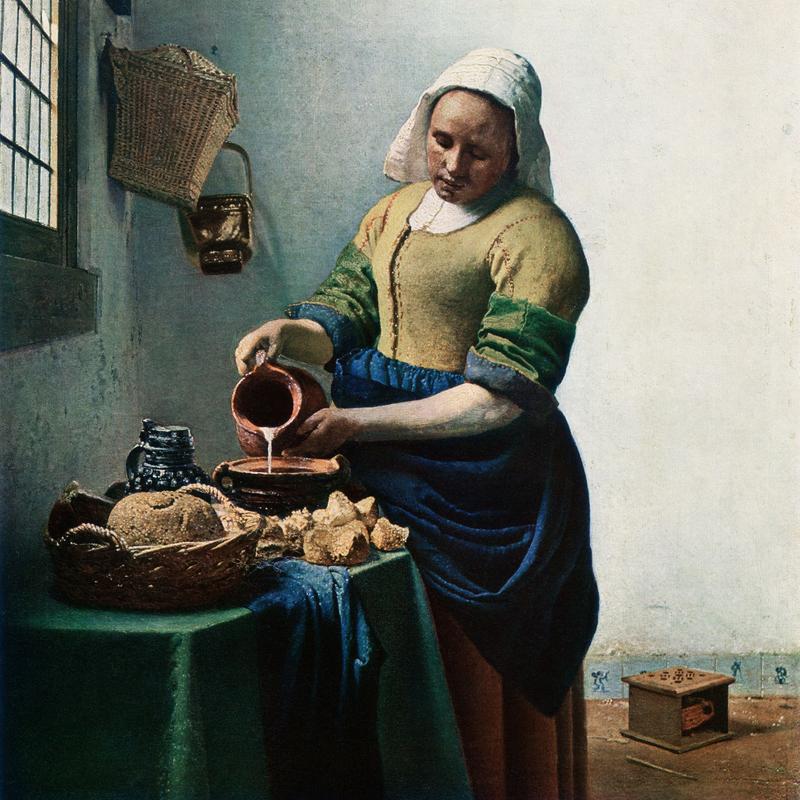
Full Bio is our book series where we spend time with the author of a deeply researched biography to get a fuller understanding of the subject. Our guest is the author of the book Vermeer: A Life Lost and Found, Andrew Graham-Dixon. Vermeer is a Dutch master whose paintings like the Girl with the Pearl Earring and View of Delft are known for the use of light and shadow as well as technique and for their beauty. They can be seen at the Louvre, the Met, and the Rijksmuseum in his homeland of the Netherlands.
There is very little written about Vermeer himself, no letters, no diaries. Andrew Graham-Dixon researched Vermeer's life by using family wills and papers, maps, religious affiliation and the world around him. As Graham noted, Vermeer only lived to be 43 years old, dying in 1675, and during 16 of those lived years, there was war in the Dutch Netherlands. Let's get in today's discussion involving European conflict, his family lineage and the influences on his life. Here's my Full Bio conversation with Andrew Graham-Dixon, the author of Vermeer: A Life Lost and Found.
[music]
Vermeer was rediscovered in the mid-19th century. By whom and under what condition was he rediscovered?
Andrew Graham-Dixon: Well, Vermeer vanished from history not long after he died, partly because he was so little known during his own lifetime that he was an easy man to forget. Although his paintings were so beautiful that nobody who had one would ever destroy it or lose it. They survived, but they didn't survive as being by him. They survived as being by Pieter de Hooch or Frans van Mieris or whoever the dealer felt he could sell the painting as being by, in one case, the famous Dresden lady reading a letter at an open window. The dealer actually painted out the background to make it look more like a Rembrandt and passed it off as that.
He had completely vanished by the mid-19th century. It was at that time that a great French chap called Théophile Thoré, so revolutionary, who was exiled from France because of his part in the 1848 revolutions. He ended up in Belgium, which is every Frenchman's idea of purgatory. He wiled his time away by rediscovering Vermeer. By the time he'd finished, he had more or less reset the shattered bones of Vermeer and re-established him as an actual artist. Although he said in the same breath as rediscovering him that he remained an extraordinary mystery. Why had he disappeared? Why did we know nothing about him? Thoré called him the Sphinx of Delft.
Alison Stewart: Let's talk about a few facts. How many paintings are we aware of by Vermeer that exist now?
Andrew Graham-Dixon: Well, I'm not a great one for statistics, but 30 and a bit, let's put it that way. There's some dispute about one or two pictures, but let's say 36, 38, something like that.
Alison Stewart: Do you think there are others out there?
Andrew Graham-Dixon: Well, I know that there's at least one out there, or at least I hope it is because it was stolen from the Isabella Stewart Gardner Museum in Boston. I really hope that one's out there. There's another one, if anybody's trawling the auction catalogs and looking out for things, there's a painting that was auctioned in 1696 as a Vermeer, which was a Vermeer, of a man washing his hands in a see-through room full of sculpture. Where is that? There's also a painting of a single house in Delft, which I think is the rest of the house that we see the right-hand part of in the famous picture the Little Street. There are some pictures to look out for, but we don't know where they are.
Alison Stewart: We're talking to Andrew Graham-Dixon. He's the author of Vermeer: A Life Lost and Found. It's our choice for Full Bio. Considering there are minimal accounts of his life. How did you go about writing this book?
Andrew Graham-Dixon: Well, I took the approach of trying to reconstruct, as it were, his networks, to try and find out as much as I could about the people who commissioned his pictures. There were very few of them. The people whom he knew, about his family, his mother, his father, his sister, and to piece together as much as I could about him from his proximity to those people. We've got very few documents that have a direct bearing on Vermeer's life. I found that in reconstructing these networks, suddenly a whole new vista opened up and a whole new Vermeer emerged as a result.
Alison Stewart: One of the ways you look at Vermeer in this book is to get to know the people who around him and the world around him and the world he inhabited and the world that he inherited. In fact, the first part of your book is called the inheritance, 1560 to 1632. 1632 being the year that Vermeer was born. You write about the history between Spain and the Dutch Netherlands. First of all, why did Spain want to control the Dutch Netherlands?
Andrew Graham-Dixon: Well, why does Vladimir Putin want to control Ukraine? People who are very powerful and have empires tend not to want to let go of part of their empire. The Spanish had lost the confidence of their subjects in the Low Countries because the Protestant idea had spread to those parts, and the people who lived there, very many of them wanted no longer to be Catholics. The king of Spain said, "Well, that's not up to you, I'm afraid. If you're not going to be Catholics, I'm going to have you executed." He tried to impose his will on them, and that resulted in a revolt, a revolution, and they ceded from Spain,
The cause of the war was that they wanted independence, they wanted freedom, and the Spanish wanted to control them and to control their belief. If the Spanish had been prepared to say, "Fine, if you want to be Protestant, stay Protestant. Just remain within us, remain part of our team," the Dutch and all of the people in Flanders and Brabant and so on, who were rebelling and who eventually formed their republic in the watery land of Holland and further north, they might never have done that.
Alison Stewart: What did you want us, the reader, to understand about the violence during this time?
Andrew Graham-Dixon: Well, to me, if you walk into a lot of museums that contain great collections of Dutch art, it's quite rare to find any of those museums that will give you an explanation of the sheer stress, trauma, death, destruction, suffering, martyrdom that went into the creation of the Dutch Republic.
If you don't understand that the Golden Age was really also an age of blood, an age of steel, an age of gunpowder and dynamite and siege warfare, and women and children being massacred in their homes, that's what the Dutch Republic was shaped out of, then I don't think you can remotely begin to understand the charge of meaning that Vermeer gave. For example, Vermeer gave to his wonderful depictions of domestic peace and tranquility. What he's painting for a people who've lived through all that is a kind of heaven on earth. If you don't know what they've lived through, you just can't get that.
Alison Stewart: I was curious. How is Vermeer tied to the horrible atrocities that occurred during this time?
Andrew Graham-Dixon: Well, partly by blood. His maternal grandfather, who's a man called Balthasar, rather a character, but very much in Vermeer's past. Balthasar was three years old when one of the very worst atrocities of the Dutch revolt, namely the sacking and the looting of the great city of Antwerp by mutinous Spanish soldiers who hadn't been paid for years on end, they went into the richest city in Europe and they laid waste to it, killed-- Nobody knows how many people exactly, but something like 8,000 people were killed. Many women were violated. Innocent children died. It was a truly awful, awful thing.
Balthasar was there. He was brought up in Antwerp. He was three years old when it happened. His daughter Digna, like so many Dutch people, they are refugees from the southern Netherlands. It's a refugee state when they settle in the Dutch Republic and they tell their children, like Vermeer, the stories of where they came from and what happened and how it is that they came to be living there. They would, of course, have told them the great tales, the atrocities and so on.
I mean, even the name of the inn, the pub which Vermeer's father ran, his second inn, the larger one, it was called Mechelen. He bought it under that name. He didn't name it. That inn was named by people who came from Mechelen, which was a city that had been entirely decimated by Spanish invaders that killed most of the people there. Vermeer essentially lived in a kind of0-- I suppose you could call it a kind of Holocaust memorial by name.
It was still a tavern and people drank there, and I'm sure there was lots of laughter, but the name itself, this whole Dutch Republic carried these scars, these memories. To me, thinking about the Dutch Republic and not knowing about what happened before is rather like trying to understand 1950s Germany, say, if you don't know about the terrible things that happened in the 1940s.
Alison Stewart: We're discussing Vermeer: A Life Lost and Found. It's by Andrew Graham-Dixon. It's our choice for Full Bio. Vermeer's parents, Digna and Reynier born in 1595. Reynier born in 1591. First of all, let's start with Digna. You spoke of her earlier. What kind of family did she come from?
Andrew Graham-Dixon: Oh, quite a characterful family, I think. Her father, Balthasar, we know quite a lot about him thanks to a brilliant American archival researcher called John Michael Montias, who did a huge amount of fantastically effective work in the archives about Vermeer's family back in the 1980s. He discovered that Balthasar had been involved in an infamous counterfeiting plot to forged millions of dollars worth in modern currency of false coins so that a particular debt could be paid off. It seems to have involved national security. It's all very skullduggery. I don't go into it in huge detail because I have enough, as it were, extraneous material to go through.
We know that he was quite a character and that he wanted the best for his daughter. He left Antwerp and tried to make a new life in Amsterdam. That's where Digna met Reynier, Vermeer's father. The circumstances in which they met are very interesting. This is one of the key parts of the book, because what I discovered in my researches is that both Digna and Reynier are clearly part of a very radical, fascinating religious movement called Remonstrantism or Arminianism, the adherents of which are wonderful people.
They're very, very Christian in a very straightforward way. They're charitable, they're kind. They're people who believe that you should love thine enemy as well as love thy neighbor. They're extremely moral and they are great pacifists in this age of war. That meeting between Reynier and Digna is very much at the core of my book. In fact, I should confess that I wrote a version of the first hundred pages of my book before I discovered that they were part of that religious movement and had to throw the whole thing away. It was a year and a half of wasted effort. In these books I talked about the Dutch having scars. Well, I've got a few scars myself.
Alison Stewart: What kind of family did Reynier come from?
Andrew Graham-Dixon: Reynier like so many Dutch refugees, or immigrants, refugees from Antwerp and places like that. He wasn't from Antwerp, but he was from Flanders. They were in the cloth trade because there's this great tradition, as I'm sure you know, of cloth and tapestry making and that being one of the great sources of wealth in Flanders and Brabant.
Vermeer's grandfather was a tailor, and Reynier, his father, the son of the tailor, was trained up in Amsterdam. That's why he was there. He was learning to make a very luxury kind of damask fabric called kaffir, and he trained to do that. He seems not to have really taken to it, because by the time he's in his late 20s, he started inn keeping, and that seems to have been the job that really suited him.
Alison Stewart: When they married in 1615, as you said, they were part of the Remonstrant movement. What did it mean to be a member of the Remonstrant movement? What did that mean for the daily life of the person involved in it?
Andrew Graham-Dixon: At that time, it meant a great deal of difficulty because, as often happens when peacemaking groups come into being and make their desire for peace known, they are quite often branded as terrible troublemakers. Because the Remonstrance came from within the established Dutch Orthodox Reformed Church, the Calvinist Church of the Dutch Republic, they protested, they remonstrated against some of the doctrines of that church, including predestination, a doctrine they hated because they said it condemned unborn children to go to hell, or children who'd been stillborn condemned to go to hell.
They didn't like the Orthodox Calvinist determination to continue fighting Spain at all costs and not make peace or not even countenance the idea of peace. They had bones of contention, and they hoped that they could live and their voices would simply be heard, and that perhaps the Calvinists would perhaps slightly soften their approach. Instead of which, they were absolutely crushed.
There was a coup d'état. The Calvinists got together with the leading Prince of Orange and they took over the country. Al the Remonstrants were told, "You either go into exile or you convert, but you can't be a Remonstrant and live here." They went underground. We know that Vermeer's father and mother and their family priest, who was a very radical Remonstrant, who was part of an even more radical pacifist and, for want of a better word, feminist fundamentalist Christian group called the Collegiate, but sprang from the same roots as the Remonstrant. They all lived underground, and they had to, as it were, not tell anybody what they were doing.
Alison Stewart: We're talking to Andrew Graham-Dixon. He's the author of Vermeer: A Life Lost and Found. It's our choice for Full Bio. Let's get into the name Vermeer, how they ended up with the last name Vermeer, because we've been calling them Digna and Reynier. I want you to explain how they became Digna and Reynier Vermeer.
Andrew Graham-Dixon: Well, surnames were not that commonly adopted in the Dutch Republic, and that's one of the reasons that it's hard to find people. They begin to take established surnames at this point, and in fact-- I mean, it's a bit of a long story, but Reynier initially doesn't take the name of Vermeer. He takes the name De Voss, which means fox, and his first name also means fox. He's called Mr. Fox Fox, if you like.
Alison Stewart: They ran a business called the Flying Fox on top of it.
Andrew Graham-Dixon: Yes, his tavern was called the Flying Fox. He's not just any fox, he's Aesop's. Well, he's like Aesop's Fox who wants to reach the grapes that he can't reach and is unhappy about it. He's a kind of fox with superpowers because he can fly and get the grapes anyway. It's probably also a way of saying that, "Come and drink in my tavern, because the grapes here aren't sour at all, not like the grapes complained about by the fox who had no wings." So it's. They like these kinds of jokes, the Dutch. They still do. I'm sure he had a wonderful sign that he himself painted of a flying fox.
The inn itself was full of painters, because he liked painters. He had many friends who were painters. In fact, his notary was an art collector. He had lots of connections with the art trade. The pub was only two doors down from the Guild of St. Luke, which is the Guild of the Artists, the painters, the pottery makers, the tile makers. Anybody who makes anything creatively is a member of the Guild of St. Luke.
He's not an artist, but he's an art dealer. There's a drawing school for young budding draftsmen in the same street. Vermeer, as a child, he sees artists on all sides. He probably sits at the tavern table watching artists draw. I imagine he grows up surrounded by artists. His father even has a sort of secondary business. He's an art dealer. The tavern is full of pictures.
Alison Stewart: The Vermeers ran the Flying Fox. They ran the Mechelen Inn, which you mentioned earlier, until Reynier's death. It became very clear in his parents will when Vermeer, I think he was 5, I think you wrote, that he was going to be left enough money to become educated and taught a trade. I thought it was very interesting about the way it was worded. Can you explain why it was worded the way it was?
Andrew Graham-Dixon: It was fairly straightforward. It just indicates that they both agreed that whatever happened to either of them, the one who survived would have to be obliged to put some money away to make sure that he got an education. It suggests they had a certain definite ambition for this boy. It's interesting that he's called Johannes, not Jan.
Everybody in the family who was a man going back generations is called Jan, which is a really working-class Netherlandish name, whereas they want him to have-- It's more the name of an erudite churchman. In fact, it is the first name of their Remonstrant radical preacher who's clearly very close to the family. He's a man called Johannes Taurinus. I rather suspect that Johannes Vermeer is named after this troublesome priest, as the Calvinists would regard him.
Alison Stewart: You said that he likely grew up around painters. What did painters do in that day? What was the role of a painter?
Andrew Graham-Dixon: Well, it's a very broad question. What they didn't tend to do in the largely Protestant cities of the Dutch Republic, they didn't paint very many explicitly religious pictures. They didn't paint for the church. Not much. Not much at all. The churches had been whitewashed and images had been proscribed. Most Protestants, even Remonstrants, regarded religious imagery as something they didn't want. They could have paintings that had religious meanings, but they didn't want to see Jesus Christ or Mary, Mother of God, on the wall of their house or their church, because they regarded that as idolatrous.
In the absence of that kind of church commission, what you had was quite a lot of secular painting. You had paintings of, for example, kermesse scenes, peasants getting drunk, paintings to make you laugh. You had paintings of Dutch landscape which might perhaps express pride in your country. These pictures could have many different meanings. Paintings of flowers, paintings of fish, paintings of meat and cheese, quite a lot of secular painting. That's what Vermeer's paintings have always been taken to be part of, but they're not.
Alison Stewart: That was Andrew Graham-Dixon, the author of Vermeer: A Life Lost and Found. Tomorrow on Full Bio, we'll hear about Vermeer's compromise with his rich mother-in-law and the patrons who allowed him to complete most of the works of art we know.
Copyright © 2026 New York Public Radio. All rights reserved. Visit our website terms of use at www.wnyc.org for further information.
New York Public Radio transcripts are created on a rush deadline, often by contractors. This text may not be in its final form and may be updated or revised in the future. Accuracy and availability may vary. The authoritative record of programming is the audio record.