
Frida Kahlo and Diego Rivera at MoMA
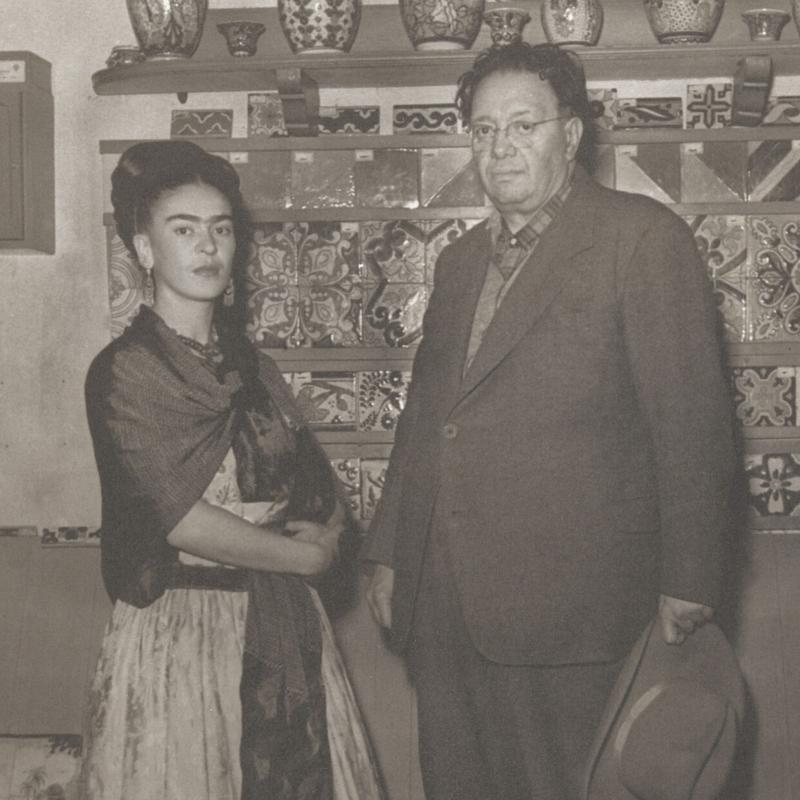
Alison Stewart: This is All Of It on WNYC. I'm Alison Stewart. When you walk into an exhibit about Frida Kahlo and Diego Rivera, you might first expect to see their famous paintings, but at a new MoMA show about the famous Mexican artists, the first sensation you'll hear is opera. The exhibit is called Frida and Diego: The Last Dream. It's organized in conjunction with a new show about Frida and Diego at The Met Opera, premiering in May. The opera set designer, Jon Bausor, also helped design how the viewers take in Kahlo and Rivera's paintings at MoMA. Frida and Diego: The Last Dream is running now through September 12th.
A sample of some of the work of the show is on our Instagram Stories now @allofitwnyc. El Último Sueño de Frida y Diego debuts at The Met Opera on May 14. I have with me now in person, Beverly Adams, MoMA's curator of Latino art. Nice to see you again, Beverly.
Beverly Adams: Nice to see you.
Alison Stewart: And set designer, I hope I'm saying your last name right. Jon Bausor?
Jon Bausor: It's Bausor, actually, like saucer.
Alison Stewart: Jon Bausor. Thank you so much for joining us. I appreciate it. This is a unique collaboration, Beverly. How did the museum first get the idea to create a partnership with The Met Opera?
Beverly Adams: Well, the museum has had interesting collaborations with the opera in the past. For example, when there was a William Kentridge retrospective at MoMA, there was also his premiere of his opera at The Met Opera. It's not something completely unknown to the two institutions, but when we found out that they were going to do a new production of El Último Sueño de Frida y Diego, we thought, "Well, we have Frida and Diego." These are artists that we had been long invested in their careers and have long histories with, and just thought it would be an amazing idea to have Jon Bausor come and think about our collection as he was thinking about developing the sets and costumes for the opera.
Alison Stewart: Jon, the opera is set to debut in May at The Met. What's the basic premise of the opera?
Jon Bausor: It's set on the Day of the Dead, and it's two weeks before the death of Diego Rivera. He's attempting to ask Frida to take him back, essentially to take him home, to take him to death, and Frida's having none of it, really. She doesn't want that. She's very happy in her peace, but she does want to create art. It's a kind of an anti-love story, I suppose, where the two meet again in death, and on that day of Day of the Dead, basically go up to the terra firma and experience things taken by Catrina, who's like the guide that takes them between life and death, takes them to the underworld.
Alison Stewart: How did you decide what the set would look like?
Jon Bausor: It always comes from dramaturgy. I think the story-- it has to come from what's being beautifully created by Nilo and Gabriela. It's an ever-changing set. It's transformational. It starts off in one place, but it's 22 scenes, and it's moving pretty quickly. It's not a standard four-act opera. It's evolving in front of you, like their work, as I would say. It does all sorts of things. It takes you from the terra firma, from the ground. Then the ground splits open, and out of that fissure comes the dead, effectively. From that point onwards, all chaos ensues.
Alison Stewart: We can see that at The Met when you first walk into the exhibit. Beverly, how did you decide on the focus of this exhibit and what you wanted to explore with both artists?
Beverly Adams: Well, it really started with what our collection has and also how Jon wanted to tell his story, tell the story of the opera. What we really wanted to do was bring the collection into the forefront. Jon, which he does beautifully in the exhibition or in the installation, is put a spotlight, literally and figuratively, on all of these works so that you could get a close look at them in this amazing context. One of the things that was important for a point of departure for me is that we have in the collection these beautiful watercolors done by Diego Rivera over the course of a few years, ending in 1932, that were done for the stage set and for the costumes for a ballet that a Mexican composer, Carlos Chávez, did that premiered in Philadelphia in 1932.
We see the artist as stage designer early on in his career, in the late '20s, early '30s. That, to me, was an interesting meta moment. I wanted to start with that piece and have it be a touchstone for how you see the rest of the works throughout the space.
Alison Stewart: You know what, when you first come through this curtained hallway, your eye falls to a piece on the wall, Tree of Hope, Remain Strong. It pictures Kahlo sitting next to the back of a body. She's stretched out. There's bloody scars on her back. It's referring, I think, to Kahlo's spinal surgery. This could be for both of you. Beverly, I'll ask you to go first. How do you think this entrance to the exhibit, why was it one of the first things you wanted people to see?
Beverly Adams: For one thing, it's an exhibition about both of them, but we had to pick some place to start. This is a work that's not in MoMA's collection, but a loan from a private collector. It's a spectacular later work from the '40s, where you see her story encapsulated the difficulties that she's gone through physically, yet this hope, this continuing to move forward. She's in this beautiful Tehuana dress. You see her holding her little flag of hope. Her life story-- it's part of her life. It's really encapsulated in this beautiful self-portrait. We just thought it would be a gorgeous way to start the show because it's such a powerful image. I don't know. Jon, what do you think?
Jon Bausor: I think, for me, it was such a major influence on the design for the show. There's a giant fissure, kind of crack through the center of the piece. It's all about this duality. There's the light and the dark, which is the theatrical journey that we go through in the actual opera itself. As you say, Beverly, the Tehuana dress is this beautiful construct that I think had so much influence on what we've done for the costume designs in the show. This sense that she's constructed this image for herself, like armor, effectively, over her disability that sits below that, and the pain that sits below that.
We show that during the show. We show that during the opera itself, this sense of construct, and when we X-ray into it, essentially, almost by losing the layers and putting them back on again. I think, as a painting, it had a huge influence. It was just amazing to see that in real life, and then have the opportunity to spend time with it and to evolve what I was designing on the stage at The Met accordingly.
Alison Stewart: Then, when you turn to the right of it, you see this beautiful red tree with a mirror at the top. Jon, would you describe that for us?
Jon Bausor: Yes. I suppose it's my response to-- It's a link between the opera and what I designed in the opera, at the center of which is this tree, which is almost like the heart of Frida, which represents so many things, from the arterial heart, to the idea of lineage and her family tree, and her pain. In this exhibition, it sits there as this twisted, contorted thing that's trapped within a blue bed like a framework of the Casa Azul, and then releasing itself into a mirror above, releasing into that mirror, like that was sat on the canopy of her bed that she painted and she viewed so many things from when she was laying there, unable to move and restricted by that.
It's the heart of the design. As soon as you go into the opera, as soon as we go into the underworld, this tree sits there like a totem, like it does in the art show at MoMA. It sits there in the opera as this full-on totem at the very heart of everything.
Alison Stewart: What do you think, Beverly? I'm just curious. It's so well staged, the exhibition. All the art is so beautifully staged with these curtains, and they're pulled back, and it immediately draws you into the art. I was curious, what was behind that? What do you think about that?
Beverly Adams: Again, this was Jon's way of-- The stage, the opera has the singers that are dressed as the characters. You have Frida and Diego there. There are proxies singing the opera, but what we have are the paintings. We wanted to create these moments where they were revealed or that you were drawn to see the painting in this way that really felt special. Felt very different, too, than a regular exhibition. Felt like they were not only decorating the set, these paintings, but they were animating the set. They brought it to life.
Alison Stewart: It's so interesting. I went around three times. It was really a pretty great example of how you can combine the two. By the way, we're discussing the new exhibit at the Museum of Modern Art about Frida Kahlo and Diego Rivera. It's called Frida and Diego: The Last Dream. It's on view now through September 12th. It is made in collaboration with The Met Opera, which is premiering an opera about Frida and Diego in May. We are speaking with Beverly Adams, MoMA curator of Latin art, and set designer Jon Bausor, who worked on both the exhibit and the opera. Did I get it right? I hope so. I'll do my very best.
There's a picture of Frida's called Self-Portrait with Cropped Hair. Beverly, what is she addressing in this picture?
Beverly Adams: I think she's addressing the rocky relationship that she had with her partner, Diego Rivera, in a breakup. You see her with her hair all cut off and strewn around the picture. She's dressed in a man's suit, might be Rivera's suit. Then there's a text at the very top of the picture that says, I'm paraphrasing, basically, "If you love me, it was for my hair, and now that I'm bald, you don't love me anymore." Which I think is a reference to a popular Mexican song, like corridos. These paintings are very delicately done, almost like retablos, which is another form of popular Mexican painting. I think, specifically, when it was made, it was a reference to her relationship with Rivera.
What I think is interesting about this picture, and all of the Kahlos in the show, is that they live beyond maybe their original signification in that they're so relatable. I think that there's actually a large exhibition in Houston right now about Kahlo being an icon for so many other artists that used her works-- that her works empowered other artists to write about disability. Not to write. Write, or paint, or make operas about things. I think this picture is one of those that does that. It is about a specific time in her life, but at the same time, it has empowered others to make art and is an icon in and of itself.
Alison Stewart: If you go upstairs into my office, there's a big Frida Kahlo on my chair, like a huge scarf. Every day, when I come in, I bow to Frida. Jon, scaffolding plays a big role in the design of the show and the opera, and part of the exhibition. Why is scaffolding such an important part of the theme?
Jon Bausor: I'm fascinated by this construct and this idea-- the thing that Diego was-- he would spend many of his hours on scaffolding, effectively making his work. They're making these murals, and I love the idea of this prop, these things holding things up, like crutches, supporting things, like they would be supporting Frida in her corsetry, in the way that she's held up after this horrible accident she's had. I feel like that was interesting in terms of-- to play with and to deconstruct and show within the way that we're assembling things in the room. As you say, it does come into the opera. We see Diego making a mural in the second half of the opera.
I just love the kind of sculpturalness of the whole thing. It's propping up this scaffolding net, which you might see on a sidewalk in New York, this blue netting, which is a modern material. It's an industrial, modern material, dyed blue, a bit like a darker version of La Casa Azul color, but it sits there as this kind of modernity that almost looks a little bit like silk, or it could look like a bloodied gauze, but now blue, effectively, that you might wrap around a wound or something like that.
Alison Stewart: There's a photo in the show, Beverly, of Rivera sketching his first impressions of San Francisco. The couple had just moved to the United States. They'd be here for a few years. How did they find the transition from Mexico to the US?
Beverly Adams: Famously, Kahlo had a tough time with it. She was with him while he was making these miraculously beautiful murals in San Francisco. She accompanied him to New York, to Detroit, and she found it very difficult and missed Mexico tremendously. What I love about that photograph is that they're both very-- It's a beautiful photograph that was part of a New York Times article announcing Rivera starting out this project. What few people remember now is that in 1930s, Rivera was probably the most famous artist of his time. I mean, MoMA's second retrospective of a single artist was Rivera. First was Matisse, and second was Rivera.
In the '30s, he was much in demand, and he traveled all over the US, doing special projects. Kahlo came along and eventually began to work while she was here. There's a beautiful painting in the show from 1931, while they were in Detroit, where she's straddling the borderline between the US and Mexico, and you can tell which one she favors.
Alison Stewart: You include a piece by Frida Kahlo, originally painted in 1937. It's a self-portrait of Frida and her pet monkey. First of all, can you tell us a little bit about this pet monkey and why it was so important in her life?
Beverly Adams: I don't know a lot about the monkey, I'm afraid to say. Jon, do you know about the monkey?
Jon Bausor: I don't know much about Fulang-Chang, but I think her monkey was quite important to her. I know she had one. She also had these little puppets, and she was obsessed with baby dolls, and had these little creatures and little forms effectively surrounding her at all times. I think, probably, Fulang-Chang was part of that.
Beverly Adams: In her house, she had a deer as a pet. She had small dogs. They do end up in her works. There's a beautiful painting in the show where she has the body of a deer with her face. I think that the menagerie in Mexico City and the Casa Azul shows up in her paintings quite frequently.
Alison Stewart: This show at MoMA, you have the opera. Other museums, like you said, are doing retrospectives of Frida Kahlo's work. Netflix is planning a series around Frida and Diego. I think Brooklyn Museum did a show a few years ago. For each of you, I'll ask you to weigh on this. Why do you think Frida and her relationship with Diego are having such a moment right now? What do you think, Beverly?
Beverly Adams: Well, beyond the relationship part, I mentioned that Rivera was the most famous artist of his time in the '30s. We can now say the same is true about Frida. She has this power and this way of relating. Her works are infinitely relatable, and there's a whole phenomenon around her. I think that because she so openly described herself and constructed this outward-looking view of herself for people to relate to, that we continue to do that. We saw her as maybe the artist's wife at first, but she has totally become the painter on her own. We love that kind of story, right? As the woman artist who comes out from underneath the very large shadow of her husband.
There are so many things that we can relate to in her work that, to me, it seems natural to want to keep looking and thinking about it. I think sometimes the life overshadows the work, and I would just be here to advocate that the work is amazing.
Alison Stewart: What do you think, Jon?
Jon Bausor: Yes, I agree. Obviously, I agree with Beverly. This emotion laid bare her introspection and bravery, and not shying away from exposing that, and showing that makes it modern, makes it contemporary, and makes us interested in it. Obviously, Diego is much more contemporary to that time and political to that time, but obviously, that has waves of current-- It seems there's a similarity there.
Also, just the beauty of that, as Beverly said, not only the beauty of their painting, but the costume, the heritage that sits within that. We're being very true to that, and we've done a lot of work with my co-costume designer, Wilbert Gonzalez, and I for the MoMA show and for The Met show, too, to go to Mexico. We're having the embroidery made in Oaxaca by the real people that made it originally, generations on.
Alison Stewart: We're going to have to leave it there. I want to shout out Beverly Adams and Jon Bausor. The name of the show is Frida and Diego: The Last Dream. It's at MoMA. Thank you for your time.
Beverly Adams: Thank you.
Jon Bausor: Thank you.
Copyright © 2026 New York Public Radio. All rights reserved. Visit our website terms of use at www.wnyc.org for further information.
New York Public Radio transcripts are created on a rush deadline, often by contractors. This text may not be in its final form and may be updated or revised in the future. Accuracy and availability may vary. The authoritative record of programming is the audio record.