A History of Movie Music
Alison Stewart: This is All of It on WNYC. I'm Alison Stewart. Happy Friday, everybody. We had a great week of conversations, and if you couldn't be with us each and every second, you can go back and listen to them wherever you get your podcasts or on our show page@wnyc.org. We talked to actor and writer John Leguizamo about his new show at The Public titled The Other Americans.
We spoke about comedy in the era of censorship with NPR correspondent David Folkenflik and Vulture editor Jesse David Fox. We puzzled over New York City neighborhood names with Greg Young of the history podcast The Bowery Boys. Yesterday, we spoke with actor Timothy Olyphant about his new role on the TV series Alien: Earth. That interview in particular was quite lively, shall we say? Next week is shaping up to be quite special as well. Baker Paul Hollywood will be here on Monday to talk about his cookbook.
Now, let's get this hour started with a look at the history of movie music.
[music]
You know that theme, it's not the AOI theme. It's the 20th century studio fanfare, one of the most recognizable sounds in the history of movie music. That theme was originally composed in 1933 by Alfred Newman, an accomplished Hollywood composer who won nine Oscars for scores for movies like Wuthering Heights and the Hunchback of Notre Dame. He is also the father of film composers David and Thomas Newman. Of course, there's his nephew, Randy Newman.
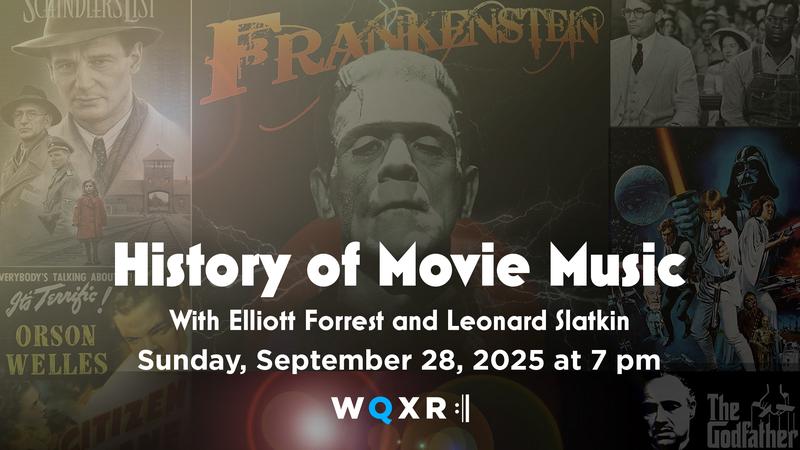
Movie music is an art form going back more than a century. Of course, it predated dialogue in movies, and the form has made stars out of people like John Williams, Terence Blanchard, Rachel Portman and Hans Zimmer. On Sunday, WQXR host Elliott Forrest will speak to conductor and composer Leonard Slatkin about the history of movie music. That'll be in The Greene Space Live. First with a preview, I have Elliott with me here in studio. Hi, Elliott.
Elliott Forrest: Great to see you. Great to be with you.
Alison Stewart: Hey, listeners, we want to hear from you about this. Who are your favorite movie composers? What are your favorite movie scores and soundtracks? We might get you to sing a little bit. [laughter] Our number is 212-433-9692. 212-433-WNYC. Elliott, when do you first remember noticing the music in movies when you went to see them?
Elliott Forrest: I think the entry point for me to really focus on movie music was the music of Bernard Herrmann, which we cover. Once I started to really focus in on not just music in films or even classical music or orchestral music that was used in films but written specifically for movies, and I zeroed in on Bernard Herrmann. I realized what an incredible art form it was. When you think about Bernard Herrmann's very first film was Citizen Kane, and his last film was Taxi Driver. Everything for Alfred Hitchcock in the middle, including Psycho, that's a career from Citizen Kane to Taxi Driver with all the Hitchcock in the middle. That's amazing.
Alison Stewart: What did he understand about Hitchcock thrillers? What did he understand that they needed musically?
Elliott Forrest: I think that he understood some aspects of psychology and really capturing what was going on emotionally. Sometimes a film composer, it's just like, bum, bum, bum, and it's about the action, and sometimes it's what's going on internally. Also, there's little hints every once in a while. For example, the famous Psycho scene. We've just spent 20 minutes with him with Birds, and all of a sudden, it's reap, reap, reap, whop, whop. [laughter] He's giving you a hint as to who the killer is in the music. There's a lot. It can be dense and really interesting.
Alison Stewart: Well, let's hear it.
[MUSIC - Bernard Herrmann: Psycho]
Elliott Forrest: This is the famous driving scene. What's interesting about-- a couple of things. First of all, on Sunday, when we go through the history, I'm going to show this scene without any music whatsoever.
Alison Stewart: Oh, that's going to be great.
Elliott Forrest: You're just like, "She's just driving," and, "Oh, that looks like an interesting hotel. Let's check into that." Then I'm going to play it with the music, and you can see where the drama is. The other thing that Bernard Herrmann did was he would orchestrate specifically for the film. For example, films like Jason and the Argonauts only has percussion and brass, but there's only strings in Psycho. The reason is that it makes it that much more strident and that much more tense.
Alison Stewart: Music and movies were around before people could speak in movies.
Elliott Forrest: Right, yes. We like to say silent movies were not silent. [laughter] Even at the beginning, there was someone playing live. Even if you jump to some of the later films of Charlie Chaplin, they would add music to it even before there was dialogue. Music has always been a part of the films, even in the "silent era."
Alison Stewart: Tell us about one of the first films that used underscoring.
Elliott Forrest: There's this thing called diegetic. It's not a word People really know that much about it. A diegetic music is when it's part of the film. For example, you see a scene and there's an orchestra, there's a radio. That makes sense. There was a period where they could to add music and they went, "We can't just add music. Where is it coming from? We're in a doctor's office. Where's the orchestra?"
They didn't think that the audiences would buy the underscoring, the non-diegetic music. There was a film in the '30s, Symphony of Six Million, where Max Steiner was scoring the thing, and the scene really wasn't working. They just went, "Put some music underneath it." They were like, "The audience won't know where the music-- Just do it. Just put it underneath it." and underscoring was born.
Alison Stewart: Lets listen to Max Steiner's Symphony of Six Million.
Actress: It may interest you to know Dr. Felix Klob, that he died calling your name.
[MUSIC - Max Steiner: Symphony of Six Million]
Actress: I feel sorry for you.
Alison Stewart: I feel sorry for you.
Elliott Forrest: The main theme underneath that really was not an original theme. It was both the Moldau and people might know it as Hatikvah, the Israeli national anthem. There's this Israeli sense, this Jewishness underneath it, which is a theme of the film.
Alison Stewart: Let's take some calls. Christine's calling from Basking Ridge, New Jersey. Hi, Christine, thank you so much for calling All of It. You are on the air.
Christine: Hi, thank you guys for taking my call. Longtime listener, first time caller.
Alison Stewart: Love it.
Christine: I heard you guys ask, what's your favorite soundtrack, and the first thing that comes to my mind is-- Honestly, musical theater and movies that I've seen, which is just-- Sorry, that's not important because that's not about underscoring. We're talking about underscoring. I'm all about Howard Shore, Lord of the Rings films. Just thinking about it gets me emotional because every important moment in this film, which a lot of people are big fans of, is just really empowered by Howard Shore's music. That film and how important it is to me in my life is nothing without the music that underscores it. Thank you, guys.
Elliott Forrest: The thing about Howard Shore really harkens back almost to Wagner because Wagner was really one of the first composers that would create these leitmotifs in his operas in the sense that the characters had theme or a prop would have a theme. I don't remember the exact number. I did a full hour. It was such an honor. Last year, I sat on stage with Howard Shore, just with him alone-
Alison Stewart: Oh, wow.
Elliott Forrest: -for 90 minutes with his entire film-- all of his films, or most of them. I can't remember Lord of the Rings, maybe a couple of dozen themes. The characters has-- The Ring has a theme. There's all these different themes that he created, massive amounts. He got Oscars for it, and well deserved.
Alison Stewart: Let's listen to Howard Shore.
[MUSIC - Howard Shore: Lord of the Rings Symphony]
Alison Stewart: Eric is calling us from South Orange, New Jersey. Hi, Eric, you're on the air.
Eric: I just wanted to just put out a shout out to one of my favorite scores. I have a lot of favorites, but I wanted to just put a spotlight on Under the Skin by Mica Levi, which is one of the more terrifying and unique and distinctive scores. It's so eerie. I like that it's a a modern score, but it hasn't given up on melody. A lot of modern scores are more amorphous, but this one actually does have a lot of really strong melodies in it. I just think it's a real masterpiece.
Alison Stewart: Thank you so much for calling. I'm speaking to WQXR host Elliott Forrest about the history of movie music. He'll be in conversation with conductor Leonard Slatkin in The Greene Space this Sunday at 7:00 PM. A lot of composers and directors develop a working relationship. Why do you think that happens?
Elliott Forrest: It's interesting because directors will use actors and then not use them again, or even sometimes cinematographers, but there's this bond between directors and filmmakers. My friend Doug McGrath, who wrote and directed the films Emma with Gwyneth Paltrow, and Infamous, and Nicholas Nickleby had said to me that the composer is the second major voice in the film.
When you start to look at both Hitchcock and Bernard Herrmann, and of course, John Williams and Steven Spielberg and Terence Blanchard and Spike Lee, they create these relationships almost for life. They say, "We're going to go on this journey together. It almost doesn't even matter what the film is. You're going to come with me and you're going to help create this new world."
Alison Stewart: Steven Spielberg and John Williams, I believe they worked on more than 25 films together.
Elliott Forrest: Something like that. They've said that Fabelmans, the last film, would be their last original collaboration. We all hope not. The last time I saw John Williams on stage, he was having trouble with mobility. I don't really know how physically active he is at this point. What a legacy. Just so much. It was Johnny Williams when he started. He played the piano. There's some scores that I really love. To Kill a Mockingbird was actually a scoring by Elmer Bernstein, but the piano playing was John Williams. He just goes back throughout the entire history of this business, and just all the films. Jurassic park, it just doesn't end. Star Wars. Amazing stuff.
Alison Stewart: Let's listen to a little bit of E.T.
[MUSIC - John Williams: E.T.]
Elliott Forrest: Sunday in The Greene Space, we're going to let John Williams tell this story. They were editing the film for E.T. At the end, the last 20 minutes, if you remember, it's this huge chase scene. They meet up and they finally get up to the alien, and it goes up to space. Wasn't working. Traditionally, what happens is, is that the composer will write the music and then they'll cut it up a great deal and fit it to the film. It just wasn't working. Spielberg says, "You know what? You just play the music. You just play this big suite of music in the last 20 minutes, and I'll cut the film to the music.
Alison Stewart: Wow.
Elliott Forrest: Extremely generous. Rarely happens. The first time John Williams conducted live with the New York Philharmonic, I was in the audience, and I'm watching this scene, and it's just big and sweeping and operatic. I'm thinking, "You know what? I don't really want to watch a film unless the New York Philharmonic's playing live anymore. This is really good. I love doing this."
Alison Stewart: Let's talk to Tex, who is calling in from New Jersey. Hi, Tex. Thank you so much for calling All of It. You're on the air.
Tex: Oh, it's my honor and a pleasure. Speaking of otherworldly, and not to take anything away from John Williams, but I don't think any film has eclipse to score to The Wizard of Oz. When I listen to The Wizard of Oz, I don't see how physically you can write that and play it. It's just otherworldly. It's just so far and above anything I've ever heard since.
Elliott Forrest: It's an amazing score. These are amazing songs. I think a lot of people know this. They almost cut Over the Rainbow because it didn't really fit. They thought it slowed the film down. It's an amazing musical. On Sunday, just so people know, we're going to leave out a lot. I'm just telling you now, we're going to leave out a lot.
Alison Stewart: [crosstalk]. It's okay.
Elliott Forrest: We're going to leave out a lot. I love movie musicals, from The Wizard of Oz, to Singin' in the Rain, to Rocky Horror Picture Show. We're really going to focus on orchestral and symphonic music. One of the reasons is there was a time when orchestral and symphonic music was heard primarily in the concert hall. I think I can say without equivocation, the majority of the symphonic and orchestral music heard today is heard in the movies. Whether it's the movie theater or streaming, that's where people are hearing orchestras.
Alison Stewart: We're talking about movie music with WQXR host Elliott Forrest. After the break, we'll talk about Spike Lee and Terris Blanchard as well as Tim Burton and Danny Elfman. We'll take more of your calls. This is All of It.
[MUSIC - Luscious Jackson: Citysong]
Alison Stewart: You are listening to All of It on WNYC. I'm Alison Stewart. I'm speaking with my colleague, WQXR host Elliott Forrest about the history of movie music. He'll be in conversation with conductor Leonard Slatkin in The Greene Space this Sunday at 7:00 PM. Could you fill people in on Leonard Slatkin who don't know?
Elliott Forrest: So Leonard Slatkin is one of the great American conductors. He just turned 80. He is still very active. Multiple Grammy Award winner, National Medal of Arts recipient, longtime conductor of the St. Louis Symphony, the Detroit Symphony. He was conductor of the National Symphony at the Kennedy center when it was run by professionals. His parents were both in orchestras-
Alison Stewart: Oh, interesting.
Elliott Forrest: -in the '40s for a lot of these film scores. Leonard as a kid would go and sit when they were making these movies, sit with his parents when they were in the orchestra. I don't want to give too much away, but let's just say there's a famous, maybe the most famous two note movie theme ever, which is played on a cello. In the original score, it's his mom.
We'll talk more about that on Sunday in The Greene Space. Leonard grew up with this, and it's been a big part of his life. He's just now actually creating a new radio program himself on the history of movie music. I just have to say, I asked him to join me for this and he readily agreed. We did it once in Nyack already together. Immediately we got off stage and he went, "I want to do this again."
Alison Stewart: Oh, great.
Elliott Forrest: We had a great time. He's just a great raconteur, and a great musician, and a great American conductor.
Alison Stewart: Let's talk about another prominent pair, Spike Lee and Terence Blanchard. We have a clip from Blanchard's score for Malcolm X. What do you want to say about that?
Elliott Forrest: That's another great pairing, another great relationship. Terence Blanchard has scored many things for Spike Lee, and just another great example of how a director finds this other voice that says, "I want you to be a part of this." Malcolm X is really great. I'm not sure which clip you're going to have, but if you hear a trumpet, that is Terence Blanchard, because he is and was primarily at first a trumpet player and then went on to compose.
Alison Stewart: Let's listen.
[MUSIC - Terence Blanchard: Malcolm X]
Alison Stewart: Like you said, it's like another voice.
Elliott Forrest: You know what's really great about some film music is you can see the movie. You can see the film in your head. It just takes you right there. Whether it's Jurassic Park or Star Wars, it's like you're in the movie the moment you hear some of these themes.
Alison Stewart: Let's talk to Monk, who's calling in from Brooklyn. Hey, Monk, you're on the air.
Monk: Hi. Thank you for having me. I just wanted to touch on-- you mentioned you were going to talk about Danny Elfman here in a minute. I just love when artists who are usually associated with more popular culture music, not so much symphonic music, take the route of movie scoring, like Jonny Greenwood from Radiohead for There Will Be Blood, even Quincy Jones, Danny Elfman. I love seeing the versatility of these musicians and what they have to offer to movie scores. When you realize just how grand their mind is, that they can switch it up just like that and do a movie score, easy peasy, it's mind-blowing. I really love it.
Elliott Forrest: 100%. Danny Elfman was in a rock band for a long time, and then some-- Whether it's his own ambition to do it or whether somebody like Tim Burton says, "Maybe Danny Elfman would be good for this." It's interesting how many films Danny Elfman and Tim Burton have done. Then sometimes you'll hear these scores and other things. I love the score to Edward Scissorhands. It's one of my favorites. You'll see even a whole 'nother movie about Christmas. It has nothing to do with Danny Elfman or Tim Burton. They're going, "Oh, that's Edward Scissorhands." They're just putting that in there because it just feels right.
Alison Stewart: Edward Scissorhands, Charlie and the Chocolate Factory, Batman. Well, let's hear Beetlejuice as well.
[MUSIC - Danny Elfman: Beetlejuice]
Alison Stewart: I remember from Oingo, Boingo.
Elliott Forrest: Right.
Alison Stewart: Danny Elfman.
Elliott Forrest: I did a full hour special for WQXR with Danny Elfman right in these studios here at WNYC. Again, there's this connection. He's a little offbeat, that Danny Elfman-
Alison Stewart: Yes, he is.
Elliott Forrest: -and so was Tim Burton. I think they found each other.
Alison Stewart: I am going to bring in the woman, Rachel Portman. Describe Rachel Portman for People.
Elliott Forrest: Rachel Portman is this great English film composer. Again, she partnered with Doug McGrath on films like Emma and Infamous and Nicholas Nickleby. We do find a lack of women-
Alison Stewart: Yes, we do.
Elliott Forrest: -in this business still for all sorts of stupid reasons. [laughter] Rachel is really an elegant, elegant woman, and wrote some beautiful music, particularly for that first film that Doug did with Emma.
Alison Stewart: Let's listen.
[MUSIC - Rachel Portman: Emma]
Alison Stewart: Let's talk to Laura, who's calling in from Westville. Hi, Laura, you're on the air.
Laura: Hi, there. Thanks so much for having me. As an Italian, when I heard you guys in this conversation, I immediately thought about two other pairs of composer-directors that are iconic in my opinion. One is Ennio Morricone and in particular his relationship with Sergio Leone and his movies. If I think about the theme from The Good, the Bad and the Ugly, talk about an immersive sensory experience. I think it just transports you there in that movie, in that scene. It's just fantastic. Then, of course, Nino Rota and Federico Fellini, and in particular, 8½. I think that music just really makes the movie. Just wanted to put it out there.
Elliott Forrest: We talk about both these composers on Sunday in The Greene Space. Particularly, I've got a fun story about Nino Roto. If anybody knows anything about his music, they know the theme from The Godfather. He was tentatively nominated for an Oscar for that score, but it was for an original score. They yanked the nomination from him because it wasn't an original score. He had used it in a previous film in a whole 'nother way. We'll play both of them on Sunday.
Alison Stewart: Let's talk to Bianca from Westchester. Hi, Bianca. Thank you so much for calling All of It. You're on the air.
Bianca: Thanks for taking my call. I was thinking about how you were saying that you can hear some music and instantly think of the visuals that come with it. It made me think of Disney Pixar's Up, the beginning of Up. Then I thought, "This is really spread into all forms of visual media." The opening music to Game of Thrones or Westworld are just incredibly iconic, and they immediately give you the visual of the entire series.
Alison Stewart: It's true. Thank you so much for your comment.
Elliott Forrest: Michael Giacchino, who wrote the theme to Up and got an Oscar for that. Really a beautiful score, and obviously, well deserved, and a very active composer these days as well.
Alison Stewart: As we're starting to wrap up on time, do you want to give us a little bit of what Sunday's going to be like?
Elliott Forrest: Seven o'clock in The Greene Space. Leonard Slatkin and I. We're going to play about, I don't know, 30 different film clips. We're going to work through the history of the films. We'll talk a little bit about the early days, a little bit of history, some about this relationship. I will say that we are sold out. We've sold all the tickets to this event in The Greene Space. We're happy about that. We're going to stream it. You can find out about streaming this event in The Greene Space, wherever you are around the planet. Seven o'clock Eastern Time from The Greene Space. From here in New York, go to wqxr.org, and you can find out information on how to join us virtually.
Alison Stewart: What are some of your personal favorite scores?
Elliott Forrest: I have a fun story that I'll save for Sunday, but Lawrence of Arabia is an amazing score. I mentioned it earlier, To Kill a Mockingbird. I had the opportunity to meet Elmer Bernstein a couple of times, and his score to To Kill a Mockingbird is very reminiscent of Aaron Copland, very American. I just don't think that classic film with Gregory Peck would be what it is today without that beautiful score by Elma Bernstein.
Alison Stewart: I think the thing we're going to go out on, I'm looking at the list, and I'm going to go out on Hans Zimmer.
Elliott Forrest: Okay.
Alison Stewart: We're going Hans Zimmer, Interstellar. Do you want to add anything before we go?
Elliott Forrest: He's clearly one of the most popular and active composers today. He's got a big staff working with him. When you think drama and fight scenes and big motion pictures, Hans Zimmer's right there.
Alison Stewart: I've been speaking to WQXR host Elliott Forrest. His show about movie music will be-- he'll be in conversation with conductor Leonard Slatkin in The Greene Space this Sunday at 7:00 PM. They'll be talking about movie music. It sounds like a great conversation. You can stream it live. Thanks, Elliott.
Elliott Forrest: Thank you, Alison.