
Fallen Angels' with Rose Byrne and Kelli O'Hara
Alison Stewart: This is All Of It. I'm Alison Stewart, live from the WNYC studios in Soho. Thank you for sharing part of your day with us. I'm really grateful that you're here. On today's show, next hour, we'll spend the entire hour talking about art in New York. We'll learn about the new documentary Maintenance Artist, which talks about the Department of Sanitation's first artist in residence. We'll talk about an exhibit featuring the work of Ceija Stojka, a Roma artist and Holocaust survivor who did not begin making art until she was in her mid-50s. We'll preview a new art fair opening at the Powerhouse in Gowanus. That's the plan. Let's get this hour started with a hilarious revival on Broadway.
[music]
Alison Stewart: A century ago, the Noel Coward play Fallen Angels caused a stir when it premiered in the UK. It was called vulgar. It was about two grown women talking about the joys of S-E-X. The comedy follows Jane and Julia, who both had an affair with a dashing Frenchman named Maurice. That was years ago, before they were married. Now their husbands are on a golfing trip, and Maurice is back in town. Jane and Julia are played by the dynamic comic duo Kelli O'Hara and Rose Byrne. Jane and Julia decide to wait together for Maurice to come calling. While they wait, they have some champagne and more champagne and more.
As the night wears on, Jane and Julia get pretty snockered, and a misunderstanding might finally drive a wedge between these two women. Fallen Angels is running now at the Todd Haimes Theatre. It was just nominated by the Drama League for Outstanding Revival of a Play. I'm joined by the two leads, Kelli O'Hara. Hi, Kelli.
Kelli O'Hara: Hi.
Alison Stewart: And Rose Byrne. Hi, Rose.
Rose Byrne: Hi.
Alison Stewart: All right. You guys were so funny before we went on the air. You were just talking and talking and talking and talking. Did you know each other before the show?
Kelli O'Hara: No.
Rose Byrne: No, just the read-through.
Kelli O'Hara: Not the read-through, the--
Rose Byrne: The reading.
Kelli O'Hara: We did a one-night gala reading. It stands for the Roundabout, about what, a year and a half ago, two years?
Rose Byrne: Yes.
Kelli O'Hara: It was so fun that Scott Ellis, our director, said, "You want to do it again"?
[laughter]
Kelli O'Hara: Literally, that's how it all--
Alison Stewart: Really?
Kelli O'Hara: Yes.
Rose Byrne: Yes. It was a lovely surprise, wasn't it? We didn't really know how the play would-- It's obviously a very old play. It would be fresh and relevant. It's Noel Coward. It's brilliant. I think we were all happily surprised at--
Kelli O'Hara: Yes, at how, even though written 100 years ago, how prescient it is. It's amazing how current in certain ways it is.
Alison Stewart: What made you interested in doing a play that was over 100 years old?
Rose Byrne: [laughs]
Kelli O'Hara: Well, Scott sent it to me, and I read it, and I was laughing at the things that haven't gotten old, to be honest. I've asked a couple of women, big heroes of mine. I was like, "Why is this play not done? Why have you not done it?" It feels like this thing that we've unearthed in a way. I think it is controversial. There's some vulgarity, and there's some risque qualities, and that makes it so much fun. It's two women at the helm. That made me want to do it. Then he said Rose Byrne, and I was like, "Well, I'm all done here. My decision's made."
[laughter]
Alison Stewart: What made you want to do it, Rose?
Rose Byrne: I think Kelli's been so erudite about it. I love Scott. I'm such a fan of Kelli. We did this reading, and it was such a delightful surprise. Obviously, I didn't know the play either, and it was really sort of an unearthing. It just lifted off like a great play does in a way that it just suspends itself, and you're like, "Oh, there's magic here. Let's see how far we can take it." I was so interested in the comedic two-hander for women, which is very rare, I would say. It's been a delight to try to mine it more and more.
Alison Stewart: You both have to play high-minded Brits. You're from Australia, you're from Oklahoma. [laughs] What is the secret to a good British accent, Kelli?
Kelli O'Hara: Oh, gosh. Let's ask Kate Wilson.
Alison Stewart: Let's ask Kate Wilson.
Kelli O'Hara: Kate Wilson from Juilliard. She's been our vocal coach, and she's had to do everything from Mark Consuelos's French accent to our high upper-class British accent. I think there's a very much of a kind of a-- I'm going from very Queen's English, which was a little-- This would be before the-- There's flat As and oh, dah, that kind of thing. I think it just makes you sound a little-- oh, I don't know what the word is. It's super fun to do.
Rose Byrne: It's very fun. It's half of the work in a way, really, because he's just such a linguistic genius. The gymnastics of the language and the words is just-- It's all in there. It's very technical in a way, because he's trying to hit all those marks.
Alison Stewart: I was going to ask, how does the accent help the play move along?
Kelli O'Hara: It's not Shakespeare. It's Shakespearean in the fact that there's a rhythm to it, but there's also alliteration. I say, "I shall get deep depression if we don't." If you trust those things, then it basically comes out in a sing-songy, really fun kind of thing. That's the technical part of it. It's been a wonderful challenge. We've talked about this, about getting that language technically right so that the rest of it can work.
Alison Stewart: My guests are Rose Byrne and Kelli O'Hara, the stars of the Broadway revival of the Noel Coward play Fallen Angels. It's about two women who unravel when they learn their old flame is back in town. It's running now at the Todd Haimes Theatre. I think the last time you were on stage in New York was Medea, right, at BAM?
Rose Byrne: Yes.
Alison Stewart: That was a really good show.
Rose Byrne: Thank you.
Alison Stewart: That was an incredible show.
Rose Byrne: Thank you.
Alison Stewart: Then you also do great comedy on screen, on platonic and physical-
Rose Byrne: Thank you.
Alison Stewart: -obviously. If I Had Legs I'd Kick You. That was the last time you were here, that amazing performance.
Rose Byrne: Yes, I know.
Alison Stewart: What is it like transitioning from a very serious project to a more humorous one?
Rose Byrne: That was part of the draw. I was so eager to do a departure from something like Legs, which was obviously a very dramatic piece. It had gallows humor, but it was obviously very dark material, into something the polar opposite of that, which I think most performers are drawn to. You never want to try to repeat yourself. You always want to try to challenge. This was on stage, which is such a rigorous discipline and muscle that I had not done for five years. I wasn't sure if I could pull it off at the time. I was also flying back and forth doing the Academy Award business. That's a lot of days that we missed. At one point, it was pretty bad, wasn't it? Like, is this going to come together?
Kelli O'Hara: Well, no, because somebody said, "This takes a lot of rehearsal." I said, "Well, I wish we had had some."
[laughter]
Rose Byrne: Literally.
Kelli O'Hara: She's got the Golden Globes, the Academy Awards, the BAFTAs.
Alison Stewart: That's like a part-time job.
Kelli O'Hara: It really is.
Rose Byrne: Then the snow. We missed days because of the snow.
Kelli O'Hara: Yes, the snowstorm.
Alison Stewart: Oh, my gosh.
Rose Byrne: Kelli was doing concerts as well. We were in and out-
Kelli O'Hara: We were both flying in and out.
Rose Byrne: -with the roller suitcases. We'd come in and out. It's a testament to the piece, which is incredibly written, to Scott Ellis that we-- I think the previews were so important to solidify--
Kelli O'Hara: This is a very audience-collaborative piece. A comedy needs that final collaboration, and they've been wonderful.
Alison Stewart: What did Scott Ellis tell you that you use every night on stage, your director?
Kelli O'Hara: Oh, that's great.
Rose Byrne: That's a good question.
Kelli O'Hara: I like that question, too. What did he say?
Rose Byrne: He's recently like-- It's such a collaboration with the audiences, and that's a roller coaster. Sometimes a joke lands, and it doesn't the next night. He's always like, "Keep the stakes high. Remember, keep the stakes high. It will be different every night, and that's okay." It's good to remember because when it's crickets, when you're like, "Okay, I didn't get a laugh. You've got to move on." That can be distracting, and you just have to, I find, power through.
Kelli O'Hara: Yes, that's the kind of director he is. He's very flexible. It's basically there is no have-to, even if it's a drama. I think it's definitely be ready for anything. As long as you're on the point of telling the story and keeping the stakes high and so forth, then you can be proud, no matter what the audience response is.
Rose Byrne: Yes.
Alison Stewart: What do you do when the audience is just dead?
[laughter]
Kelli O'Hara: To credit this play, we haven't had really ones, but we've had a couple of matinees, where we're like, "Oh, man. Shoot."
Rose Byrne: I know.
Kelli O'Hara: They call them napinees.
Alison Stewart: [laughs]
Kelli O'Hara: I mean, napinees.
Rose Byrne: Napinees.
Kelli O'Hara: Napinees.
Alison Stewart: Every once in a while, you look up, and you're like, "I think that person's asleep down there."
Kelli O'Hara: We used to call them prescription audiences. It's terrible. I know it's terrible. Stop it. I've worked for the Roundabout four times. Those days are hard, especially for comedy. You really kind of walk away thinking, "I'm the worst there ever was."
Rose Byrne: I tell Kelli I'm doing the performance for her.
Alison Stewart: [laughs]
Kelli O'Hara: "This is for you today. Today, this is for you." She's like, "Today's for you, Julia."
Rose Byrne: I do. "This is for Julia."
Kelli O'Hara: "This is for you today."
[laughter]
Alison Stewart: I'm talking to Rose Byrne and Kelli O'Hara. They're starring in Fallen Angels. It's at the Todd Haimes Theatre. Kelli, what's going on with Julia when we first meet her in her marriage? What's going on?
Kelli O'Hara: Right? It's so funny. I kind of tie the beginning to the end. If they don't laugh when I say, "But we're not in love at all," a bit now, then they won't like it when we go and leave with-- Well, spoiler. I won't say the ending, but the point of it is that this Noel Coward, big subjects, but so flippant about it all. We're pretending to have this really beautiful, great life. Everything's fine except you're saying these very passive-aggressive things, right?
[laughter]
Kelli O'Hara: You have to just stay on the float of it, float above high, but while you're saying these things. Really, I think it's very identifiable in a way that Seven Year Itch, that whole thing. It's funny that we're having this conversation this morning, and this is the day that all of this unfolds. Very brilliantly scripted by Noel Coward. It's really just a setup, and the action happens when Jane arrives.
Rose Byrne: [laughs]
Alison Stewart: Well, Jane, her first instinct when she finds out Maurice is in town is to run away. Why does she decide to go initially?
Rose Byrne: Jane tends to overreact, I think. She's a little bit of an overreactor, and she really leans on this friendship with Julia to-- Julia's the leader. She looks up to her. She's going to help her make the decision. They're going to figure this out together. Jane is reactive, and it gets like-- In our big unraveling scene of when we're drinking, it becomes quite-- this violence between the women is revealed, or Jane turns, and it's brilliant.
I've been rereading the play. Stage directions are very wonderful, particularly for Jane when she starts to lash out. It's a lot of fun. She's a little bit paranoid, too. Desperately wants what she wants, but is also deeply paranoid, I think, even more than Julia, about the marriage and the men and the transgressive behavior. She's a bit of a wild card.
Alison Stewart: [chuckles] We'll talk more about Fallen Angels after a quick break. This is All Of It. Okay, here we go.
[music]
Alison Stewart: You're listening to All Of It on WNYC. I'm Alison Stewart. My guests in studio are Rose Byrne and Kelli O'Hara. They are the stars of the Broadway revival of the 1925 Noel Coward play Fallen Angels. It's about two women who unravel when they learn their old flame is back in town. It's running now at the Todd Haimes Theatre. Let's talk about acting drunk.
[laughter]
Kelli O'Hara: Okay.
Alison Stewart: What is your process, Rose, for conveying how increasingly drunk your character gets?
Rose Byrne: That's a good question. I think it's really challenging, to be honest. I feel like it's a bit of an outside-in in that the physicality informs everything, and that thing of when you are drunk and how that affects your body, how it affects your face, how it affects your. It's a technical endeavor every night. In real life, Alison drunk is very different from Rose drunk, Kelli drunk. I think that the contrast of our behavior is also where the humor lies. We're in these gowns, beautiful gowns, with these crazy props, like this performance we're about to put on, and then to slowly get more sloppy and sloppy and try to-- I think the key is also when you're really drunk, you're trying to act sober.
Alison Stewart: That's right. Of course.
Rose Byrne: Absolutely. The main thing you're trying to do is keep sober. It's a challenge, yes. To track it, that's the big thing, too. I find that the hardest part is tracking it. You're not drunk in a second. It takes a minute, and it takes a thing.
Kelli O'Hara: That was the one thing, just to pick up how it slowly progressed.
Rose Byrne: His writing just--
Kelli O'Hara: It does it for you.
Rose Byrne: It does it for you.
Kelli O'Hara: I really just trust the language.
Rose Byrne: Doesn't it?
Kelli O'Hara: Yes. The last show I did on Broadway, I played a drunk in Days of Wine and Roses.
Alison Stewart: Days of Wine and Roses, yes.
Kelli O'Hara: They're very different. The joyous and then the very dark. There was a lyric that Adam Geller wrote, when all your breath comes out in a bubble. It's a technical thing for me, but it really informed the breath. I don't think about it as much as I'm really talking now when we're doing it. Because again, it's in the language, it's in the shared experience. There is a breath. I think we both-- If you blow all your breath out, literally, there's a [exhales]. I'm physically making-- Your body lets go. You just can't hold. That's why you're so uninhibited when you're drunk. You're boneless.
Alison Stewart: Yes. It's sort of interesting to watch the physical comedy because there's a scene with you on a staircase.
[laughter]
Alison Stewart: You're trying to come down the staircase, the very treacherous staircase. What does it say in the script about how your character descends the staircase?
Kelli O'Hara: It doesn't.
Alison Stewart: Interesting.
Kelli O'Hara: It doesn't. I'm pretty sure I'm correct that Scott and David Rockwell decided there would be a staircase.
Alison Stewart: Oh.
Kelli O'Hara: It doesn't. Although this play hasn't been produced as many times as it should, I think over the years, there's probably very, very many ways that a hangover shows itself in this play.
[laughter]
Alison Stewart: There's a lot of great props. You mentioned them, Rose. These very long cigarette holders. How do you decide to use the props to the best of your ability? Because they can get in the way sometimes.
Rose Byrne: Oh, Alison, that was the rehearsal, was the props. It is extraordinarily challenging. Tracee Chimo, who plays Saunders, the housekeeper. That part coming in and out, these simple things of like serving dinner, drinking. We drink so much. We drink like 2 liters of soda water when we're on stage. Sorry, I just said three. It's really Australian things in a row. [laughs] There's so much liquid involved. That's half of the rehearsal was a technical feat of like dinner, props, serving, eating, talking, drinking. I feel like that was the huge challenge of it.
Kelli O'Hara: It was, but you're such a mischievous. She's been using the prop in ways that I can't-- She's been stealing in the scene, my napkin, my bell.
Alison Stewart: [laughs]
Kelli O'Hara: It's going to be more and more-- Just come later, and I will not have any props left on the stage. She's sticking it in her dress, whatever.
Alison Stewart: Tell us about Saunders. Because we have a clip we're going to play. Tell us a little bit about Saunders in the room.
Kelli O'Hara: Tracee Chimo, she's a brilliant comedian. By the way, she has two baby toddlers in real life. The three of us in rehearsals, Rose off a plane, whatever I was doing, Tracee with these toddlers, we were all lying on floors, falling asleep between our breaks. Saunders is this really affectless, confident blowhard maid who knows everything about everything.
Rose Byrne: And a late addition to the play.
Kelli O'Hara: He added her in, yes.
Rose Byrne: Which is interesting because he realized he needed more--
Kelli O'Hara: He needed something, that foil. She's a foil. She comes in, and a little bit pierces our fantasy world that we think we have by making us less intelligent than we think we are.
Rose Byrne: Yes, she's a bit mysterious. She's been everywhere.
Kelli O'Hara: She's been everywhere.
Rose Byrne: Done everything.
Alison Stewart: Name-dropping?
Kelli O'Hara: Knows much more than we do.
Rose Byrne: Tracee's just an assassin. She comes in. My children loved her. My kids saw the play, and they're like, "We love the cleaner. We love her."
Kelli O'Hara: "We love the cleaner." [laughs]
Rose Byrne: She's so brilliant.
Alison Stewart: Well, let's listen to a scene. This is when Saunders comes out of the kitchen, and Jane and Julia quickly change the topic with complete non-sequiturs so that Saunders doesn't necessarily catch on that they're waiting around for a man. Let's listen to an example. Here are Jane and Julia talking about Maurice until Saunders comes out, and they switch topics. This is from Fallen Angels. It is going to come any minute now.
[music]
Alison Stewart: No, that's the show. That's the promo for the show. I see it.
Julia: Wouldn't it be too wonderful if he arrived suddenly now?
Jane: Oh, I should choke.
Julia: You're sure you left a thoroughly clear message at your flat in case he went there first?
Jane: Of course.
Julia: We're bound to get a frightful shock when we do see him.
Jane: Oh, I don't see why.
Julia: He's bound to have gotten bald or gone fat or something.
Jane: No, no, he won't have changed at all. He wouldn't come if he had because he's far too conceited.
Julia: No, not conceited. A little vain, perhaps. Naturally. [chuckles]
Jane: With those eyes. Who can blame him?
Julia: Those hair.
Jane: And those teeth.
Julia: Oh, those legs.
Jane: Oh. Julia. [chuckles]
Saunders: [unintelligible 00:18:13]
Julia: The cushions of the carriages are always so dusty, I find. She ought never to have been burnt at the stake because she was such a very nice girl.
Jane: I've heard that the worst part of parenting is the children.
[laughter]
Alison Stewart: Oh, it is so funny. By the way, that was a computer mistake. That was not--
Kelli O'Hara: So funny to hear it.
Alison Stewart: Was that funny to hear?
Kelli O'Hara: Ew. Yes.
Alison Stewart: Why was that funny?
Rose Byrne: Totally. I've never heard it like that before, like a radio player.
Kelli O'Hara: As a radio player, yes.
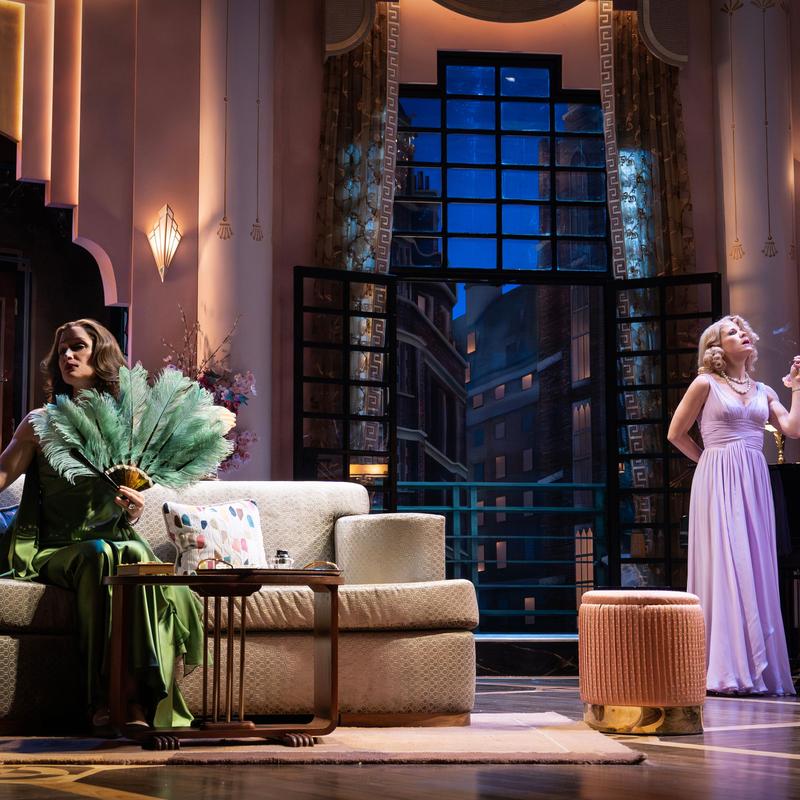
Alison Stewart: I wish people could see the set. The set is stunning. I went home and googled Art Deco couches. I had to know more about it. How does that help you get into the character, a beautiful, beautiful set like that?
Rose Byrne: Everything. It was just so good because it is really trying to transport you to a different time and a different place, and it's the presentation of it. This is a luscious play. It is not a raw dramatic, but it's about that. It's about the costumes, the fabulous set. The set, you get really lost in it. A couple of friends have seen it. Mark's son was saying he got lost in the set for the first half an hour; he was just looking at it.
Kelli O'Hara: You have a feeling that David Rockwell did the set, and it's just choosing these fabrics, choosing-- The rugs are from an actual design from the time.
Alison Stewart: Oh, my gosh.
Kelli O'Hara: It's very intentional. Plus, Jeff Mahshie's costumes, again, those colors, it's all very intentional. I do realize when I'm sitting on the couch, and the curtain goes up, there's this kind of-- I hear it. It's an audible gasp and then an applause because they're taking in that set. I know it's that they're going, "Oh, the ride begins." It's something of really visual beauty.
Alison Stewart: The reviews of this play have all pointed out that during these troubling times, that it's just really great to sit down and laugh. What do you think is valuable about a play like this, a play that is just plain fun?
Rose Byrne: Well, I think the value of that, too, escapism. This is purely that. Noel Coward's thing was always never leave the audience bored. That was his thing. He's like, "You can do this, you can do that, but do not bore them." Look, I'm obsessed with comedy. That was my thing, is how do we make this as funny as we can? It's delicate, and it's challenging, but the writing just serves every single decision you try and explore. I don't know what you think helped with the value of the painting.
Kelli O'Hara: Now, if they've said that, that's the biggest goal for me. I love to go inside a very deep human behavior and study it and do shows about it. This time, in where we are in the world, I wanted to escape all of it. I wanted to be part of something that was an escape for myself, and I wanted to be something that provided an escape for everybody else. I've said it. We're not curing cancer here. What we're doing is we're hopefully providing a laugh for 90 minutes straight, no intermission, just a bubble that you can live inside. I think that's not putting your head in the sand. That's actually doing some self-care.
[laughter]
Alison Stewart: Absolutely. The name of the play is Fallen Angels. My guests have been Rose Byrne and Kelli O'Hara. Thanks for coming to the studio.
Kelli O'Hara: Thanks, Alison.
Rose Byrne: Thanks, Alison.
Copyright © 2026 New York Public Radio. All rights reserved. Visit our website terms of use at www.wnyc.org for further information.
New York Public Radio transcripts are created on a rush deadline, often by contractors. This text may not be in its final form and may be updated or revised in the future. Accuracy and availability may vary. The authoritative record of programming is the audio record.