
Exploring the 'World of Black Film'
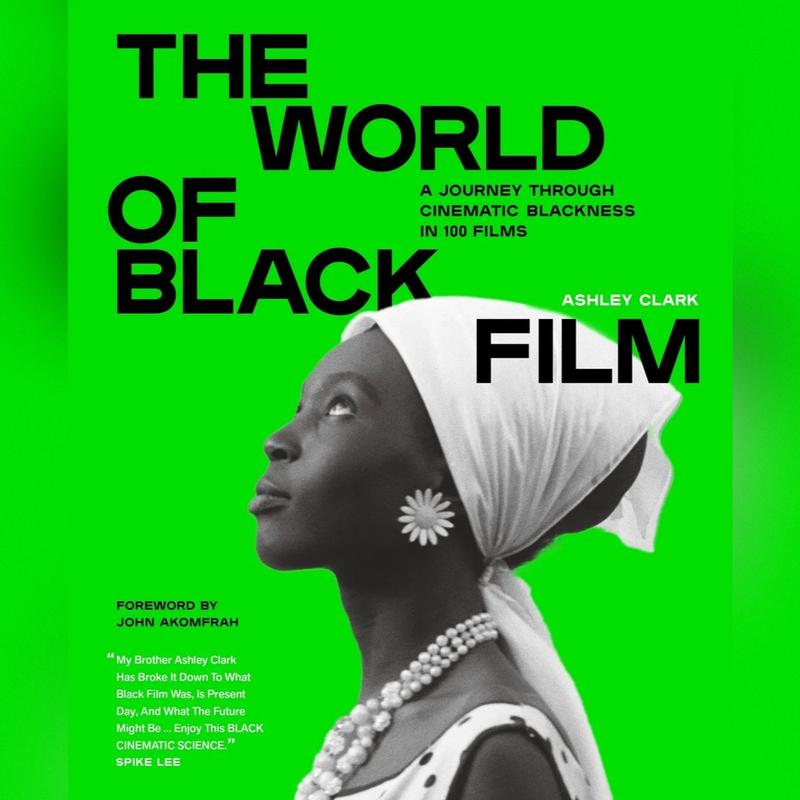
Alison Stewart: This is All of It on WNYC. I'm Alison Stewart. A new book celebrates the global impact of Black filmmaking with a list of 100 movies from around the world. It's titled The World of Black Film: A Journey Through Cinematic Blackness in 100 Films. The book was written by Ashley Clark, the curatorial director of The Criterion Collection. It contains films from 1913 to 2024, and it includes movies from Senegal, Cameroon, France, Chad, Jamaica, the US and more.
Ashley will be curating a film series at the Brooklyn Academy of Music this weekend to accompany the book, which includes special screenings of Malcolm X, Daughters of the Dust, The Harder they Come, and a whole lot more. The series begins Friday and runs through March 3rd at BAM. First, Ashley Clark joins me now to discuss the new book and preview some of the films screen this weekend. Hey, Ashley.
Ashley Clark: Hi, Alison. How are you?
Alison Stewart: I am doing very well, thank you for asking. First of all, why did you want to make sure this book, this gorgeous screen book right here, covered film from around the world, not just from America?
Ashley Clark: American popular culture in general has been so important to me as a kid growing up in the UK. I love The Fresh Prince, but my background as a Black British person, Jamaican heritage. As someone who moved to America, I've got lots of different parts of heritage and parts of my identity and my view of film and Black film reflects that. I wanted to make sure that other parts of the world and its cinematic heritage from Africa, the Caribbean, Europe, was integrated into this. I thought there was a gap in the market to tell a story that covered all sorts of Black cinema and think about what connected it all.
Alison Stewart: Your work with The Criterion Collection is about making all types of films available to audience, whether it's 4K restorations or to stream on the Criterion Channel. So many of these films wouldn't have been available before. How are things changing when it comes to availability, specifically of Black films?
Ashley Clark: I think that I'm very privileged and proud to do the work at Criterion, where I have this mandate to amplify and support film that I'm passionate about. I get to work with the most considerate and passionate people who care about world cinema. I just think the more of us there are doing this work, and you see it in young cinephiles who use things like Letterboxd, and you see that rep theaters, the attendance is a sky high with young people who were just so keen and excited to tap into the past and are seeing films like, I don't know, The Watermelon Woman by Cheryl Dunye from the the '90s, or Compensation by Zeinabu irene Davis also from the late '90s.
They're thinking to themselves, "These films resonate so much with me now. Where were these films all my life?" It's so exciting to be able to put them out into the world with care and love.
Alison Stewart: We are discussing the new book, The World of Black Film: A Journey Through Cinematic Blackness in 100 Films by Ashley Clark, the curatorial director of The Criterion Collection. Ashley has also programmed a special film series at BAM, Selections from the World of Black Film. It'll be going from February 27th through March 3rd. You write, "I had to establish some rules for myself, otherwise this project could have swiftly gone off the rails." Let's talk about some of those rules. How did you decide what a Black film was?
Ashley Clark: I put it to myself quite simply that I wasn't going to try and arbitrate what Blackness was generally, but I wanted to decide-- I decided in my book that it was films about Black life, films that were about Black people's lives and experiences as a central part of the film. Whether it was a feature or a documentary film, a fiction film, it had to be about Black people, centrally told with compassion and care.
I didn't restrict it only to Black filmmakers because that would be cutting out a lot of film history. The first Black Hollywood film was 1969. That was a really late date. That was The Learning Tree, directed by Gordon Parks, the great photographer for Warner Brothers. He went on to do Shaft. Don't know how that sounds in a British accent, Shaft. Anyway, how that went on to almost save MGM from bankruptcy. A classic Black exploitation film. It really just had to have Black humanity and life at the center of the film, whatever the genre or the style or who was behind the camera.
Alison Stewart: Oh, I used to dance to the Shaft LP in my living room. It was awesome. I had a whole dance routine. It was good when I was six years old. Let's talk about how you had to pick one film per filmmaker. What were some instances where it was hard to pick one film from a director?
Ashley Clark: I think, ultimately, I wanted it to serve the international theme and thread of the book. A good example would be-- Do the Right Thing by Spike Lee is the movie that started it all for me. I saw it when I was 14. It blew my mind. It gave me a sense of what film could be beyond just entertainment. If you ask me what my favorite film was, it might be that. For this book, I chose Malcolm X because it's reflective of Malcolm X's international spirit. He's an international presence in the book. Some of his best writing is his letters from Ghana. In the film, there's a cameo from Nelson Mandela right towards the end. It's a genuinely international film.
Then there's another film called Sweet Sweetback's Baadasssss Song, another-- Not sure about that in the English accent, but give it a go. People might think that's the one he must choose from Melvin Van Peebles. That's the classic the start of Black independent cinema. I actually chose his film from four years previously called The Story of a Three-Day Pass, which he made in France in the French language. He adapted it from a novel that he'd written in French, because like so many Black American icons, from Paul Robeson and Josephine Baker and James Baldwin, he'd moved out of America. He'd moved to Europe to seek new opportunities that had been actively denied to him in America.
This French new wave film, Story of a Three-Day Pass, when it premiered at the San Francisco film festival in 1967, people were shocked because they thought it was going to be some white French guy. Chicago's Melvin Van Peebles showed up with his entourage, and people were shocked. It was a direct line from that to Hollywood two years later deciding that Black filmmakers maybe could make films in Hollywood with Gordon Parks' The Learning Tree.
Alison Stewart: The book is in chronological order. The oldest film on the list is from 1913. It's from the US, and it's a silent film. Tell us a little bit more about it.
Ashley Clark: This is a film called Lime Kiln Club Field Day. Catchy title. It was assembled from rushes that were discovered in the MoMA vaults by their curators, and it was pieced together and premiered in 2014. I was very fortunate to be there at the premiere of that. It stars the great vaudevillian entertainer Bert Williams, who was from the Bahamas and moved to America and who became famous, hugely famous in America, but with one little thing that you have to point out, he was a Black actor wearing blackface makeup in line with the traditions of that time. In this film, he's wearing blackface makeup, perhaps in order to make sure that the other Black actors in the cast didn't have to.
It's this sweet and funny and strange romantic comedy that was never finished, with this glaring, ugly thing at the heart of it, which is this blackface makeup. Like a lot of films in the book, there are elements and aspects of it that are difficult to wrestle with from a contemporary perspective, but they're really important for us to understand history and to understand some of the compromises that Black performers have always had to make, and also for us to look closely at the idea of authorship. To what extent was Bert Williams actually in control of his public persona and performance? He was actually a really interesting, intelligent and smart guy. That's over 100 years old and the earliest film in the book. Very strange and captivating silent comedy.
Alison Stewart: The most recent film in the book is from 2024. It's Blitz from director Steve McQueen. Many will likely know him from 12 Years a Slave, which won Best Picture at the Oscars. Why did you decide to include Blitz?
Ashley Clark: I think Blitz is an underrated film. It's a World War II epic. It didn't have the widest theatrical release, which I think was a shame, because it's a film that deserves to be seen and heard in the theater. Ultimately, I picked it because it's a personal film for me. There are aspects of the film. It's told through the eyes of a mixed race boy who has a Black Caribbean father and a white mother. That's my background.
There's thousands of war films, World War II films, but very few look at the conflict through the perspective of that character and look at issues of race and class in that sensitive and thoughtful way. I thought it was a very moving film, and it seemed like a nice personal grace note. The book is not overly autobiographical. I thread myself in there occasionally for that subjective aspect. I thought it would be nice to land it with a slightly personal grace note. I also like the film and wanted to use this space to advocate for it.
SpeakerC: You also included Black Panther. Now, of course, books go to print early. If you had the opportunity to include Sinners by Ryan Coogler, would you have included Sinners rather than Black Panther?
Ashley Clark: I would have made a mention of Sinners somewhere in the book, and I like Sinners very much. Ultimately, Black Panther was always going to be the Kugler film because of its African Afro, futuristic style and theme and content. It has expansively diasporic casting. The Black actors in this film come from all over the world. I think there was myriad ways that I was able to connect Black Panther to other films in the book.
That's something I was so keen to do, to take you by the hand and make all of these connections. There's an obvious connection the great free jazz musician Sun Ra, and his wild film Space is the Place, which is made in Oakland, which is where Ryan Coogler's from. There's a shot in Oakland, contemporary scene in Black Panther, and that's where Sun Ra lands his spacecraft in Space is the Place. It seemed like a really nice connection,
Speaker 1: It was really cool in Black Panther when his aircraft takes off and you look at the bottom of it and it's this gorgeous mask. It's amazing.
Ashley Clark: Absolutely. That thing of the artifacts, the scene with Michael B. Jordan in the British Museum, that connects to so many films in the book, from Timbuktu, to Black Girl, to Dahomey by Mati Diop, a recent film about African art and sculpture and restitution and all of these complicated ideas. Black Panther's right in the heart of all of that.
Alison Stewart: let's get some of the films that you'll be screening at BAM as part of your book launch. Black Girl from 1966. Tell us a little bit about this film.
Ashley Clark: Black Girl is a film that, even though it's short, it's only an hour long, but it's widely regarded as the first feature film made in Sub Saharan Africa by a Black filmmaker. It's made by Ousmane Sembène, who's a Senegalese filmmaker who only came to filmmaking in his 40s after a long, winding life of labor activism and being a novel writer and traveling. He decided that filmmaking was actually the easiest and most direct way to speak to his compatriots in a language that they could all understand.
This is the story of a young Senegalese woman who leaves Dakar to join up with a bourgeois white French family to essentially become their maid. They treat her with everything ranging from indifference to outright hostility. It leads to her downfall, really. It's a bracing and very sad film, but it's also beautiful and beautifully made and thoughtful and ultimately, I think, quite a hopeful film. It's been a foundational film for a lot of filmmakers. It's been referenced widely, including, quite recently, the film Nanny by Nikyatu Jusu, which won the Grand Jury Prize at Sundance a few years ago and which, like Black Girl, is part of The Criterion Collection.
Alison Stewart: One movie that's really fun that you're screening is Set It Off from 1996, directed by F. Gary Gray and starring Jada Pinkett, Vivica Fox and Queen Latifah. Let's listen to a clip where they went for the robbery a little too early.
Vivica: Y'all, we weren't ready. You know we weren't ready.
Latifah: Look, if I didn't set it off, we'd be cakes and bates for the next two months. I had to push up.
Vivica: Whoa, whoa.
Alison Stewart: I love Latifah [unintelligible 00:13:16].
Vivica: It worked, didn't it?
Latifah: Look, Tisean, it's over. We got about-- [laughs]
Vivica: What?
Latifah: About 12 Gs. $12,000 in 60 seconds. Why don't you come over here and sit down beside me? Okay. Come on.
Alison Stewart: Queen Latifah isn't doing-- you're not hearing her, but she's doing some serious acting in that clip.
Ashley Clark: Part of me is like, "Do you really want to hear from me or can we just let the clip go?" [laughter] It's so absorbing. It's an amazing film. All female heist thriller from 1996, right in the heart of this amazing decade for Black cinema in America, where studios inspired by the success of Spike Lee, and early on in the decade, John Singleton, were green lighting these films that really centered Black experience.
They were done at a high level of budget and craft. Set It Off is right in the middle of that. I think it's a slightly underrated film, which drives me crazy. I think more people should see it. I think it's a great film to see on the big screen. It's a lot of fun, really, like old school, by a filmmaker who just loves movies. He's just a great, talented genre filmmaker. As you say, the cast, Queen Latifah, Jada Pinkett Smith, just beautiful stuff.
Alison Stewart: You get to pick one more film to shout out during the film festival. We got about a minute left.
Ashley Clark: Woof, I'm going to shout out Sarah Maldoror's Sambizanga from 1972, which is, I believe, the first or one of the first films to be made by a woman in Africa. It's a very powerful, ferocious, but also extremely beautiful and well-made anti-colonial drama about the freedom fight for Angolan people. It's told through a feminist lens, and it's about a woman's political awakening. It's just an incredible film, the kind of film that I think people will see and think, "Why did I not know about this earlier?" Also part of The Criterion Collection, but I would advocate for seeing it on the big screen this weekend.
Alison Stewart: The book is called The World of Black Film. It also has a special film series at the Brooklyn Academy of Music, Selections from the World of Black film. From February 27th through March 3rd. My guest has been Ashley Clark. Thank you so much for being with us.
Ashley Clark: Real pleasure. Thank you so much.