Explaining Climate Science Through Comedy
David Furst: This is All Of It. I'm David Furst in for Alison Stewart today, and we continue our Climate Hour with a look at the way we talk about the crisis. Take this example of climate communication from President Trump's climate speech to the UN General Assembly this week.
President Trump: We have the most oil of any nation anywhere. Oil and gas in the world, and if you add coal, we have the most of any nation in the world. Clean. I call it clean, beautiful coal. You can do things today with coal that you couldn't have done 10 years ago, 15 years. I have a little standing order in the White House. Never use the word coal. Only use the words clean, beautiful, coal. Sounds much better, doesn't it?
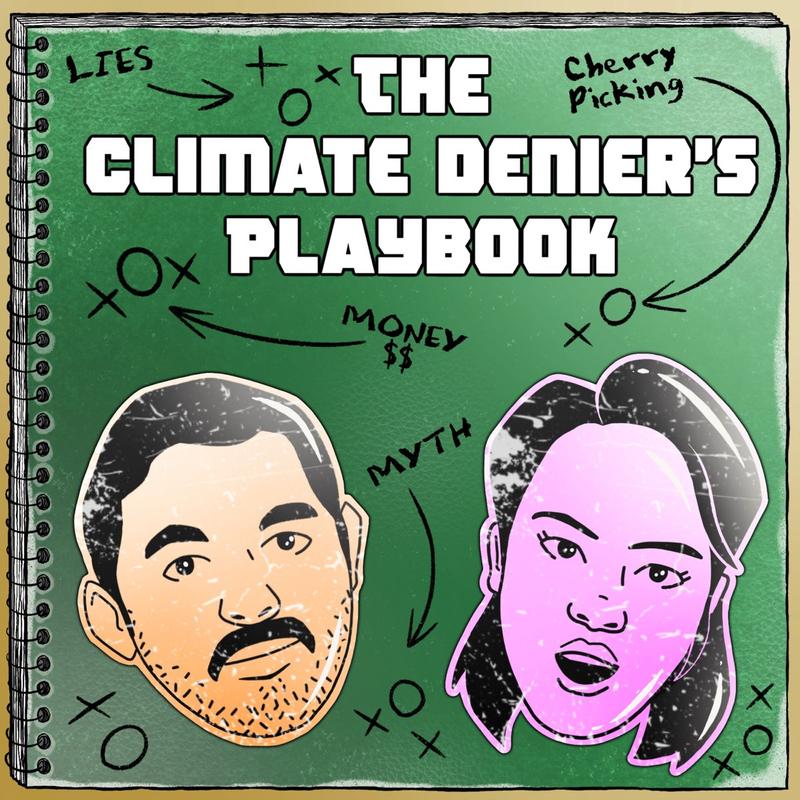
David Furst: Does coal need a bit of rebranding? Just throw the words clean and beautiful in front. Problem solved. When there is so much misinformation out there and so many powerful interests working to shape the narrative, the language matters. Which is why when you're trying to get people to tune in and not turn away from the crisis, that can feel so depressing, you sometimes need to get creative. Like our next guests, who try to find the funny. We are joined by a pair of comics with advanced public policy degrees to talk about the value of humor in climate communication. Rollie Williams studied climate science and policy at Columbia and is the founder and host of The Climate Town YouTube channel. He's also the co-host of the podcast The Climate Denier's Playbook along with Nicole Conlan. She's a comedy writer for The Daily Show and The Late Show with Stephen Colbert. Her degree is in sustainable urban planning from the University of Southern California. Rollie and Nicole, thank you both for joining us today. Rollie, Nicole? Oh, it sounds like we might have some difficulty with Rollie and Nicole's Zoom connection.
We're going to see if we can get them back in just a moment here. You're listening to All Of It here on WNYC. Hey, if you want to join this conversation, you can always give us a call here. The name of the podcast again, it is called The Climate Denier's Playbook, and it features Rollie Williams, who has studied climate science and policy at Columbia, and he's the founder and host of the Climate Town YouTube channel. Also, the co-host of this podcast. It is called The Climate Denier's Playbook, and his other co-host is Nicole Conlan. She's a comedy writer for The Daily Show and The Late Show with Stephen Colbert, and her degree is in sustainable urban planning from the University of Southern California.
Rollie and Nicole, I think you are both back. Welcome to All Of It.
Rollie Williams: Thank you so much.
Nicole Conlan: Good to be here.
David Furst: It's great to have you with us. Rollie, let's start with the name of your podcast. The Climate Denier's Playbook. I take it you're not actually out to assist climate deniers with tips here.
Rollie Williams: If they can glean some cool tips from our podcast, I guess that's fine, but no, it's sort of a breakdown of their playbook and how they use different rhetorical techniques to basically take a half-truth and stretch it over a giant lie and make it all feel like it's plausible.
David Furst: Maybe you can give us a demonstration of your approach to climate misinformation. Nicole, I don't know if you heard the clip. Just a bit earlier, we played the clip of President Trump speaking to the UN yesterday, talking about clean coal. I'm sorry? Clean, beautiful coal.
Rollie Williams: Beautiful, clean coal. Yes.
David Furst: There you go. There you go.
Rollie Williams: I've heard that quote.
David Furst: What do you do with that?
Nicole Conlan: Well, I mean, sorry to all of our sign listeners out there, but he's really trying to put lipstick on a pig with this one. You can call it clean and beautiful if you want, but that doesn't change what it is. We're going to do all the clean, beautiful, toxic waste. We love clean toxic waste, don't we, folks?
Rollie Williams: Beautiful, glowing waste. Spread it on my skin. Sorry, this wasn't meant to be us trying to do our best Trump impressions on the radio.
Nicole Conlan: I assure you, this is the best we can do.
Rollie Williams: Yes, we're hitting our peaks here.
David Furst: It's not getting any better. That impression.
Rollie Williams: Yes, because it's already the best. Exactly.
David Furst: Well, let's hear another clip. This is President Trump at the UN again yesterday, talking about climate change as nothing but a great big lie.
President Trump: It used to be global cooling. If you look back years ago, in the 1920s and the 1930s, they said global cooling will kill the world. We have to do something. Then they said global warming will kill the world, but then it started getting cooler, so now they could just call it climate change, because that way they can't miss. It's climate change because if it goes higher or lower, whatever the hell happens, this climate change, it's the greatest con job ever perpetrated on the world, in my opinion.
Climate change, no matter what happens, you're involved in that. No more global warming. No more global cooling. All of these predictions made by the United Nations and many others, often for bad reasons, were wrong.
David Furst: How do you deal with this, Rollie? This has it all. [crosstalk] Mockery of science denying climate change as a thing. This comes from the top. The President of the United States.
Rollie Williams: Yes. I mean, in this, he was just running down the index of all the different climate change denial tropes. He's got, like, scientists said it was cooling, and now it's warming. That's not really true. He said the '20s and '30s. I think the time most people refer to are the '60s and '70s, when, like, under 10% of the climate scientists were like, maybe this is going to cause a cooling effect. We're not really sure. Then they're like, oh, no, it's warming. My approach to this would be to dive into the archives and look at what people were actually saying and compare that to what people said they were saying and try to juxtapose that.
I mean, this was. This is hard to debunk because it's like a Frankenstein's monster of all the different tropes, all lumbering through the United Nations.
Nicole Conlan: What he's trying to do is he's trying to create the appearance that there is not consensus on climate change or that scientists don't know what they're talking about. I think the thing to hammer home is very much like, "No, no, no, no. 99.9% of the scientists in the world are aligned that climate change is real, and it's happening, and it's getting hotter, and it's happening fast.
David Furst: What do you do there? How do you respond in terms of finding the comedy? I don't want to step right up and say, "Make me laugh." Your first response might not be thinking, "Oh, isn't this funny?"
Rollie Williams: Actually, weirdly, my first response was that. I think this is pretty funny, but only because my job is to look at this stuff and try to make a little hay out of it. I think the way I would approach this, again, is like, okay, well, what's the truth? What are the scientists actually saying? Then, trying to use that media and riff on the media itself, like picking one specific sentence and trying to go from there. Aim small, miss small, kind of thing.
David Furst: We're speaking-- [crosstalk] Oh, sorry. Go ahead, Nicole.
Nicole Conlan: He's giving this speech, and he's visibly sweating on an 80-degree day in September. He's trying to deny climate change is happening. I'm like, man, climate change is happening to you right now.
Rollie Williams: Look at yourself, dude.
David Furst: We are speaking with Rollie Williams and Nicole Conlan, comedy writers. You both started out with degrees in climate and climate adjacent fields. How did you find your way to comedy, Nicole? How did this happen?
Nicole Conlan: For both of us, comedy happened first.
Rollie Williams: Yes, the old switcheroo.
Nicole Conlan: We've been doing improv together since high school. Then, when my comedy career post-college wasn't working out so hot, I was like, maybe it's time for grad school. I've been interested in environmentalism for a long time. The thing that got me into climate change specifically was the documentary Merchants of Doubt, which is all about climate change misinformation and disinformation. I ended up going to grad school for urban planning because that's a particularly useful lever against climate change, I feel.
Then afterwards, I was like, I think the only thing I can do is television, so I went back to that, but I never lost interest in it. That's how I came back to this.
David Furst: Rollie, it was comedy first for you?
Rollie Williams: Yes. I was doing comedy in college, and then I moved to Denver, and I was doing comedy like four or five nights a week in Denver. Then I moved to New York, and eventually I started doing a comedy show that was called An Inconvenient Talk Show, where I played a strung-out Al Gore on an I told you so tour. After enough months of performing that show, I met a bunch of climate scientists along the way. It was just a comedy show. In meeting climate scientists and hearing every single one of them say we really don't have this under control, and this is actually a massive problem.
I went back to grad school. I went to Columbia to get a degree in climate science and policy as a way to make the comedy show better.
David Furst: Wow.
Rollie Williams: Both Nicole and I are coming at this from a perspective of like, how do we do the still do comedy but also add climate to that comedy?
David Furst: So it started out as a comedy tour and then you actually became Al Gore.
Rollie Williams: Yes, I am Al Gore. You're exactly right. I'm ready to say on public radio that I am Albert Arnold Gore Jr. Thank you so much.
David Furst: Well, can you give us some examples of some topics that you've covered recently on your podcast and how you thought about what was most important to communicate in those stories? Nicole, do you want to give an example?
Nicole Conlan: Yes. We actually just released an episode called-- It's actually Global Cooling, which we recorded a couple of seasons ago. That was perfect timing for the Trump thing. Then the most recent episode we did was about something called the light-duty loophole, which is about how trucks don't face as stringent regulation as cars. That's why you get these proliferations of enormous gas guzzling trucks everywhere. I think when we're picking topics, we try to find something that is both a piece of misinformation or disinformation that permeates everybody's lives without really knowing about it.
I don't know a lot of people who understand that the F150 is regulated in a different way than a Toyota Corolla. It makes you see the world a little bit differently. Also, pieces with a clear villain or somebody clearly that we can point at and be like, this is the target of what we're trying to make fun of. I think helps clarify the story and makes it a little simpler for people.
David Furst: Rollie, is that a key part of the comedy that this is? A lot of people who talk about ethics and comedy, that it's not about punching down. It's about punching up at those in power. Is that really the target?
Rollie Williams: Yes. It's like just bullying if you're punching down like, "Oh, this group that's had it bad for years. Let's pile on again." No, I think that's a big key to this. There's not always a bad guy. It wasn't always an intentional thing that got us into this situation. For instance, like, Nicole is an expert in urban design, and one thing that she brought to my attention was that parking spots are governed by a bunch of incredibly archaic, nonsensical rules that just get adopted by townships as they are incorporating.
We're grandfathering new towns in with old town rules. It doesn't make any sense, but it wasn't really a bad guy. It's just like it was easy to copy paste. Now there's 4,000 parking spots at your local dentist's office.
David Furst: We're speaking with Rollie Williams, founder and host of the Climate Town YouTube channel, co host of the podcast The Climate Denier's Playbook alongside late-night comedy writer Nicole Conlan. Rollie, ultimately, what do you hope to accomplish with this climate comedy work? Is it just to get some laughs or is it really to break through that misinformation and to have an impact.
Rollie Williams: I want to go back and do some other kinds of comedy. I like a lot of comedy, not just climate comedy. It just so happens that there is a deluge of disinformation that's constantly pouring over the bow of my boat. Sorry, my book on mixed metaphors is coming out soon. It's more out of a reaction to just the state of the world. There's just so much disinformation that is keeping the country back. We're holding ourselves hostage with a bunch of nonsense, and I am aggravated by it, and this comedy is just a reaction to that.
I would love to go back to my number one calling, which is as a billiards YouTuber. That's a real thing. Someday I'll be back.
David Furst: You're hoping that you can solve this thing first and then get back to the billiards comedy.
Rollie Williams: Yes, the stuff that really matters. Billiards comedy.
David Furst: Of course. Nicole, you started to touch on this before, but what is your sense for the audience for this content? Does it change anything about your approach when you feel like you're sharing something that you think is new to most people versus to moments where you might be preaching to the choir?
Nicole Conlan: I am sort of under no delusions that we're going to-- Some climate denier is going to hear our podcast and it's going to change him forever and will alter the trajectory of his life. I think we're ultimately producing a podcast to give a sense of catharsis to people who might not have a lot of people in their lives to talk about climate change with, or people who maybe sensed that something was weird in the messaging about climate change and couldn't quite put their finger on what.
We are here to entertain people who are interested in the subject of climate change. I'm less worried about preaching to the choir because I think there are so many little things about climate change that you just don't think about in your day-to-day lives. We cover such a broad range of topics that even if you're somebody who, like, "Yes, I know a lot about the atmospheric science of climate change." You're not going to know about, for example, a TV show that is spewing a specific piece of misinformation that is about, like, wind turbines, for example.
I think there's a lot of different topics. People find us because they are interested in climate change, and they just want two people to hang out with in their ears and talk about it with.
David Furst: It can be all of those things. Check it out, The Climate Denier's Playbook. Rollie Williams, Nicole Conlan are the co-hosts of that podcast, The Climate Denier's Playbook. You can also check out the Climate Town YouTube channel that Rollie hosts. Rollie and Nicole, thank you again for joining us today.
Nicole Conlan: Thank you so much.
Rollie Williams: Thank you so much.