Examining the Importance of Poetry with Ada Limon
David Furst: This is All Of It. I'm David Furst, in for Alison Stewart. Thanks for joining us. Coming up on today's show, we'll talk about why two of my colleagues decided to listen to decades' worth of Grammy Award Album of the Year winners and hear what they learned. We'll also hear from the team behind a new documentary about ESPN's origin story, and the conclusion of Alison's conversation with Mark Oppenheimer, the author of the biography Judy Blume: A Life. That's the plan, so let's get this started with poet Ada Limón.
[MUSIC - Luscious Jackson: You and Me]
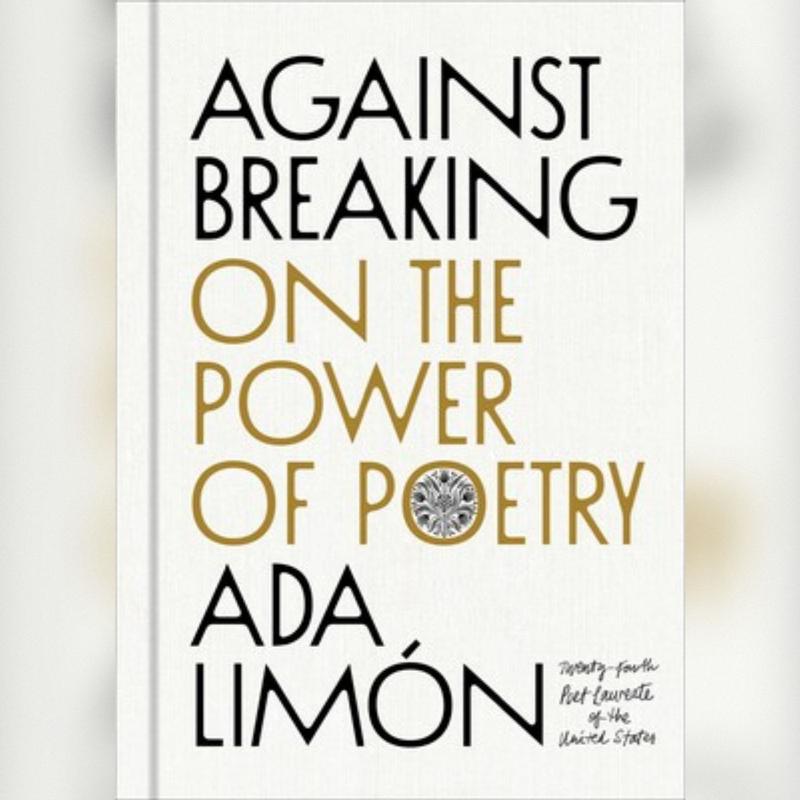
David Furst: Today is the first day of National Poetry Month. It's a time to celebrate an art form that has the power to inspire, to comfort, and to challenge us. To help us kick it off, we are joined by Ada Limón, who has served as the 24th Poet Laureate of the United States. In her new book, Against Breaking: On the Power of Poetry, Limón makes the case that poetry is not just something we read, but something that can be a lifeline.
She draws on her time as poet laureate to reflect on how poetry can bring people together. Limón is known for bringing both a clarity and emotional depth to her writing, often turning to the natural world as a way to explore grief, joy, and what it means to be alive. She's the author of seven acclaimed collections. Against Breaking: On the Power of Poetry officially comes out on Tuesday, and Ada Limón joins us now to talk about it. Ada, welcome back to All Of It. Good to see you again.
Ada Limón: Good to see you. Thanks for having me.
David Furst: Listeners, we hope to hear from you during this conversation about the poems that matter to you and why. What's your favorite poem? Who is a poet that you admire? What poems bring you comfort or joy or just a smile? Give us a call or send us a text at 212-433-WNYC. That's 212-433-9692. You can also reach out to us on social media @AllOfItWNYC. Ada, let's talk about the power of poetry. We lead busy lives. There's a lot going on in the world, as you well know. There's a lot to sort out every day. There are so many distractions. I'm pushing my cell phone across the desk right now, turning it upside down. Why does poetry matter, and why does it matter right now?
Ada Limón: I think that we are living at a moment where language feels as if it is being used as a tool for chaos, as a tool for violence and propaganda. I think that poetry is the opposite of that. I think it's the antidote to that. I think that it is, in many ways, a sacred but secular language that is used to reimagine breath and stillness and reinvigorate words themselves with the power of music.
For me, poetry has the ability to not just help us slow down and breathe and recognize that there's breath built into every line, but it also truly helps us to recognize that language can be useful again, can be joyful again, and can have a power to bring us back to ourselves, as opposed to being used, again, for that negative purpose that sometimes feels as if it's used for harm.
David Furst: The main text in your new book was presented as your closing lecture as poet laureate in the Library of Congress on April 17th, 2025, about one year ago. In your introduction, you say, "When I walked on the stage in the Coolidge Auditorium in the Jefferson Building at the Library of Congress, our nation was changing in dangerous ways that we were just beginning to witness. We knew what was coming." Can you talk about that moment?
Ada Limón: Yes. When I was first inaugurated as the US poet laureate in October of 2022, we had this large celebration. It felt like there was this moment of everyone gathering and coming together, and it was very joyful. Then that evening in April of 2025, which was my last talk, we gathered beforehand. Many people who walked into the room had been let go, working for the Parks Department, working for the NEA. People that day had had their offices raided by DOGE.
It was a complete reversal of where we were three years before, when we had this feeling of momentum. I think I took that stage, recognizing that we were heading in a very dangerous direction. I remember my friends at the National Parks Department saying, "You should wear green in support of us." I wore my green suit, thinking all the little, small ways that we can show up for each other. Yes, it was a very strange and surreal moment, especially to have experienced its opposite in the fall three years earlier.
David Furst: Did you feel the weight of responsibility for being there to represent your colleagues, and what message did you want to deliver with this address?
Ada Limón: Yes, I felt the weight of responsibility, but also, I felt as if all of us were going through it. In the three years I served in that role, I worked a lot with federal agencies, with some of the best federal agencies, including the Library of Congress, including the National Parks Department. I think, for me, it felt as we were grieving together. What I wanted to do was recognize the moment, but also to offer even a small, little moment of hope.
Not hope as something you have or that someone can give you, but hope as something you do, something that you show up for every day. Like much of my writing, as much as it was for everyone in that room, it was also for myself, as I think many of us know that sometimes when you're having a hard time and you're recognizing the great grief of the moment, what you can do is try to show up for others. In doing so, you buoy yourself.
David Furst: That's a beautiful speech, and it's a beautiful book. Against Breaking: On the Power of Poetry by Ada Limón. I wanted to ask you how you arrived at that title for this book, Against Breaking.
Ada Limón: I feel like, and I'm sure you are well aware of this, that we keep using the phrase "a breaking point." [chuckles] "Oh, it feels like we're at a breaking point." I kept thinking, "What does that look like?" I thought, "No, we can't break. We have to move and shift and grow and change and meet the moment as new people for sure, but we can't be destroyed by this moment. We can't break." I thought, "What are the tools that we have?" There are so many. There are so many, even though sometimes it feels like there aren't. Poetry is one of those tools that can help us remember our courage, remember our humanity.
I feel that way about all the arts, that they're a way of showing up and celebrating what's good in us. It's hard. It's hard to see that. I think, as you know, in your work, there's so much of what we do that is recognizing the very difficult moment that we're in. I think we also need to recognize that there is so much good and so many people creating things, making things, whether it's music or paintings or poems. That's where the title came from, was that I felt like poetry could allow us not to break and instead bend and shift and move with the moment and meet it with grace and power.
David Furst: We're speaking with poet Ada Limón, and we'd love to have you join this conversation as well. Let us know about perhaps a favorite poem, maybe a poet that you especially like to lean on during uncertain times. Give us a call, 212-433-WNYC. That's 212-433-9692. Let's welcome Charlotte to the conversation in Rye, New York. This is All Of It. Thanks for joining us.
Charlotte: Hi. Thank you, guys, so much for having me on. It's so funny that your conversation just went to because the poem I wanted to share is from Andrea Gibson, who recently passed and just had a whole documentary come out about their life and dealing with grief and celebrating grief. First, I recommend to everyone to see that documentary, Come See Me in the Good Light. Super short poem of hers called Good Grief from their book, You Better Be Lightning, that just reads, "Let your heart break so your spirit doesn't."
Just those four simple lines hold so much power. That is what I find is so amazing and freeing about poetry is that three, four, five words can say more than a whole 500-page book. They can hold so much meaning and power. Especially when you know the story that surrounds an author as well, it brings even more profundity to it. Yes, their words stand alone. I just wanted to share that.
David Furst: Charlotte, thank you so much.
Ada Limón: I'm so glad. I love Andrea, and their work has been just so beautiful to experience. That documentary is incredible. I so appreciate you bringing their poem into the space today. That was really good for me to hear.
David Furst: We'll take some more of your calls and read some of your texts, 212-433-9692. This text from Matt in White Plains saying, "Just about every poem in the book, Consolations II: The Solace, Nourishment and Underlying Meaning of Everyday Words by David Whyte takes readers closer to what it means to be human, whether we experience anguish, care, love, and more. That's a great recommendation. Let's hear another call. Colleen calling from Putnam County. Welcome.
Colleen: Hi. Thank you. Yes, I'm a school librarian in Westchester County.
David Furst: All right.
Ada Limón: Yay, librarians.
[laughter]
Colleen: Thank you. Yes, I love my job every day. I'm very lucky to be a school librarian and work with kids and books and literature, and my favorite thing every day. Nikki Giovanni has a wonderful poem. One of my colleagues introduced me to her as a poet, and it's called My First Memory (of Librarians). At the end of the poem, she says--
The welcoming smile of my librarian
The anticipation in my heart
All those books--another world--just waiting
At my fingertips.
That's the kind of librarian I try to be. I have a warm and welcoming vibe in my library. They're high schoolers, so I want them to come in and enjoy the space and be able to decompress and relax and find their love of literature in my space. I spend my days surrounded by words and books and the wonderful feeling that that can create when you find something you connect with. That's what I want to share with them.
David Furst: Colleen, thank you so much for sharing today.
Ada Limón: I love that so much, Colleen, because you are changing lives. I don't know how much you get to see it and experience on a daily basis, but you are changing lives, and I hope you know that. They are so lucky to have you. Keep doing that work. It's just so needed right now. We need those spaces where we feel welcome and where someone might give us a book or a poem that reminds us not only that literature is vast and opening, but that we aren't alone. Thank you so much for that, for the work you're doing.
David Furst: We're speaking with poet Ada Limón. The new book, it's coming out on Tuesday, so it's almost out. It's called Against Breaking: On the Power of Poetry. I wanted to read just the very opening line here and have you respond. It begins, "Truth be told, anytime I begin to write anything these days, my whole life flashes before my eyes. I ask myself, 'Do I want to break something, or do I want to mend something, or simply try to carve out a small place to breathe?'" Those are some strong opening words to begin with. I wanted to hear your thoughts on that. Do you feel like the creation of art right now, even the decision of what type of art to create, comes with some extra weight?
Ada Limón: I do. I do. Artists have experienced moments like this throughout history, throughout time. It feels as if there are times where your art really is supposed to be something that brings us together and something that might offer someone a thread of survival, a little rope out of the well. Then there are times where your art really needs to disrupt the system and be full of rage and power and try to shift something. That's really useful, too. I think there are times when you sit down to try to make something. You're really discussing with yourself, with your inner self, "Where do you want to take this? Where do you want to go? What is needed, and what do you need?" I think that conversation is something that a lot of artists are having right now.
David Furst: Let's take another call. This from Terry in Manhattan. Welcome to All Of It.
Terry: Hi, how are you?
David Furst: Great. Do you have a poet you want to mention?
Terry: I do. It's Andrew Marvell, the English Renaissance poet. I think all the cool kids are reading Andrew Marvell these days.
[laughter]
Terry: Andrew Merville. That was such a rich time of poetry, the 17th century in England. First of all, he could be very witty. It was a time of wit. He was very witty, but he could be funny. I think the poem everybody knows is To His Coy Mistress, which starts with that line, "Had we but World enough, and Time, This coyness, Lady, were no crime." He also wrote these beautiful pastoral poems, and he just has really arresting lines. I think in these turbulent times, a pastoral is a nice thing to read. It's almost like being out in nature in a book.
Ada Limón: I love that you brought in Andrew Marvell. I feel as if there's something very true right now for me that nature poetry, which can get a bad rap as you know--
David Furst: Can it?
Ada Limón: I find it so healing right now. When I put together the anthology, You Are Here, which is all new nature poems, I was thinking about some of the great poets that I admired who wrote some of those early nature poems. Yes, I love that you brought that in because I think about Whitman. I think about Leaves of Grass. I think about Emily Dickinson.
Every time I go to the page, there are moments where I think of Robert Hass's line, "Maybe it's time to write a poem about grace." I think, yes, maybe it's time to write a poem about grace. I feel as if nature poems are really needed right now. Not just for our hearts and not just to feel calm, but also to respond to the new planetary moment that we're in. Whether that's with grief or with wonder, I think that that's really important. I'm really glad you brought that in.
David Furst: Ada, I have so many questions for you, but I really wanted to bring this up because a lot of people are intimidated by poetry, right? They can be. Sometimes people feel like they're not understanding what's going on in a poem. In an interview on Latino USA last year, you told Maria Hinojosa that more people should give themselves permission to not understand a poem. I love that. Why is this helpful in our practice of reading poetry?
Ada Limón: Well, I think that we've been taught poetry in ways, sometimes by really wonderful teachers, but sometimes by people who-- or even by books or textbooks that make it seem as if a poem has an answer, that it's a problem to be solved. It's much more like music. If you're listening to the radio in the car or if you're listening to whatever streaming service you use, oftentimes, you get to a song you don't really like, you skip it, and then you just listen to another song, but it doesn't mean you don't like music if you skip one song.
Sometimes people will read one poem and think, "Oh, I don't like poetry," as if one poem represents all of poetry. The other thing we do with music is we don't say you have to understand it in order to like it. Sometimes what happens is you just need the poem to wash over you, to hear its music, to even be distracted by an image. I once had this woman who said, "I'm so sorry. I didn't really pay attention to the rest of the poem you read because I started thinking about my own mother."
Then I got distracted, and I had this whole memory of my mom and when she drove me to an appointment, and I said, "No, that's wonderful. My poem just made you time-travel." That's incredible. That is the right experience with a poem. Whatever experience you're having is the right experience with a poem. I just want people to have that permission to sometimes get distracted by their own emotional interiority. That's a beautiful thing, too.
David Furst: We're speaking with poet Ada Limón here on All Of It on WNYC. The new book is Against Breaking: On the Power of Poetry. We're also taking your calls. Join this conversation. Let us know about some of your favorite poets and poems. Let's hear from-- Oh, let's see. James in North Carolina. Do I have that right?
James: Yes, sir. Can you hear me all right?
David Furst: Yes, welcome.
James: Thank you. Yes, I'm James. I live in Brevard, North Carolina, an hour west of Asheville, in the scenic Blue Ridge Mountains, where my family's been for 300 years. I lived in New Jersey and commuted and worked in Manhattan for the 10 years before COVID and realized that there was a lack of nature. Going back to the nature poetry, I've always been a fan of minimalist nature poetry, especially my favorite poem is by 8th-century Chinese classical poet Li Bai. It's called Green Mountain. If I may, can I read it for you?
David Furst: Yes.
Ada Limón: Please.
James: Yes, sure. It's--
You ask me why I dwell in the green mountain;
I smile and make no reply, for my heart is free of care.
As the peach-blossom flows downstream and is gone into the unknown,
I have a world apart that is not among men.
There is a silence in those words that reminds me of when I sit by a river and ponder our place in this large universe, that there's quiet in between the words that ground me.
Ada Limón: I love that. I'm thinking of Wendell Berry's The Peace of Wild Things. That's just so incredible because when I was doing my project, You Are Here, we ended up putting a poem by Lucille Clifton in the Smoky Mountains. Being in that place is just so incredible. I'm really glad that you brought that in because it feels to me like you just brought a little bit of the Smoky Mountains here.
David Furst: [laughs] Thank you for that as well. Yes, let's take another call. Susan in Queens, welcome to All Of It.
Susan: Hi, I'd like to read A Coat by William Butler Yeats, which has been my favorite for more than half a century.
David Furst: Wow. Okay, please.
Susan: I made my song a coat
Covered with embroideries
Out of old mythologies
From heel to throat;
But the fools caught it,
Wore it in the world’s eyes
As though they’d wrought it.
Song, let them take it
For there’s more enterprise
In walking naked.
I just always found when I would think of this, when I was feeling a little show-offy and stuff, and it would always bring me back to being a little more humble and a little more introspective as to why. Okay, thank you.
David Furst: Thank you so much for sharing.
Ada Limón: I love that. Yeats is one of my favorites.
David Furst: Are there certain poets, Ada, that you've been thinking about, especially over the past year or two?
Ada Limón: The last year, I spent a lot of time with Emily Dickinson. That's a funny thing to say, but I did. It just felt like every time I was looking for a certain kind of feeling or an experience, I just went to her collected and perused and would feel always-- I would always find something that moved me. One of my favorite quotes from her is that quote, "Not knowing when the dawn will come. I open every door." I think about that because it feels to me like poetry is opening every door. It goes back to the idea of all the tools that we need right now, and poetry being one of those important tools.
David Furst: Well, there are so many beautiful moments in your new book, Against Breaking: On the Power of Poetry. I'll just read this one. Here, you're telling a story about a man who confessed to you that he had been writing poetry privately, right? Pieces that he never intended to share, and you write, "It gives me great joy to know people are writing secret poems. If you are one of those people, I want you to keep going, even if you never hand it to another person. There is power in making private poems. Aren't we all walking around with some unsaid pain or some uncelebrated wonder?"
Ada Limón: One of the best things about serving in the role as poet laureate is that I had this misconception that it was my job to go out in the world and talk about poetry. Really, my biggest job was to listen and receive other people's stories about their poems or the poems that they love or admit to me that they were secret, private poets.
Every time there's a new study out that says no one's reading or no one reads poetry or whatever it is, I don't believe it, because my experience on the road was entirely different. I just don't think it's measurable. I think it's very difficult to know if someone reads one poem on the subway or reads one poem on Facebook or some sort of social media platform, or picks up a book and reads a line or two. I wonder if, really, there's more poetry circulating out there in the world than we know.
David Furst: Well, Ada, just as we're wrapping up, do you do anything special to celebrate National Poetry Month? Will there be cupcakes?
Ada Limón: [chuckles] I just celebrated my 50th birthday.
David Furst: Happy birthday.
Ada Limón: Thank you. I might pause on the cupcakes, to be honest.
[laughter]
Ada Limón: What I do try to do, and I recommend it, but it is very daunting, is I try to write a new draft of a poem every single day for the month of April.
David Furst: Okay. Well, I'm keeping you from it. Get to work. Ada Limón is the former Poet Laureate of the United States. Her forthcoming book is titled Against Breaking: On the Power of Poetry. It is out on Tuesday. Thank you for joining us today, and happy National Poetry Month.
Ada Limón: Thank you so much for having me.
Copyright © 2026 New York Public Radio. All rights reserved. Visit our website terms of use at www.wnyc.org for further information.
New York Public Radio transcripts are created on a rush deadline, often by contractors. This text may not be in its final form and may be updated or revised in the future. Accuracy and availability may vary. The authoritative record of programming is the audio record.