
Ethan Slater and Marshall Pailet's Play 'Marcel on the Train'
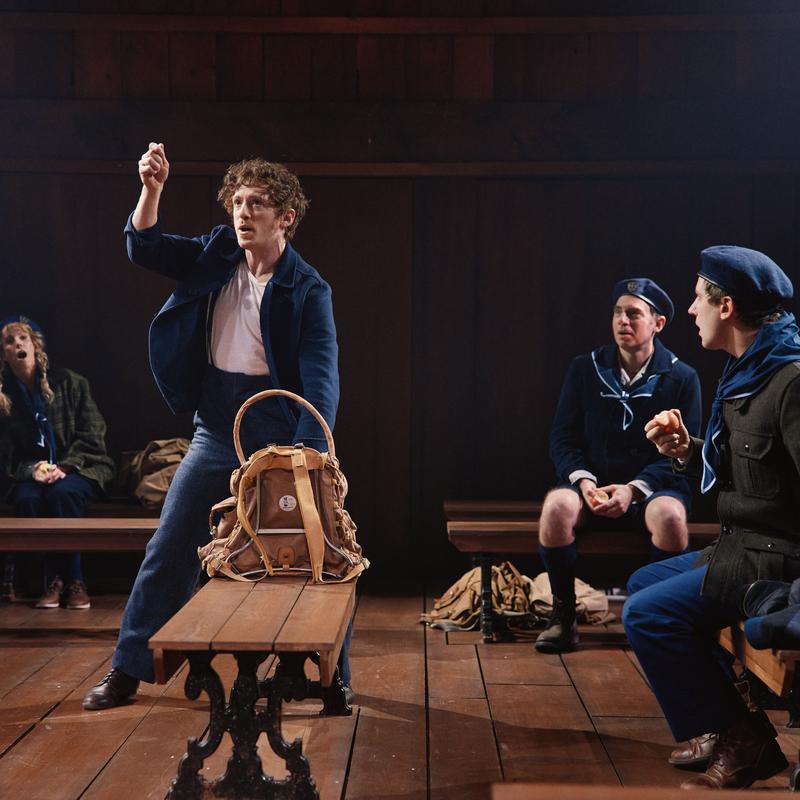
Alison Stewart: This is All Of It on WNYC. I'm Alison Stewart. It's an amazing story that happens to be true. The world's most famous mime, Marcel Marceau, spent his youth as part of the French Resistance in World War II. His real name was Marcel Mangel, and he helped save Jewish orphans by smuggling them out of Nazi-occupied France on a train that was headed for the Swiss Alps. From that nugget of truth comes a hundred-minute play co-written by Ethan Slater and Marshall Pailet. It's called Marcel on the Train.
How was Marcel able to keep the children quiet, entertained, and not scared? Who were the children? Would they have memories of this moment? Would they live long enough to have memories of this moment? What would happen when Nazi forces confront them? Would they make it to the Swiss Alps? Marcel on the Train is playing at the Classic Stage Company on East 13th and is up until March 22nd. Joining us now is Tony nominee Ethan Slater, who co-wrote the play and who plays Marcel. Hi, Ethan.
Ethan Slater: Hi.
Alison Stewart: And also Marshall Pailet, co-writer and director of the play as well. Hi, Marshall.
Marshall Pailet: How are you?
Alison Stewart: I'm doing well. Ethan, when did you first learn that Marcel Marceau was a member of the French Resistance? Because I just learned on last Sunday.
Ethan Slater: Well, it was a fact that snuck up on me because it seems like something that I should have known. First of all, just thank you for that succinct summary of the play. I don't think I've quite heard it spoken about in that way, and it just feels really true to what we're trying to do, these questions of the future and what happens when you're stared down with the face of fascism.
I was doing research on silent film comedians, on Charlie Chaplin and Buster Keaton, with whom I'm deeply obsessed. I got into this little era of history where Charlie Chaplin was being accused of being Jewish. I use "accused" because that's how it was being levied. Like a real scholar, I googled "Charlie Chaplin Jewish," and I found this story about a young Jewish boy who fell in love with Charlie Chaplin seeing a movie of his in the '30s in France. As he got a little older, he joined the French Resistance.
That man grew up and became Marcel Marceau. My mind was blown by this, by the fact that-- I grew up going to Jewish day school, and I went to Jewish summer camp. Anybody who's had one of those experiences knows that you're given books of the famous Jewish people all the time; every baseball player who is Jewish, every actor. You just know these stories, and I didn't know this story.
Alison Stewart: Interesting.
Ethan Slater: It was like a blank spot for me. I read up a little bit on it, and I called Marshall, and I said, "I think that there's something really beautiful here, this sort of thriller story, this sort of Life Is Beautiful story," but the story of Marcel Marceau in a moment that we don't know about. I knew all about his work as a mime, but I didn't know about his work as a freedom fighter.
Alison Stewart: As a writer, what stood out to you about the story?
Marshall Pailet: Well, first of all, just to say, the day he called me was the day that my son was born.
Alison Stewart: Oh, nice.
Marshall Pailet: We texted him. It just--
Ethan Slater: Well, I was calling because [crosstalk], to be fair.
Marshall Pailet: I'm going to make you look good, Ethan.
Ethan Slater: Thank you.
Marshall Pailet: First I sent him the picture, like 8 pounds and 7 ounces, like baby and mommy are doing great.
Alison Stewart: "Wants to write a play."
[laughter]
Marshall Pailet: He called, and he's like, "Oh my God, he's beautiful. How's Kellie? Can I send you guys anything? This might not be the right time, but did you know in 1943, a young Marcel Marceau smuggled--" I was like, "Ethan, Ethan, Ethan, that's very interesting. This is not the right time." This story of this man before he became the world's most famous mime, performing this act of silent heroism in the face of fascism, I think, to us was a story that was interesting on its face.
Then, not to mention the fact that especially now, four years later, we're both Jewish fathers raising young Jewish children, so it felt very personal. The thought of placing this story on one train ride was exciting and thrilling to us. Then, moreover, and also taking in the director's side of my brain, "How could we incorporate the theatrical tools of Marceau in the telling of the story of a young Marcel Marceau?" We knew it would be a play with talking, but how could we incorporate silence and stillness and silliness and these things that were so uniquely Marceau? That was our jumping-off point, and we really didn't look back from it.
Alison Stewart: Ethan, what did you study about Marcel Marceau, about the way he moves or maybe even the way he spoke later in life that you were able to use in your portrayal?
Ethan Slater: As an actor, I think the fun challenge about this is it's Marcel before he becomes Marceau. He's a young guy. He hasn't gone to drama school. He hasn't studied mime yet. He just loves Charlie Chaplin, basically. Finding the way to embody the person who becomes Marcel Marceau, and then by the end of the play, becoming the Marcel that we know. I was just watching a lot of videos and sitting in my room and trying to emulate what he's doing and trying to get the little gestures and details and see where he's very balletic and where he's idiosyncratic.
Then working with Marshall, we did a lot of just one-on-one in a rehearsal room, the two of us, with a mirror, messing around, trying to figure it out. It's just a lot of painstaking watching videos.
[laughter]
Marshall Pailet: I should also add that we worked with--
Ethan Slater: Oh, yes.
Marshall Pailet: We have a movement director who helps sculpt the movement, and Ethan worked with two mimes who are disciples of Marcel Marceau.
Alison Stewart: Oh, interesting.
Marshall Pailet: We have that secondhand-- Marceau passed away, what, 15 years ago or so, but so we. We feel like we have that secondhand knowledge that has been incredibly useful for Ethan and for the whole company.
Ethan Slater: Yes, it's been invaluable.
Alison Stewart: What piece of information did they give you as they were watching you develop the character?
Marshall Pailet: It's called the pop.
Alison Stewart: The pop?
Ethan Slater: Yes, these little things. These little, like when you're establishing a move, the little pops. It's like--
Alison Stewart: Oh, I know exactly what you mean.
Ethan Slater: Just like to give the object some certainty. Some things seem a little bit obvious once they're said, but the mime tells you where to look. The gaze is really important, for where your eyes go. These elements of tension and where you're floating and leading with your chest and all these little-- it's just tiny little things that have been really helpful.
Marshall Pailet: Because as a mime, you're interacting with nothing. There's no props, there's no stuff, so you have to define the thing for the audience before you interact and do a story with it. People won't go on the journey if they don't know what's happening. When there's nothing there, there's just-- It has to be so physical and precise, and you have to have the right bounce in your fingers and echo with your fingers. It's all super interesting to watch.
Alison Stewart: You have to explain to them, "I am on the train. This is the train door,-
Marshall Pailet: "This is a car."
Alison Stewart: -and now I am opening the door."
Marshall Pailet: Exactly.
Alison Stewart: I am speaking with co-writers of the play Marcel on the Train, Ethan Slater and Marshall Pailet. Marshall directs the play. Ethan stars in it. It's part of Marcel Marceau when he was part of the French Resistance, who's helped save orphans. It's at the CSC Stages. I have to ask about this, casting adults as children. What directions do you give adults so that they could play scared children riding on a train?
Marshall Pailet: First, just to say, it's the story of this young man saving these children. We don't have children in the show, we have adults. The germ of that idea was the thing about saving a child's life; is you're not just saving the child, you're saving decades of life. Everything that that child is going to become, what they're going to do, and so it was important to us that we represented on the stage what Marcel really is saving, which is decades and decades of life.
That was the germ of that idea. In terms of directing the actors, look, they're really, really good actors. I don't have to direct them too hard, but the thing that we talked about was not how do I shift my voice, how do I shift my body. It's about getting into the mindset of a child. In this case, they're all 12. One of the big things we talked about was the dissonance between real and perceived stakes.
Some things, kids-- We both have kids. There are things that they think are scary, that aren't that scary to us. There's some things that they don't think are that scary that they really should be scared of. It's kind of defining how do you feel about this thing and coming to peace with the fact that the audience is going to have a different opinion than you, this is a show where these kids are escaping Nazis their entire life.
There is a Nazi in the show. For the audience, that's really scary. It's really scary to watch that man come on stage in the jacket with the swastika and the armband, and explaining to the actors and just remember to telling them, like, "How many Nazis have you seen today? 100, 150?" It's scary, but it's your life, it's your stasis. That was a big part of getting into the psychology of a 12-year-old.
Alison Stewart: Each child represents something different on the train. What's the four children represent to you on the train?
Marshall Pailet: Ooh.
Ethan Slater: Well, it's a good question. In reality, the true story is he had probably 20 or so per trip. We obviously wanted an amalgamation of those characters. They represent different things. We've done the little mapping, the very Jewish storytelling mapping of the four children on the Passover Seder story. I don't know that that's quite exactly right, though. I think we have the version of an idealist who grows up holding really fast to the ideologies of right and wrong. We have the without judgment pessimist, somebody who has been through something that is incredibly painful, and so she's looking for what's going to go wrong. We have-
Marshall Pailet: The chameleon.
Ethan Slater: -the chameleon, the shapeshifter, who is going to do "whatever I have to do to survive. I will say anything. I will do anything." Those people tend to be very successful. Very, very successful. Then we have somebody-- Marshall already referred to stasis. We have somebody who, like the stasis is this moment of trauma, this deeply traumatizing moment. She is existing in that.
If we were going to do the Seder for children, she's the one who doesn't know how to ask. Yes, I think that that's-- The nice thing is, since we knew that we were going to fictionalize this train ride, we have yet to find any-- we don't know who he saved in real life. We've looked, and we haven't been able to find. If you're out there, come come at us. We knew that we could design children that would give the story maximum tension and allow us to have this philosophical debate about the value of delight in the face of horror. Yes, we were able to design the children to make Ethan's life as Marcel as difficult and delightful as possible.
Alison Stewart: One of the children, she's a bit of a pragmatist, like you said, and she's not like an antagonist towards Marcel.
Ethan Slater: Pragmatist is a better word than I used, yes.
Marshall Pailet: [unintelligible 00:11:18].
Alison Stewart: Yes, because Marcel has this good nature, and she's pragmatic. What do you see as her role in the play?
Marshall Pailet: Look, I think that at the center of this play, it's a cast of six, and all of the actors are amazing, but the central relationship is between Marcel and this one child. Her name is Berthe. He is the ever-optimist, and she is the ever-we can call a pragmatist, but sometimes that comes across as pessimist. I think that for us it kind of-- the two of them represent the two sides of the drama mask.
Ultimately, what the show is about is the synthesis of these two perspectives and how Marcel Marceau as an artist was someone who incorporated both delight and positivity and never ignored the horror or the death that was inherent in his upbringing. He brought both to his art, and that's what made his art so special. That relationship kind of informs his ultimate worldview, and I think our worldview as well.
Alison Stewart: It's interesting, Julie Benko was here.
Ethan Slater: Oh, really?
Alison Stewart: Yes, last week performing, and I think she performed in Williamstown. Is that right?
Ethan Slater: She did, yes.
Marshall Pailet: Yes, she did. She's in Ragtime.
Ethan Slater: She's in Ragtime right now.
Marshall Pailet: She's a fantastic performer. Good friend.
Alison Stewart: I want to talk about the stage at CSC, Classic Stage Company. It's a thrust stage, means it goes out into the audience, and there's audience around three sides of it. What's challenging for you as an actor on a stage like that?
Ethan Slater: Oh, there's a lot of challenges. I think the biggest one is just trusting that-- Marshall is our eyes, because you always feel a little bit like you're giving somebody your back. Backting can be very exciting and very dynamic, but it also is like I don't want to be neglecting somebody, I don't want to be-- I want to make sure people are being let in in the right way. There's the challenge of getting out of your own head in those moments.
Marshall Pailet: Yes. Just to illustrate what Alison is saying, imagine the stage is a big, long rectangle, and the audience is on three sides. Three-quarters of the audience is on the big sides of the rectangle, but then there's some audience that's all the way downstage or in the front, and so we always have to be-- This is a story that nobody knows. This isn't a revival.
The only way that they will understand the story is if they hear everything and see everything. It's hard to see everything when the actors are playing to three sides, and so we spent a lot of time making sure that everyone in the house had a dynamic, exciting viewpoint where they understand the story at all times. I would like to say it came easy to us. It didn't. It took a lot of work.
Ethan Slater: That said, I will also say that there are huge, huge benefits to this thrust. We're talking about the challenges, but it's also, as an audience, you're in the show.
Alison Stewart: Oh, yes.
Ethan Slater: You're immersed in it. You feel implicated by it. You feel like a part-- "We're not going to bring you up on stage." It's very safe. I know audience participation is terrifying. It's not that, or at least it is for me, but the experience is incredibly intimate because of that thrust. I've done a couple of shows there, and I think that is a really special thing, especially when it's a show that takes place on a train ride. I think you really feel like you're on the train with us
Marshall Pailet: I say that--
Alison Stewart: Oh, you're in Assassins. That's right.
Ethan Slater: Yes.
Alison Stewart: I saw Assassins.
Marshall Pailet: He was great in it.
Ethan Slater: Thank you.
Marshall Pailet: Yes, playing the guitar, acting. What a guy. What a talent you are. [crosstalk] Wow.
Alison Stewart: [laughs] I'm going to bring it down now. I'm going to ask a serious question.
Ethan Slater: Please.
Alison Stewart: Well, they are serious, but this is a very serious question. I'm curious between the conversations that you guys had when you were writing this, the play that has laughs and it uses clowning, but it's talking about something really tragic. Talking about kids surviving the Holocaust. What were those conversations like? How did they go? What did you come up with?
Marshall Pailet: Sure. I've got an angle.
Ethan Slater: Great. Do you want to start?
Marshall Pailet: I'll start.
Ethan Slater: Okay.
Marshall Pailet: When we were writing this, we were looking for inspiration, tonal inspiration to the artists of the time, Marcel Marceau, obviously, but also Charlie Chaplin. These were artists who did not shy away from the horrors of their time, or the Holocaust. Like they addressed it head on in their art with humor, and they use that humor in order to try to defang and disempower.
If we laugh at the thing, it's not so scary, and it makes-- If it's not so scary, then there you feel like you can do something about it. This is not a story about today explicitly, but it is a story about the past, where we can learn lessons from that past to have resolve about today. Just like those artists back then didn't shy away from that, we didn't want to shy away from it either.
Ethan Slater: Yes, I agree with that. I would say that it takes place in the past, and yet it is still about today, and this is happening. We talked a lot about how this is the story about how children have the right to grow up without being hunted by soldiers, without being hunted by police, and yet we live in a time where that is happening. The Holocaust is a story that a lot of people, a lot of the New York theater-going audience is very familiar with. We know that it happened then, and it is happening now, and I think a lot of people know that it's happening now. I think that hopefully this is a lens to see today through the past in terms of the humor of it, unless you wanted to--
Marshall Pailet: Yes, I'm piggyback. Marcel Marceau as an artist would often try to be a bringer of light and delight, and his characters would be dealing with these little everyday horrors. This is a story about him trying to be this beacon of hope and resolve and delight for these kids in one of the darkest events in modern history. I think that we-- Well, I know that we hope that this show in 2026 can be a bringer of light and delight but also resolve for audiences who likely, like we are, are struggling and reckoning with a world that is seemingly darker by the day. We're scared. The way that we reckon with that is through art. We hope that receiving the art makes the reckoning easier for our audience.
Ethan Slater: Look, not for nothing, it's also not exclusively but quintessentially Jewish thing to take these moments of deep pain and trauma and laugh either at it or through it or with it or alongside it. This isn't Mel Brooks. We're not laughing at it, but we are laughing in it. It's been an interesting thing. You're bringing this up, and we had renewed conversations about it when we brought in audience members.
Because we were doing so many-- As we were writing it, we were taking it very seriously in every aspect, but when you're rehearsing and you're making jokes, you're trying to find the levity in the moment, you can sometimes forget that audiences are seeing it for the first time. We were confronted with our first audiences with this idea that people are too nervous to laugh, too scared to laugh, or their laughter comes out of their nervousness. We were like, "Oh, right, the audience is the other cast member." That has renewed these conversations in a way that has made the preview process pretty amazing.
Marshall Pailet: It's a very fun room. Everyone in it is Jewish, essentially. It's a lot of-- By room, I mean rehearsal room, all the actors and the stage managers and the designers, the creative team. There's just a lot of jokes. There was a lot of yuk-yuks and a lot of talk about bagels and lox. It is fun engaging the audience with it and bringing them on the train with us and teaching them the role of delight as well. I think people are really enjoying it.
Alison Stewart: Something I have to ask you about, the lighting, because that is magnificent, right?
Marshall Pailet: Ain't it cool?
Alison Stewart: It's really, really cool.
?Ethan Slater: Brandon Stirling Baker.
Alison Stewart: Who is it?
?Ethan Slater: Brandon Stirling Baker.
Alison Stewart: Glad you said it. When did that become apparent the lighting was going to be integral to the play?
Marshall Pailet: I interviewed our lighting designer about a year ago, and he's an amazing designer. I was saying this to Ethan this morning that he is one of the creative forces that really sculpt this version of the show. He was always pushing for, like, what's the most beautiful, what's the most Marceau version of this idea from a lighting perspective, but also from a writing perspective.
Ethan Slater: Yes.
Marshall Pailet: I encouraged him to go arty, go beautiful, go silhouette, and he-- The lighting is just spectacular, and it's bold, and I'm really proud for people to see his work.
Alison Stewart: What's the best advice, direction you got from your director?
Marshall Pailet: Ooh. Ooh.
Ethan Slater: I haven't gotten anything good.
Marshall Pailet: [laughs]
Ethan Slater: He says a lot.
Alison Stewart: Chat, chat, chat.
Ethan Slater: In his defense, I mostly tune him out. You know what? That's a really good question. I think one of the benefits of working so closely with a collaborator. Marshall and I have been writing together almost every day since 2021-- 2020?
Marshall Pailet: Yes.
Ethan Slater: We're on year six-
Alison Stewart: Wow.
Ethan Slater: -of being incredibly close friends and collaborators, which means that when we transitioned into the roles of director and actor again, he's said so much to me already about this role that you kind of wonder, "What are the other things that he can possibly say?" Yet, every day there's something good. I just wish that I had a better answer instead of rambling about nothing for--
Marshall Pailet: It takes a lot of trust, right? Because my-- Ethan is an extraordinary performer, as you disagree.
Ethan Slater: Sure.
Marshall Pailet: He is amazing, but he also has an incredible sense of stage. He knows when he's looking at people and when he's not and how to craft performances. It takes a lot of trust for me to be like, "You think that you're facing the audience in this moment. I promise you that you're not. Do what I'm asking of you. It'll make you look better." He does, and so I appreciate that trust.
Ethan Slater: Well, okay, that's a logistical one. Marshall is great with the logistics. Of course, he's very good at creating a stage picture, but actually, as you started talking, it made me think about just the moments of stakes. I think Marshall is a really brilliant writer. Anybody who's seen it, he's a brilliant writer, and he combines that with his directing in a beautiful way to create stage pictures that are rooted in the storytelling and in the emotions of these characters.
He's a deeply attuned director who listens to actors, obviously, but I think one of the big things was we have this opening bit where Marcel is trying to win over the pragmatist, and it's difficult. We've gone back and forth a lot about how broad it is, how successful it is, how whatever it is, how many swings and misses there are. I think early on, Marshall was just like, "Hey, just remember, you can't let her know about the stakes, but the stakes are outrageously high." I think that was a beautiful thing.
Alison Stewart: The name of the play is Marcel on a Train. It's playing at the Classic Stage Company on East 13th, and it's up until March 22nd. My guests have been Ethan Slater and Marshall Pailet. Thanks for being with us.
Marshall Pailet: Thank you.
Ethan Slater: Thank you, Alison.
Alison Stewart: I'm Alison Stewart. I appreciate you listening, and I appreciate you, I'll meet you back here tomorrow.