
Ethan Hawke's 'Best Actor' Nominated Performance in 'Blue Moon'
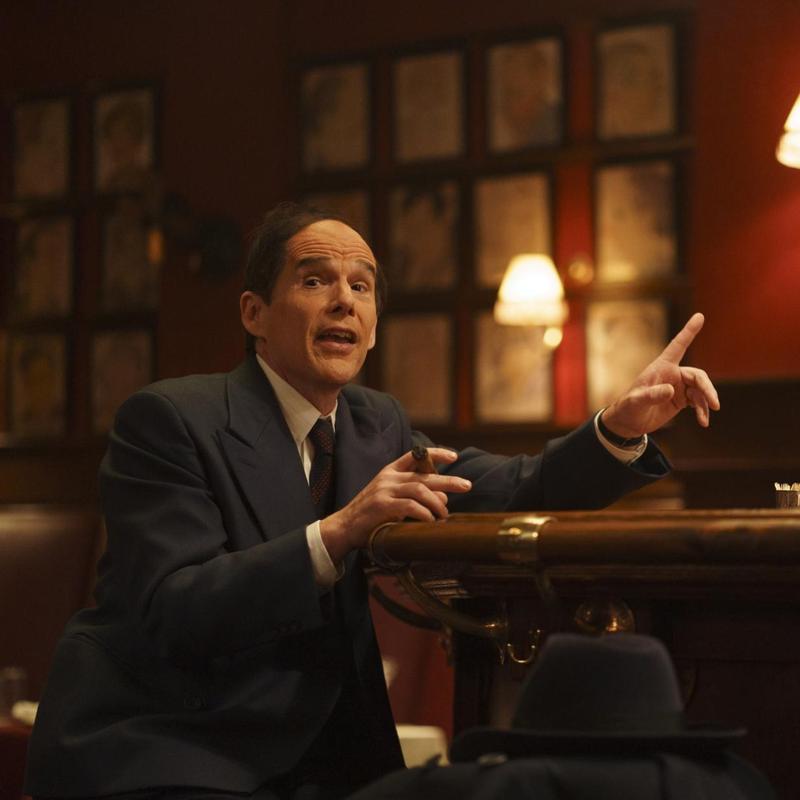
Alison Stewart: This is All Of It. I'm Alison Stewart. In the film Blue Moon, Ethan Hawke plays Lorenz Hart, the lyricist who worked for years with Richard Rodgers, creating songs like Isn't It Romantic and My Funny Valentine. That is until Rodgers decided to work with Oscar Hammerstein on a little thing called Oklahoma. Hart is watching his work relationship slip away while Rodgers and Hammerstein have created a show that he thinks is sappy and for the hoi polloi. That's where we meet him, at the opening night party for Oklahoma, where Hart is hurting and finding some comfort in booze, again. Here's a clip of Lorenz Hart, known as Larry, cornering Richard Rodgers at the party. Rodgers is played by Andrew Scott. This is from Blue Moon.
Lorenz Hart: I remember when I first heard about you. You were just Morty Rodgers' little brother. You were 17?
Richard Rodgers: 16.
Lorenz Hart: Yes, I was 23.
Richard Rodgers: Yes, you were the wise, old man in the mountain.
Lorenz Hart: When I first heard you play your stuff, I knew you had it. I wasn't entirely convinced that I had it, but I heard something that afternoon, originality, melody, grace.
Richard Rodgers: Come on. Come on, Larry, stop it. Come on. What's the matter with you?
Lorenz Hart: You worked your whole life for this night, Dick. Nobody's worked harder, and nobody deserves it more.
Richard Rodgers: All right, thanks, thanks, Larry. Thank you.
Lorenz Hart: All right, all right. That's what I wanted-- Just go enjoy your party.
Richard Rodgers: Hey, look at me. Look at me. We're going to do A Connecticut Yankee. All new.
Lorenz Hart: Yes.
Richard Rodgers: We're going to write four, five new songs together.
Lorenz Hart: I have ideas already.
Richard Rodgers: Right?
Lorenz Hart: Yes, and if I get some pages down for Marco Polo, can I send them over?
Richard Rodgers: You have to ask me that, Larry? I owe my professional life to you.
Alison Stewart: Hawke is almost unrecognizable in the film. He appears to be 5 feet tall, balding, with brown eyes. He really disappears into the role, delivering witticisms and barbs and compliments, some tender, some terribly insincere. He does it all with a plum in a terrible comb-over, and you love him. The Motion Picture Academy certainly loved him, which is why they gave him a nod in the Best Actor category at this year's Oscars. The film is also nominated for Best Original Screenplay. Blue Moon takes place almost entirely over one night in 1943. When he joined us to talk about it, I started by asking Ethan Hawke to tell us what was going on in Lorenz Hart's life and in his head when we meet him in the film.
Ethan Hawke: I mean, this is an opening night party that changed the world. I mean, what's going on with him is he's sitting on the edge of a cliff. In his whole era, the Jazz Age is about to fall into oblivion, and all his work is basically going to be rendered irrelevant as something new takes off. Oklahoma, in a strange way, represents the moment America started seeing itself in the third person. As Larry says, Oklahoma is nostalgic for a world that never existed. We're telling ourselves stories that feel good and are flattering but aren't true.
Alison Stewart: What is his goal that night at the party?
Ethan Hawke: Put simply, I think I really believe his goal that night is to convince Rodgers that he's a better partner than Oscar, to present him this idea of this musical Marco Polo, and to give himself life back, as he says to Rodgers, he just says, "I expect more from you. We can do more." It's not that he doesn't like Oklahoma. He just expects more from a genius like Rodgers. I think his dream is if he can just stay sober long enough to convince Rodgers that obviously he should come back and work with me.
Alison Stewart: What was challenging, sustaining a character in a real-time narrative? This is 90 minutes. It's like 90 minutes at a party. 90 minutes in the life of Lorenz Hart. What was hard for you or challenging for you to sustain that?
Ethan Hawke: It's like this-- It's like, have you ever seen those really complicated dominoes where they line them up and they make a shape as you knock them down? When you're making a film in real time, you watch me walk into that party, and by the time you leave the party, you know I'm going to be dead. Each domino has to hit the one in front of it. It's not a movie that's going to be made in the editing room when they can't rearrange the scenes. You can't cut out one part of the performance or shave it. It's all happening in real time.
The stakes are so high. I mean, first of all, just the idea. I would so love to be able to go to 1943 and attend the opening night party of Oklahoma. I know I'm a theater nerd, but it would thrill me to no end, so to be able to invite the audience into this moment, that's the spell that the movie is trying to capture or throw or cast, whatever the right word is.
Alison Stewart: We get a sense that Larry, he's going through tough times emotionally. He's a little bit lonely. What's the cause of his loneliness?
Ethan Hawke: A little bit lonely. I mean, if you listen to The Rodgers and Hart Song Book, which is staggering, and I highly recommend, if anybody has any interest, Ella Fitzgerald's double album, Ella Sings Rodgers and Hart. It's just phenomenal. There's something-- they should play this album, when they have the dictionary, it says melancholy, they should just play this album. It's the definition of bittersweet. It's so funny, it's so smart, it's so alive, and it's so deeply sad and lonely. A lot of that comes from these lyrics of Lorenz Hart. The lady is a Tramp, My Funny Valentine, you mentioned a handful, Bewitched, Bothered and Bewildered. They're heartbreaking, and they're funny.
Why is he lonely? He's lonely because he hates himself, first of all. He sees himself as unworthy of love. What started that? I don't know. At the point we find him, his temporary cure for his loneliness, alcohol has overshadowed whatever the real pain is, whether it's being gay in a time in America when it was illegal, whether it's the fact that he knows the wellspring of his talent is drying up, whether-- It's a lot of things now that are now totally overshadowed by the alcoholism.
Alison Stewart: We're talking to Ethan Hawke about his new film, Blue Moon, about the life and career of Lorenz Hart. Richard Rodgers remains pretty gracious, and he wants to keep working with his friend, but he wants him to be his work friend. He wants him to show up on time, to show up not drunk. How did you and Andrew Scott, who plays Richard Rodgers, how did you develop a dynamic of "We're going to be friends, but I'm wary of you, Larry?"
Ethan Hawke: It's like we're seeing this 25-year relationship in the last conversation they ever had. It was a real challenge to try to fit all the feelings we wanted to fit, all the emotions that we wanted to be alive and in the present moment without exposition. A normal biopic would show you when they first met, and show you their first hit song, and show you when they won the award, and show you when they're on the cover of Time magazine, and then show you the 15 times he showed up drunk, but we're just getting to see them on this last conversation. One of the things that was important to Andrew, we know a lot about--
The two of us have been involved in the theater and artistic life our whole lives, and artistic breakups are different than romantic breakups. They're similar. There's an intimacy. These guys wrote a thousand songs together. They wrote so much music. That's so many late nights sharing your innermost thoughts, trying to get at something real, talking about what their relationships with their fathers are like, what their relationships to the lovers are like. That's a lot of nights drinking and carousing at burlesque houses.
If you see interviews with Richard Rodgers late in his life, he is powerfully angry about the end of their relationship, and he's full of so much love and humor when he talks about the beginning. It's very moving. The relationship meant a lot to him, but it's like-- I don't know if you-- Andrew and I thought about it. It's like the ex-wife showing up at your new wedding and wanting them to thrive and be good and wanting this breakup to be good for both of them. It's not going to be okay for Larry.
Alison Stewart: It's interesting because it sent me to the dictionary. Is it envy or is it jealousy? When I looked up the two. Envy is when a person wants what someone else has, but jealousy is when you fear losing what you have to a third party. I thought, "Maybe it's both."
Ethan Hawke: Yes. I also think it's complicated for Larry because I think he's seeing it's not just Richard Rodgers' fault, and it's not just his alcoholism. He wants something else from his art, and what-- I likened it to this. Imagine if you were the greatest mandolin player in the world and then you watched Elvis break, and you now know in the days following that, no one in the world cares how good you are at a mandolin, and your whole life has been dedicated to something that people think is antiquated, and how difficult that would be, because you want to be, "Hey, guys, wait. Don't you remember the mandolin? It's amazing. Check out this amazing mandolin solo."
When the world is waning out of what that great American songbook work, musical theater was changing, getting more-- and evolving for the better in many ways, but it wasn't what Larry did.
Alison Stewart: He starts to cling to the hope of a relationship with a woman named Elizabeth, a much younger girl, a college girl, half his age, played by Margaret Qualley. She's just bee's knees. She's excellent.
Ethan Hawke: I know. She is.
Alison Stewart: It's an impossible romance, really, but what does it reveal about his character, him wanting to be with Elizabeth? Whatever 'be' is.
Ethan Hawke: Whatever 'be' meant to Larry. She might have represented to him the idea of a 1943 "normal relationship." If he could just carry off something, maybe that would change people's perception of him. Maybe her beauty wasn't staggeringly inspiring to him. Maybe he really did love her poetry, but more what I came to see is it reminded me of someone self-cutting. That it's the trauma and pain of losing Richard Rodgers is so great and so significant, it's almost like a lance to his chest, and if he looks at it, he knows he's going to die. So he creates a new pain.
He starts putting all his energy on Elizabeth. I think he's smart enough to know this relationship is never going to work out, but it's a pain that feels familiar and uncontrollable, whereas the Richard Rodgers pain is just overwhelming.
Alison Stewart: Let's listen to another clip from Blue Moon. This is Ethan Hawke and Margaret Qualley as Larry and Elizabeth when Elizabeth shows up at the party.
Lorenz Hart: Elizabeth.
Elizabeth: Larry.
Lorenz Hart: My irreplaceable Elizabeth.
Elizabeth: I'm so happy to see you. Do you like the hair?
Lorenz Hart: I love it. It's much better than the red.
Elizabeth: I think so.
Lorenz Hart: I mean, I like the red too, but this is much more otherworldly.
Elizabeth: I have to go set up for the party.
Lorenz Hart: No, no, no, I got you some flowers.
Elizabeth: Aw. I'm overwhelmed.
Lorenz Hart: I have that effect on people.
Elizabeth: I have so much to tell you.
Lorenz Hart: Like what?
Elizabeth: I've been writing in my journal again.
Lorenz Hart: I hope you let me read it. No, no, no, no, the big one.
Elizabeth: And these are what Richard Rodgers is getting? Larry.
Lorenz Hart: What?
Elizabeth: My mother would die if she saw this. With your permission.
Lorenz Hart: Permission granted.
Elizabeth: That guy I told you about.
Lorenz Hart: Cooper.
Elizabeth: It finally happened. Yes, on my birthday. The night of my 20th birthday. Pretty dramatic, actually. You could write a play about it.
Lorenz Hart: A musical. He has risen.
Elizabeth: Larry.
Lorenz Hart: It's an Easter musical. It's very religious.
Elizabeth: Let me clarify by saying it almost happened.
Lorenz Hart: Clarify immediately.
Elizabeth: I'm going to tell you the whole story later.
Lorenz Hart: No, no, no, I demand to know the shorthand version now.
Elizabeth: The shorthand version.
Lorenz Hart: Yes.
Elizabeth: Okay. The skin on his back was flawless. Got to run. You're going to introduce me to Richard Rodgers, right?
Alison Stewart: It's so interesting because she's practical in many ways. She's not evil. She really wants to meet Richard Rodgers. How does Larry respond to that?
Ethan Hawke: I don't know. You can imagine, right?
Alison Stewart: So sad.
Ethan Hawke: I've spent half my life meeting actors and stuff, and we're having a nice time, and they say, "Are you going to introduce me to Linklater?" We all know that feeling. I think he's so thrilled to use whatever tool he has to get her attention. If that means the carrot of meeting Richard Rodgers, fine. He's going to use every card he's got.
Alison Stewart: What did you like about the script? What was unique about the script, which was written by Richard Kaplow?
Ethan Hawke: Listen, my character does not stop talking. It's almost like a man who's put in front of a firing squad, and if he stops talking, he'll be killed. That's how I felt about it. It was an unbelievable amount of verbiage to have to memorize, but I giggled through the entire experience of memorizing. I would be sitting there running lines to myself, just cackling. I'd be in a coffee shop looking like a lunatic as I just-- because he's so smart. I've been lucky enough. One time in my life, I did this play, The Coast of Utopia, and got to spend nine months in a rehearsal room with Tom Stoppard.
When you're in the presence of a world-class mind with a world-class wit, it is so delightful. Larry is just delightful to be near. His insights, whether they're wicked or silly or whatever, they're so funny and so smart that I would-- It was just so enjoyable. The screenplay is so disciplined. It's so precise. It's built so well. It's just a phenomenal piece of writing. As actors, we have this thing. Sometimes you read a script and the more you work on it, the more it falls apart in your hands. You just, "Wait, that doesn't make sense. Why would she say that--"
Then sometimes you work on something and your admiration for it just blossoms because the level of difficulty is so hard, and to capture Rodgers and Hart on this night, hats off to Robert Kaplow.
Alison Stewart: You're a musician. What song do you really like that they wrote?
Ethan Hawke: My Funny Valentine. My Funny Valentine is one of my absolute favorites, but I didn't know Bewitched, Bothered, and Bewildered, and I promise you, stop what you're doing out there. Find time. Put on some headphones. It's eight minutes long. Listen to Ella Fitzgerald's version. Listen to any version, but I love Ella's, and close your eyes, and it's like a little play. It's the most amazing piece of writing. It's unlike anything in contemporary music. I have all these young people in my life, and I want to send all these popular musicians. I'm like, "Please, please listen to the Rodgers and Hart songbook. These lyrics can be better, you guys."
Alison Stewart: That was Ethan Hawke talking about playing Lorenz Hart in the film Blue Moon. Hawke is nominated for best actor at this year's Academy Awards. If you want to hear more of our conversations with Oscar nominees ahead of the awards, make sure to tune in next week, we'll talk to the star and director of the Brazilian political drama The Secret Agent. We'll hear from co-writer and director Chloe Zhao about Hamnet, her take on the life of William Shakespeare. Actor Rose Byrne will talk about playing a mother in over her head in the film If I Had Legs I'd Kick You, and if you like Sinners, we'll hear about it from stars Miles Caton and Delroy Lindo.
That's all coming up next week. Those films have all been nominated at this year's Academy Awards. The ceremonies will be held on the evening of Sunday, March 15th. We have more All Of It on the way. Coming up, your opinions about the best karaoke songs. We want to know what makes some songs better than others and whether you have ever actually heard good singing at a karaoke bar. That's next, right after the news.