
DOC NYC: Prepare For "Santacon"
( Pinball Party Productions )
Alison Stewart: This is All Of It on WNYC. I'm Alison Stewart. I was looking at the show rundown for tomorrow and I realized there's synergy. The first hour is devoted to plays known as two-handers. I'll speak with Keanu Reeves and Alec Winter about their roles in the revival of Waiting for Gadot. Then I'll speak with Tony winner Kara Young and Nicholas Braun, the stars of the Off Broadway show Gruesome Playground Injuries. The playwright will join us too.
Then we'll close out the show with an hour of art. We'll learn about the new exhibit at MoMA dedicated to Cuban artist Wifredo Lam, and we'll discuss the quilting exhibition at the American Folk Art Museum. That's on tomorrow's show. Now let's get this hour started with that one day in December that you either love or hate SantaCon.
[music]
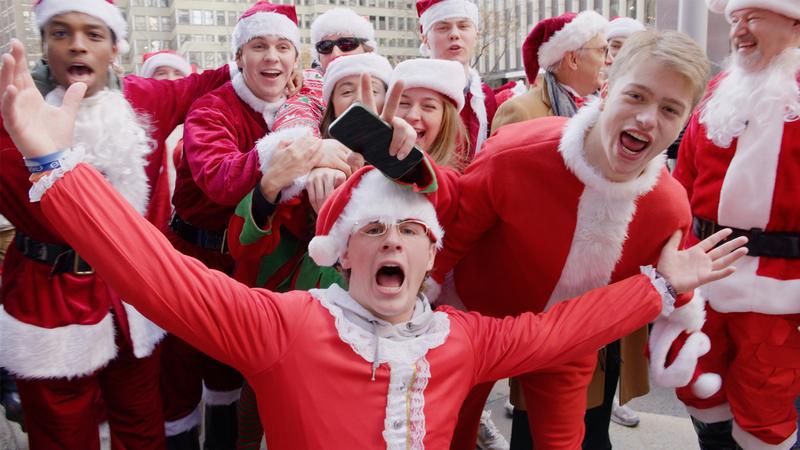
SantaCon is associated with thousands of people heading out into the streets dressed in Santa outfits, ready to party. The original SantaCon had a very different set of goals. The origins of SantaCon are explored in the new documentary Santacon, premiering this week at DOC NYC. The film tells the story of a group of SantaCon founders who were part of another group called the Cacophony Society. It's the group that started Burning Man.
The original SantaCon was more of a political statement. Organized chaos designed to poke fun at the commercialization of the holiday. As SantaCon spread across the country, the founders soon lost control of the original mission. Santacon premieres at DOC NYC on Thursday, November 13th at 6:45 at the Village East by Angelica, and a Q&A to follow with my next guest, the director Seth Porges. Hi, Seth.
Seth Porges: Great to be here.
Alison Stewart: Listeners, we want to hear from you. Have you ever attended SantaCon? What was the experience like? Or maybe you're one of the original gatherings of SantaCon in the '90s or you were a member of the Cacophony Society. Or maybe you have strong feelings about what SantaCon is today. We want your SantaCon feelings. Give us a call at 212-433-9692, 212-433-WNYC. Seth, how did you get interested in exploring SantaCon?
Seth Porges: Everything I knew about SantaCon before was what everybody in New York knows about it, which is you make the mistake of walking outside on the wrong day and you see one guy in a red suit and you think, "He must be going to the mall," and you see another and you're like, "They're not both going to the Mall, are they?" Then you see a thousand, and then you look at your calendar and you realize, "Oh, my goodness, I've made a terrible mistake."
That's all I'd ever thought about it. Until one day I bumped into an old friend of mine, a guy named Scott Beale, at a bar, and it was around Christmas time several years ago. He just starts talking about how he and his friends have been involved with the creation of SantaCon. I'm like, "Wait, what are you talking about?" He says, 'Yes, we also started Burning Man." I'm like, "Wait, what?"
Alison Stewart: What?
Seth Porges: He's like, "Yes. Our group was also the real life inspiration for Fight Club and Project Mayhem." I'm like, "Wait, hold on a minute." Then he says the thing that really blows my mind, which is that he personally had videotaped several of the first years of SantaCon, and he offered to show me the footage. When I saw the footage, this movie just came alive in my head.
Alison Stewart: That's an amazing time to have drinks, let me tell you. It started with the Cacophony Society. What was the original ethos?
Seth Porges: The Cacophony Society were these post dada anarcho prankster, sort of performance artists, group of people who really just wanted to do cool, random stuff that would confuse you, that would scramble your brain. That would be this sort of orchestrated absurdism that by showing you something you had never seen before, maybe you've seen one Santa, but you've never seen a thousand Santas, would force you to just stop and maybe think for a second, "Hey, is there more to this world than I ever thought there could be?" They started all sorts of things that just came and went, and then they started things like Burning Man and SantaCon that just also sort of stuck around forever.
Alison Stewart: What would you say their politics were?
Seth Porges: I think it's kind of a fallacy to say there were politics to the Cacophony Society. I think it was more about surreal absurdism. I think what they really stood for was this idea that creativity, collaboration, and fun are important things for living a good life. If they stood for something or against something, I think it was the notion that we live in a world in which those values, creativity, collaboration and fun may not have the meaning given to them that they actually do have to us as people, and to find a way to give that to people in some way, even if just a random person who sees a bunch of Santas on the street.
Alison Stewart: All right, Seth, who is responsible for the original idea that became SantaCon?
Seth Porges: Well, for that, you have to blame Rob Schmitt, who was somewhat anonymous about his contribution to this awful war crime until somewhat recently. He, of course, is in the documentary copying to all his crimes, he and his friends. SantaCon was created by the Cacophony Society, and they were an avowedly collaborative group. I think even Rob would be hesitant to say, "Hey, I deserve any or all of the credit." These were friends coming together and doing this together.
Alison Stewart: What was the original intent of the event of them dressing up like Santa?
Seth Porges: It kind of depends which Santa you ask. If you ask Rob, he would just give you a very sphinx like response and say, "It's about more Santa," whatever that means.
Alison Stewart: It's about more Santa. [laughs]
Seth Porges: It's about more Santa. That's what he always says. Like, "Rob, what's the point here?" He just goes, "More Santa." I'm like, "What does that mean?" He won't even tell me. You ask some of the other original Santas-
Alison Stewart: I know exactly what he means.
Seth Porges: Yes, exactly, more Santa. You ask some of the other original Santas, and they will say they're poking fun of consumerism and Christmas or how this icon of Santa Claus himself had become this commercial mascot for Coca Cola and some other brands. The idea, I think, is to create this tabula rasa, this blank slate, again, this piece of absurdism where you see it, you don't know what to make of it. In that blank space, you fill in the blanks with something else. My favorite thing about the old archival footage, which is the heart of the film, isn't so much how the Santas are acting, it's how the people around them are acting.
Alison Stewart: It is.
Seth Porges: Yes. You see these faces, right? Now we all have been conditioned to know SantaCon is the worst. Run, hide, lock up your family. We know this fence is electric. Do not touch it. Back then, nobody had ever seen this thing before, and you see all sorts of different responses, from joy and wonder to true terror take over people's faces. I think that was the whole point.
Alison Stewart: It tells you more about the person and how they respond. It tells you more about them than about the people in the Santa outfits.
Seth Porges: Yes. You look at the footage, I don't think the Santas were actually acting all that different back then than they are today. There were always some bad Santas acting naughty in the mix. There was always a little bit of alcohol, a little bit of rule breaking, certainly some law breaking that these people were filming because nobody ever imagined this footage would be seen by anybody like you would today. They were always just a little bad Santa-ish.
The people around them, it's a novel thing. This was a new thing. What changed with SantaCon was the novelty and the newness went away. When you see this for the first time, you don't know what to make of it. You allow yourself to feel surprised, to feel awe, to feel wonder. When you see it again and again and again, suddenly all of that meaning goes away and it just becomes an excuse to get drunk.
Alison Stewart: We're discussing the new documentary Santacon with director Seth Porges. The film premieres at DOC NYC tomorrow at 6:45 with screenings throughout the festival. Listeners, have you ever attended a SantaCon? What is your best or craziest memory? Maybe you attended the original SantaCon in the '90s. 212-433-9692, 212-433-WNYC. You can call in and join us on the air or send a text. Let's talk to Susie from Astoria. Hi Susie, thanks for calling all of it.
Susie: Ho ho ho.
Alison Stewart: Ho ho ho.
Seth Porges: Ho ho ho.
Susie: One of my favorite things was way back in the beginning and I started doing it in New York in 2002 and I started the first one in Boston shortly after that because Boston didn't have it. I was an old time Burning Man person and there was a really creative underground scene at that time which as you said, sort of got co-opted. One of the cool things is that we used to have songbooks and people would sing these fractured SantaCon carols, but you could just say, 'Santa's wife's a?" and everybody would say, "Ho ho ho." Get it? Santa's wife is a ho. Anyway.
Or every time you'd get on a subway, "Santa's on the move, Santa's on the move." I think it was 2003, I got to be a counter. That was to count how many Santas there were going from one part of Central Park where we were doing reindeer games. "Red rover, Red rover, let Santa come over," but because everybody was Santa, they would just all run to the middle and smash into each other. It just was fun and like 250 people that sort of knew each other, and good costumes, man. Really good costumes.
Alison Stewart: Love hearing it. Thank you so much for calling in about the early days of SantaCon.
Seth Porges: Yes, those fractured Christmas carols. That was always a big part of SantaCon from the very beginning. In some of our home movie footage, the movie kind of chronicles four of the first five years as SantaCon moved from city to city. Began in San Francisco, then hopped over the Portland, Los Angeles, eventually landed in New York, where we all know and love it today, of course. In Portland-
Alison Stewart: Portland was interesting because SantaCon in San Francisco, it sort of happened. People are kind of reacting to it. They're not quite sure what to make of it. Then it makes its way to Portland and has a very, very different feel.
Seth Porges: Yes. We talk about this being this blank slate in which people put their own hopes, dreams, fears onto it. Well, the city of Portland believed the Santas to be terrorists.
Alison Stewart: Literally.
Seth Porges: Literally terrorists. They met them at the airport with intelligence officers. The Santas told me they believed their phones were being tapped. There were undercover Santas. The Portland sequence ends with them going to a shopping mall. A shopping mall that became famous because it had an ice skating rink where Tonya Harding got her start. They were going to summon the spirit of Tonya Harding. When they get to the shopping mall, they are met by a phalanx, a wall of police in riot gear who tell them on camera that, "If one Santa crosses the street, we are moving in." What did the Santas do? The only thing they can do, summon the spirit of Christmas and sing some fractured Christmas carols at them.
Alison Stewart: It's scary for a moment.
Seth Porges: It is scary for a moment.
Alison Stewart: Looking at that footage, because they are in full riot gear.
Seth Porges: Yes, and there really was a sense that something could go wrong here because they're really-- you see in the folks with the riot gear on that they wanted to use their toys. The kind of paranoia and fear that seeped through the Santas was palpable. One scene we have on camera, John Law, who's sort of one of the original organizers of SantaCon, sees this guy taking notes and interviewing people and becomes convinced, "Is this guy an undercover cop. What's going on?" Basically, gives him the third degree, only to find out that it is Chuck Palahniuk, the author of Fight Club, who is embedded with the Santas.
Alison Stewart: Let's take a call from Dan, who is calling from Brooklyn. Dan, thanks for calling All Of It. You're on the air.
Dan: Hi there. SantaCon, after the mayhem of originally coming to New York and it grew and grew, one of the things that you just saw so much of was this intense creativity in costumery and shenanigans. It's one of those things where you realize that in preparing for and preparing for it, people get their outfits together, they come with their little shticks, that some of the best parts of Santa Claus are not just the day itself. It's hanging out with your friends before and figuring out what you're going to do and coming up with your little thing.
There was elf bowling one year where a bunch of elves line up at the bottom of the hill at Central Park and a giant yoga ball painted white gets rolled down the hill and all the elves go flying like bowling pins. Some people had these leggings on that when they piled on top of each other in like this gymnastics structure, they looked like a hearth and a fireplace. Super amazing creativity before it just became a bunch of Santa hats and jeans. One of the things about the Cacophony Society in general and the confrontations you can have, the Cacophony Society, people knew that you can go out and do your thing, but no one's obligated in any way to react how you expect them to.
Alison Stewart: Yes.
Dan: There was a lot more question marks going on. For plenty of Cacophony things, it didn't always have to be fun. It could just be interesting.
Alison Stewart: I'm going to cut you off right there. Thank you so much for calling in. My guest is Seth Porges. He has a new documentary called Santacon. We're going to have more of your calls and more with Seth after a quick break. This is All Of It.
[music]
You're listening to All Of It on WNYC. I'm Alison Stewart. In studio with me I have Seth Porges. He directed a new documentary, Santacon. The film premieres at DOC NYC tomorrow at 6:45 and it screens throughout the festival. It's interesting because it seems like the evolution of SantaCon also was part of the evolution of the Internet.
Seth Porges: Yes.
Alison Stewart: Right? How do they go hand in hand?
Seth Porges: SantaCon started in 1994 in San Francisco. By 1998, the first year it's in New York, most of the original creators were kind of through with it. Of course, SantaCon carried on without them. The reason it carried on is because the Internet was becoming the Internet. SantaCon itself was never a brand. It was never a piece of IP. It was never a piece of property that anybody owned. It was an idea. With the Internet, that idea spread. That idea spread to different cities, to different people, to different organizers. whatever specific personality the original creators put into it became lost in the shuffle as our collective populace ID took over what SantaCon would become.
Alison Stewart: Let's talk to Ben, who's a bartender. Hey, Ben, thanks for calling All Of It.
Ben: Hey, Alison, how you doing?
Alison Stewart: Doing well.
Ben: Oh, man. As a bartender in the Lower east side, I have so many perspectives on SantaCon.
Seth Porges: I hear you, man.
Ben: I'll just say I hear you about it being a creative experience and everything, but it's New York. There's so many other creative experiences and ways to get together. We shut our doors to Santa's on SantaCon and as so many other bars do, too, because we know, like, I've just seen-- I've broken up so many fights between Santa and his elves. I've seen so much puking and peeing between cars and pooping and shouting just the most crazy, horrible things from Santas. I don't know, I like to say it's a day where a lot of white guys who like to dress the same regularly all get together and dress the same and get drunk continuously.
Seth Porges: Bromageddon.
Ben: Yes. Maybe that's just the dark side of the moon of SantaCon, but I feel like it's been hijacked by these kind of the worst of New York people who really just want to get completely unruly and hide that unruliness in the crowd. It's dangerous.
Alison Stewart: Yes. Thank you for calling. We really appreciate it. When did SantaCon become hijacked, to use Ben's word?
Seth Porges: The original creators basically stopped going after '98. Some stuck around, but I think it became a gradual shift over that period since then. It just sort of spread and spread and spread. In the first couple years after then, you still have people involved with the original SantaCons. You still have a memory of what SantaCon was, but I would say by the 2010s, at that point, there's very, very, very little resemblance to what SantaCon would be, what it was. That's when it becomes this perennial butt of late night comic jokes. It's when the bars start putting up the no Santas allowed signs. It's when really it just becomes this thing that New Yorkers kind of love to hate.
Alison Stewart: This text is interesting. "It's fascinating that Seth comments on the reactions of the bystanders, the reactions of non-participants, and the contrast between the groups seems embedded now in SantaCon Productions. I've never done SantaCon, but in 2016, I was marching in the Million Man March for Black Lives in New York City, which was scheduled on the same day as SantaCon, which meant that we made our way up 6th Avenue. We encountered throngs of Santas weaving their way through our masses. I remember watching a very confused gingerbread cookie walk several blocks with us before finding her way out."
Seth Porges: Wow.
Alison Stewart: That's a New York comment.
Seth Porges: What a scene. Only in New York, right?
Alison Stewart: Let's talk to Laura, who's calling in from the West Village. Hi, Laura, thanks for calling All Of It.
Laura: Hi. How are you doing?
Alison Stewart: Doing okay.
Laura: I was calling because I think it was about 2006, and we lived in the Meatpacking District with my two young kids, and we happened to walk out onto the street upon SantaCon, and they were thoroughly confused.
Alison Stewart: Why were they confused?
Laura: All the Santas. They really believed in Santa and couldn't believe that there was all these Santas and naughty Santas and blue Santas. We happened to run into Michael Stipe on the corner, who was completely enraged by the whole affair, which kind of led me to believe that we were on the right track.
Alison Stewart: Another New York story.
Seth Porges: Oh, my goodness. Thank you. That's amazing.
Alison Stewart: Let's talk to Mary Beth on line six. Hi, Mary Beth, thanks for calling all of it.
Mary Beth: Hi. Thank you. I love this show. This documentary sounds so interesting. When you were talking about seeing the Bystanders. I remember that when I was in high school, freshman high school, it was probably 2002, my friends and I, growing up in the New York City suburbs, we took the train in for the first time by ourselves going into the city, and we walked right into SantaCon, completely unbeknownst to us that this was going on.
It was just such a funny memory because we were totally shocked, and we were like, "What is going on?" It wasn't that long ago that I believed in Santa myself. Then all of a sudden, there were all these Santas and they were drunk. It was just a really fun memory. I remember writing about it on LiveJournal. I don't know if you remember the site LiveJournal but it was a blogging site.
Seth Porges: Of course.
Mary Beth: I remember we were all talking about it on LiveJournal, and it was just a fun, crazy memory that the first time we went into the city, on our own, we ran into all these Santas.
Seth Porges: Yes. Never meet your idols.
Alison Stewart: This text says, "While I don't approve of recreational consumption of alcohol, I absolutely love seeing scores of Santas. It really says Christmas is around the corner." It's interesting. I'm not giving away, but you do bring some of the originators to SantaCon New York.
Seth Porges: Yes. The only way this movie could end in my mind was, okay, these people who create SantaCon, they disowned their creation. To me, it just felt like a Frankenstein story, and that meant that they had to confront their monster by the end of this movie. I was able to convince, maybe even some say, trick, the original creators of SantaCon to return to New York and face their creation for the first time in some 25 years. My goodness, was it intense? Was it emotional? Honestly, kind of hilarious. It was a good time.
Alison Stewart: How do you think smartphones and social media has changed the tone of SantaCon?
Seth Porges: Well, when SantaCon was started, this was an era in which people weren't performing for a crowd except the crowd immediately in front of them. Nobody was acting in this way where we kind of see a lot of people act now, which is everything is a post. That just wasn't on their minds. People just acted differently. A little bit more free, a little bit more abandoned.
The thing that I love about the archival home movies I have is people were being recorded. Thank goodness. That's how I was able to create this film, but they didn't act like they were. They were being recorded, and it was incidental, not the point. My goodness, yes, everything has changed with smartphones out there, of course.
Alison Stewart: What do you mean they didn't act like they were being record--
Seth Porges: They were committing crimes on camera. They weren't self-conscious about the way they were looking, they weren't posing. They weren't doing TikTok dances. They were just being their silly Santa selves. I don't know what the statute of limitations is for illegally climbing the Brooklyn Bridge. Maybe it's passed, maybe it isn't, but today, if you film that, you're probably going to get into trouble.
Alison Stewart: This text says, "It's like when Joan Cusack says in the movie Working Girl, 'Sometimes I dance around my apartment in my underwear. It doesn't make me Madonna.' Just because drunks are wearing red hats doesn't make them Santa."
Seth Porges: No, it doesn't.
Alison Stewart: The name of the documentary is Santacon. Its director is Seth Porges. The film premieres at DOC NYC tomorrow at 6:45 and it screens throughout the festival. Seth, thank you so much for making the film and coming to talk to us about it.
Seth Porges: What a joy. Thanks for having me.