
Corporate Thrillers on the Criterion Channel
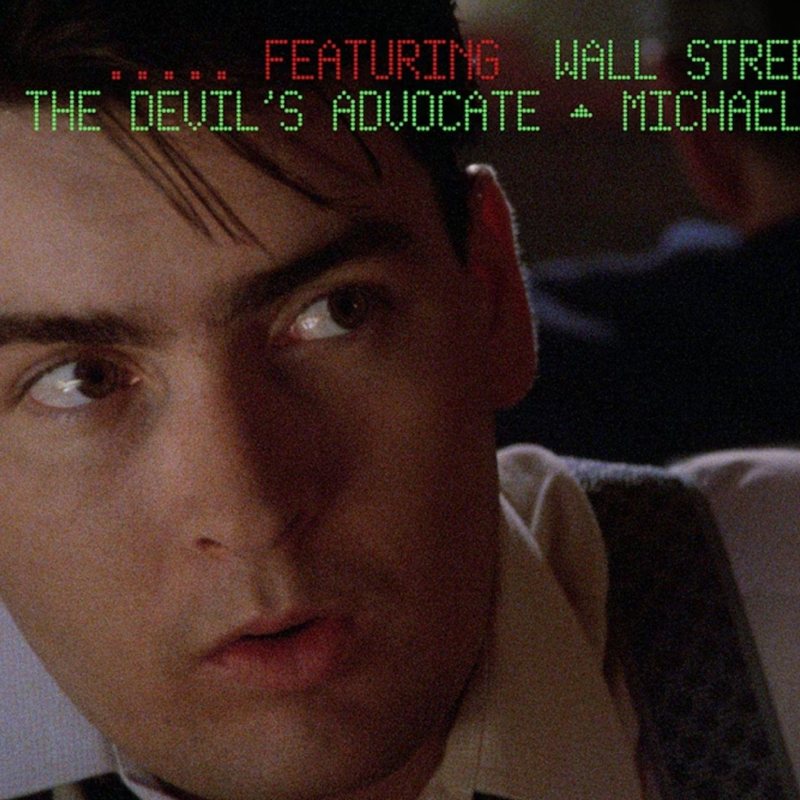
Alison Stewart: You are listening to All Of It on WNYC. I'm Alison Stewart. Money, power, corruption, sex, lawyers, whistleblowers, Michael Douglas. These are all features of a certain genre of movie that captured Hollywood from the late '80s to the early 2000s: the corporate thriller. These movies might feature a power-hungry Wall Street broker or a lawyer who might literally be in league with the devil. They have twists and turns, usually starring a dapper leading man, and they often have a showstopping courtroom scene.
You can watch many of these movies now on the Criterion Channel, thanks to their April series, Corporate Thrillers, featuring 10 different films. Joining me now to discuss some of these films is our friend of the show and of the Criterion Channel. It's Clyde Folley. Hi, Clyde.
Clyde Folley: Hi, Alison. Thanks for having me back.
Alison Stewart: Listeners, we want to hear from you. What's your favorite corporate thriller? Our phone number is 212-433-9692, 212-433-WNYC. What do you like most about corporate thrillers when they're done well?
Clyde Folley: That's a good question. Look, an inherent feature of the corporate thriller is that they're about money, sex, and power. I think that those end up being fairly cinematic themes to explore. What do you get? You get high-stakes dealings. You get intrigue. You get jockeying for power. I don't know. It's all very watchable.
Alison Stewart: It includes menswear suspenders.
Clyde Folley: Oh, big time. Wall Street has more suspenders than any other movie I've seen.
Alison Stewart: A lot of these films are from the late '80s, the early 2000s. Why do you think that particular time period produced so many of these kinds of movies?
Clyde Folley: Well, the Wall Street figure really becomes a bigger, larger-than-life figure in the 1980s. Sorry, I got to jumble my thoughts for a second. I think with the premiere of Wall Street in the '80s, it really synthesizes this kind of figure. Wow, I've completely lost my train of thought on this one.
Alison Stewart: You know what? We're going to play from Wall Street. This was a big movie. This is what started it all, with Michael Douglas playing Gordon Gekko. He won an Oscar.
Clyde Folley: He did. Michael Douglas is great in this movie. Also, this is the beginning of the Michael Douglas character, if you will.
Alison Stewart: Let's listen. This is his famous speech, "Greed is good," from the movie Wall Street.
Gordon Gekko: I am not a destroyer of companies. I am a liberator of them. The point is, ladies and gentlemen, that greed, for lack of a better word, is good. Greed is right. Greed works. Greed clarifies, cuts through, and captures the essence of the evolutionary spirit. Greed, in all of its forms, greed for life, for money, for love, knowledge, has marked the upward surge of mankind. Greed, you mark my words, will not only save Teldar Paper, but that other malfunctioning corporation called the USA. Thank you very much.
Alison Stewart: He almost had me there. What do you think this captured about America in the 1980s?
Clyde Folley: Well, here's the funny thing about Wall Street. It's a movie that comes out in 1987. It comes out right around the time of Black Monday, that huge stock market crash, and it comes out around the time when a lot of people on Wall Street started getting busted for insider trading. It's one of these things where this movie happened to be about a lot of these things, to the point where when Wall Street comes out in 1987, they realize they needed to put a card at the beginning of the movie that said "1985," because at this point, a lot of people were not doing the things that were being done in this movie out of fear of going to jail.
It captures that. It also just captures this frenetic, high-speed energy of working in finance at the time. Also, this movie never stops moving. That camera is constantly moving. It's got that great Stewart Copeland soundtrack and also all those songs from David Byrne and Brian Eno's My Life in the Bush of Ghosts. It's just a very high-energy, propulsive film.
Alison Stewart: The next movie in the series, The Firm from 1993. It's directed by Sydney Pollack. It stars Tom Cruise. It's adapted from a John Grisham novel. For those who might not remember what The Firm is about, can you give us the logline?
Clyde Folley: The Firm is about a hotshot Harvard Law School graduate, Tom Cruise, basically being recruited by this elite law firm in Memphis. He's brought in on the promise of money and power. Then he starts realizing that this firm is not all that it's cracked up to be. In effect, it could be a front for the mob.
Alison Stewart: Here's a clip from the movie The Firm, when an FBI agent explains to Mitch, played by Tom Cruise, exactly who he's working for.
FBI Agent: Your law firm is the sole legal representative of the Morolto crime family in Chicago, known as the Mafia, the Mob.
Mitch McDeere: I don't believe it.
FBI Agent: They set up legitimate businesses with dirty money from drugs, gambling, prostitution. All cash, all moved offshore. You believe it. That's why you talked to Thomas Abanks in the Caymans. That's why he got this private investigator asking questions that got him killed. Maybe 30% of their clients are legitimate. They bring in a new rookie, throw money at him, buy the car, the house. After a couple of years, your kids are in private schools. They're used to the good life. They tell you the truth.
Alison Stewart: That's from The Firm. What makes Tom Cruise perfect for this movie?
Clyde Folley: This is early in Tom Cruise's career. It's not the very beginning. I don't think the Tom Cruise persona was fully locked in at this point.
Alison Stewart: Interesting.
Clyde Folley: If you watch movies like Risky Business and especially The Color of Money, where he's definitely doing the Tom Cruise thing, but he's playing it at 11, so unmodulated, very fun to watch. I think that as an actor, he's maybe a little more malleable in this time period. Keep in mind that Tom Cruise, who may in fact be the last movie star working today, also has so much control over the projects that he's doing. He's a producer. He hasn't worked with an especially difficult director in a long time. I think that at this point in his career, he is this hotshot law school grad who's capable of being put in these situations and being put in these different kinds of movies and working it.
Alison Stewart: We're talking about corporate thrillers, a series of 10 movies available to stream during the month of April on the Criterion Channel. My guest is video editor and curator Clyde Folley. Listeners, we're taking your calls. What's your favorite corporate thriller? Give us a call at 212-433-9692, 212-433-WNYC. Let's talk to Steve in Airmont. Hey, Steve, thanks for calling in.
Steve: Alison, thank you for taking the call. How about a movie called The International?
Alison Stewart: How about it?
Steve: Well, Naomi Watts, Clive Owen. From start to finish, it's incredible. I didn't see it when it was in the theater. I saw it on cable. I watched it multiple times, and I'm wondering if it made the list.
Clyde Folley: It did. It's there.
Alison Stewart: All right.
Clyde Folley: Watch it on the Criterion Channel right now.
Alison Stewart: Great. Thanks for calling in. This said, "I don't believe it did as well as a film, but there was a time when nearly everybody on every subway car was reading The Bonfire of the Vanities."
Clyde Folley: Oh, yes.
Alison Stewart: This one says, "The Secret of My Success by Michael J. Fox." That is from Rusty in Brooklyn calling in. Let's talk to Katie, who's also calling in from Brooklyn. Hi, Katie, thanks for calling All Of It.
Katie: Hi. Thanks so much for taking my call. I just wanted to bring up a film that I think is a Criterion favorite, maybe a bit of a stretch. The first thing that came to mind when you described the elements of the corporate thriller, which are money, sex, and power, was actually Jacques Tati's Playtime, insofar that it sets up all of those elements in a corporate setting for one and completely neutralizes all of them throughout its runtime through absurdity and humor. I don't know. I see a kernel there, and I wanted to posit it to you.
Clyde Folley: I love Playtime. It's an all-time masterpiece. I think it's very funny, the idea of sliding that into corporate thrillers because it's absolutely not a thriller. You know this. Also, I don't know, that's my favorite programming, is looking at something from this oblique angle and going, "Oh, yes, that actually does work." Shout out to Jacques Tati, corporate thriller filmmaker.
Alison Stewart: Let's move on to Disclosure from 1994, directed by Barry Levinson, also starring Michael Douglas alongside Demi Moore. It's thorny territory for 2026, a fake sexual harassment claim. How do you think this movie holds up?
Clyde Folley: I think Disclosure holds up great.
Alison Stewart: As he crosses his arms in front of him. [laughs]
Clyde Folley: Well, this is--
Alison Stewart: Body language. Body language, Clyde.
Clyde Folley: I don't want to say this is an indefensible position. Let me stake out my claim on this hill and die on it. Let's step back for a second. What is Disclosure? Disclosure is a 1994 thriller starring my man, Michael Douglas, Demi Moore, Donald Sutherland, directed by Barry Levinson, and adapted from a Michael Crichton novel. Here's some context on Disclosure. It is the year after Jurassic Park, the movie, comes out, which is one of the biggest hits of all time. I can't say for certain what decisions were being made behind the scenes.
My impression is that basically, after the success of Jurassic Park, Hollywood said, "We have to adapt every single Michael Crichton novel right now. Get him out there. What do we have here? Oh, this book in which a man is sexually harassed by his female boss. Okay, great. Get into production." I think, in a way, this film is the perfect time capsule for just describing what the sexual politics of the 1990s were. I think it is another great entry in the body of work of Michael Douglas, being someone who is anguished in dealing with sexuality in the '80s and '90s.
I don't know. I think that this movie is very strange and very compelling. It also has, without a doubt, the greatest VR sequence in any movie. It comes out of nowhere. This movie doesn't need it, but you get it.
Alison Stewart: You get it anyway. Let's talk to Robin in Long Island City. Hi, Robin. Thanks for calling All Of It.
Robin: Hi. I thought of The Player with Tim Robbins. Anything with Tim Robbins is great.
Alison Stewart: Thanks so much for calling in. Many texters are texting in "Working Girl starring Melanie Griffith."
Clyde Folley: Oh, yes, sure. Is that a thriller?
Alison Stewart: I don't know.
Clyde Folley: Corporate. You know what I mean?
Alison Stewart: It's a corporate?
Clyde Folley: Comedy.
Alison Stewart: More corporate. Swimming with Sharks. This one says, "Philadelphia. The stakes for Tom Hanks's character are so high."
Clyde Folley: Oh, why isn't Philadelphia in this series? That's a great question.
Alison Stewart: There you go. Maybe next time. Let's talk about a movie that I secretly love, The Devil's Advocate from 1997.
Clyde Folley: Alison, let's go. We're ready.
Alison Stewart: A young Keanu Reeves and Al Pacino, directed by Taylor Hackford. What else could you want? You got Pacino going for it in this film.
Clyde Folley: Look, there's one thing that actors want to do above all else, and that is play Satan. All the big ones get to do it once. This is Pacino's entry. I don't know. When was the last time you watched The Devil's Advocate?
Alison Stewart: Oh, gosh. I don't know. I loved it. I don't remember when. He stuck with me. Let's listen to this particular rant from Al Pacino going on a rant about God.
John Milton: He's an absentee landlord. Worship that? Never.
Kevin Lomax: Better to reign in Hell than serve in Heaven. Is that it?
John Milton: Why not? I'm here on the ground with my nose in it since the whole thing began. I've nurtured every sensation man has been inspired to have. I cared about what he wanted, and I never judged him. Why? Because I never rejected him, in spite of all his imperfections. I'm a fan of man. I'm a humanist. Maybe the last humanist. Who, in their right mind, Kevin, could possibly deny the 20th century was entirely mine? All of it, Kevin.
Alison Stewart: You got to love that. Come on.
Clyde Folley: I hadn't seen The Devil's Advocate since it came out in 1997. Now, mind you, I was 11 years old when this came out. A shout-out to my father, Gary Folley, for telling me to watch The Devil's Advocate. I rewatched it this weekend in preparation for coming on here. A couple of things. One, I forgot how long it is. This thing is pushing two and a half hours. This scene that was just clipped, is basically the last 20 minutes of the movie. I forgot. The last 20 minutes is really just Al Pacino screaming at Keanu at length. Talk about unmodulated performance at 11.
Alison Stewart: Oh, yes. Your favorite movie of the 10. What do you think?
Clyde Folley: Wall Street, absolutely.
Alison Stewart: Let's talk to Cameron. Cameron, I think it is, in the Bronx. Hey, Cameron.
Cameron: Hi.
Alison Stewart: Hi. What movie do you like?
Cameron: Oh, it's Dark Waters by Todd Haynes, starring Mark Ruffalo.
Alison Stewart: It's about?
Cameron: Oh, it's about the DuPont poisoning of a West Virginia town, where the PFOA that leaks into the water. It's based on a true story.
Alison Stewart: Thank you for calling in.
Clyde Folley: I like that movie a lot, too. It took me a few years to catch up with it. I'll be honest. A lot of courtroom dramas, it takes me a little bit of time to muster up the enthusiasm to watch them sometimes. There's so many bland ones. I remember just hearing this one was good, and it's just like, "Wow, Todd Haynes really knows how to make a courtroom thriller." You wouldn't expect it from him.
Alison Stewart: We've been talking about corporate thrillers, a series of 10 movies available to stream now during the month of April on the Criterion Channel. My guest has been curator Clyde Folley. Thank you so much for joining us, Clyde.
Clyde Folley: Thanks for having me.
Copyright © 2026 New York Public Radio. All rights reserved. Visit our website terms of use at www.wnyc.org for further information.
New York Public Radio transcripts are created on a rush deadline, often by contractors. This text may not be in its final form and may be updated or revised in the future. Accuracy and availability may vary. The authoritative record of programming is the audio record.