
Coping with the Holocaust Through Art
Alison Stewart: This is All Of It on WNYC. I'm Alison Stewart. In 1943, Ceija Stojka-- Stojka
Laura Hoptman: Stojka.
Alison Stewart: Stojka. Thank you. Stojka was nine years old when she and her family were taken from their home in Vienna and sent to a series of concentration camps. They were among hundreds of thousands of Romani people targeted under Nazi prosecution. It wasn't until Ceija was in her 50s that she began making art about her experience of the Holocaust and the life she remembered before then. A new exhibition at the Drawing Center showcases that work. It's called Ceija Stojka: Making Visible, and it offers some of her most comprehensive collection of her work ever shown in the US. It'll be on view through June 7th. Laura Hoptman is the executive director of the Drawing Center, and she's in studio with us now to talk a little bit about it. Thanks so much for joining us again.
Laura Hoptman: It's my pleasure.
Alison Stewart: Ceija Stojka didn't start drawing or painting until she was in her 50s. What's her story of discovering her passion for art?
Laura Hoptman: It's a very interesting one and very unique because she took it up as a matter of urgency. She had something to say to the Viennese community and to the world. She had been saying it with lectures, and also she wrote a book right before she started her visual art journey, if you will. With increasing alarm, she was watching the rise of the neo Nazi right in her home country of Austria, where in 1987 the presidency was won by one Kurt Waldheim, who was an ex-SS officer.
It was not the only indication of the rise of the right, but one that really set off alarm bells. Stojka, who had, in the past, until her later years, not been forthright about her experiences during the Second World War, during the Holocaust, and this is typical of Holocaust survivors in general, decided that now was the time. She had tools to start painting to hand because of her grandchildren. She took up a piece of cardboard and some acrylic paints and began to paint. What she painted was a combination of her memories as well as a narrative work that really took advantage of this great storytelling ability that was innate in her.
Alison Stewart: She was self-taught.
Laura Hoptman: Yes. As a visual artist, she was self-taught, but as the years went by and she painted and drew from her late 50s almost until her death. Her last work in the show is from 2011. During this period of time, the work changed and grew. She developed into an artist and then became a great artist during this period.
Alison Stewart: For someone walking into the Drawing Center, what should they be looking for as they move through the exhibit?
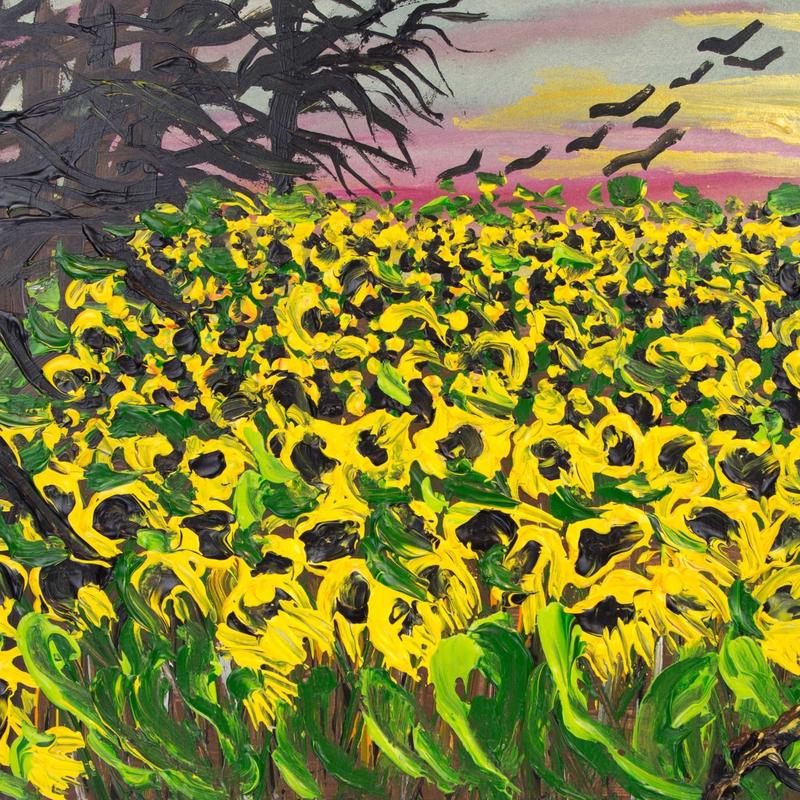
Laura Hoptman: It's an exhibit full of contradiction, because Stojka was a great colorist, and this could be traced back perhaps to her interest in carpets, for example. She sold carpets for a while, or it's something that was innate within her. This was a great talent in her so her works are extremely colorful. Many of them feature flowers, sunflowers particularly, which are significant for the Roma people, as well as birds, lots and lots of ravens, which can also be a positive thing, but also a little bit of a portent of something a little bit more troubling happening. She used very bright colors and these wonderful, lively compositions. At first glance, the works are fabulously alive. When you begin to look at them, very many of them are telling a story that would give you pause.
Alison Stewart: Is that what she meant about her light and her darkness in her work?
Laura Hoptman: Yes, that, but in a larger sense, her work is bifurcated. Part of it is this harnessed to this will for her to get the story of the Roma Holocaust out to a general public. The other part is this luxuriating and being a wonderful painter. She has a whole group of works that depict what Roma life was when she was a tiny child before the Anschluss of 1938. There are two kinds of picture-making happening. There's the almost bucolic landscapes juxtaposed with these very stark, harsh memories of the loggers, the camps that she was in as a small child.
Alison Stewart: There's a ton of range in her work, both in her style and the subject matter as you described. Why is that range so important to understanding her as an artist?
Laura Hoptman: Because it's an interesting thing when one is grappling with such a large historical moment like the Holocaust. It's famously an example in culture of something that is not just difficult to grapple with, but impossible to grapple with. Stojka decided to take it head-on with a kind of ingenious honesty that is rare. There's nothing on top of those memories of those moments of looking at a Nazi officer, the black boots of a Nazi officer. There's one portrait, if you will, of just the black boots, and it's extremely menacing. It has a childlike quality, but it was full of emotions, in fact.
Alison Stewart: My guest is Laura Hoptman, the executive director of the Drawing Center, and we're talking about a new exhibit called Ceija Stojka: Making Visible. It features the work of a Roma artist and Holocaust survivor who did not begin making art until her 50s. It's on view at the Drawing Center in SoHo through June 17th. The show is called Making Visible. Why that title?
Laura Hoptman: It's an important fact to understand historically that most histories of the Holocaust tend to simplify this terrible thing that happened to humanity, and focusing on one, perhaps two groups of people who were victimized by the Nazis. The Nazis victimized quite a number of different kinds of people. Not just Jewish people, but neurodivergent people, gay people, and the Roma people. The Roma minority, if you will, is the biggest minority in Europe today. It's a large and very visible population across West East and Western Europe.
After the Anschluss in 1938, this group was particularly targeted. By 1939, groups of Roma people were being taken away and put in concentration camps, work camps, but at also extermination camps. For Stojka, this history, even though it affected probably a million people, with a half a million people returning, so half that population was decimated. It was not a part of the Holocaust conversation. Especially with the rise of the neo Nazis, the far right in Austria at the end of the 1980s, it became more and more important for Stojka and also for culture to insert this, to open up our understanding of this terrible event to include all kinds of different people, and especially in Austria, for Stojka at the time.
Alison Stewart: I understand that Stojka was also an advocate for Roma rights, not just an artist. Did her creative work intersect with her activism?
Laura Hoptman: Her activism started first. When she became an activist, she harnessed all of her creativity as a speaker and a storyteller, but also as a writer. She published one book before she started working in the visual arts. When she started making the paintings or the works on paper, we'll call them, because their paintings on cardboard, and that's why they're at the Drawing Center, it was in service of her activism. As she continued to work and became more adept at this particular medium that she was using, it became an end in itself.
Alison Stewart: It's interesting that the written work she did, it was We Live in Secrecy. Is that the piece?
Laura Hoptman: Correct. That's her memoir.
Alison Stewart: Is that in the show at all? Is that involved in your show?
Laura Hoptman: There are elements of her written work in the exhibition because we have several vitrines full of ephemera notes that she's taken or even journals. Most pertinently to this, at the end of the 1980s, she befriended a German filmmaker called Karen Berger. Over the last years of Stojka's life, Berger created not one, but two documentaries about Stojka, which were broadcast posthumously. This is something that has broadened Stojka's impact and also her fame.
That's the other thing that's important to know. Although, of course, the terrible story of the Roma persecution in the 20th century in Europe is not well known, Stojka succeeded in making herself and this cause visible. By the end of her life, she was a well-known public advocate, a well-known public figure, not just in Austria, but in Europe.
Alison Stewart: What kind of person was she?
Laura Hoptman: From the documentary, you could just see a very warm and open.
Alison Stewart: You can see even the pictures of her a little bit.
Laura Hoptman: That's right.
Alison Stewart: Continue. I'm sorry.
Laura Hoptman: I never met her, unfortunately, but a very warm, gentle, giving person, very familial. In the documentary, you could see her interacting with her kids and also with her grandchildren. She was really communitarian in everything that she did. For example, she returned to the scene of her suffering three times at the invitation of these advocacy organizations. When she did, she would bring family with her.
Alison Stewart: This is the first major exhibit of her work in this country. What made you think that it would resonate with a US audience?
Laura Hoptman: There are so many entry points to this work, and one of them, of course, is that this is a Roma artist. How many Roma visual artists does a typical American person know? Not very many, to be honest. Although we have a million Roma people in this country and they're spread out all over the country. It's not a visible minority. That said, there are other ways to look at the work from the art perspective, which is what the curator Lynne Cooke has taken on, which is to frame Stojka as an important Roma voice, as a voice for a story about the Holocaust that is never told. Those are the two things. Thirdly, as an artist, and in fact, as Lynne Cooke argues, a great artist, somebody who took this up and became great in 10 to 15 years, in the short time period that she was working.
Alison Stewart: What makes Stojka's work feel urgent right now?
Laura Hoptman: Certainly, all three of these issues, that is the excellence in visual art, the timeliness of the information that she is giving, as well as the fact that she's coming from a Roma person, which is a perspective we very rarely see. All of those things are pertinent. I have to say the most pertinent, we all have to say the most pertinent issue here is that she created this body of work for a moment in Euro-American history or European history, where it felt the most urgent, where there was a resurgence of the ideology that created her suffering. Nowadays, I think that we can see, we can pinpoint areas in our own country and in Europe as well, where there is a similar rise of the right wing with some ideas that similarly echo some of the ideas that were happening the Nazi ideals from the 1920s, 1930s, and 1940s in Europe.
Alison Stewart: We got a very funny text, an interesting text that says, "Could you please spell her name for us?"
Laura Hoptman: C-E-I-J-A S-T-O-J-K-A.
Alison Stewart: Ceija Stojka: Making Visible is at the Drawing Center through June 7th. My guest has been Laura Hoptman, the executive director of the Drawing Center. Thanks for coming by the studio again.
Laura Hoptman: Thank you for having me.
Copyright © 2026 New York Public Radio. All rights reserved. Visit our website terms of use at www.wnyc.org for further information.
New York Public Radio transcripts are created on a rush deadline, often by contractors. This text may not be in its final form and may be updated or revised in the future. Accuracy and availability may vary. The authoritative record of programming is the audio record.