
Cold War Choir Practice' is a New Play About One Family's Experience of the Reagan Years
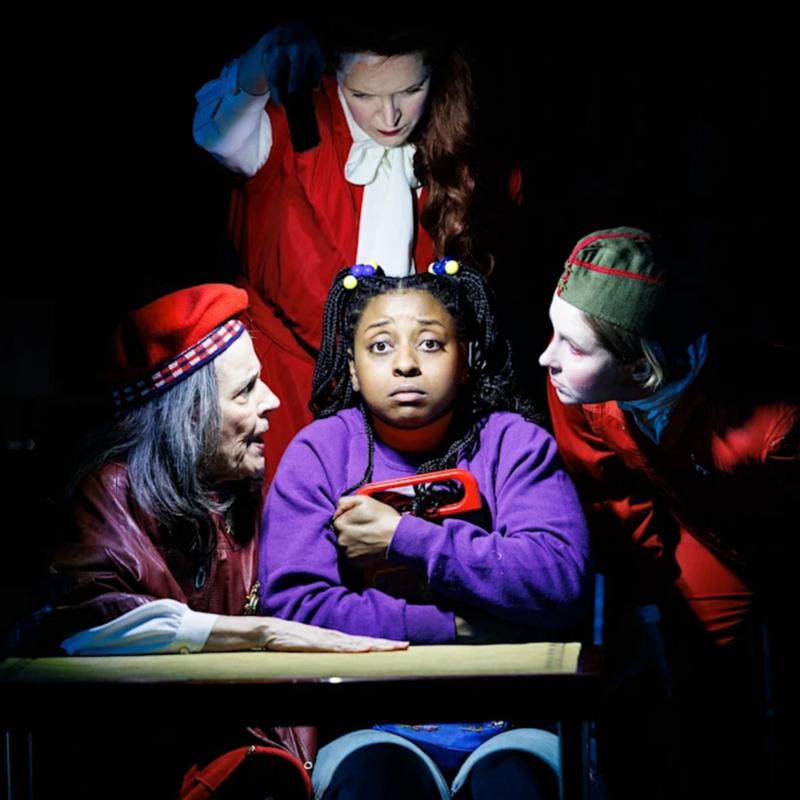
Alison Stewart: This is All Of It on WNYC. I'm Alison Stewart. Imagine being a 10-year-old girl, and all you want for Christmas is a Speak & Spell and a nuclear radiation detector. Why? It's 1987, and a war with the Soviet Union seems possible. That girl who goes by Meek is our protagonist in a play called Cold War Choir Practice by Ro Reddick. Cold War Choir Practice is surreal and down-to-earth. That is where the laugh-out-loud and bit of pathos humors collide.
The surreal part includes, for example, a trio of Soviet spies who look like the Andrew Sisters. The down-to-earth part is about Meek and her family trying to live life and make a go of a roller rink in Syracuse. They don't get much help from Meek's Uncle Clay, who has made it big. He's a hardcore Republican who works for President Reagan. He is on the nuclear talks, and he has to go to Washington. He needs one thing. Someone to look after his wife. She's recently been deprogrammed from a cult, and it's a bit wobbly. Now he needs his estranged family's help.
The reviews have been great. One called it a fun, antic, and ingenious show, and Vulture called it one to watch. You can see Cold War Choir Practice at the MCC Theater on 52nd and 10th through March 29th. Joining us right now is playwright Ro Reddick. Hi, Ro.
Ro Reddick: Hi.
Alison Stewart: The actor who plays Meek, Alana Raquel Bowers. Hi, Alana.
Alana Raquel Bowers: Hello.
Alison Stewart: First of all, I want to congratulate you on winning the Susan Smith Blackburn Prize.
Ro Reddick: Woo.
Alison Stewart: Woo hoo. For Cold War Choir Practice. For people who don't know, folks who have won it in the past have been, oh, Lynn Nottage and Jackie Sibblies Drury. Where were you when you found out?
Ro Reddick: I was heading to tech rehearsal, and I got a phone call, and yes, it was awesome, but I had to keep it under my hat. I was just like having a really great day at tech.
[laughter]
Alison Stewart: What did it mean for you to get that award?
Ro Reddick: I know it's such a reassurance that the work that you're doing is being seen and is respected by your peers and people in the industry. I don't know. It meant everything. Like you said, you named some of the people who have gotten in the past. I've tracked that award in some of those playwrights, and I love their work. That felt surreal to be included in that group.
Alison Stewart: Alana, how did you hear about Cold War Choir Practice?
Alana Raquel Bowers: I was actually in Philadelphia doing a show at the Wilma Theater. I got an email from Maria Striar and Michael Bulger from Clubbed Thumb, an incredible downtown theater company. They sent me this play, and they were like, "We would love for you to read the role of this 10-year-old Black girl. I was like, "Well, I'm in Philly, so I don't know if I'll be able to make that work." My show at the time, we weren't sure if we were going to extend, but if we did, it would be the same week of the reading.
They were like, "Well, what's your schedule for the extension?" I told them, and they were willing to actually train me back and forth from New York to Philadelphia in order for me to do this reading because they were so adamant about the incredible piece that was Cold War Choir Practice. They were equally as adamant about me reading Meek. I was like, "Okay, I'll try. Yes." Like, "I'll keep you posted." That's exactly what ended up happening. I would do a show, the next morning, I would go up to New York and do some reading. We would be workshopping it. I would go back, do a show that night.
Alison Stewart: Wow.
Alana Raquel Bowers: Come back. I did that maybe for three days, I guess.
Ro Reddick: I felt like we were in that room for a week. It was like a full week.
Alana Raquel Bowers: It was a full week. Yes. Luckily, I didn't have a show every night that week. When we were in that room, and I met Ro for the first time, and I got a taste of what the language felt like altogether, it was like nothing I've ever read before, first of all. It was one of the most exciting pieces of theater that I'd put my vessel into because I'd never witnessed or read a piece that embodied a little Black girl with such complexity and such adventure.
I grew up watching things like Indiana Jones, Star Wars. I envision, and I hope for a day and a time where Black people, Black women, Black girls, Black youth can live and breathe and embody stories like that and exciting obstacles that those characters and those stories in particular endure. I was like, "Ro literally wrote it." That's wild. It was so cinematic, and so the themes were just like jumping off of the page. I don't know how it was going to work as a play. I was like, "Well---"
Alison Stewart: My description, it was hard to write the description.
Alana Raquel Bowers: I think, first of all, incredible description.
Ro Reddick: That was a great description.
Alison Stewart: Thank you.
Alana Raquel Bowers: That was a wonderful description.
Ro Reddick: I loved that.
Alison Stewart: Is there anything you would like to add to the description before we talk about the play?
Ro Reddick: No, not at all. I thought it was perfect.
Alison Stewart: When did you start writing this play, Ro?
Ro Reddick: I started in the fall of 2022 when I was in grad school. I went to Brown's MFA playwriting program. The previous spring, Putin had invaded Ukraine, and I had taken this class that was all about art history and politics and the Cold War, and mid century technology. I had all of these things swimming in my head. We were supposed to write solo shows that semester, and I didn't want to write a solo show.
I just started writing these monologues for these different characters for-- I think I wrote Smooch's monologue that he gives when he comes to give out the coupons. That was one of the first things I brought in. I wrote this monologue for Virgie that no longer exists, and a little song for the choir. Everyone else is writing solo shows, and I like bringing this piece, but I'm glad I didn't go with the theme that semester.
Alison Stewart: We're talking to playwright Ro Reddick about her work Cold War Choir Practice, about a 10-year-old girl and her fight for her family and her country. Also joining us is actor Alana Raquel Bowers, who plays that young girl, Meek. You can see Cold War Choir Practice at the MCC Theater on 52nd and 10th through March 29th. You are a grown woman playing a 10-year-old girl.
Alana Raquel Bowers: I am.
Alison Stewart: How did you prepare for the part?
Alana Raquel Bowers: Oh, wow. I think first of all, children are so observant, they are so smart, and at the end of the day, they're people, they're little people, but they're people with their own brains, with their own ideas, with their own dreams. I just started there. I don't think Meek was any different from any other character that I played because she is a person seeing the world through very specific eyes. At the end of the day, that's all of us on earth.
Then I really took a lot of my physical inspiration and the thing that shifts energetically in me from my own goddaughter, who was 8 at the time that I started reading the play, but by the time we started doing it, she'll be 10 in July. She's arriving at Meek age, and she is the smartest person that I know. She is so sharp. She asks questions to everyone. It doesn't matter who you are or how much leverage you have in the room, she wants to know the answers.
I think that she embodies what Meek desperately is asking for in this play, which is the ability to connect with people. She was definitely my external inspiration. Internally, I think I just wanted to make sure I was not making a caricature, but I was making a person. I just tried to play her as authentically as I can. It's easier when the writing is good, I'll tell you that.
Alison Stewart: Ro, what has Meek be-- Has she been sold about the Cold War? What does she believe?
Ro Reddick: When we meet her at the beginning of the play, she's in a choir that is singing for peace and also, I guess, shoring up American values around capitalism and patriotism. I think at the top of the play, she's just trying to figure out how to save herself and her family. All of that is coming from this message that she's getting from the choir that there is this imminent threat and that music and her voice as a child can somehow protect her family in some way. She's trying to figure that out.
Alison Stewart: You actually sang in a choir. I know you've talked about this a little bit.
Ro Reddick: I did.
Alison Stewart: Would you explain a little bit? You were in a choir that was like this.
Ro Reddick: Yes, it was not quite like the choir in this play, but we did sing about nuclear annihilation and world peace. [laughs] There wasn't weird patriotism or nationalism in that choir. It was a Cold War-era choir, and it was all about saving the world from itself.
Alison Stewart: Did you question what you were singing yourself?
Ro Reddick: Not at all.
Alana Raquel Bowers: Not at all.
Ro Reddick: Loved the songs, had a great time.
[laughter]
Ro Reddick: Wasn't until I was an adult and I was telling people about this, that they were like, "Mmh".
Alison Stewart: What does Meek think about her singing in the choir? What does it do for her?
Alana Raquel Bowers: I think it grants her a type of power and autonomy. I think it's hard. As the youngest in my family, it's hard. Meek is an only child. It's difficult to be a kid amidst adults, because oftentimes they don't really trust you with certain information. You feel left out. Singing this song about freedom and about-- assuming that this could do something for the country, for my family, for myself, I feel like that excites Meek. Even though she-- I think because she is the only Black girl in the choir, there is another sense of pride that she has to be like, "Well, these people have a certain reason why they're singing, and I have my own reason why I'm singing."
Alison Stewart: We're talking about Cold War Choir Practice. We'll have more after a quick break. This is All Of It.
[music]
Alison Stewart: You're listening to All Of It on WNYC. I'm Alison Stewart. We're talking to playwright Ro Reddick about her work Cold War Choir Practice, about a 10-year-old girl and her fight for her family and her country. Also joining us is actor Alana Raquel Bowers, who plays that young girl, Meek. You can see Cold War Choir Practice at the MCC Theater on 52nd and 10th Avenue through March 29th. One of the main settings for the play is a roller rink that's run by Meek's dad. Would you describe her dad, Smooch?
Ro Reddick: [chuckles] I describe him in the front matter as like the mayor of every room he walks into. He's a former Panther. He's very community-oriented. He's all about the people around him and making sure that everybody is taken care of. That's why he runs this space, this roller rink that's struggling financially, but really he wants it to be the heartbeat of the neighborhood.
Alison Stewart: What's Meek's relationship with her father and with her grandmother who comes in the show and makes a hilarious appearance?
Alana Raquel Bowers: Yes, she does. I think her family means a lot to her. Her father and her grandmother are who she sees every day. They're who drop her off at school and choir practice. They're who tuck her in at night. When Meek is singing these songs and thinking about what nuclear war could do, the first people she has in her mind are her father and her grandmother. I think in the same way that I know I'm very close with my family, there are conversations that I have with myself where I feel like I'm using the voices of my family members because that's how close we are.
I think that is the same rhetoric that I could describe Meek with her dad and her grandmother because there are even moments in the show where she repeats like, "Well, my dad said, grandma said," in a way that feels like a familial call and response because she just-- The soundtrack of her mind are these people, I think.
Alison Stewart: This is where the family drama comes in. Enter the Black Republican, Clay, the brother. He comes to visit the family with his wife in tow, and Smooch is not having it. What's their beef?
Ro Reddick: There's longstanding tension between the two brothers that goes back to Clay leaving the family behind to pursue his career in politics. Then there's a very specific incident that happens where Clay says some really hurtful things in the news that Smooch reads that sets off this very specific conflict that they have when he comes with his wife, Virgie.
Alison Stewart: I wonder, because I was watching the play, saw it last Thursday, and the staunch Republican guy is a dark-skinned actor, or Smooch is a light-skinned actor. Is that in the script?
Ro Reddick: That is not in the script. The skin tone is not in the script.
Alison Stewart: I just wondered.
Ro Reddick: Yes, that is not in the script. [laughs]
Alison Stewart: Just curious. There really isn't too much of a description about the mom. Right?
Alana Raquel Bowers: Right.
Alison Stewart: What do you think about that? There's no mom.
Alana Raquel Bowers: We, as a cast, we asked Ro, and Ro was like, "You choose."
Alison Stewart: Oh.
Alana Raquel Bowers: We were like, "Okay." Lizan Mitchell, the great Lizan Mitchell, who plays Puddin in the play, is really big on backstory. We as a family-- no shade to Virgie, but not including Virgie.
[laughter]
Alana Raquel Bowers: The actor who plays Clay, the actor who plays Smooch, Ms. Lizan, and I had a conversation about where my mom is, why she's not there anymore, why we're all living under the same roof, when the wedding was, when the last time I saw Clay was. Things like that, to really inform how we meet each other every night on stage for the first time or for the audience's first time.
That's why I love rich work, rich theater, because you get to-- There are some things on the page that are undeniable, and then there are opportunities for the players inside of it to create even more richness off the page that one may not see, but could maybe sometimes feel, depending on how you're listening to the play. We have our own secret about where Meek's mom is.
Alison Stewart: Okay. Don't tell me the secret. Ro, where did you come up with your characters' name? Meek, Smooch, Clay?
Ro Reddick: I have a cousin who goes by Puddin. Everybody just called her Puddin, and I love that nickname. That's where Puddin gets her name. That character's not based on my cousin. Smooch-- I love nicknames. When I hear nicknames in real life that feel interesting, I just tuck them away in the back of my mind. I think I knew someone called Smoochie when I was really young. I made it smooch. For whatever reason, I thought, that's a great nickname for him. Clay just made sense for that character. Meek, my full name is Raineeka, and I used to be called Neeka and NeekNeek when I was a kid. I gave Meek a name-- I imagine her full name is Shamika, and they just call her Meek and MeekMeek as a nickname.
Alison Stewart: This play has surreal elements to it. I should put that out there. Were these always a big part of the script?
Ro Reddick: Yes.
Alana Raquel Bowers: From the jump.
Alison Stewart: From the jump.
Ro Reddick: [laughs] Yes. Because the choir was one of the first things that I was thinking about. A lot of the weirdness comes out of the choir, and they were the first. I was thinking about my experience in a choir and thinking about how I'd make my own choir songs and how this choir would function in a way that feels different than a traditional chorus. I wanted them to be strange and weird and protean. Yes, a lot of the weirdness came out of them.
Alison Stewart: Alana, what do you like about working in a play where you have to suspend reality? Also, what's challenging about it, too?
Alana Raquel Bowers: Everything. There's nothing more difficult than teaching the audience how to watch your play. That is the most fun for me. I enjoy that challenge, because I don't think this story has ever been told before or this kind of story has ever been told before. What an exciting venture we have every night of allowing an audience into a thing that they may think they know what they're about to see or know nothing about what they're about to see and flip their minds regardless.
In this world, I think it is, I think the particular challenge that our director, Knud Adams, gave me was somehow being a grown woman playing a 10-year-old, but also being the straight man, because there's so much absurdity happening around Meek that the audience has to trust her eyes. That is a very-- I will say that is a very difficult ask, but the reward is so great because oftentimes we don't trust children's eyes. We don't trust what they are telling us and how they are seeing the world. I take that responsibility very seriously. It is very hard, but the challenge-- The challenge is hard, but the reward is so great.
Alison Stewart: Ro, what is a surreal moment that just every time you see it just makes you happy that is in this play?
Ro Reddick: [laughs] I don't know if there's like one particular surreal moment, but I do love any moment where Virgie is in her own world and the characters in the play don't know what's happening in her head, but the choir singing what's happening in her head. I do love her taking the bomb out. Oh, that's a spoiler.
[laughter]
Ro Reddick: I also like the very beginning of the show when we first see her getting help, and they just sing this little weird 'la la la' across the stage, and they're lighting themselves. Knud has them shining a light on their face, the choir members. I love that moment. Those are just weird little moments that I love.
Alison Stewart: Did you do any research into cults? Because Virgie is very much in a cult.
Ro Reddick: Yes, absolutely. I was thinking a lot when I was writing this play about the individual versus the group, or how an individual figures out how they fit, and how hard it is to find some balance between autonomy and belonging, group membership. That looks more or less fraught, depending on the characters that we're looking at. With Virgie, it's probably one of the most fraught moments. I was thinking about cults a lot. I was thinking about modern-day cults like NXIVM, and I was also thinking about Lifespring, which was a cult in the '80s for entrepreneurial-minded people. I just tried to make something that felt of this world but was inspired by both of those capital forward cults.
Alison Stewart: It's interesting about both of you because you both wear many hats. You were an actor.
Ro Reddick: I was, yes.
Alison Stewart: How did it make you a better playwright?
Ro Reddick: I love giving actors fun things to do on stage. I love writing something that they can either take or leave. Like giving them a little invitation to try something and to give them a moment where they can really shine. I just love that. I just love actors and what they bring. I'm okay with letting them have their interpretations of a character, which can be hard if you've never been an actor. You don't understand what their contribution is. It's easier for me to let go of the reins a little bit because I've been in another position in the room.
Alana Raquel Bowers: So huge. Huge. That's not common, especially with new playwrights or playwrights making their debuts, they're very-- Sometimes it's very difficult to let go of the thing that you made. Ro has been so incredibly generous and selfless in allowing us to make it ours in a way. I can't express enough how incredibly collaborative this whole team has been the entire time, from the designers to the creative team to the cast. It's truly like a one-in-a-million experience.
Alison Stewart: You've worked behind the scenes as well on The Black Tone play.
Alana Raquel Bowers: Oh, yes, The Black Wolfe Tone. Yes.
Alison Stewart: The Black Wolfe Tone. We had that on the show.
Alana Raquel Bowers: Oh.
Alison Stewart: We had Kwaku on the show.
Alana Raquel Bowers: That's right.
Alison Stewart: I thought you were an associate producer on that show as well.
Alana Raquel Bowers: Yes.
Alison Stewart: What did you get from working behind the scenes that you can use as an actor?
Alana Raquel Bowers: Oh, wow. I think collaboration. Me understanding that collaboration works on both sides of the stage because there is such an importance in ensuring that people of color are on both sides. What's, I think, even more important is understanding and making sure that everybody is speaking the same language, that everybody understands what the goals are and where we want to get to, and that everyone's goals look the same, and we have similar ways that we want to get there. I think that theater is such a magical use of artistry and advocacy, but sometimes we get caught up because we assume that there are reasons to gatekeep.
I am excited to continue my producing ventures and allow more transparency into the conversation, because that's the only way-- Because actors are smart, designers are smart, writers are smart, directors are smart. Everyone understands why we're trying to get to where we need to get to. I believe with a little bit more transparency, we can arrive there in a way that feels collective and in a way that everyone receives the reward. Collaboration and understanding how that works on both ends, I think, will continue to inform how I show up on stage as well as behind it.
Alison Stewart: Ro, on your website-- and this has made me laugh and laugh. It says on your website that Ro has an MBA from NYU, which she has no intention of using.
[laughter]
Ro Reddick: That's correct. No shade to NYU. I had a great time in that program, but I have no intention of going to the corporate world.
Alison Stewart: Does your business education help you at all in the field that you've chosen?
Ro Reddick: It does. Because before, when I was an actor, my perspective was so-- I'm not saying all actors are like this, but I was very much in my own world, and my perspective was very limited and specific, and then forcing myself to be in an environment where I was out of my depths in some regards and just completely different than everyone else who had it, working from a different set of expectations. It forced me to pan out and listen more than I spoke, and just figured out how to think in a different way. That made me grow up a little bit. Then having a real job after graduating also helped with that. I know where I belong in this world, and it is not in the business part of things.
Alison Stewart: I've been speaking with playwright Ro Reddick and actor Alana Raquel Bowers. They're on Cold War Choir Practice at the MCC Theater on 52nd and 10th Avenue through March 29th. Thank you for coming to the studio.
Ro Reddick: Thank you.
Alana Raquel Bowers: Thank you.
Alison Stewart: There's more All Of It on the way.