
Cillian Murphy on His New Movie 'Steve'
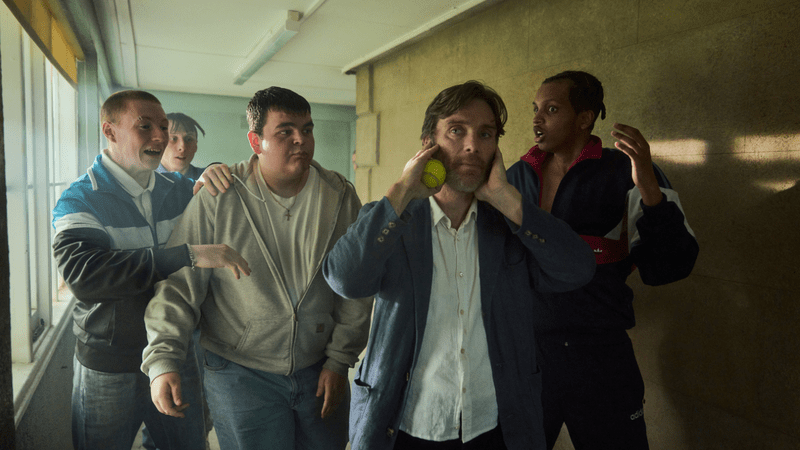
( Cr. Robert Viglasky/Netflix © 2025. )
Alison Stewart: In the new film, Steve, Oscar-winning actor Cillian Murphy stars as a man having a very, very bad day. Steve is the head teacher at a reform school for boys in Britain. His pupils are funny and angry and talented and an explosive. Steve has to be everywhere at once, stopping fights and encouraging learning, and telling his students that they can't call him terrible names to his face. On this particular day, a journalist and a camera crew are at the school to do a story on the school and its students. The kids are very excited to be on camera, Steve less so.
Things go downhill fast when one of Steve's favorite students, a kid named Shy, has a terrible phone call with his mother. He starts to act out with the camera crew rolling. To make matters worse, Steve receives troubling news about the future of the school, and Steve himself is struggling with addiction, sneaking drinks and taking drugs throughout the day. All of this swirls together into a toxic stew. When a crisis with Shy arrives, Steve isn't fully prepared to handle it. Steve is in select theaters on September 19th and on Netflix, October 3rd. Here's my conversation with Cillian Murphy.
[music]
Alison Stewart: Cillian, this all happened fairly quickly. It went from a book to a script to shooting. How long did that take?
Cillian Murphy: I'd say about maybe six months. It was pretty quick.
Alison Stewart: What do you like or what's good about shooting in such a quick style?
Cillian Murphy: Well, I always prefer a shorter shoot than a long shoot, particularly for a story like this. It's very hard to sustain that, certainly for this character, that level of charged anxiety and live it. I was also a producer on this film, so I was double-jobbing. A nice, brief shoot was probably the best in this instance.
Alison Stewart: What did you learn about producing, making Steve, that you maybe didn't know before?
Cillian Murphy: Oh, gosh. Well, I employed a few things or a few approaches on this film that I'd learned many years ago when I was working with Ken Loach. One of which we managed to shoot the film chronologically and sequentially. That was massively beneficial to us and to the younger actors and to the crew. Ultimately, that's what you do if you could with every film. Just logistically, it doesn't make any sense if you're moving around the place. We're in one location, so we managed to do it.
Then there are a few other tricks, like the scene where the head of the trust comes to tell them the school is shutting down. We had never encountered those actors or met them or rehearsed with them or seen them on the set. The first time they walk into the room is the first time we'd ever seen them. The scene was incredibly charged and incredibly adrenalized when it happened. There are the takes that we used in the film. That's a Ken Loach tactic.
Alison Stewart: That's interesting that you shot chronologically. Why would that be useful to young actors?
Cillian Murphy: Well, because you're not jumping around the schedule all the time, shooting the end first. They're accumulating the information emotionally as they go along, as per the character. Say if it's your first time making a film, it's like life. You're gathering it in a linear fashion rather than a crazy, all-over-the-place fashion.
Alison Stewart: Is that something that you learned to develop as an actor in film?
Cillian Murphy: You can't do it normally, but I had the luxury of doing it once. If any time I can, I'll try and do it.
Alison Stewart: Tell me about working with your director. You've worked with him before?
Cillian Murphy: Yes, this is our third piece of work together. He's a magician, really. I'm in awe of what he does. We worked together on series three of Peaky Blinders. It was a very different piece of work because it's quite broad in some ways, and it's very aggressive and loud. Whereas this film, it had to be very, very sensitive and delicate. I could see that he had all those skills. He's a real, real artist. We had made this other film together called Small Things Like These. Actors absolutely adore working with him.
Alison Stewart: What's his name again?
Cillian Murphy: Tim Mielants.
Alison Stewart: I'm glad you said it. Tim Mielants. [laughs]
Cillian Murphy: Tim Mielants, yes. I'd work with him forever. We have a massive understanding and trust together.
Alison Stewart: Why do you trust him? Why do you trust Tim Mielants?
Cillian Murphy: Well, you learn that through work and experience. You know that he'll be there to protect me. He's not going to let me down, and I'm not going to let him down. We have a shared taste, I think, and we really care about each other. Therefore, when you go to do the work, you feel safe.
Alison Stewart: That's interesting, feeling safe for an actor. What does that mean exactly?
Cillian Murphy: Just feeling safe to experiment, feeling safe to try things out, to make mistakes. Sometimes mistakes are portal to real creativity, I think. You have to be in a safe environment to do that.
Alison Stewart: We're talking to Cillian Murphy about his new film, Steve. He produced it as well. We get this glimpse into Steve's life at work. Not so much his backstory, not so much what's going on with him outside of the school. In your head, did you have a sense of Steve's backstory?
Cillian Murphy: To a degree. The way the film is structured is that it's a day in the life. It begins at eight o'clock in the morning on one day, and it finishes at the same time the next day. Really, all you need to know about the characters is what you receive on the screen. A lot of the younger actors had a whole constellation of lives worked out for them. Then I talked an awful lot to the writer, Max Porter, about Steve. Ultimately, for me, it was more about reacting than acting, if you know what I mean, this particular job.
Alison Stewart: Because you had to react because--
Cillian Murphy: Well, because that's the way that his day unfolded was, "Oh, [beep] I didn't realize that the documentary crew were coming. Oh, my God, there's a member of parliament coming." He's one of these people that has a deficit of time, a deficit of sleep, a deficit of budget. He's over-caffeinated. I felt that the best way to do it was not to plan anything and just to be completely open to what I received, really.
Alison Stewart: When he realizes that the documentary crew is going to be there, the look in your eyes is just like, "Oh, crap, I can't believe this is happening."
Cillian Murphy: Yes, we've all been there, right?
Alison Stewart: Why do you think Steve has come to this job, this job being a teacher at a school for at-risk boys?
Cillian Murphy: Well, both my parents are retired teachers now.
Alison Stewart: Oh, my mom was a teacher.
Cillian Murphy: Well, there you go. So many people I've met over the course of promoting this film have teachers or social workers as parents. I think it's a vocational job. I think you need to do this thing. You have a drive in you to help people, or to help children in this case. I feel like the kid that has been written off for the kid, this is the institution or society has abandoned ideologically. If you can reach that kid and make him or her feel seen, I think if you can do that, that level of satisfaction keeps bringing people back to it. This is not being a teacher, but growing up around teachers, this is what I feel is the drive for the good ones.
Alison Stewart: Steve, he seems like someone who is truly dedicated to his work, to helping these kids. What do you think he loses or sacrifices by giving so much to the children at the school?
Cillian Murphy: I think that it's that old adage, put on your own oxygen mask first before putting on others. I think he's probably not carrying it for himself in any way. He's minding all these kids, and the school is falling apart, and it's underfunded, and then he's going home, as you say, to these two little girls and his wife. They're probably struggling to meet the mortgage and all these things. I think the last thing he's thinking about is himself. There's a lot of unresolved things that he's carrying around that become clear over the course of the film.
Alison Stewart: What does he want for the boys at the school?
Cillian Murphy: I think he's working day to day. I don't think he really has an overarching ambition. I think he wants them to be okay today and then okay tomorrow. Then, ultimately, I think he wants them to feel like they are valued and that they are valued in the school, and then hopefully valued by society, because a lot of them would have-- I think there's a generational shame or whatever that's passed down, or they've not been looked after or there's been absent parents or whatever, so just to feel valued, I think.
Alison Stewart: He's very good at de-escalation.
Cillian Murphy: Yes.
Alison Stewart: Why do you think he's so good at de-escalation?
Cillian Murphy: Again, I think some people have a nature like that. They don't have that sense of aggression or they don't react in that way. They are diffusers.
Alison Stewart: I always wonder about those people because they're so calm in a moment, which could easily turn. There are moments in the film where it could easily turn. How did you work with that dynamic? Is it in the script? Is it the director?
Cillian Murphy: Yes, it's very much working with Tim, the director, and with Max the writer, and pushing it and pushing it and pushing it physically. That first fight with the boys that he intervenes in, we added the bit that he actually gets knocked down and knocked over. That wasn't part of it, but we worked that out in the blocking of the scene.
Alison Stewart: More interesting.
Cillian Murphy: You keep turning it up to the point where it's not just breaking the fight up. In fact, he's getting knocked down, but he manages to hold it together and stuff like that just to keep experimenting with the scenes.
Alison Stewart: Did you tap into anything personally when you were in those scenes? Were you like that as a teenager? Were you ever like that as a young man, where you just thought, "The world isn't going to understand me. I don't want to deal with it. I'm walking away"?
Cillian Murphy: Well, I think that's the condition of adolescence, really, isn't it? You think you're the most important thing in the whole world. It's a very solipsistic existence, as it should be, where you're the most important thing that's created. Then if you don't have any support system or outlet or anyone to talk to, it can turn inwards and become very problematic. I guess I had all of that. Luckily, I had a very stable family. I was very lucky. You can see how it couldn't go anyway, really.
Alison Stewart: Was acting ever a part of that when you were young?
Cillian Murphy: No, I didn't start till I was 20, but I was playing music. I was playing a lot of music.
Alison Stewart: Oh, really?
Cillian Murphy: Yes.
Alison Stewart: What did you play?
Cillian Murphy: I was just playing in bands for a long time, yes.
Alison Stewart: Any names that we would know?
Cillian Murphy: Plenty, plenty. You don't need to know them.
Alison Stewart: [laughs] I worked at MTV for a very long time. Since I was asking, I was curious.
Cillian Murphy: We never ever got anywhere near MTV.
Alison Stewart: My guest is Oscar-winning actor Cillian Murphy. We're discussing his new movie, Steve, which is about a head teacher at a last-chance boys' reform school. It's in select theaters on September 19th and on Netflix, October 3rd. What was it like to work with so many young actors on a set?
Cillian Murphy: They're amazing. They give me a real shot in the arm, their commitment and their energy for it, and their dedication. That's something you try to sustain over a 30-year career. Those guys have it in such-- it's so natural to them, and they're so committed. I thrived off their energy.
Alison Stewart: What did you get out of working with young, young actors?
Cillian Murphy: I just think it's their life, the life that they have, and that sense of potential that gets eroded as you get older, I suppose.
Alison Stewart: I love that Tracey Ullman was in this. It was interesting watching a couple of interviews that you've done about the film. She makes you smile every time she talks about her character, which isn't a particularly comical character.
Cillian Murphy: No.
Alison Stewart: Not at all. What did you like about working with Tracey Ullman?
Cillian Murphy: She's just an icon, and she's just also a beautiful human being. She's a really caring, kind, soulful person who happens to be hilariously funny, but is a brilliant dramatic actor, and just doesn't get to show that off much. It was great to see her be so brilliant in this role, which is a very demanding role.
Alison Stewart: What was the relationship between your character and her character?
Cillian Murphy: I think she's his most important confidante and friend in the world. I think he tells her more than he tells his wife, and everything about work. I think he compartmentalizes everything.
Alison Stewart: Oh, interesting.
Cillian Murphy: I think that's the only way he can survive.
Alison Stewart: Is that where the addiction comes in?
Cillian Murphy: Yes, I think he compartmentalizes that as well. Those people who have that way of saying or rationalizing these things, insanely saying, "It's okay for me to hide drugs in the laundry room, to hide whiskey in the basement," that's totally--
Alison Stewart: It makes sense.
Cillian Murphy: It makes sense, yes, and that's it. Then it's okay for me to not tell my wife what's just happened to work, or it's okay for me to not tell Amanda that I'm relapsing and all these things. You know what I mean? That's the kind of tricky world of addiction. Everything becomes justified, I think.
Alison Stewart: There's a boy at the school named Shy, which is what the book is based on.
Cillian Murphy: Yes.
Alison Stewart: What's Steve's relationship with Shy?
Cillian Murphy: I think they're two sides of a coin, really. They're both really sensitive and brilliant people, and very open people. On this particular date, events trigger them both into this breakdown. They're circling around each other. They both really care for each other, but they can't reach each other. Their relationship starts off at the beginning of the day, and things are going all right, and then events take place that fracture that relationship in a terrible way. In the book, it's heartbreaking. I hope in the film, it touches people, too.
Alison Stewart: What is it about Shy that really touches Steve?
Cillian Murphy: I think he sees his talent and his humor and his passion for music. Like you said, I think he sees it in all those kids. I think he sees the best in people. He's not one of those people.
Alison Stewart: It's interesting because he just describes each boy with such-- describing their charm and what they're good at. People would not necessarily agree with it, maybe when they first meet young men. How does he find that in people? What is it about Steve that he finds the best in all of these boys?
Cillian Murphy: I really don't know the answer to that. I think it's just a type of person that is selfless, and I wish I had that. It's an amazing trait.
Alison Stewart: When Steve sits down with this documentary crew that shows up, and he thinks, "Oh, gee, I have to deal with these people as well," they ask him to describe himself in a few words. He says, "Very, very tired."
Cillian Murphy: Yes.
Alison Stewart: What is making him so exhausted?
Cillian Murphy: I think it's everything that I just described, the school falling apart, trying to raise a family, trying to stay sober and clean, and try to hide all of these things, try and compartmentalize all of these things, not looking after his health. Yes, that's, I think, some of it.
Alison Stewart: Do you think he's a good leader? Steve's a good leader?
Cillian Murphy: Yes, I do, actually. Yes.
Alison Stewart: What makes him a good leader?
Cillian Murphy: I don't know because he cares about people. He cares about his staff, and he really cares about the kids. He's non-judgmental, and he's compassionate.
Alison Stewart: The one thing that does trigger him is when it is announced that the school is going to be closed.
Cillian Murphy: Yes.
Alison Stewart: It's also done in a real cheesy way, kind of a gross way. [laughs] Why does that trigger him out of almost everything we see that day?
Cillian Murphy: Because I guess that represents the bureaucracy, and when people begin to see these institutions in terms of numbers and figures and profit and loss rather than human beings. They look at these children as statistics and problems rather than human beings. He's confronted by these two people. I think all his commitment and dedication over the years has just been eroded by someone in an office. He just can't take it.
Alison Stewart: Your beard looked like you hadn't shaven in several days.
Cillian Murphy: Yes, it's not a very attractive beard. [laughs]
Alison Stewart: It's interesting, though, when you get into a character, when you get into his physicality, what was it about having a beard? What was it about wearing clothes that were a little bit too big that helped you get into character?
Cillian Murphy: I just think that he doesn't care about his appearance. He doesn't care about any of that stuff. I think that in his youth, he may have had aspirations to be like, I don't know, a writer or something like that. Again, no time. Everything gets left. All the self-care just gets abandoned, so he's like, "Well, shaving is irrelevant."
Alison Stewart: It's interesting because I think we have different opinions about what the end of the movie might have meant, which is fine because it's good. People have different opinions about art.
Cillian Murphy: Yes, I think it's not meant to be, in any way, prescriptive. It's meant to be ambiguous entirely and open to interpretation.
Alison Stewart: I said that he goes home. I'm not giving much away. He goes home and has a normal life after this really terrible day he's had. He had to deal with so much. I don't want to give that part away. There's a little pink bedroom, and his little girls are there, and his wife is really lovely to him. I thought that was, "Oh, we've just seen him in one circumstance. He's got a whole other life we have to deal with, too." What did you think happened?
Cillian Murphy: I don't want to say because that's just my interpretation. People see the film through the lens of their own life experiences. I have a friend and she has daughters. She saw the movie, and she said, "He's got daughters. He's going to be there for his daughters. Other people might have a different opinion." I really enjoy that in art, where the audience finishes the story rather than the storytellers.
Alison Stewart: Yes, I thought daughters was interesting. They're cute daughters, and they're sweet.
Cillian Murphy: Yes, they're not big men charging around half-formed men. He's raising girls when he's minding boys.
Alison Stewart: I want to ask about Peaky Blinders before you have to go. The new film is set to premiere next year.
Cillian Murphy: Yes, next year.
Alison Stewart: The Immortal Man. It's what it's called?
Cillian Murphy: Yes.
Alison Stewart: All right. What keeps you interested in playing that one character after all these years, Tommy?
Cillian Murphy: Yes, the writing was always the draw because it was exceptional writing. I'm always attracted to good writing. It's rare to play a character for 12 years, which was a quarter of my life. You get to age with that character. You never get to do that. Normally, you play characters at that point in your life at that time. Whereas this, I got to do it for such a long time. You can go to places you never normally would, really.
Alison Stewart: You don't have to name names, but have you just turned down a script because the writing wasn't good?
Cillian Murphy: Oh, yes. [chuckles]
Alison Stewart: It could have had all the names attached to it, but you were like, "No, no, this writing is not for me. This is not a good piece of writing."
Cillian Murphy: Yes, but it's generally a combination of elements. It's not just the writings. It's the directing. The foundation of every film is the script. If the script is shaky, the house is going to fall down ultimately.
Alison Stewart: Can a script be fixed or no?
Cillian Murphy: Well, it depends, the extent of the damage. [laughs]
Alison Stewart: What do you mean?
Cillian Murphy: How extensive the fix is, I suppose.
Alison Stewart: I would say my last question. I don't think it's going to work because I was going to ask you what you hope audiences take away from Steve. It's not that you don't care. It's that you don't want to tell us what to take away.
Cillian Murphy: No, I care incredibly about it.
Alison Stewart: They see it.
Cillian Murphy: Yes, and the responses we've been having are so genuine and so profound. I'm not saying that just for the sake of saying it. People have been writing to us. I've had really, really, really long, emotional conversations with people about it. That's what I mean that the film isn't finished until people see it, and the audiences finish the film for themselves, and we don't do it. I think the less that I say about it, the better.
Alison Stewart: Even if huge amounts of audiences don't see the film, are you happy with the way it came out?
Cillian Murphy: I'm entirely happy with the film, yes. The beauty of it is that audiences really seem to be connecting with it.
Alison Stewart: The name of the film is Steve. I've been speaking with Cillian Murphy. Cillian, thank you for making the time. It was good to talk to you.
Cillian Murphy: Pleasure.