
Celebrating the Life of Comedy Legend Mel Brooks
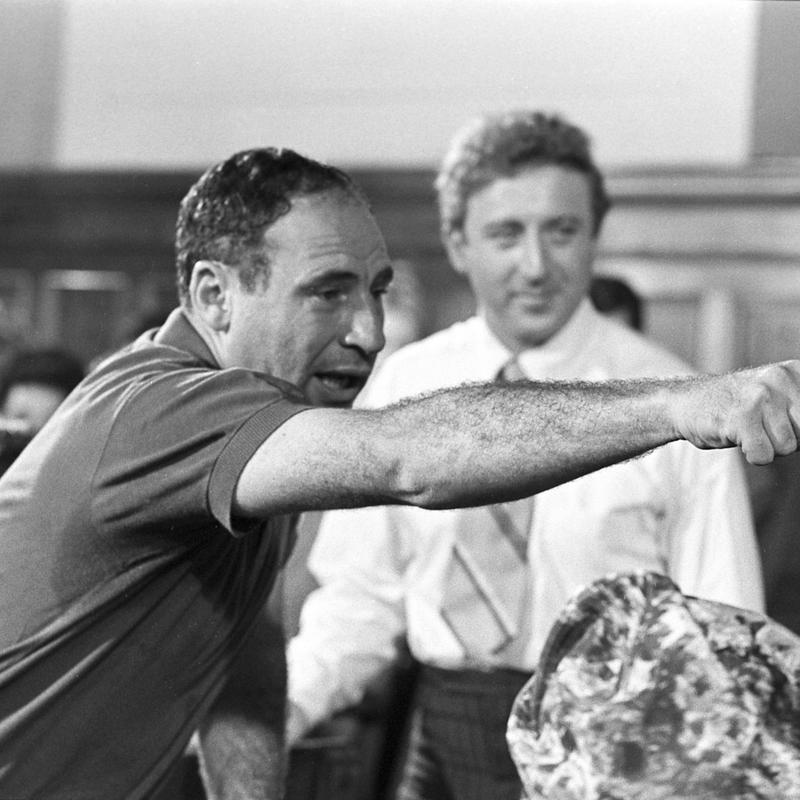
Alison Stewart: This is All Of It on WNYC. I'm Alison Stewart. If you're holing up this weekend to avoid the weather, it's a great time to go back and to listen to some of our conversations we had this week on the show. Earlier this week, we spoke to Dr. Patricia Papernow about step-parenting. She shared some advice and answered listener questions. Let me tell you, if you are in a blended family is a must-listen. You might want to listen to Mark Strong. He plays Oedipus on Broadway or Namir Smallwood. He's starring in Bug opposite Carrie Coons, two great conversations with Broadway actors. You can hear all of our segments wherever you get your podcasts or on our show page @wnyc.org. Now, let's get this hour started with one of Brooklyn's most famous exports, Mel Brooks.
Speaker 1: Hello, young lovers, whoever you are. What do I spy? A little grain of rice. Newly married.
Speaker 2: This morning.
Speaker 1: This morning, folks, and they said it wouldn't last.
[laughter]
[MUSIC-Mel Brooks: High Anxiety]
But then you take my hand
My heart starts to soar once more
Key change!
High anxiety
It's always the same
Hey-xiety
It's you that I blame
It's very clear to me
I've got to give in
High anxiety
And remember, folks, be good to your parents
They've been good to you
You win
Alison Stewart: That's a title song for Mel Brooks's film High Anxiety, in which the Hollywood legend of the Lampoon takes on the highbrow work of Alfred Hitchcock. He spoofed classic horror and Young Frankenstein. He had fun with sci-fi and Spaceballs, and he took on western and racism in Blazing Saddles. Mel Brooks was born 100 years ago this June. To celebrate his life legacy and the laughter, a new two-part docu-series called Mel Brooks: The 99 Year Old Man is available to stream on HBO.
In the role of fan is Judd Apatow, who takes Brooks from his childhood in Brooklyn to his first experiences as an entertainer in the Borscht Belt onto Hollywood hits that have made him a household name. Joining me now is Michael Bonfiglio, co-director with Judd Apatow of Mel Brooks: The 99 Year Old Man. Hey, Michael.
Michael Bonfiglio: Hey, Alison. Thanks so much for having me on. I'm a big fan of your show.
Alison Stewart: Oh, thanks a lot. What did Mel Brooks mean to you growing up?
Michael Bonfiglio: He was around all the time. I remember, I think the first Mel Brooks movie I saw was we had a sleepover birthday party and rented Young Frankenstein when I was a kid. We just thought it was amazing and weird and funny. He was always just part of the fabric of laughter. It was really exciting to get to spend time with them and make this film.
Alison Stewart: How did you decide how to use Judd Apatow in the film?
Michael Bonfiglio: Judd has a relationship with Mel that they've known each other for quite a while. We felt like it would help the interview to have Judd on camera to interact with Mel. Frequently, we stay off camera, and we did for all the other interviews. We wanted to have kind of a loose feeling, knowing that we were going to be going back to a lot of old talk shows and other appearances that Mel has made over the years, and wanted our original footage to feel unique. We shot most of it handheld and had it feel like hanging out with Mel.
Alison Stewart: Was it hard to keep Judd sort of-- hard to direct him a little bit because he's such a fan?
Michael Bonfiglio: He is. Mel just is everything to Judd. Judd's also a performer, so he was aware that the cameras were on. I think the biggest challenge for him was getting Mel away from some of the stories that he's told a million times and try to get a little bit beneath the surface to get to as much as we could, the real Mel, and I thought Judd did a great job. We did about 10 or 11 hours of interviews over the course of four different days. That was how we did it.
Alison Stewart: That's a lot of interview for a man who's in his late 90s. [unintelligible 00:04:59]
Michael Bonfiglio: Yes, he's 99. We started the movie when I think he was almost 98. He's just incredibly quick. I saw him the other night that he came to our premiere, and he's amazing. We can all hope to be as sharp as he is at 99.
Alison Stewart: Listeners, if you're a Mel Brooks fan, call in and tell us what your favorite moments from his films are, or maybe you have quotes from Young Frankenstein or Blazing Saddles that you use in your daily life. Call and share in the impact of the comedy legend Mel Brooks what that has been like for you. Our number is 212-433-9692, 212-433-WNYC. The film goes all the way back to the beginnings.
Mel Brooks' father died of tuberculosis when he was 2, leaving his mother to care for him and his three older brothers. The Depression would hit a little later on. Let's listen to a bit of your film about what he says growing up in the woods, as he says, an ugly kid in Brooklyn.
Mel Brooks: I was able to make all the guys on the block laugh. I was able to tell the stories. I was the commentator on life. I was the Jiminy Cricket to their Pinocchio. I was the comic conscience of my neighborhood, and I always felt adored. I think that, given a lot of love as a child, it was the need to continue it. I never really did feel inferior, though I had every right to, looking at myself in the mirror, but I never did. I never felt inferior.
Alison Stewart: How did his family fare during that time? A very difficult time.
Michael Bonfiglio: The way he puts it is they didn't know anything different. As a kid growing up in the Depression in Brooklyn, it was just how things were. I'm sure that for his mother and his aunt, who helped them out quite a bit, that it was a real struggle. They really didn't have two nickels to rub together and managed to make it, and Mel found his calling in show business.
Alison Stewart: How do you think it shaped his approach to comedy?
Michael Bonfiglio: I think probably the idea of having almost nothing to lose and going no-holds-barred. He started off actually as a drummer and would play the drums on street corners and subway platforms and anything he could get when he was a young teenager, 13, 14 years old. Eventually made his way to the Borscht Belt and the Catskills and started as an understudy in a theatrical production up there. I think that his Brooklyn upbringing is still part of who he is. He still has a New York accent, despite the fact that he's lived in Southern California for about 60 years now. I think it's part and parcel of who he is.
Alison Stewart: So much of Mel's persona is couch and being a Jew from Brooklyn. That's his deal, right?
Michael Bonfiglio: Totally, yes.
Alison Stewart: Aside from comedy, what did his Jewish New York identity mean to him?
Michael Bonfiglio: I think it's more of a cultural thing for him. He did not grow up particularly religious and still is not particularly religious. I don't believe he was even a Bar Mitzvah. I think that the Jewish sensibility in comedy is part of something that he's helped-- It's not just part of the fabric of his comedy and who he is, but it's something that he's helped perpetuate into the culture. It's so just connected with, I think, what we think of as American comedy is a Jewish sensibility that is also specifically New York, I think.
Alison Stewart: We're talking with Michael Bonfiglio, co-director of the new biographical docuseries, Mel Brooks: The 99 Year Old Man. Let's talk to Jason in Dobbs Ferry. Hey, Jason, thanks for making the time to call All Of It.
Jason: Hey, I can't wait to see this documentary. I'm a huge Mel Brooks fan, and thank you for making it. I just wanted to point out that I think over the course of his career, people have regarded him as an incredible performer, making really funny films, but I think he's been overlooked for his skill as a director, his filmmaking. He shoots films incredibly. You look at how Young Frankenstein was shot, and he casts impeccably, and the performances by these actors. Who would have thought Gene Hackman in a comic role like that? I just want people to give their due for him as an incredible filmmaker as well. I do have one favorite line, if I could share that.
Alison Stewart: Sure, go for it.
Jason: In History of the World, there's a scene around the Last Supper when everybody is sitting next to Jesus, and Mel plays a waiter who is taking their breakfast order. At one point, Jesus says, "One of you will betray me tonight." There's this really tense moment, and somebody says, "Who?" The waiter goes, "Judas." Everybody turns, and he goes, "How do you want your eggs?" I just think that's one of the best moments in film.
[laughter]
Alison Stewart: Thanks, Jason. Let's talk to Lee from the East Village. Lee, you're on the air.
Lee: Thank you. I also am a big Mel Brooks fan, going all the way back to the producer's 2000 Year Old Man. I'm a physician, but I have this ridiculous knowledge of film because I love it. I think the scene that Mel Brooks doesn't get as much attention, but it deserves some attention, is To Be or Not to Be, in that there is a song and dance with Anne Bancroft in Polish to Sweet Georgia Brown, and it's stunning. You just feel the love and the happiness and the joy of watching this. That's all I could say. The point, though, that I have a poster for the remake of To Be or Not to Be in Polish in my house, and every time I see it, I smile.
Alison Stewart: Lee, thanks for calling. That's really interesting. Michael, he's jumping ahead, talking about Anne Bancroft. Anne Bancroft was actually his second wife, we should say.
Michael Bonfiglio: Yes.
Alison Stewart: It was funny the way they met because he stalked her for a week, for the lack of a better-- That's the phrase he uses-
Michael Bonfiglio: It is.
Alison Stewart: -that he stalked her for a week. He kept just turning up wherever she was. She said, interestingly, that she fell in love right away. What was at the heart of their relationship?
Michael Bonfiglio: I don't know exactly. I think there was a tremendous amount of mutual respect. I think that there was some just romantic magic that they had because they had this incredible 40-plus-year relationship that lasted until Anne passed in the early 2000s. They loved working together, they loved making each other laugh. They were each other's best friend and soulmate. It's a really beautiful love story that we explore quite a bit in the film, but it's one of the great Hollywood love stories.
Alison Stewart: You see it in the film that he talks about her, and then he looks sad. [crosstalk]
Michael Bonfiglio: I think it's still very hard for him to talk about her and to see her on screen. In the interviews, anytime that Judd brought up Anne, he got wistful and a little quiet, and is still not super comfortable talking about her. I think the loss is still very, very present for him, and we found it very moving.
Alison Stewart: Let's talk to Bob in Jackson Heights, Queens. Hi Bob. Thanks for making the time to call All Of It.
Bob: Thanks for having me. I was thinking about there's a movie called My Favorite Year, about a kid that gets a job in an office working for mythical character. We know it's Sid Caesar and the writers' staff is those legends. I meant Neil Simon, Matt Hike, and Mel Brooks, et cetera. Anyway, My Favorite Year was the summer of '67, and one of my closest high school friends got a job as a production assistant on this movie that Mel was making, which was not yet named The Producers, but they were making it all summer in midtown.
I was lucky enough to get to go to be a hanger-on and just lurk in the background, and watching film scenes. Then even better was that the cast and he would go to a restaurant called Max's Kansas City, 17th in Park almost every night and just hang and drink, and tell stories. I got to talk to Mel, and I learned he had been a musician in the Catskills. He was a drummer. His name, Max Kaminsky, was stenciled over his bass drum.
Alison Stewart: You know what, I want to interrupt you there for one second, though, because I want to bring in Michael. You go into that in the documentary, that his name was Max Kaminsky.
Michael Bonfiglio: Yes.
Alison Stewart: It's really a funny story. Would you tell us that about him?
Michael Bonfiglio: Yes. One of the funny things about Mel is you never know exactly how much of his stories are true or not. He was born Max Kaminsky, and he was a drummer in the Catskills, and playing all kinds of gigs, weddings, and bar mitzvahs, any place he could make a buck. He tells a story in the film that he was once booked on a date, and there was also a trumpet player named-- Oh, gosh, I'm forgetting the name, but the same last name, Kaminsky.
He showed up to the date, and the people who'd booked him said, "Where's your trumpet?" They had booked the wrong person. His mother's maiden name was Brookman. He changed his stage name to Brooks, and it stuck, and that's where we are now. What a great story about hanging out on the set of the producers. Incredible. I think at that time it was called Springtime for Hitler.
Alison Stewart: Oh, we'll get into that and a whole lot more after a quick break. This is All Of It.
[music]
Alison Stewart: You're listening to All Of It on WNYC. I'm Alison Stewart. We're discussing the new docu-series, Mel Brooks: The 99 Year Old Man. You can watch it on HBO. I'm talking to its co-director, Michael Bonfiglio. Michael, Mel Brooks, and his brothers were enlisted to fight in World War II. We learned this in the documentary. How did he feel about the war when it's happening? How did he feel about prejudice during the war?
Michael Bonfiglio: I think even till today, he sees the Second World War as the last great correct war. I think he enlisted in the reserves when he was just 17, still in high school. He went into the combat forces right out of high school toward the tail end of the war. He felt like many Americans and Allied forces that this was a just war, that fighting the Nazis and fighting fascism was correct and just, and was important. He spent time in France, in particular, right after the Germans had left. He was clearing landmines and checking for booby traps. He was shot at. He had real combat experience, and I think it affected him very deeply.
Alison Stewart: It's interesting. Let's talk to Steve from Queens. He has a question about this. Hey, Steve, thanks for calling in.
Steve: Thank you for taking my call, and you guys did a great [unintelligible 00:18:18] I didn't get to see the whole thing, but great documentary from what I'm seeing. I'm so glad you're getting to talk with this man and hang with him. He was an engineer I know, during the war and clearing mines. That's what amazes me, for this man to have the-- He's always, my lifetime seemed like this happy, go lucky. There's jokes.
I had heard a story that he had met for Bob Hope at one of his Bob Hope shows during the war and was trying to, I guess, hang, and talk with him or whatever, but Bob was like, "I got a lot to do," and was like, "Kid, go over there." That's a story I'd heard. I don't know if it's true or not. I thought I'd ask that, and I'll let other people talk. You take care, and thank you very much for taking my call.
Alison Stewart: Did you ever hear that story?
Michael Bonfiglio: I have not heard that story. With 100 years of life, Mel has so many stories. My take on it is there's always a kernel of truth in all of his stories, but a lot of them, he's reworked and embellished and made funnier and more entertaining over the years. After the war ended, he stayed in the service and did entertainment for the troops. It's certainly very possible that he would have crossed paths with Bob Hope. I'm not familiar with that particular story, but it's probably true.
Alison Stewart: This brings us to The Producers, a movie musical about Hitler. Supposed to fail, but it doesn't. It's very funny, but it does have a serious meaning to it. What's the deeper conversation that he was trying to have with The Producers?
Michael Bonfiglio: I think that the idea of making fun of Hitler-- The producers came out 22 years after the war, which if you think about at that time, the revelations of the Holocaust and all of that, no one was making comedy out of this kind of material. People were not joking about Hitler. During the war, Chaplin and the Looney Tunes Cartoons and, lots of people were poking fun at Hitler, but after the war and the revelations about what had happened during the Holocaust, people weren't joking about it.
The Producers was so bold in making fun of Hitler and Nazis, and fascism that it was really quite striking, and a lot of people considered it to be in terrible taste. I think Mel's philosophy in making fun of fascism and Nazis is about demoting and reminding people that these are people, and let's take away their power. You see the legacy of that today constantly, and every meme of Greg Bovino and Stephen Miller and all these other psychopaths who are making decisions right now. It's important.
Alison Stewart: It's like South Park.
Michael Bonfiglio: Absolutely. It has been incredible.
Alison Stewart: Let's talk to Elise from the Upper West Side. Hi Elise, thanks for calling, All Of It.
Elise: Hi, thank you for having me on. I was very much raised on Mel Brooks' comedy and huge fan. I just wanted to share my favorite quote, my favorite memory from the 2000 Year Old Man, which is, "Never run for the bus." He's asked how he's maintained his longevity, and his answer is, "Never run for the bus." I think of that every single time I run for the bus.
[laughter]
Alison Stewart: Elise, thanks for calling in the 2000 Year Old Man. This, I learned from the documentary, was a bit he used to do at parties.
Michael Bonfiglio: Yes. It was an improvised bit that he and Carl Reiner did. Carl was actually pitching a sketch. They were both working at Your Show of Shows. It was the early 1950s, and Carl was pitching a sketch for the show and it did not make it to the show. It was the thing that he and Mel would do just to make each other laugh, make people at parties laugh. At one party, Steve Allen, the talk show host and comedian, saw them perform this where it killed for everybody who saw it, and he convinced them to put it on a record.
The record became a hit and really brought Mel for the first time into the public eye. He had been working on Your Show of Shows for many years, but was only behind the scenes. He was a writer and no one had really seen him. The 2000 Year Old Man got him before the public in a new way and really was the beginning of Mel the performer publicly.
Alison Stewart: A person who was his real, I guess, mentor is the right word, would be Sid Caesar.
Michael Bonfiglio: Absolutely. Mel is the first person to say that without Sid Caesar, there's no Mel Brooks. Sid Caesar was somebody who Mel met up in the Catskills. Sid took a real liking to Mel and brought him onto Your Show of Shows, where initially, Sid was paying Mel under the table just out of his own pocket. Mel was not officially part of the staff in the beginning. Mel credits him with really giving him his start to his career. Then later on, Mel repaid the favor by putting Sid into History of the World, Part 1, and he's in a couple of the other movies as well. He's in silent movie.
Alison Stewart: Let's take up more calls. Let's talk to David from Lloyd Harbor. Hi David, thanks for calling, All Of It.
David: Thanks for having me on. Big Mel Brooks fan. I just want to say that I knew I married the right woman when my wife got up in the middle of the night and bumped into something and she quoted Madeline Kahn from Blazing Saddles and said, "God damn it."
Alison Stewart: [laughs] Thanks for calling. That's funny. Kenny is calling from Wayne, New Jersey. Hi, Kenny.
Kenny: Hey. I'm calling because I'm. I've always been a huge Mel Brooks fan ever since I was probably about 8 years old and saw my first Mel Brooks film, which probably was a bit too young. I have many memories with my best friend watching Spaceballs on the weekends. We've definitely seen the movie over 100 times, can probably quote the whole thing. Since our childhood, we've now been friends for about 20 years and still quote the movie to each other.
We will always call each other up and remind each other of our good times, quoting Spaceballs. Probably our favorite quote is the Abbott and Costello-esque scene in which they're watching themselves on the screen, and they say, "What happened to then?" "We missed it." "When?" "Just now." "When will then be now?" "Soon."
[laughter]
Alison Stewart: Thanks for calling in, Kenny. We're talking to Michael Bonfiglio, the co-director of the new biographical docu-series Mel Brooks: The 99 Year Old Man. You can watch it on HBO. Throughout the docu-series, Michael, we hear Mel Brooks talking about some really big feelings about anger and fear, and death. Let's listen to a little bit of him from the documentary, his thoughts on fear and comedy.
Speaker 4: The Jewish timing dictated most of modern comedy.
Mel Brooks: It has to do with fear. There's a great energy that fear can create. Is that guy coming for me? Is that a swastika, whatever?" There's fear. It's always lurking. It creates an energy. Fight or flight is right there for every Jew.
Alison Stewart: Where did he get the idea that humor could speak so directly to those serious topics like fear?
Michael Bonfiglio: I think that Mel's philosophy is that anything can be the fodder for comedy and that comedy is a really powerful force. He says at one point in the film, where he's quoted as saying, "Comedy is the opposite of death," that the joy and liveliness of comedy and laughter reminds us of why we're alive. Particularly in the face of darkness, it's important to connect to joy and to the reason why we need to get through the darkness and defeat the darkness. I think it's a real primal kind of a thing. Mel has just been such a proponent of that throughout his entire career.
Alison Stewart: Let's talk to Peter in Astoria. Hey, Peter, thanks for making the time to call, All Of It.
Peter: Hey, Alison, thanks for taking my call. Let me say Mel Brooks has made me laugh more and more over the years because I get more of his jokes as I've gotten older. History of the World, Part 2, he's coming down. He's Moses coming down from the mountain. He's carrying these three stone etched tablets, and he's walking, and he stumbles a little, and he drops one, and it goes-- I gave away the joke. "I bring you these 15-- oops, 10 commandments." Everyone's like, "Oh, 10 commandments now." As a recovering Roman Catholic, I've always enjoyed that part the most.
Alison Stewart: Thanks for calling in. He and Gene Wilder co-wrote Young Frankenstein, but Wilder said he would only star in it if Mel didn't act because Mel, as he described it, had a way of breaking the fourth wall, whether he meant to or he didn't mean to. What strikes you as a difference between a Mel Brooks movie with that kind of winking at the audience and a Mel Brooks movie that doesn't quite do that? Does the comedy land different?
Michael Bonfiglio: I think it does. I think one of the things about Young Frankenstein that makes it work so well, that one of the callers earlier discussed was that he had this just sort of slavish devotion to recreating the James Whale aesthetic from the original Frankenstein. By playing all of the camera movement and production design as just so seriously and then having the comedy juxtaposed against that, makes it even funnier.
I think Gene Wilder was right. I don't think that Young Frankenstein would work the same way that it does had Mel been in it, because there's just something about his presence that is so funny and self-aware in a way. I think it's one of the keys to why Young Frankenstein is such a classic.
Alison Stewart: He's had this lifetime of blockbusters, but he produced two movies with very dissimilar sensibilities to comedy. David Cronenberg's the Fly and David Lynch's the Elephant Man. What do you think most people don't know about Mel Brooks's contribution to filmmaking?
Michael Bonfiglio: Those weren't the only two. The film, My Favorite Year, Frances with Jessica Lange. There's a whole string of films from the late '70s through the '80s that Mel produced through a company called Brooks Films. Actually, one of the first productions was the Elephant Man. We were honored that we got to speak with David Lynch just a couple of months before he passed. He's in the film talking about Mel.
One of the fascinating things about the decision that Mel made to not only hire David Lynch after-- Lynch had only made Eraserhead, which was a midnight movie. It's one of my favorites, but it's a very odd movie. It's not a film that you would think a producer would say, "Oh, this guy should make a more mainstream narrative." Mel saw something in Eraserhead and in David that made him hire Lynch to direct the film, gave him final cut, protected him, and let him make the film that he wanted to make.
Then the most incredible thing is that Mel did not put his own name on the movie because he was worried that if people saw the name Mel Brooks, they would think it was a comedy. He didn't put his name on the movie despite having produced it.
Alison Stewart: You can learn a whole lot more about Mel Brooks in the docu-series Mel Brooks: The 99 Year Old Man. Thanks to all our listeners who called in, and thank you very much to co-director Michael Bonfiglio. Nice to meet you, Michael.
Michael Bonfiglio: So nice to meet you, Alison. I listen to your show all the time, and I'm honored to have been on.