
'Burnout Paradise' Explores the Treadmill of Life
Alison Stewart: This is All Of It on WNYC. I'm Alison Stewart. The show Burnout Paradise has been running for a little while now at the Astor Place Theatre. I mean running literally, because the cast is on treadmills the entire show. Burnout Paradise was created a few years ago by the Australian theater collective Pony Cam. The show demonstrates the challenges of burnout by giving four performers a seemingly impossible to-do list.
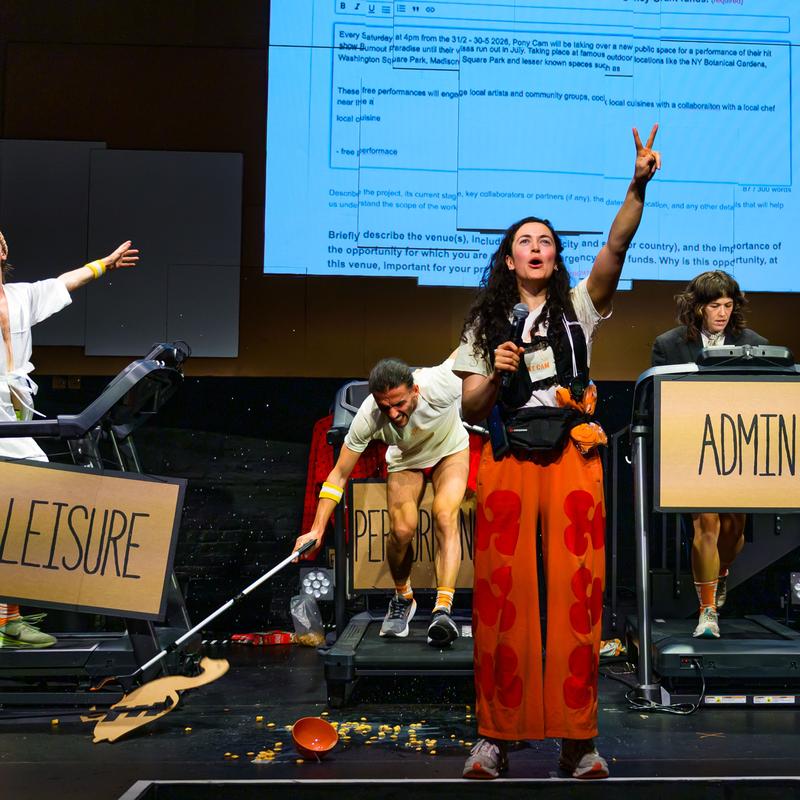
One cast member is cooking a three-course meal, including pasta from scratch, while running on a treadmill. Another is filling out a grant application while also running on a treadmill. A third is doing a performance of some kind, singing a song, or doing a monologue. The fourth has a long list of leisure tasks to complete, including things like chugging a beer and painting your nails, both running on treadmills. The audience is invited to help Pony Cam with this epic to-do list. If the performers/runners don't finish these tasks by the end of the show, the same audience gets a full refund.
Burnout Paradise is running now at the Astor Place Theatre. I'm joined now by three members of Pony Cam Collective: Ava Campbell, Dominic Weintraub, and William Strom. Thanks for joining us.
Dominic Weintraub: Thanks for having us.
William Strom: Hello.
Ava Campbell: Hello.
Alison Stewart: William, how did the collective of Pony Cam first form?
William Strom: We met when we were studying a theater degree in university in Melbourne. It was a three-year course. There was nine people in our cohort, and out of those nine, the five of us have stuck together.
Alison Stewart: What's the ethos of the group? What drives you?
Ava Campbell: I think what drives us is a collective sense of joy. We always say if we're having fun on stage, we know our audience will be having fun on stage. I think that really brings us together, as well as a deep love of comedy and clown, and works that make us think introspectively.
Alison Stewart: What was the original idea for Burnout Paradise?
Dominic Weintraub: At the time we came up with the idea, we'd been working together for about six years, sort of from the point of graduating all the way through COVID. Every year, we'd been making a lot of new work, four or five new shows a year, which is a lot.
Alison Stewart: That's a lot.
[laughter]
Dominic Weintraub: It's a lot of new work. It was really taking up all of our time and all of our lives and was forcing us all to sacrifice the things that mattered to us personally in order to keep this work going. Then, at the very point that we were really, really exhausted, a festival came to us and asked us to pitch a new idea to them by midnight. We looked at each other, and we were like, "Okay, we're going to pitch a new idea by midnight. What do we want to do?" We're all exhausted. What can we possibly do? At that point, Claire Bird, another one of the company members, was just like, "I don't care what we do, but I never get time to look after my body, and I want to get fit." We were like, "Okay."
Alison Stewart: [laughs]
Dominic Weintraub: We bought four treadmills. We're going to get fit. We're going to run together. Then, from there, this odd show emerged.
Alison Stewart: What did you think when they said you had to come up with it by midnight? That must have been shocking. [laughs]
Dominic Weintraub: It's an exciting push. It's a festival that means a lot to us, I think. Anytime we had an opportunity to work with those folks, we wanted to jump at it.
Alison Stewart: Ava, as you started to think about the show, you had to decide what the theme of the show, what the ethos of the show would be. What did you want the show to examine about burnout in the 21st century?
Ava Campbell: I think the show is really trying to capture that feeling of what it's like to do too much too fast for too long, and it examines the consequences of that. We wanted to create a picture of what that's like, but I think also we wanted to create a space where we could hold people's burnout and alleviate that burnout as well.
Alison Stewart: What did it mean for you when you thought about burnout as a theme for your show?
Dominic Weintraub: I really struggle with the idea of burnout. It's something that gets talked about a lot nowadays, and people really throw it around as really just a synonym for tired. It can be used really to just mean, I didn't have a good sleep last night, all the way through to I need to leave my job and move to another country. The idea of burnout to me feels so abstract and hard to hold on to. I think that, for me, a big part of making this show is about us trying to work out how we could hold all of that, whether it's whether you're tired or whether you need to move to another country. We're all here, we're all exhausted together, and trying to find a way to connect our experiences of exhaustion was important.
Alison Stewart: What does burnout mean to you, William?
William Strom: I think I share some of Dominic's observations. It feels like a very individual experience. It means something different to every person who feels it. I think through doing the show, we've also found that people feel it in isolation. Although we talk about it together, it feels like something that is a malady of an isolated individual in a way. One of the beautiful discoveries of doing the show is that by having this community that comes together, to work together, to support each other night by night, in the audience and in the performers, there's almost a remedy offered, or at least a way to keep moving.
Alison Stewart: We are talking about the show Burnout Paradise, which features four performers completing a nearly impossible to-do list in front of a live audience while running on treadmills, and the audience helps them along the way. My guests are performers Ava Campbell, Dominic Weintraub, and William Strom. Burnout Paradise is running now at the Astor Place Theatre. I have to think of a different way of saying running now. Let's talk about runners. Were you all runners before this started, Dominic?
Dominic Weintraub: No, not at all.
Alison Stewart: How about you, Ava?
Ava Campbell: No.
Alison Stewart: [laughs]
Dominic Weintraub: None of us were runners.
Alison Stewart: None of you were runners?
Ava Campbell: We were theather kids.
Dominic Weintraub: It was a reckless decision.
Alison Stewart: How did you know how to run, but you need to know how to run and be a performer? How did you learn this?
Dominic Weintraub: A lot of the rehearsal process. We made the show in three and a half, four weeks or so. A lot of the rehearsal process was just doing silly things on treadmills and trying to see what's interesting and what's not interesting, but also to train our treadmill "dexterity" so that we could stay safe-ish in all of the things that we're doing in the work.
Alison Stewart: Dominic, some of the stuff you seem to do looks a little dangerous.
Dominic Weintraub: [chuckles] This is very true, yes.
Alison Stewart: Have you fallen off the treadmill yet?
Dominic Weintraub: I have fallen off the treadmill a number of times, every single time, incredibly publicly. The first time we performed in New York at St. Ann's Warehouse about two years ago, a year and a half ago, it was opening night. It was the biggest night of my theater career. I was in New York City. It was opening night. It was so many people in the room that I respected, and I thought about meeting for a decade. In the first two minutes of the show, I'm trying to take my underwear off-
Alison Stewart: Yes, you are.
Dominic Weintraub: -without revealing myself to anyone in the audience. I'm trying to take them off and wiggle them down. In the first two minutes of the show, I fell off the treadmill and tore a bunch of ligaments in my thumb, which I then didn't get diagnosed properly for another year or so. I got surgery last September to fix it all up.
William Strom: Dominic's thumb has been a whole odyssey amongst the company.
Dominic Weintraub: Indeed.
William Strom: I'm glad it's on the main dish.
Alison Stewart: Is that code word if there's a problem? Oh, God, is it Dominic's thumb?
[laughter]
Ava Campbell: Yes.
Dominic Weintraub: It is now.
Alison Stewart: It is now. Ava, what kind of toll is this taking on your bodies?
Ava Campbell: Much like William was saying before, burnout can be invisible. I think the toll on this show can be invisible. As performers, I think we're really good at masking any sort of indications of wear and tear. Also, performatively and from our culture in Australia, we just grin and bear through it. I think it does take a toll. What helps is the fact that we're a collective and we do it together. When we're all in, that is a really powerful force for us as a company.
Alison Stewart: William, what do you do to get ready before the show?
William Strom: I like to take a 15-minute nap.
Alison Stewart: Nap? Power nap?
William Strom: A power nap, yes. Really, it feels great. Then just physical stuff, trying to warm up. Especially like my knees joints, they get worn pretty hard in the show. Just a good knee, leg warm-up, and making sure my breathing is going okay because it's going to be needed.
Alison Stewart: How do you get ready, Dominic?
Dominic Weintraub: I often go grocery shopping the one hour before I have to be on stage. I don't get a lot of time outside the theater to do what I need to do. That's a perfect time for me just to be uninterrupted. Everyone thinks that I'm warming up, and I know that I'm not going to be contacted by anyone, so I can go and grocery shop in silence. Then as I wait--
Alison Stewart: [laughs] Up to the Wegmans?
Dominic Weintraub: To and from the Wegmans. Don't you worry, they know me well. Then in the few minutes, we have a half hour on stage as we warm up while the audience come in. In that time, I really like to just get chatting with an audience member in the front row and start to meet people and start to connect. Once I feel connected to an audience, then the show feels much easier to do.
Alison Stewart: We're talking about Burnout Paradise. We'll have more after a quick break. This is All Of It.
[music]
Alison Stewart: You're listening to All Of It on WNYC. I'm Alison Stewart. We're talking about the show Burnout Paradise, which features four performers completing a nearly impossible to-do list in front of a live audience while running on treadmills. Burnout Paradise is showing at the Astor Place Theatre. I'm speaking to performers Ava Campbell, Dominic Weintraub, and William Strom.
Okay, so these four different treadmills, they are labeled Survival, Admin, Performance, and Leisure. You swap through the treadmills for people at home. Each of you spend a different amount of time on the treadmill. William, how'd you decide on these four different categories?
William Strom: When we were making the show and looking for a frame of what can hold all of these fascinating things that we're making ourselves do on treadmills, we kind of started to land in this idea of burnout, of what are all of the things in our lives that demand energy from us. We narrowed it down into Survival, which is the basic needs of you need to eat, you need to sleep. Admin, a huge demand on us as an arts organization. On many, many people, just those administrative tasks, answering your emails, submitting whatever applications you need to submit.
We've got Performance, which is our version of work, I guess. It's what we spend all of our time doing. It's deeply precious to us, and it also absolutely contributes to this feeling of exhaustion, of burnout that we all fall into sometimes. Then there's Leisure, which are the things that we do in our "downtime." We feel that sometimes those can be sometimes the reliefs and sometimes the biggest causes of, "Oh, gosh, I have to get up and go and see my friends now," or "I have to go and do the groceries," or whatever it is. Those are the four worlds we landed in.
Alison Stewart: Dominic, which treadmill is your least favorite to be on and why?
Dominic Weintraub: [chuckles] I would have to say that I really struggle with the Performance treadmill. In it, I'm trying to do a complete costume change whilst running backwards as fast as I can. It's the first performance that happens in the show. It happens in the first 10 minutes. I don't think that the audience fully understand what's going on in the show by this point. In my head, in the first 10 minutes of the show, I'm straight into fight or flight mode. It's life or death up there. Every single time I'm taking off my underwear, this might be the time that I die. The real fear really kicks off in a rough way.
Alison Stewart: Which is your least favorite to be on?
William Strom: Mine changes depending on the show.
Alison Stewart: Oh, interesting.
William Strom: Sometimes I'm on the Survival treadmill, and I'm trying to cook up a storm for our two guest diners, and I'm really exhausted. Other times, an audience member might see that I'm exhausted and come up and just really generously offer support to me, and that changes the whole thing for me.
Alison Stewart: Ava, there's so much to take in at once. There are four different things going on. There are people on stage, audience members on stage. A cast member's doing this, a cast member's doing that. There are cameras, there's a big screen. How is chaos a part of the show?
Ava Campbell: I think chaos is a part of the show because it's probably like visually a part of the show, but it's also a part of the show inner feeling. That's really intentional. A lot of people will say, "Gosh, that's my brain on stage." I think it really provides the different multi-faceted attention grabs that you can have.
Alison Stewart: It's interesting with New York audiences. Some people love to participate. Other people are like, "Put your hands up. Stay away from me." How have you found New York audiences so far, Ava?
Ava Campbell: They've been beautiful and so willing. We've done this show in a few countries around the world, and the New York audiences have been so warm and so willing right from the get-go.
Alison Stewart: You have people applying lipstick to you, running out of the theater to raising canes to pick you up food, to chopping onions for you. William, what have you noticed about the way the audience is willing to participate?
William Strom: I find in this show, we get people participating who maybe sometimes are the sort of person who says, "No, thank you, I absolutely will not." I think that's due to the nature of the participation is less, like, "Come up, and I've got a trick that I'm going to play," and more "Hey, I'm William. I'm trying to do this thing up here, and I really just need help. Can someone help me, please?" People are willing to help, which is amazing to me.
Alison Stewart: I would guess through improv, Dominic, you learn how to talk to people to get them involved in helping you. How do you talk to people on stage to get them involved?
Dominic Weintraub: I think it starts off with that genuine connection. It starts off with humor and with warmth and with an open invitation and some insight into who we are as people. We try to filter that on early in the show, make them feel like they know us as people. Then, from there, I think that there's a healthy amount of desperation that's required. As William said, we're really struggling up there and making sure people know that we really need their help to get through.
Then, about halfway through the show, there's always a point where we need to start to enforce a little bit of discipline, actually, because I've certainly had a lot of shows where, whether intentionally or not, the audience really work themselves up into a frenzy. We have sometimes 20, 30 people trying to get onto stage-
Alison Stewart: Oh, that's interesting.
Dominic Weintraub: -trying to work out how to run the show themselves, how they can help, and they sort of end up taking over the show. At about halfway through the show, we're usually internally having a dialogue with each other about, okay, how do we now more carefully select who we invite up and how do we make sure we have new people coming up and not just the same few people coming up over and over again? How do we make sure we're scaling up the difficulty of what we're asking people to do and providing enough structure in the room so that the show can have a satisfying arc?
Alison Stewart: We got a question here from someone in our audience. The text says, "Saw the show two weeks ago. Loved it. What's the oddest thing a member of the audience has done on stage or around the stage thus far?"
[laughter]
William Strom: There's a very knowing pause between us. There's a lot of, shall we say, bold things that audience members have done in different nights of the show.
Ava Campbell: Very brave.
William Strom: Very brave, yes.
[laughter]
William Strom: One of our tasks on our to-do list is apply sunscreen, wherein we ask an audience member to come up and put some sunscreen on somewhere on our body. Last week, we had someone run down from the balcony, get onto the stage, take their shirt off, grab this big jug of sunscreen, and just spray it all over themselves, and then sort of start rolling around on the floor.
Ava Campbell: Also elicited an audience member in the front row to come up and rub his chest as well.
Alison Stewart: Oh.
William Strom: That was awesome. Also, one of those moments, like Dom mentioned, that we needed to just sort of, "Okay, folks. All right."
Alison Stewart: [laughs] There are real stakes in this show, I should say. You offer a refund if you don't complete all of your tasks. Dominic, why did you decide to add the refund element?
Dominic Weintraub: I think that we really wanted to connect a real sense of urgency to what we're doing. We never wanted it to feel like a series of disconnected tasks or things that were just fun or silly to do. We wanted the show, every single night, to feel directly connected to our personal lives. The idea of offering audiences money back, and that money comes directly out of our own pockets, out of our own wages, provides the show a sense of, I guess, stakes, where if we don't complete it, we do actually lose money. In that way, we really, really do need the audience to come and help us. Otherwise, we're not getting paid tonight. It's not quite that direct.
Alison Stewart: Wow. How are you doing so far?
Dominic Weintraub: William, what's our total?
William Strom: Well, we've done the show all up about 170 times now and lost 97 of them, so it's not a good ratio, I'll say that much.
[laughter]
Alison Stewart: Ava, what are your hopes for the show for the future?
Ava Campbell: We hope the show just keeps on running. We love touring this show to different places, and we love connecting to different cultures and experiencing how they experience burnout. We find the conversations that it creates around work culture is really interesting, so we just hope to be able to keep providing a platform to have those conversations.
Alison Stewart: Burnout Paradise is showing now at the Astor Place Theatre. My guests have been Ava Campbell, Dominic Weintraub, and William Strom. Thank you for coming in. We really appreciate your time.
Ava Campbell: Thanks, Alison.
Dominic Weintraub: Thank you so much for having us.
William Strom: Thanks for having us.
Copyright © 2026 New York Public Radio. All rights reserved. Visit our website terms of use at www.wnyc.org for further information.
New York Public Radio transcripts are created on a rush deadline, often by contractors. This text may not be in its final form and may be updated or revised in the future. Accuracy and availability may vary. The authoritative record of programming is the audio record.