
Building the World of 'Hamnet' with Production Designer Fiona Crombie
Alison Stewart: This is All Of It on WNYC. I'm Alison Stewart. World-building is an important part of making films. Creating an environment where the characters live and breathe. In the Oscar-nominated film Hamnet, we are taken back to the 16th century of England when a young couple lives, loves, and then grieves the death of their son. The couple is the Shakespeares, Agnes and Will, and they experience the loss quite differently. From lush gardens to the bustling Globe Theater, Oscar-nominated production designer Fiona Crombie created these worlds using detail and a bit of imagination. Crombie is known for her diverse work on films like Cruella, Mickey 17 and The Favourite. She was nominated for that film too. This year, she has earned her second nomination for Hamnet. Fiona Crombie joins us now as part of our series The Big Picture, where we recognize talent behind the camera. Hi, Fiona.
Fiona Crombie: Hi.
Alison Stewart: I gave my quick understanding of what a production designer does, but you're the expert. How do you explain what production designers do?
Fiona Crombie: I do it really simply by saying, if you imagine a frame of film, like just a scene in a film, the production designer is across the location or the set build. It's the broad big picture, and then it's the tiny details. We're involved in the food that's on a plate or the cutlery, the color of the curtains, the carpet, as well as the actual architecture, or it could be landscape even. It could be the animals. I'm talking about animals sometimes. It's basically everything that's in a frame that's not an actor, not a costume, not hair and makeup.
Alison Stewart: When a production designer has done a good job objectively, how does it help the film?
Fiona Crombie: I think what it does is it wordlessly informs the audience about-- Could be just the backstory of a character or the circumstances. Production design can make you feel something that isn't said. That's what it can do, really. It can just offer more.
Alison Stewart: The first time you read Hamnet was to take it in, to take the story in, but when you read it again and began to think about the work you would do on it, what came to your mind? What did you see?
Fiona Crombie: I think for me, I always am pretty quick with responses. I think I felt very much that there was a contrast between this rambling nature and this sort of untethered quality of the character of Agnes and then the structure of Tudor architecture, like immediately I felt there was a potential with the contrast of the really linear graphic architecture and the heavy ceilings and what it would feel for somebody who is comfortable outside to decide to come inside. Yes, things like that. Also crucially for me, I was really struck by the depiction of family and the way that I related to it. Even though it's obviously a story set centuries ago, I kept thinking of my family, my children, my mess, my life.
I was like, "Ah, how do I bring that into a period film?"
Alison Stewart: It's interesting because your job has so much to do. You have to decide what size beds will be in the scene, and where cobblestones will go in the yard and what stones those will be. There's just a lot to consider. Where did you start with Hamnet? What was your first thing you focused on?
Fiona Crombie: I always do a a two pronged approach. I'll go historical accuracy, and we'll look at-- I'll understand what it was, and then I'll do an emotional response. It's just gathering images from all over the place. Can be paintings, photography or colors. Anything that feels like it's sort of resonating what I'm instinctively feeling about the script. Then I'll see where they come together and where they meet, and I'll see what repeats itself. Like, what do I keep finding myself drawn to? Then, at the same time as I'm doing that, in the case of Hamnet, we were also location scouting.
We were going around and looking at a bunch of buildings with the idea that we would shoot on location, which didn't come to fruition. We ended up building our sets, but doing that, I was understanding the spaces and feeling how people lived. It was hugely informative with our set builds, was just spending time in buildings.
Alison Stewart: My guest is Fiona Crombie, the Oscar-nominated production designer for Hamnet. This is part of our Big Picture series. Recognizing the talent behind the camera this Oscar season. What conversations did you have with Director Chloe Zhao?
Fiona Crombie: The thing that was really interesting and I hadn't really clocked this early on, is that what I did when I met with Chloe was I prepared a run of images that for me illustrated the tone of the film and the sort of themes and ideas that I was thinking of. I sent that to her before we met, and she really connected with it. In some ways, we didn't have to have masses of conversations. We sort of arrived at the start of the project with the understanding. Then for her, having it feel authentic and grounded and, I don't know, embedded was very important.
Authenticity is hugely important to Chloe. Anything artificial or overdone was just no, we're not doing that. We want to keep it precise and personal the whole way through.
Alison Stewart: Chloe Zhao says that she brings people together, "Who have a certain instinct." What instinct served you well on Hamnet?
Fiona Crombie: Oh, [chuckles] I think I love detail. I'm always searching for what I can tell through an object. I think also we were really keen for it to feel very, like I say, real, even though obviously it's a film. We did, I don't know, we brought in lots of really textured elements. Like, we used reclaimed timbers, and we used vintage fabrics. I think the big thing was about trying to loosen it up so it didn't feel like a documentary, or it didn't feel like we were standing back admiring period sets. It was the opposite.
It was trying to bring the audience right next to the family when they're sitting at the table, and I wanted them to be in amongst everything, and for there to be the real sense of the daily life of a family felt very, very important to me. That is probably what it was that I was bringing.
Alison Stewart: Is the film cast when you come aboard?
Fiona Crombie: Yes. Not everybody, but I knew that it was Paul and Jesse.
Alison Stewart: How does the cast make a difference in the work you do? Because I'm thinking about how physical Jesse Buckley is, especially in this film. Did you take that into account?
Fiona Crombie: Yes, it does actually make a difference. It's a bit strange when you start a project, and you don't have that character because-- Or the lead or the person, because you do think about spaces and, I don't know. I do think about that, and I knew-- I think it's also really makes such a difference when you see them in costume and hair and makeup and themes. The transformation was incredible. Jessie, she arrived. She had bleached blonde hair and no eyebrows because she just finished The Bride, and within-
Alison Stewart: Oh, my gosh.
Fiona Crombie: -24 hours, she was freckled, and she had this long, dark hair, and that became Jessie because she was always hanging around between takes. Then I remember seeing her at a breakfast line, and she didn't have her hair, and I thought, "Oh, who's that?" I totally had decided that Jessie was the person with the-- Jesse was Agnes, and it was so brilliant. Yes, working with her and doing-- We did foraging workshops, and she played with all her props so that she could really work with. Knew how to create compresses and do various things. She really gets into it, she wanted to understand it.
Alison Stewart: Yes, I'm interested in the rough-hewn nature of the material you had to work with, whether it be the wood or the burlap, how that played into your production design.
Fiona Crombie: Yes, texture is very important. For me, the thing was, when we decided to build the set, particularly, we always knew we were going to build the globe, but when we decided to build the Hamlet house. Why am I saying Hamlet?
Alison Stewart: Henry Street Home. Right?
Fiona Crombie: Sorry. You know what I'm saying?
Alison Stewart: I know what you mean.
Fiona Crombie: Yes. The Shakespeare house, I should say. It was only nine weeks. We had nine weeks. It was very, very fast to build this enormous house with a full backyard and everything. Using the reclaimed timbers and using-- We chose props that had history. They might have a break, they might be repaired. There was just a decision to find anything that brought a story or history into the set build. I think it made the most enormous difference for us. It's like every plant that's in the garden is old. It's got some little dead bits and like leggy. It's rambling.
All of those things, I think, contributed to just taking it and making it feel embedded in a way that it's really hard to just do with new materials. It was a very good decision that came late, but it absolutely informed the film, I think.
Alison Stewart: My guest is Fiona Crombie, the Oscar-nominated production designer for Hamnet. All right, let's talk about the globe. The original Globe theater burned. There's a theater on the original site. What was important to you about getting right about the globe? Then what was important to you about being able to use your imagination about the globe?
Fiona Crombie: Well, what was important was actually just the sense of there being this kind-- With a circular shape for a start. Ours is smaller. Like it's 70% of the real scale. What I really wanted to do was I wanted it to feel-- To have a simplicity. When we went to visit the globe that stands today, which, as you say, is actually the later globe, it has a-- There's a grandeur, there's marble columns and gold capitals. It felt like a next phase, absolutely, than the globe that we wanted to create, which feels-- It should feel like it's the beginning of something.
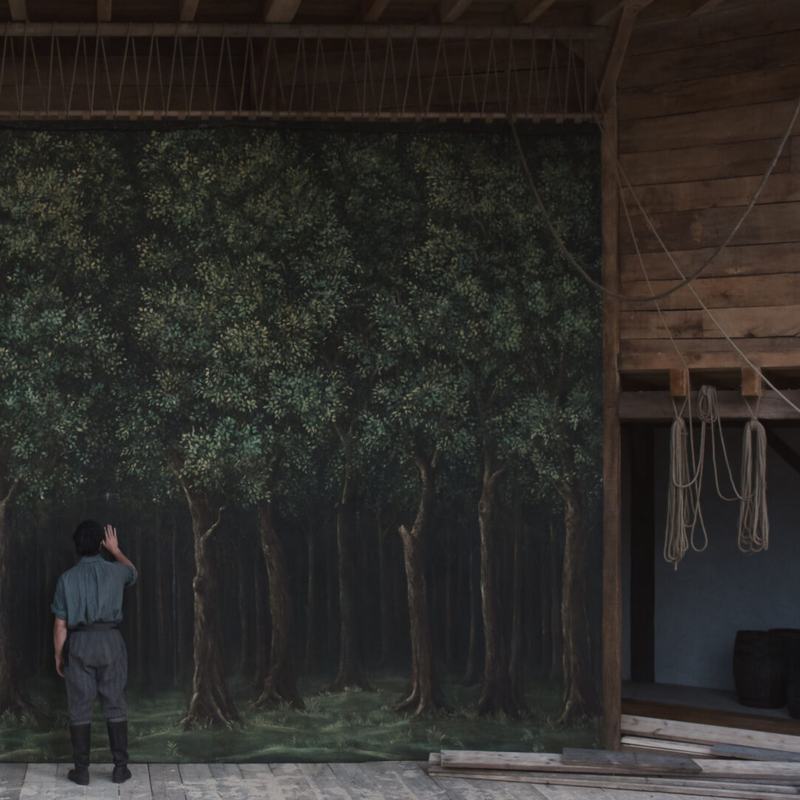
It also needed to feel linked to the aesthetic of the story that we've been telling and the forest, particularly. That was Chloe's direction to me. She said, I want it to feel like the inside of a tree. The idea of the circular looking up to the sky through a circle, we were always going to honor the shape of the globe and the exterior, the look of the exterior. When it came to the interior, the significant deviation is that we put the painted backdrop onto the stage, which our understanding is that that was something that was starting in Italy at the time, but would not have been in the UK or in England.
Also, we changed the orientation of the side of stage that would not have been there. He would not have been sitting there with access to the stage that way. He would have been up higher on another level. Those changes are about informing story. You know, we wanted him to be closer and to be able to see Agnes in the audience. Most importantly, we wanted to have our forest brought to the stage, and so we did our own little version. I think it was really important, and it really works beautifully.
Alison Stewart: You said this very interesting thing in an interview. You said, "We're sort of a funny department in that we have so much run up, we do so much pre-production, and then we leave it, and it's almost like you're handing over the keys." What was hard to leave behind?
Fiona Crombie: Do you know what? Like, so often on my movies, I actually have this thing where I'm quite happy just to hand over, see everybody take it on, and just go with it. Because we have to keep moving, we have to be ahead. I don't tend to have an emotional response to my sets, but on Hamnet, I absolutely did. I felt incredibly connected to those sets. What was really good about it was we were at a studio. Even though we were working ahead and I would be in my office, I could still walk down and visit the backlot and see what was going on.
I don't know if it was because we grew gardens or something. There was something about those sets. They had a life that I haven't really encountered in the same way. There was an emotional connection that I haven't had. It wasn't just me. It was like the whole crew. We all felt very connected to this temporary dwelling that is no longer there. It's--
Alison Stewart: It's on film. You all can always visit.
Fiona Crombie: It's on film. I know. Thank goodness, I know my camera roll. There's lots of camera roll.
Alison Stewart: My guest has been Fiona Crombie. She's the Oscar-nominated production designer for Hamnet. It was part of our Big Picture series. This interview recognizing the talent behind the camera this Oscar season. Thank you for your time, Fiona.
Fiona Crombie: Oh, thank you so much for having me.