
Broadway on the Radio: 'Chess' at WNYC
Alison Stewart: This is All Of It on WNYC. I'm Alison Stewart. We're live in The Greene Space in Soho-
[crowd cheers]
Alison Stewart: -with a special episode of All Of It for you today. It's Broadway on the Radio. For the next hour, we'll be joined by the team behind the Broadway musical Chess. It's the Cold War era story of international espionage and duplicity, a political love triangle, and a high-stakes game of literal chess. We've got with us Tony Award-winning director Michael Mayer.
[applause]
Alison Stewart: We've got librettist Danny Strong.
[applause]
Alison Stewart: We've got with us Freddie Trumper, Aaron Tveit.
[applause]
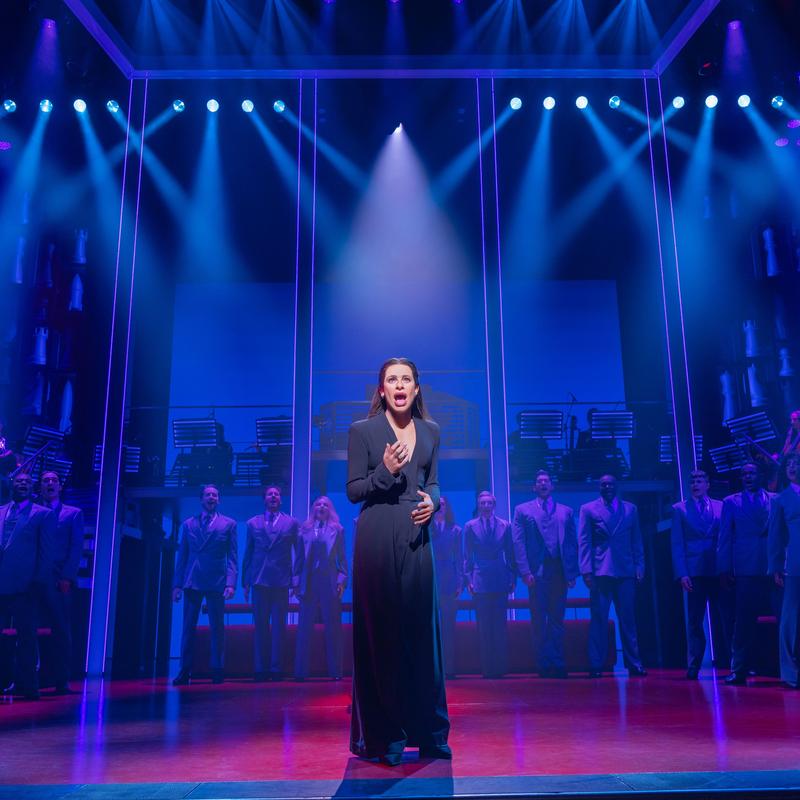
Alison Stewart: We have got Florence Vassy, Lea Michele.
[applause]
Alison Stewart: Anatoly Sergievsky, Nicholas Christopher.
[applause]
Alison Stewart: Let's hear it for our band. We have a special organization here. Everybody, let's hear it for the band.
[applause]
Alison Stewart: If you're not here with us in person or listening to us, you can see this shindig by going to wnyc.org, where you can watch a free live stream of today's broadcast. Now, let's get going and hear some music. We're kicking off this Cold War musical drama in the Soviet Union. Here's Nicholas Christopher as Anatoly with Where I Want to Be.
[MUSIC - Nicholas Christopher: Where I Want to Be]
[ANATOLY]
Who needs a dream?
Who needs ambition?
Who'd be the fool
In my position?
Once I had dreams
Now they're obsessions
Hopes became needs
Lovers possessions
Then they move in
Oh, so discreetly
Slowly at first
Smiling too sweetly
I opened doors
They walked right through them
Called me their friend
I hardly knew them
Now I'm where I wanna be and who I wanna be
And doing what I always said I would
And yet I feel I haven't won at all
Running for my life and never looking back
In case there's someone right behind to shoot me down
And say he always knew I'd fall
When the crazy wheel slows down
Where will I be?
Back where I started
Don't get me wrong
I'm not complaining
Times have been good
Fast, entertaining
But what's the point
If I'm concealing
Not only love
All of her feeling?
Now I'm where I wanna be and who I wanna be
And doing what I always said I would
And yet I feel I haven't won at all
Running for my life and never looking back
In case there's someone right behind to shoot me down
And say he always knew I'd fall
When the crazy wheel slows down
Where will I be?
Back where I started
[applause]
Alison Stewart: Nicholas Christopher singing Where I Want to Be from the musical Chess. We are live in The Greene Space with the stars and the creative team. I'm bringing back to the stage, Michael Mayer and Danny Strong. Nicholas, we just heard Where I Want to Be. It's the first time we hear from Anatoly. It's the second song of the whole show. How does this song introduce us to Anatoly?
Nicholas Christopher: I think it's a moment where we get to peek into Anatoly's mind for the first time. I think Anatoly is somewhat of a stoic character. This is the first time that we get to see his inner thoughts, and then he closes back up, and then we don't really get to see that until Florence is introduced into his life.
Alison Stewart: How does Where I Want to Be set up the show and the stakes of the show?
Michael Mayer: I think what Nick said is correct. We're living in the Cold War when this story takes place, and he is a Russian grandmaster. He is completely controlled by the KGB. He is not permitted to have any kind of real, authentic personal life. The fact that in this moment, he's left alone to ponder his situation in a completely pure and deeply personal way is a great way for us to know what's inside him. As the story progresses, we're waiting for that to get unlocked again.
Alison Stewart: Danny, the story of this revival, it begins with you. How did you find yourself taking on the task of remastering Chess?
Danny Strong: Insanity.
[laughter]
Danny Strong: I was just listening to it, and I thought it's this beloved score in musical theater lore. Famously, the show doesn't make sense, so it's rarely produced.
[laughter]
Danny Strong: I'm not saying anything that anyone else hasn't said for the last 40 years.
Alison Stewart: It's been said before.
Danny Strong: I didn't know why, so I thought, "What is the problem of Chess?" Because I've actually never seen a production of Chess. I'm just a musical theater nerd who knows the music backwards and forwards. I watched a video of the show being done with Josh Groban and Idina Menzel. As I started watching it, my rewrite brain started kicking in. It was like, "What would I do to this to see maybe I could rework this show in a way that this music could get everything it deserves?" That's where it all began.
Alison Stewart: What did the story need?
Danny Strong: [sighs]
[laughter]
Alison Stewart: Sit down for a while.
Danny Strong: It's like I'm reenacting the moment with my therapist.
[laughter]
Danny Strong: Well, it needed clarity, first and foremost. It needed clarity, and it needed, I think, some character deepening. I think it needed a sense of making things feel more realistic so that you could just be more engaged with the story. Thus, if you're more engaged with the story, the music will have more impact, or the hope was for the music to have maximum impact. That's why we're here, because these songs are so incredible.
Alison Stewart: Why did you want to be involved in the revival of Chess?
Michael Mayer: Well, I got a text from Danny Strong at midnight one night out of the blue.
Danny Strong: I'd been drinking.
[laughter]
Danny Strong: True story.
Michael Mayer: He said, "Hey, Michael, it's Danny Strong. I'm going to fix Chess, and you're going to direct it."
[laughter]
Michael Mayer: I said, "I'm in." I was actually at the concert that Danny listened to the recording of. I went in 2008, and I had very much the same experience Danny had. This was an extraordinary score. I had no idea what was going on the entire time.
[laughter]
Michael Mayer: When Danny, who I admired so much as a writer, reached out to me this way, I thought, "Well, I'm absolutely going to hear what he has to say." It was 10 years ago that we started discussing it.
Alison Stewart: 10 years ago. Wow.
Michael Mayer: Yes.
Alison Stewart: Aaron, we're going to bring you up on stage. Come on up.
[applause]
Aaron Tveit: Hi.
Alison Stewart: Hi. What was your familiarity with Chess?
Aaron Tveit: I was very familiar also with the music. I studied theater in college. When I had started studying theater, I basically only knew the shows that I was involved with in high school. I had some friends that said, "You have to listen to all these albums," and Chess was one of them that I was handed. I just remember being completely blown away by the music. It also was one of these things where nobody performed any of the songs because they were too difficult, so it always had this lore in my head of this untouchable score, and then, yes, I came around, and we get to be a part of it. It's amazing.
Alison Stewart: Nicholas, how did you discover Chess?
Nicholas Christopher: In musical theater class, the tenor boys would always sing Anthem, and that's all I knew, really.
[laughter]
Nicholas Christopher: Yes, from hearing it in class, and that was really it. All I knew was Anthem until I ran into Michael one day, and he asked me to do a reading of it. I was like, "Oh, boy, this is really good."
Alison Stewart: Why are these two gentlemen right for their parts, Michael?
Michael Mayer: Interestingly, I think both of them could do either role.
Alison Stewart: I thought so, too.
Michael Mayer: That is really unusual because these roles are incredibly demanding, not just vocally, but emotionally, and from an acting perspective. You're looking at two of the absolute finest musical theater performers on the planet, and people who get--
[applause]
Alison Stewart: I agree.
Michael Mayer: True, true, true.
[applause]
Michael Mayer: The fact that they can, not only achieve what is demanded of them vocally, but the fact that they can deliver emotionally and narratively while they're performing these songs, it's an Olympic feat actually, I think.
Alison Stewart: Danny, I want to bring you into the conversation. You put at the front of the plot, the USA versus the USSR and the chess game, and the geopolitical influences. Why did you want to push the script in that direction?
Danny Strong: Well, it was one of the first ideas I had when I was watching the Chess in Concert. This was written during the Cold War, but it's been decades since the Cold War. Perhaps a way into the story would be to add Cold War plot lines, to give it a bird's eye view, Cold War history play. I thought, well, if those were in the show, it would heighten the stakes of the show, so that the stakes would go beyond just the chess matches in the love story, which are great.
I thought with this third element, it could add a really exciting layer to the show dramatically, but then also, thematically, give the show a reason to exist because we could parallel our current political situation to the events of the Cold War. It made it very relevant. When I met with Tim Rice, one of the first things he said was, "I was writing this during the Cold War. Now, there's perspective on it." I just said, "Well, that's what I want to do. I want to put that into the show, and I want to add Cold War plot lines into the show." It was the very original idea I had when I thought, "Okay, how could I rework this?"
Alison Stewart: How did you think of developing political elements in the show as a director?
Michael Mayer: Well, it actually started when we did a presentation at the Kennedy-- what used to be the Kennedy Center-
[laughter]
Michael Mayer: -several years ago. It was right before COVID. In the presentation that we made, Danny and I both discovered a kind of epic theater event because it was a concert, and we could actually comment on the show. It became a metatheatrical device. It's right out of the political theater textbook. It's a textbook example of how to make epic theater, and that also gave us-- What we discovered there was it's incredibly funny. Suddenly, humor, which is a great political tool, became part of our arsenal.
Alison Stewart: Aaron, Nicholas, this is both for you. Broadway is often about big movements, exaggerated expressions. As actors, how do you get that expressiveness to come through the game of chess?
Aaron Tveit: Oh, very interesting. That expressiveness has to be contained, right? It creates this bubbling underneath. I think that the game of chess really has that, right? I think the way we do our chess match in the show also is that you get to see our internal thoughts and all of that bubbling underneath this very still outside perspective looking in. I think it does both of those things in a cool way.
Alison Stewart: What do you think?
Nicholas Christopher: You know, on The Birdcage, where Robin Williams was like, "Martha Graham. Martha Graham. Madonna. Madonna," but you keep it inside. That's my approach to Anatoly.
[laughter]
Nicholas Christopher: What you might see is this, but what's going on inside is this.
[laughter]
Alison Stewart: Danny, I wanted to point out that you've written for TV and film for Dopesick, for Empire. You wrote Recount. What's the difference of bringing politics on the stage versus politics on the screen?
Danny Strong: Wow, I hadn't thought about that. I think with the stage, particularly with this show, is you can add a theatricality to it. Thus, you can do multiple things. A, you can just be more blunt and more head-on with it and not have to bury it in subtext in a way that I think could be very exciting, entertaining, and then just say something in a very provocative, in-your-face kind of way, which is very much the style of theater, epic theater, Brechtian approach to theater. That was one of the basic concepts of how to do this show. It's a lot of fun. At times, it feels like we're provocateurs in the show, which I think is a very incredibly cool, hip thing for a big Broadway musical to be able to do that.
Alison Stewart: I'm going to ask Nick and Michael and Danny to leave the stage.
[laughter]
Aaron Tveit: See you later.
Alison Stewart: I'm going to talk to Aaron next. We're going to hear a song for you. We are told this is the first time performing this song outside of the theater.
Aaron Tveit: That's right, yes. We've not done this.
Alison Stewart: That's very exciting. What song are we going to hear, and where does it appear in the show?
Aaron Tveit: This is What a Scene! What a Joy! This appears early on in the show. We've met Freddie already. As people that don't know, Freddie's dealing with some mental health issues. We meet Freddie all the way down the bottom of his well, and then Lea, Florence, gets Freddie to take his pills. All of a sudden, he's on the opposite side of his well and all the way up. This scene is called What a Scene! What a Joy! They have just arrived in Merano for the World Chess Championship. He's ready to meet the press and meet his adoring fans. These are all the things that really, truly play into his own narcissism.
Alison Stewart: What do you like about performing this song?
Aaron Tveit: Yes, I think exactly that. I think it's nice to get to go full-throttle narcissist-
[laughter]
Aaron Tveit: -all the way, indulgent, all the things. Yes, it's nice.
Alison Stewart: I'll leave you to it.
Aaron Tveit: Okay, cool.
Alison Stewart: This is Aaron Tveit.
[applause]
[MUSIC - Aaron Tveit: What a Scene! What a Joy!]
What a scene! What a joy! What a lovely sight!
When my game is the big sensation
Has the mob's sporting taste altered overnight?
Have they found new sophistication?
Not yet, they just want to see
If the nice guy beats the bum
If it's East-West and the money's sky-high
They all come
You can raise all you want, if you raise the roof
Scream and shout, and the gate increases
Break the rules, break the bank, I'm the living proof
They don't care how I move my pieces
I know I'm the best there is
But all they want is a show
Well, that's all right, I'll be glad to oblige
S.R.O. S.R.O.
[applause]
Aaron Tveit: Thank you.
Alison Stewart: We've got more music on the way from Broadway's Chess. This is Broadway on the Radio from All Of It on WNYC, live from The Greene Space. Lea Michele, she's up next. Stay with us.
[applause]
Advertisement: If it's time for you to say goodbye to your car, truck, boat, motorcycle, or RV, consider donating it to WNYC. We'll turn the proceeds from the sale of your vehicle or watercraft into the in-depth news and programming that keeps our community informed. Donating is easy, the pickup is free, and you'll get a tax deduction. Learn more at wnyc.org/car.
[music]
Alison Stewart: This is All Of It on WNYC. I'm Alison Stewart, and we are live in The Greene Space at WNYC with a special Broadway on the Radio event.
[applause]
Alison Stewart: If you're listening on the radio, you can watch us at wnyc.org to watch the livestream back there. There are people watching in Brazil already. It's kind of amazing. I have the band here with me from Chess, as well as director Michael Mayer, librettist Danny Strong. On stage with me now, Lea Michele. Hi, Lea.
[applause]
Alison Stewart: We heard how Aaron and Nick found their way to Chess. How did you find your way to Chess?
Lea Michele: I found my way to Chess through Michael Mayer. This is our third show that we've done together. He's brought two extraordinary female characters to me before. We were doing Funny Girl together, and he said, "I'm doing Chess." It was after a two-show day, very late at night, and he said, "Go home and listen to this song. If this song resonates with you, then I think you might want to do the show." I listened to it in my kitchen in the dark, and it was Idina Menzel singing Nobody's Side. I could have called him right then and there and told him that I was in, but I waited, and I read Danny's amazing script. From the first scene, I knew that this was a character that I really desperately wanted to play.
Alison Stewart: You guys are late-night people.
[laughter]
Lea Michele: We have no choice. [laughs]
Alison Stewart: No choice. Exactly. How did you know Lea would rewrite for Florence?
Michael Mayer: Well, I've known Lea since she was 14, when we did the very first workshop--
Lea Michele: 10 years ago.
Michael Mayer: Yes.
[laughter]
Michael Mayer: We did the workshop of Spring Awakening. I've watched her grow up, and I've participated in part of that journey between Spring Awakening and then Funny Girl. Working on Chess and having been in the room with her during Funny Girl and watching her transform from the 16-year-old Fanny Brice at the beginning of that show to the mother of two kids and watching her husband walk out on her and seeing the emotional maturity that this 14-year-old girl that I knew suddenly was displaying, I thought, "Wow, she's really becoming a woman before my eyes. Wouldn't it be amazing to give her the chance to play a real adult professional woman from soup to nuts? Not starting as a girl, but really live in this." I knew that she would sing it in an extraordinary way.
Alison Stewart: Danny, in the script, Florence enters, and the arbiter calls her the brilliant and beautiful Florence. In the stage directions, it's described as brilliant and tough. Why is it important that Florence is tough?
Danny Strong: You're not supposed to read those stage directions.
[laughter]
Danny Strong: I don't know. I don't understand.
Alison Stewart: That's the way we do it in public radio. [laughs]
Danny Strong: I don't understand. Why is it important that she's tough? Is that the question?
Alison Stewart: Yes, why is it important?
Danny Strong: Because she's the greatest strategist in the world. I think, as a woman functioning in that men's world of competitive chess at the highest level, that there is a toughness combined with her, as the arbiter would say it, mysterious and tragic past, and that that toughness is how she was able to survive all the darkness of what she had to experience growing up.
Alison Stewart: Lea, what did you learn from Michael on Funny Girl that has been useful for you on this show?
Lea Michele: Oh, wow. I picked up so many amazing things from Michael over the years. I owe so much to him. So much of how he has pushed me in his direction has really helped me to grow as a performer. I just think what I loved about our experience in Funny Girl, which was very different from the experience of Spring Awakening and also very different from our experience at working on Chess together, was he gave me so much creative freedom.
One day, he just sat down, and he was like, "Go. Go for it with this number. Do whatever you want to do." Next thing you know, I was jumping off of a piano and laying on top of him and climbing up a ladder. It just felt so good to have that amazing sense of trust coming from him. I took that trust into our room at Chess. Funny enough, the rehearsal process, I was like, "Oh, Michael and I know each other so well. This is going to be a breeze."
I was like, "Oh, wow. Michael's really pushing me," which was amazing. I wouldn't have expected anything else, but to really help me define Florence's strength in her restraint, which is maybe closer to Spring Awakening, but very different from Funny Girl. I think it was that baseline of trust that we have for one another and the ability to go really far and then figure out where we want everything to land with that trust. Everything just feels like we can accomplish anything together.
Michael Mayer: Also, I would just add. This felt like the most collaborative as peers, which was a really new experience for me because I always felt very paternal towards Lea. Now, I feel like we're two adult professionals working together. The collaboration has been beautiful.
Alison Stewart: Let's talk about Florence. She's an immigrant to the United States from Hungary. How does that affect the stakes in her chess match personally?
Lea Michele: Everything that Florence is carrying with her, both from her past, her present relationship, the seven years that she's been with Freddie, the loss of both of her parents, I wouldn't say she wears it because she's holding it all inside. I get to have these moments in the show through song and some moments that Danny has structured so well in very simple ways, but just of her having moments to express what she's feeling internally. She's a very complicated woman with a deep amount of trauma.
Again, like I said before, it's something that I find very challenging every night to have to not use any external physicalities to express myself, which is what I'm really used to doing in a lot of the performances that I've played, or even used comedy to be able to express myself, but I can't do that with Florence. I have to play a lot of her emotions inside, and then finally having the moment at the end to have that emotional release. It's a tragic story and definitely something that I feel grateful to play. Just such a complex female character who's so strong, who is standing between these two men in this man's world of chess. As an actress, I'm just really grateful.
Alison Stewart: Danny, do you think about Chess differently now, given our current geopolitical strategy of the United States?
Danny Strong: Musical or the game?
[laughter]
Alison Stewart: Start with musical.
Danny Strong: I just think it makes the show more relevant every day that, every day, what we're going through ties in-- Not just we, but the entire world is going through is just exactly what the show is discussing, which is that we, the people, are pawns of the decisions our governments are making. There's a line at the end of the show, which is the key line of the show for the characters, which is just because our governments have lost their souls doesn't mean we have, too, as well. That's sort of the line, right? Did I just screw that up, Aaron?
[laughter]
Danny Strong: Got it mostly. Mostly. I think that line becomes more relevant every hour.
Alison Stewart: Lea, you really get to use the power in your voice in this musical. What are you able to do, as a singer, different with the music in Chess that you haven't done on Broadway before?
Lea Michele: I think that what is so incredible about this score and what I get to play specifically with Florence and this track is it's like constantly shifting gears through different genres of music and really having to be so in tune with my voice and my instrument to be able to go from these really powerful pop anthems, and then walking off stage and coming right back on and being in a lyrical soprano. The differences between what I have to do sonically with Freddie versus Anatoly and flip-flopping back and forth between the two is absolutely the most challenging thing I have ever done in my Life. It's fun, but it is something vocally that requires a lot of focus and a lot of rest, which I don't really get because I have two children.
[laughter]
Lea Michele: It's thrilling. It's really thrilling. To get to play with my instrument and really see how I can weave back and forth between the different sounds and genres is a challenge, but it is very fun.
Alison Stewart: I'm pretty sure everybody in this room knows, but for people who don't know, some of these songs were written by two of the members of ABBA, right? That's the pop--
Danny Strong: All of them.
Alison Stewart: All of them. How can I tell it was written by two members of ABBA?
Lea Michele: Oh, my God.
Alison Stewart: What do you think?
Michael Mayer: Well, I think the harmonies. Certainly, when the chorus-- We have an amazing ensemble, but the choral harmonies are right out of their songbook. I also feel structurally, we should ask our musical supervisor out there if I'm getting this right. Brian, you can give me a thumbs-up or not. It does feel like, structurally, many of these songs follow a very typical ABBA pop song structure. The interesting thing about them is that Tim Rice, who's a great musical theater lyricist, has created these character arcs inside this pop idiom. That's where a lot of the very cool tension comes in the songs. When you hear it with the full chorus and the full orchestra, it's undeniably got ABBA right in its DNA.
Danny Strong: At times, there are songs that are polar opposite of ABBA, too. That's one of the amazing things about the score that Lea was talking about was the variety of music. It just blows me away how one second, it's this pop ABBA. The next, you're in a grand opera. It's the variety, and their talent is unbelievable.
Alison Stewart: You had to lose some songs for this. How did you--
Lea Michele: Not that many.
[laughter]
Alison Stewart: Not that many?
Danny Strong: Well, it was songs and music, but I believe that is one of the key decisions of how the show-- I'm sorry. I even cut your question off. It was one of the key decisions of how the show is, I think, functioning so well, is by paring it down. Like Lea said, it's not a lot, but there's four or five songs that have been cut. There are also larger pieces of music. It makes the songs that are there. Everyone is a banger. Everyone is unbelievable. I think that was part of the secret sauce of why this production has been so successful.
Alison Stewart: The next song we're going to hear is Lea singing Heaven Help My Heart. Why did you keep this one?
Danny Strong: Why did I keep it? Well, it's really famous.
[laughter]
Danny Strong: You couldn't cut this one.
Alison Stewart: What is something that you like about singing this song, Lea?
Lea Michele: I love this song because Nobody's Side is really the first time that you get a look into how Florence is feeling and what is happening for her. As a woman who is really functioning so much and using her head and making these strategic decisions, this is the first time that she's making a decision from her heart. That is terrifying for her, and you get to see her in this vulnerable state.
When I first met with Michael, one of the first things that I said was, "I don't want Heaven Help My Heart to be this sweet love song of devotion. I want it to be a woman who feels so vulnerable and so raw for the first time listening to her heart, and that just scares her so much." To get to play her in these moments of strength, but then also get to play this moment of just extreme vulnerability, it's really exciting.
Alison Stewart: Are you ready?
Lea Michele: Yes, definitely.
Alison Stewart: This is Lea Michele.
[applause]
[MUSIC - Lea Michele: Heaven Help My Heart]
If it were love, I would give that love every second I had
And I do
Do I know where he'll lead me to?
Did I plan
Doing all of this for the love of a man?
Well, I let it happen anyhow
And what I'm feeling now
Has no easy explanation
Reason plays no part
Heaven help my heart
I love him too much
What if he saw my whole existence
Turning around a word, a smile, a touch?
One of these days, and it won't be long
He'll know more about me than he should
All my dreams will be understood
No surprise
Nothing more to learn from the look in my eyes
Don't you know that timing is not my friend?
I'll fight it to the end
Hoping to keep that best of moments
When the passions start
Heaven help my heart
The day that I find
Suddenly, I've run out of secrets
Suddenly, I'm not always on his mind
Maybe it's best to love a stranger
Well, that's what I've done--
Heaven help my heart
Heaven help my heart
Lea Michele: Thank you.
[applause]
Alison Stewart: That was Lea Michele. We've got more music on the way from Broadway's Chess. This is Broadway on the Radio from All Of It on WNYC, live from The Greene Space. Stay with us.
[music]
Alison Stewart: This is All Of It on WNYC. I'm Alison Stewart. We are live in The Greene Space at WNYC with a special Broadway on the Radio event. If you're listening on the radio, you can go to wnyc.org to watch a live stream. I'm here with the team from Chess.
[applause]
Alison Stewart: I really want to give it to the band here. Let's have a special hand for the band behind us. They are doing an amazing job.
[applause]
Alison Stewart: I'm on stage with Lea Michele, Nicholas Christopher, and Aaron Tveit. First of all, Lea, do you play chess?
Lea Michele: [sighs]
[laughter]
Alison Stewart: Nicholas, do you play chess?
Nicholas Christopher: A little, yes.
Alison Stewart: How about you?
Aaron Tveit: Same. A little, yes.
Alison Stewart: What do you like about the game?
Nicholas Christopher: I like that you can never play the same game twice. You can play the same person, but everything, it's always different. It's like acting. There's a structure there. Each piece has to move in a certain way, like we have our lines, we have our blocking. Depending on how you're feeling that day, the number of possibilities is infinite.
Aaron Tveit: I also think you never know. Much like life, too, you think it's going to go one way, and then it can just really not go any way you plan. You have to adjust to that. It's a real amalgamation of life as well.
Alison Stewart: Lea, in your character descriptions in the script, yes, we read the script, Florence and Anatoly are described as brilliant, but Freddie is described as "having a big ego."
[laughter]
Alison Stewart: How do you think this explains the way the relationships work out?
Lea Michele: Well, I think from Florence's perspective, Freddie is extremely brilliant. I think that that's what she loves about him. I think that she's very attracted to his genius. I think that because of that, it allows her to sometimes ignore the negative. I think with Anatoly, it's very clear that he's also brilliant, but there is so much more that is safer for her and loving. I get to have two very different relationships with the both of them.
Alison Stewart: Aaron, do you think your character has a big ego or is brilliant or both?
Aaron Tveit: I think all the above, yes. As I mentioned before, Freddie's dealing with some mental health issues that I think stem from being thrust into the spotlight as a child and becoming world famous as this chess champion when he was a child. Through that, though, his narcissism is also at play, and brilliance. I think all these things are very, very closely tied together. It's like poison for him because the more notoriety he gets, the more narcissistic he is, but then the more terrified he is. It's just this constant cycle that he's on of these mood swings and highs and lows that I think is really tied into his intelligence and the game of chess and his fame that he's found from all of this.
Alison Stewart: Nicholas, Freddie and Anatoly, do they respect one another?
[laughter]
Nicholas Christopher: I definitely think by the end, they do. Yes.
[laughter]
Nicholas Christopher: I think the respect comes from, at least from my perspective, when we're sitting on that bench at the end is there's this fascination, or even at the beginning when I'm watching you, there's this fascination of how you navigate the world that is the complete antithesis of the way Anatoly has been programmed.
Alison Stewart: What do you think?
Aaron Tveit: I think the same. I think by the end, we come to this mutual understanding of each other. I think at the beginning, Freddie's also blinded by his deep-rooted hate for the Soviet Union. I think at the very beginning of where we find these characters, even if Freddie may have respect for Anatoly as a chess player or a person, he's just completely blinded by this thing that he has against the Soviet Union. It's really interesting to have that strip away. He even realizes that, as Danny said before, that we're all pawns to these big governments, and then we can see each other at a more human level by the end of the show.
Alison Stewart: Nicholas, I want to give a shout-out to the woman who plays-- It's Hannah Cruz.
Nicholas Christopher: Yes.
Alison Stewart: Who plays your wife?
Nicholas Christopher: Svetlana, Hannah Cruz.
[applause]
Nicholas Christopher: The one and only.
Alison Stewart: Tell us a little bit about her, and tell us a little bit about the relationship.
Nicholas Christopher: Well, she was born in Connecticut in 19--
[laughter]
Nicholas Christopher: No, I--
Lea Michele: She has a cat named Svetlana.
Nicholas Christopher: She has a cat named Svetlana.
Alison Stewart: Really?
Lea Michele: I named her. [laughs]
Nicholas Christopher: What an uphill battle she has every day to enter into Act 2, to get the audience to see her perspective, and to just sing her face off and act her face off in, what, 20 minutes of stage time. She's so memorable. That's such a testament of who she is as an artist. When we come into our story, I haven't seen her for four years. I imagine that we grew up together.
Then, all of a sudden, there's this four-year gap. There's a lot of hurt. There are a lot of open wounds there. There is an amount of distrust, and yet there is this odd physical comfort with each other, and exploring that. The distrust doesn't mean that I hate her. I don't want her to die. I don't want my kids to die. It really throws Anatoly into this predicament of, "Do I choose myself, or do I choose others?"
Alison Stewart: Want to give her flowers on this. You recorded a cast album in January. How does that feel for you when you go into the booth, and you have to recreate the show?
Lea Michele: I was definitely nervous because I think that we just create such an energy every night with our band and singing to the audience. I just have loved every night being able to connect individually with as many people as I can find to sing these words to. It's a really thrilling experience. Going into the studio for me, specifically with Nobody's Side, I was really worried that I wouldn't be able to find that same sort of power and connection.
Something really special just happened, and sometimes it's unexplainable, but I think that the gods were really in our favor. We recorded in a studio that's very iconic for theater recordings, but it's in the round. Each night when I perform, I have our incredible, incredible ensemble, who we have to give a shout-out to because they're so amazing. They're, yes-
[applause]
Lea Michele: -brilliant and beautiful and so hardworking. In that song, they're behind me. They're like the pulse, the heartbeat of the song, but I never get to see them. There we were in the studio in this round space, and I got to look at everyone and sing the words to our whole cast. It was really amazing. We have gotten to hear some of the songs. Nobody's Side is available now for the world to hear and listen to. More coming soon, and it's going to be amazing.
Alison Stewart: What was it like for you to sing this?
Aaron Tveit: I actually had an amazing time. It reminded me, I think, not that you just-- Sometimes you can't see the forest or the trees. Doing the show eight times a week, you have lots of different thoughts. To be in that recording studio and just having a fully immersive sonic experience with that music was really remarkable to me. It was also amazing that I could really hear myself and hear everyone else, because on stage, those things are varying degrees just for the nature of performing on stage. I was, once again, reminded just how incredible this music is and how unbelievable our orchestra and our band sound. Just for all that to come together, and it'll be out, and everyone else can throw their headphones on and listen to it soon.
Alison Stewart: It'll be out when?
Aaron Tveit: It'll be out soon.
[laughter]
Aaron Tveit: It'll be out very soon. As we said, Nobody's Side out today on all platforms. Go listen.
[applause]
Alison Stewart: Nicholas, what was the experience like for you?
Nicholas Christopher: The experience was great for me. We recorded most of it in one day, and we had a couple of other days here and there for other songs. When you rehearse a show for four weeks, everybody's in the same room all together, all the time. Then you move into the theater, and everybody goes off into their different dressing rooms on different floors. You're concentrated on the show, and then you come in in a half-hour before the show. You do the show, and then you leave.
For the first time since rehearsal, we were all in one room again, like Lea was just talking about. We got to eat dinner together, and we got to really snack and joke around and have this experience. That's really what I remember from it because it was a long day of a bunch of different things, just running in and out of the booth. Coming together as a cast, we all truly get along, which is really extraordinary. For us to be in the same room, that's what I'll be thinking about as I listen to the cast album when it comes out.
Alison Stewart: When?
Nicholas Christopher: Soon.
[laughter]
Alison Stewart: This is running at the Imperial Theatre. That's where you made your Broadway debut, Les Misérables.
Lea Michele: Yes.
Alison Stewart: What's special to you about being in that theater?
Lea Michele: Oh, my gosh. I just remembered that I wrote my college essay that got me accepted into NYU about the Imperial Theatre. I didn't remember until the other day, but I wrote that other people will look back on their childhood homes as being their home and the place that really molded them. I wrote it about the Imperial Theatre because it was where I made my debut in Les Mis when I was eight years old.
It was where I really found myself, and I found my passion. I'm a mom. I have two little kids. All you can hope as a parent is that your children, whatever it is that they find something, that makes them feel safe. They can be themselves, and they can express themselves, and that they feel truly happy. That's what I found at eight inside the Imperial Theatre. Every day when I walk in, it smells the same.
[laughter]
Lea Michele: It's like I can hear the first few words of Les Mis playing. I feel so happy and so at home. It's really the happiest I've ever been in a work experience in my life. I think so much of that is just because this theater means so much to me. Yes, I could talk about it. These guys, they've heard too much, but it's very special.
Alison Stewart: Now, you two work together on Sweeney Todd, yes? What is something from that experience that you brought to Chess?
Aaron Tveit: Nick and I didn't get to rehearse Sweeney together because I joined the show when it was already going on. I think in our scenes we had, Nick had such an innate playfulness on stage. It was interesting. The tonality of the characters we were playing are actually quite reversed in this. He was a very playful person, and I was being very stoic. Now, it's flipped. I just had so much respect for Nick for his talent and what he brought to the stage every day, and him as a person. To get to walk back in with that kind of baseline knowledge of each other and then get to actually experience an entire rehearsal process and build something with him, it's been really amazing.
Alison Stewart: What do you remember from that experience?
Nicholas Christopher: I remember looking in Aaron's eyes and throwing whatever I could, including shaving cream, at him.
[laughter]
Nicholas Christopher: He was so game. I think coming into this process, I really had a trust with him of, like, we can go wherever. If somebody makes a decision, we'll just go with it and see what happens. Like I said, every time we get to sit on this bench together, we sit on the same bench in two different scenes. It's just like, "Okay, I don't know where this is going, but I'm game," and I know he's game.
Alison Stewart: Our last song we're going to hear is Florence and Anatoly singing You and I. Can you set this up?
Lea Michele: Florence and Anatoly, for four years, they have been together in a very loving and safe space. They've fled to London together, and they come back to a chess tournament, where they're going to be reunited with Freddie again for the first time, which brings up its own set of anxiety. Then they get set up, I guess you could say, in a very negative way. We sing this song to each other, the first time that we can see a real crack happening between the two of us, and in our relationship. Something that felt so pure and safe is now being attacked, and how deeply we are trying to hold on to the love that we have for each other and this connection that we have.
Alison Stewart: Let's hear it.
Nicholas Christopher: Yes, that was pretty good.
Alison Stewart: All right. Look at him, stage-managing. I love it.
[applause]
[MUSIC - Nicholas Christopher and Lea Michele: You and I]
[FLORENCE]
This is an all too familiar scene
[ANATOLY]
Life imperceptibly coming between
[FLORENCE & ANATOLY]
Those whose love is as strong as it could or should be
[ANATOLY]
Nothing has altered-
[FLORENCE]
-Yet everything's changed
[ANATOLY]
No one stands still-
[FLORENCE & ANATOLY]
Still, I love you completely and hope I always will
Each day we get through means one less mistake
Left for the making
[ANATOLY]
And there's no return
As we slowly learn
Of the chance we're taking
[FLORENCE]
I'd give the world to stay just as we are
It's better by far
Not to be too wise
[FLORENCE & ANATOLY]
Not to realize
Where there's truth, there will be lies
[FLORENCE]
You and I
We've seen it all
Been down this road before
Yet we go on believing
[ANATOLY]
You-
[FLORENCE]
You-
[FLORENCE & ANATOLY]
And I
We've seen it all
Chasing our hearts' desire
Yet I still think I'm certain
This time it will be
Our happy ending
[applause]
Alison Stewart: That's it for our Broadway on the Radio. Big thanks to Chess, and thanks to everyone who joined us at The Greene Space.
Copyright © 2026 New York Public Radio. All rights reserved. Visit our website terms of use at www.wnyc.org for further information.
New York Public Radio transcripts are created on a rush deadline, often by contractors. This text may not be in its final form and may be updated or revised in the future. Accuracy and availability may vary. The authoritative record of programming is the audio record.