
Bigfoot' Tackles Mob Mentalities and Small Towns Off-Broadway
Alison Stewart: This is All Of It on WNYC. I'm Alison Stewart. Welcome back. This hour, we're talking about a couple of shows that are nominated for outstanding musical at this year's Lucille Lortel Awards. Now we're going to take a trip to a town called Muddirt, the setting of Bigfoot! A New Musical co-written by Amber Ruffin.
[music]
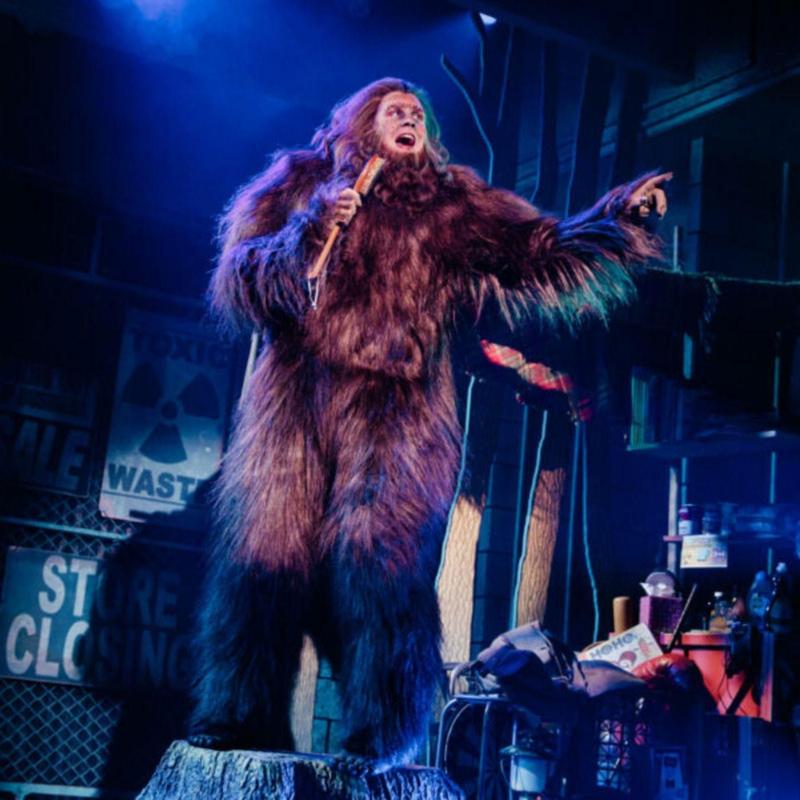
Alison Stewart: Muddirt is the home of the musical's titular character, played by Grey Henson. Bigfoot lives on the outskirts of town, which is situated somewhere between a chemical plant, a toxic river, and a hill with an imminent mudslide. Bigfoot's mother. Yes, he's got a mom. Her name is Francine, a normie played by Crystal Lucas-Perry. He grew up in the woods because Francine feared how the townspeople would treat him. That fear turns out to be warranted when a corrupt mayor uses Bigfoot as the boogeyman to stir up an angry mob. Meanwhile, the mayor pockets the money from a brand-new water park.
If that sounds like a zany plot, it is. It's also hilarious and carried by a great musical score and some seriously talented voices with Tony nominees all over the place. Bigfoot! A New Musical is running at the New York City Center now through April 26th. It's nominated for Outstanding Musical at this year's Lucille Lortel Awards. Amber Ruffin began writing the show back in 2014, and when she joined me in studio to talk about it, along with Grey Henson and Crystal Lucas-Perry, I started by asking Amber why it took her 12 years to bring Bigfoot to the stage.
Amber Ruffin: We really were like, "Hey, we did it. What a great show. The end." Then the world started becoming the plot of Bigfoot. Then we were like, "Well, it might be time to revisit this." I feel like every day, the real world becomes more like Muddirt. I'm sorry if I am a prophet of some kind.
[laughter]
Alison Stewart: Grey, when you heard about this idea of a musical about Bigfoot, how long did it take you to say, "I want to play Bigfoot"?
Grey Henson: Not very long. There was a reading of it that I couldn't be a part of. I was super bummed because I think it's so rare to find new material that is this funny and with music that is this catchy. Yes, I jumped on it the moment I heard I was invited to the party.
Alison Stewart: It's so interesting to look in your eyes, because the last time I saw you, you were in a big, giant fur suit.
Grey Henson: I know. I was [crosstalk]
Alison Stewart: Your eyes are very expressive.
Grey Henson: Oh, thank you. Thanks. That's good to hear that it breaks through, because I do worry that I get lost in the fur.
Alison Stewart: No, you don't get lost in the fur. You don't get lost in the fur.
Amber Ruffin: Lost in the fur is this--
Grey Henson: That's the memoir.
Alison Stewart: That's the memoir.
[laughter]
Crystal Lucas-Perry: Behind the scenes. Lost in the fur.
Amber Ruffin: Lost in the fur.
Alison Stewart: Crys, you've done all kinds of theater. I saw you in 1776. You were amazing in that. You've done Shakespeare. What is similar about this show compared to the other shows that you've done?
Crystal Lucas-Perry: Oh, goodness. I would have to say the commitment is still there. I mean, you have to go full force in. We've got some great characters in the show that Amber and the team have created. Leaning all the way in so that you can feel something at the end of the night is kind of what brings it all full circle.
Alison Stewart: You've worked on Broadway before, obviously, Amber.
Amber Ruffin: Yes, some [unintelligible 00:04:00] and The Wiz.
Alison Stewart: Yes. Those are both great shows.
Amber Ruffin: Yay.
Alison Stewart: How did working on those shows help you develop Bigfoot after the 2014 version of it, and had to continue to develop the show?
Amber Ruffin: Working on those shows helped me develop Bigfoot because the development process for TV, for a movie, for a podcast, all of it is so wildly different than the process for a Broadway show. Really, getting in there at night after every show and then writing however long it takes and then waking up and getting to work, that is unheard of. That's nowhere else. There's nowhere on earth that requires you to be awake at midnight talking about what rhymes with fart. That never happens.
[laughter]
Alison Stewart: Do you like that? Do you like that sort of work-around-the-clock energy?
Amber Ruffin: Oh, yes. I thought it was very fun. I'm from late night, so if you have more than an hour, you're a rich man. I liked it a lot.
Alison Stewart: Grey, you were in Shucked, Elf, a Tony nominee for Mean Girls. What does Bigfoot have in common with those shows? Then what's a little different about it?
Grey Henson: It's funny. I was just talking about this because I feel typecast. I mean, I know, obviously, Bigfoot is very different from Buddy the Elf or Damian Hubbard in Mean Girls, but there's a through line of sensitivity and honest goodness that I think I tap into through years of work on anxiety and growing up as a little gay kid in Macon, Georgia. I think that's the similarity for me. I also just love musical comedy. I think when you can do it well, there's nothing like it, especially in a show like Bigfoot, which I'm sure people write off as being, "Oh, that's a silly new musical, 90 minutes off Broadway." It's got a lot of intelligence and smarts, and I think when humor can teach you something, that's when it's working at its best.
Alison Stewart: Part of the show, which is a great part of the show, is it's sort of broad, sort of broad comedy. What is the key, Crystal, to making broad comedy work and not come off as corny or cringy, but really make it laughable, make it just enjoyable?
Crystal Lucas-Perry: I would say a big thing is pace, not sitting too much in it, but also the discovery. The final character in our play is when the audience is there. We learn so much from them. We learn so much about what's landing, about what people are picking up. Also, we had a really lovely, long tech process, which allowed us to be able to really throw things up on the wall and see what sticks and see what we need and what we don't.
It's a lot of listening, it's a lot of trust, and it's also just about the assembly of the people in the room. We've got the right people in the room to really make these things work. When you combine all of those things together, that allows for the things that need to come to the surface and reveal themselves to take place for sure.
Alison Stewart: Amber, what is something that just slaps in the room once you got the audience and you thought, "I didn't know that that was going to be as funny as it was"?
Amber Ruffin: A joke that hits hard consistently. Well, listen, I don't want to ruin any of them, but you said slaps, and that makes me think of the-- I don't know. I feel like they're all 11th--
Grey Henson: The slap signature?
Amber Ruffin: Oh.
Grey Henson: The actual slaps.
Amber Ruffin: That's true. There are actual slaps in the show.
Crystal Lucas-Perry: There are actual slaps.
Grey Henson: Multiple.
Crystal Lucas-Perry: [laughs]
Amber Ruffin: Good job. Good job, Grey. There are multiple actual slaps in the show. They're not real, everyone. It's staged slaps. That joke hits really hard. Pun intended.
Grey Henson: Yes, there's a lot of physical comedy in the show.
Amber Ruffin: It's more physical comedy than I thought. I feel like one by one, we realized everyone was capable of it. Then it just got more and more out of hand. That's where the show is. It's out of hand.
Grey Henson: Yes.
[laughter]
Alison Stewart: I'm speaking with writer and creator Amber Ruffin and actors Crystal Lucas-Perry and Grey Henson about Bigfoot! A New Musical that's running at the New York City Center through April 26th. I have my glasses on now. The town is called Muddirt. It's surrounded by toxic chemicals. It's got a super corrupt mayor. Where did you draw from to get Muddirt? What town and experience?
Amber Ruffin: Thanks for assuming that. Nowhere. Nothing. We just wrote what we thought was the silliest thing we could think of. Real life creeps in, right? We just thought, "How far can we go while still being believable?" You know what I mean? Like, how silly can it get before people are like, "No, thank you." I feel like that's where the show resides, is at the edge of silliness, and you can still care about these characters, which is not at all what you asked, but that's where we've ended up.
Alison Stewart: Amber, this is set in the '80s?
Amber Ruffin: Yes, baby.
Alison Stewart: Aside from some great suits on Alex Moffat.
[laughter]
Alison Stewart: There were jokes about Reagan in the script. Why did you decide to set it in the '80s?
Amber Ruffin: Girl, first of all, we did it because we couldn't stop making jokes about Hulk Hogan. This show was just a vehicle to get jokes about Hulk Hogan out, but then he died. Then we were like, "Oh, God, we got to pivot," so we cut all the Hulk Hogan jokes. I guess it's set in the '80s. Now, that is real. It's also set in the '80s because it was a extremely fun time. After we wrote a couple songs for the show, we were like, "This is the '80s." Because of the way the show kind of ended up sounding. I think it's to the show's benefit, because when I think of '80s, I go, "Oh, yes, that was fun." Especially from 2026. The '80s was it.
Alison Stewart: '80s were good.
Crystal Lucas-Perry: Yes.
Alison Stewart: Remember them well. Bigfoot and his mom are really close, Grey.
Grey Henson: Oh, yes.
Alison Stewart: How come they're close? She sent him to live in the forest, but they remain close. Why do they remain close?
Grey Henson: I think he just craves the comfort that you can only get from a mother, and she has protected him his whole life. I guess it's a naivete, but it's also just umbilical. Yes, there's a lot of sweetness in that, but it not infantilizes the character, but it makes him the sweet innocent, which I think you need when someone just needs their mother in that really youthful way. Yes, she represents warmth, comfort.
Alison Stewart: Francine, why does she send her son to live in the woods by himself?
Crystal Lucas-Perry: Oh, gosh. Francine just wants to protect her son. I think one of the beauties of Francine is that she is able to see the heart in others and also see through things in a way that both elevates and lifts them, and also just appreciates. I think, again, the one person that teaches Francine as she's trying to teach the town is her son. The way that she's constantly surprised by him, the way that she's constantly just in awe of how he's able to literally have his huge presence make such a huge impact on people in the way that you wouldn't expect, is something that she catches onto very early on. That's her baby. That's the one she loves. She'd do anything to protect her son, the same way her son would do anything to protect her.
Alison Stewart: Crystal, Francine gets to sing. This has this beautiful moment when he sings about her son. Can you describe what that scene is like for us and how you get in the mood to sing that song?
Crystal Lucas-Perry: Oh, yes. Well, again, there are many things that are going on in the show, which I'll leave for the show. At this point, Francine is in a place of hope and in a place of dreaming for her son, with her son. When you have a child who's in the forest because of who they are and because the town isn't perhaps ready, even though you know that they would love him, you find yourself painting pictures and creating an ideal life of what is to come.
I think one of Francine's biggest fears is what happens if I'm not there, to be there to take care of Bigfoot. Throwing out wishes, wishing on stars, thinking about what things lie in store for him, but also knowing just how incredible he is, and knowing that no matter what, he will be fine. Also, hey, maybe there's more for him.
Alison Stewart: Bigfoot also has a really heartfelt song called Day to Day, and we're going to play a little bit of a clip of it. Would you set it up for us?
Grey Henson: Yes. This is Bigfoot's "I want" song that happens towards the beginning of the show. It's him alone after he just got a visit from his mom and the doctor. It's sort of just what he longs and hopes for, which is to belong and to have a normal life, to be a simple, everyday, not person, I guess, thing, being creature.
Alison Stewart: Being creature.
Grey Henson: Being creature, yeah.
Alison Stewart: Yes. Let's listen.
[music]
Alison Stewart: When you were writing the songs and the music, did you follow the pace of musicals like The Eleventh Hour! and the "I want" songs?
Amber Ruffin: This show was written in 2014 as a part of a series called Serial Killers, where five shows enter, and three shows get voted on to next week. We wrote the show 10 minutes at a time. Every 10 minutes of the show are two songs that we hope will get enough votes to vote us through next week. That's why there are so many Eleventh Hour! songs in this show. Like, darn near every song is an Eleventh Hour! song. We're just--
Alison Stewart: Just keep going. Just keep going with it.
Amber Ruffin: Then, when we ended up with the show, I was like, "How come every musical doesn't do this? Why do we got to wait on one good song?"
Grey Henson: [laughs]
Alison Stewart: It's interesting.
Amber Ruffin: "Why can't every song just be a hit?'
Alison Stewart: That's interesting.
Amber Ruffin: Yes. We didn't want any vegetables in this mug.
Grey Henson: [laughs]
Alison Stewart: You broke the mold a little bit.
Amber Ruffin: Yes. Every song is cotton candy, for sure.
Grey Henson: Total hit after hit.
Amber Ruffin: Yes.
Alison Stewart: All right, Amber, you told NPR our friends, you said, "Bigfoot, in my mind, is a Black woman." Then I was like, "Bigfoot, in my mind, is all LGBTQ." Then I was like, "Bigfoot is an immigrant." That's a lot to take in.
Amber Ruffin: Girl, that's how long it's been. Wasn't 2014 a long time ago?
Alison Stewart: It was a long time ago.
Amber Ruffin: As you're looking at the show, Bigfoot becomes whatever way in which you are othered, likely as you're watching it. As I was writing it, it's crazy because I was like, "Well, Bigfoot's mother is going to be white because I don't want a Black woman worrying about the safety of her son." Then I was like, "Well, Bigfoot's going to be black," because there's no way that Bigfoot can be anything other than black because of how severely Bigfoot is othered. Then, just like everything came crashing down the past 10 years. I went around and around in circles about it, and then I thought, "Let's just have the people we love the most be everything." Then that's why everyone's cast in what they're cast in.
Alison Stewart: Bigfoot gets a happy ending, Grey.
Grey Henson: Oh, yes.
Alison Stewart: Were you happy to see that he has a happy ending?
Grey Henson: Yes, of course. I think we're all rooting for that. I think we all want to belong in some way.
Alison Stewart: Why do you think audiences are ready for happy endings?
Amber Ruffin: It's really hard not to make a joke about happy endings.
[laughter]
Amber Ruffin: Audiences are ready for a show that ends joyously.
Alison Stewart: Public radio.
[laughter]
Amber Ruffin: I didn't say anything because we're really all hopeful that that's the way America is headed. Hopefully, every day, I wake up and go, "Maybe this is the worst part of this administration." Then tomorrow, I'll wake up and go, "Maybe this is the worst part of this administration." I remain hopeful, and I think that very few things are honest about how bad it is, and hopeful, and this show is both. I hope that that combination is healing to people.
Alison Stewart: When you wear the suit, do you feel different?
Grey Henson: I really do. I feel different when I look in the mirror. It's so funny, I forget that I look like that, which I think is what's so beautiful about the character. Bigfoot's like, "Oh, what do you mean I'm normal?" Then he sees how other people see him through their eyes. That's kind of the beauty of it, because I also get lost in it. I forget. I look and move around like a massive person. I'm hitting people, and I don't even know it. I had that realization the other day. I was like, "Oh, yes, this is Bigfoot. He doesn't know he's a weirdo, freak."
Alison Stewart: Your eyes. You can really see your eyes.
Grey Henson: Oh, that's so good that it reads. Also, that's why the space we're in is so perfect. It's what, 300 seats, maybe? It's intimate, and it needs intimacy, this show.
Amber Ruffin: Yes.
Alison Stewart: That was my conversation with writer/creator Amber Ruffin and actors Crystal Lucas-Perry and Grey Henson about Bigfoot! A New Musical. It's running at New York City Center through April 26, and it's nominated for Outstanding Musical at this year's Lucille Lortel Awards.
Copyright © 2026 New York Public Radio. All rights reserved. Visit our website terms of use at www.wnyc.org for further information.
New York Public Radio transcripts are created on a rush deadline, often by contractors. This text may not be in its final form and may be updated or revised in the future. Accuracy and availability may vary. The authoritative record of programming is the audio record.